Houston is the county seat of Harris County, the most populous county in Texas, and its criminal caseload is the heaviest in the state. Fine-only Class C offenses are heard by sixteen Justice of the Peace courts (two places in each of eight precincts) and by the municipal courts of Houston and roughly two dozen suburban cities. Class A and B misdemeanors, which cover most first DWI arrests, are assigned to the sixteen Harris County Criminal Courts at Law, while felonies are tried in the felony district courts; both sets of courts share the Criminal Justice Center at 1201 Franklin Street with the misdemeanor courts. The elected Harris County District Attorney prosecutes both misdemeanors and felonies in those courts. Adults who are not released after booking are held by the Harris County Sheriff in a cluster of downtown jail buildings, where hearing officers set bail around the clock.
- Harris County Criminal Justice Center (felony district courts and County Criminal Courts at Law Nos. 1–16), 1201 Franklin Street, Houston, TX 77002; District Clerk (832) 927-5800
- Harris County District Clerk (clerk for both felony and misdemeanor criminal cases), 201 Caroline Street, Houston, TX 77002, (832) 927-5800
- Harris County District Attorney's Office, 1310 Prairie Street, Houston, TX 77002, (713) 274-5800
- Harris County Public Defender's Office, Anderson Clayton Building, 1310 Prairie Street, Suite 400, Houston, TX 77002, (713) 274-6700
- Harris County Managed Assigned Counsel (MAC), 1310 Prairie Street, Suite 1600, Houston, TX 77002, (832) 927-3949
- Joint Processing Center (central booking and probable-cause hearings), 700 North San Jacinto Street, Houston, TX 77002; inmate information (713) 755-5300
- Harris County Jail, 701 North San Jacinto Street, Houston, TX 77002 (with additional jail buildings at 1200 and 1307 Baker Street); inmate information (713) 755-5300
- Harris County Sheriff's Office, 1200 Baker Street, Houston, TX 77002; non-emergency (713) 221-6000, information line (346) 286-1600
- Harris County Juvenile Justice Center (313th, 314th and 315th District Courts and juvenile intake), 1200 Congress Street, Houston, TX 77002; juvenile intake (713) 222-4865
- U.S. District Court, Southern District of Texas, Houston Division, Bob Casey U.S. Courthouse, 515 Rusk Ave., Houston 77002, (713) 250-5500
Which court hears your case. A Class C misdemeanor can bring only a fine; examples range from moving violations and public intoxication to petty shoplifting below $100, disorderly conduct, or a shove that hurts no one. A Class C citation written inside a city's limits usually goes to that city's municipal court, and Houston's own municipal court system, headquartered at 1400 Lubbock Street, is by far the busiest. When a deputy, a constable or a trooper writes the ticket in unincorporated Harris County, the case goes to whichever precinct's Justice of the Peace court covers that spot. Jailable Class A and B offenses — a first DWI, theft between $100 and $2,500, criminal trespass, low-level marijuana possession, or an assault that causes bodily injury — are docketed in one of the sixteen Harris County Criminal Courts at Law (County Criminal Court at Law No. 1 through County Criminal Court at Law No. 16); the County Judge's constitutional court does not hear criminal cases here. For a felony, the first stop is a probable-cause hearing before a hearing officer at the Joint Processing Center; the case then lands in a felony district court at the Criminal Justice Center and proceeds once a grand jury indicts. Those courts include the 174th, 176th, 177th, 178th, 179th, 180th, 182nd, 183rd, 184th, 185th, 208th, 209th, 228th, 230th, 232nd, 248th, 262nd, 263rd, 337th, 338th, 339th, 351st and 482nd District Courts, plus the 495th, 496th and 497th District Courts that opened in October 2024; they hear criminal cases only. Juvenile cases go to the 313th, 314th and 315th District Courts at the Juvenile Justice Center.
Where pretrial inmates are held. Every law enforcement agency in Harris County, including the Houston Police Department, takes adult arrestees to the Joint Processing Center at 700 North San Jacinto Street, where people are booked, screened and brought before a hearing officer. Anyone not released from there is moved into the Sheriff's housing units: the 701 North San Jacinto building, the 1200 Baker Street Jail and the 1307 Baker Street building, all a few blocks apart on the north edge of downtown. When the downtown buildings are crowded, the Sheriff has sent some people to contract jails outside the county, including the Jefferson County Downtown Jail in Beaumont and private facilities in Louisiana and Mississippi, so a person's location can change during a case. Custody and housing questions go to the Sheriff's inmate information line at (713) 755-5300.
- Local courts in Harris County (justice of the peace, municipal and county courts)
- The Criminal Justice Center and the Harris County felony courts
- What happens after an arrest in Harris County (booking, charging and magistration)
- Bail in Harris County and the misdemeanor bail settlement
- The Harris County Jail buildings and outsourced inmates
- Public defender and appointed lawyers in Harris County
- The District Attorney, pretrial diversion and specialty courts
- Misdemeanor (for example, theft, a first DWI, assault causing bodily injury, criminal trespass)
- Felony (for example, burglary, felony theft, drug possession or delivery, aggravated assault)
- Violent felony (for example, murder, sexual assault, aggravated robbery)
- Juveniles (under 17) arrested in Harris County
- Federal cases (U.S. District Court) from Harris County
Local courts in Harris County (justice of the peace, municipal and county courts)
Harris County has eight JP precincts, and voters in each one elect two justices who preside over separate courts known as Place 1 and Place 2. That makes sixteen JP courts, more than in any other Texas county. They decide Class C misdemeanors that arise outside city limits or that are filed there by county officers, and they also handle evictions, small claims, debt cases and truancy-related matters. The maximum Class C fine is $500 with no jail sentence, yet ignoring a ticket can still produce a warrant, a block on renewing a driver's license and added fees.
Before going to court, it helps to check which court is printed on the citation. A deputy constable's ticket written near Humble, for example, is filed in Precinct 4, Place 2, while a Houston police officer's ticket on the same day goes to the Houston Municipal Courts. Options at these courts typically include paying, setting up installments or community service, taking a driving safety course, asking for deferred disposition, or pleading not guilty and having the judge or a jury of six decide.
Justice of the Peace courts
- Precinct 1, Place 1 — 7300 North Shepherd Drive, Houston, TX 77091, (713) 274-0695
- Precinct 1, Place 2 — 1302 Preston Street, Houston, TX 77002, (713) 274-0590
- Precinct 2, Place 1 — 10851 Scarsdale Boulevard, Houston, TX 77089, (281) 481-9630
- Precinct 2, Place 2 — 101 South Richey Street, Suite B, Pasadena, TX 77506, (713) 274-6100
- Precinct 3, Place 1 — 14350 Wallisville Road, Houston, TX 77049, (713) 274-0760
- Precinct 3, Place 2 — 701 West Baker Road, Baytown, TX 77521, (713) 274-0900
- Precinct 4, Place 1 — 6831 Cypresswood Drive, Klein (Spring area), TX 77379, (713) 274-6556
- Precinct 4, Place 2 — 7900 Will Clayton Parkway, Humble, TX 77338, (713) 274-2450
- Precinct 5, Place 1 — 6000 Chimney Rock Road, Houston, TX 77081, (713) 274-8700
- Precinct 5, Place 2 — 16715 Clay Road, Houston, TX 77084, (713) 274-0800
- Precinct 6, Place 1 — 333 Lockwood Drive, Houston, TX 77011, (713) 274-3985
- Precinct 6, Place 2 — 1001 Macario Garcia Drive, Houston, TX 77011, (713) 274-8774
- Precinct 7, Place 1 — 5737 Cullen Boulevard, Houston, TX 77021, (713) 274-1499
- Precinct 7, Place 2 — 5300 Griggs Road, Houston, TX 77021, (713) 274-0700
- Precinct 8, Place 1 — 7330 Spencer Highway, Pasadena, TX 77505, (281) 479-6900
- Precinct 8, Place 2 — 16603 Buccaneer Lane, Houston (Clear Lake area), TX 77062, (281) 488-8780
Houston Municipal Courts
The City of Houston runs one of the largest municipal court systems in the country. Its courts handle Class C offenses that happen inside Houston city limits, including traffic, parking-related criminal citations, public intoxication and city ordinance violations, and Houston's municipal courts operate as courts of record. The main line for all locations is (713) 247-5479.
- Herbert W. Gee Municipal Courthouse (central courts), 1400 Lubbock Street, Houston, TX 77002, (713) 247-5479
- Acres Homes / North Command Station, 9455 West Montgomery Road, Houston, TX 77088, (713) 247-5479
- Clear Lake Sub-Station, 2855 Bay Area Boulevard, Houston, TX 77058, (713) 247-5479
- Kingwood Annex Court, 3915 Rustic Woods Drive, Kingwood, TX 77339, (713) 247-5479
- Southeast Command Station, 8300 Mykawa Road, Houston, TX 77048, (713) 247-5479
- Westside Command Station, 3203 South Dairy Ashford Road, Houston, TX 77082, (713) 247-5479
Other municipal courts in Harris County
- Baytown Municipal Court — 3120 North Main Street, Baytown, TX 77521, (281) 427-9511
- Bellaire Municipal Court — 5110 Jessamine Street, Bellaire, TX 77401, (713) 662-8105
- Bunker Hill Village Municipal Court — 11977 Memorial Drive, Houston, TX 77024, (713) 827-1772
- Deer Park Municipal Court — 1302 Center Street, Deer Park, TX 77536, (281) 478-7238
- El Lago Municipal Court — 98 Lakeshore Drive, El Lago, TX 77586, (281) 326-4413
- Galena Park Municipal Court — office at City Hall, 2000 Clinton Drive, Galena Park, TX 77547 (sessions at the Alvin D. Baggett Community Building, 1302 Keene Street), (713) 672-2556
- Hedwig Village Municipal Court — 955 Piney Point Road, Houston, TX 77024, (713) 465-6009
- Humble Municipal Court — 315 Bender Avenue, Humble, TX 77338, (281) 446-6574
- Hunters Creek Village Municipal Court — 1 Hunters Creek Place, Houston, TX 77024, (713) 465-5646
- Jacinto City Municipal Court — 1301 Mercury Drive, Jacinto City, TX 77029, (713) 674-8424
- Jersey Village Municipal Court — 16327 Lakeview Drive, Jersey Village, TX 77040, (713) 466-2124
- Katy Municipal Court — 5432 Franz Road, Katy, TX 77493, (281) 391-4810
- La Porte Municipal Court — 3005 North 23rd Street, La Porte, TX 77571, (281) 471-4683
- Morgan's Point Municipal Court — City Hall, 510 Bayridge Road, 2nd Floor, Morgan's Point, TX 77571, (346) 222-7396
- Nassau Bay Municipal Court — 1800 Space Park Drive, Suite 200, Nassau Bay, TX 77058, (281) 336-6297
- Pasadena Municipal Court — 1114 Davis Street, Pasadena, TX 77506, (713) 475-5562
- Piney Point Village Municipal Court — 7676 Woodway Drive, Suite 300, Houston, TX 77063, (713) 782-0275
- Seabrook Municipal Court — 1700 First Street, Seabrook, TX 77586, (281) 291-5665
- Shoreacres Municipal Court — 601 Shoreacres Boulevard, Shoreacres, TX 77571, (281) 471-3340
- South Houston Municipal Court — 1018 Dallas Street, South Houston, TX 77587, (713) 947-7700
- Southside Place Municipal Court — 6309 Edloe Avenue, Houston, TX 77005, (713) 668-2341
- Spring Valley Village Municipal Court (Hilshire Village citations are also handled at this address) — 1025 Campbell Road, Houston, TX 77055, (713) 465-0333
- Taylor Lake Village Municipal Court — 500 Kirby Boulevard, Taylor Lake Village, TX 77586, (281) 326-2843
- Tomball Municipal Court — 401 Market Street, Suite C, Tomball, TX 77375, (281) 351-7894
- Webster Municipal Court — 101 Pennsylvania Avenue, Webster, TX 77598, (281) 338-6702
- West University Place Municipal Court — 3800 University Boulevard, Houston, TX 77005, (713) 662-5825
A few cities reach into Harris County from neighboring counties, among them Friendswood, League City, Pearland, Missouri City, Stafford and Waller. Their municipal courts sit outside Harris County, but a ticket written in the Harris County part of one of those cities still goes to that city's court.
County Criminal Courts at Law
- Harris County Criminal Courts at Law Nos. 1–16 (jailable misdemeanors, plus appeals of Class C cases) — Criminal Justice Center, 1201 Franklin Street, Houston, TX 77002 (Nos. 1–4 on the 8th floor, Nos. 5–8 on the 9th, Nos. 9–12 on the 10th and Nos. 13–16 on the 11th); District Clerk's criminal records line (832) 927-5800
Courtroom assignments in a building this size shift from time to time, so check the floor and court number on the bond paperwork or the reset notice. Anyone who cannot afford a lawyer in a jailable misdemeanor can ask the court for one; the Harris County Public Defender's Office at (713) 274-6700 represents many misdemeanor defendants, and the rest are appointed private attorneys.
The Criminal Justice Center and the Harris County felony courts
The twenty-story Harris County Criminal Justice Center at 1201 Franklin Street, at the corner of San Jacinto Street, holds nearly every adult criminal courtroom in the county. The misdemeanor courts occupy the lower floors (roughly the 8th through 11th), and the felony district courts fill the floors above. Hurricane Harvey flooded the building's basement and mechanical systems in August 2017, and for several years afterward many courts held hearings in the civil courthouses, the Juvenile Justice Center and other borrowed space. The courts have since moved back, although a person with an older court notice should confirm the courtroom before the setting.
Harris County has more felony courts than any other Texas county. The long-standing benches are the 174th, 176th, 177th, 178th, 179th, 180th, 182nd, 183rd, 184th, 185th, 208th, 209th, 228th, 230th, 232nd, 248th, 262nd, 263rd, 337th, 338th, 339th and 351st District Courts. The Legislature added the 482nd District Court and, more recently, the 495th, 496th and 497th District Courts, which began hearing felony cases on October 1, 2024, to help reduce the backlog that built up after Harvey and during the pandemic. Courthouse directories now list additional newly created felony benches as well, so the exact count can grow over time. Each felony court has one elected judge, though visiting and associate judges often help with dockets.
Who does what in the building
- District judges handle felony cases from indictment through plea or trial, sentencing, probation violations and motions to adjudicate.
- County Criminal Court at Law judges handle Class A and B misdemeanors, appeals from Class C convictions, and misdemeanor probation.
- The Harris County District Clerk keeps the official files for both felony and misdemeanor criminal cases, takes bond paperwork and collects fines and costs. Its main office is at 201 Caroline Street; the phone is (832) 927-5800.
- Court coordinators for each court set and reset hearings. The coordinator's office is the place to ask about a missed setting, a reset date or a request to appear by video.
- Harris County Pretrial Services interviews people at booking, prepares the risk information the hearing officers see, and monitors released defendants who must report in, take drug tests, wear GPS units or install interlock devices.
- Community Supervision and Corrections (adult probation) supervises people placed on probation or deferred adjudication and runs many of the treatment programs tied to the specialty courts.
Getting to court
The Criminal Justice Center is downtown, a short walk from the jail buildings and the Joint Processing Center. Security screening at the entrance can take a long time on busy docket mornings, so plan to arrive early. A defendant on bond who misses a setting risks a bond forfeiture and a new warrant; anyone who cannot make a court date should call the lawyer on the case or the court coordinator before the date, not after.
What happens after an arrest in Harris County (booking, charging and magistration)
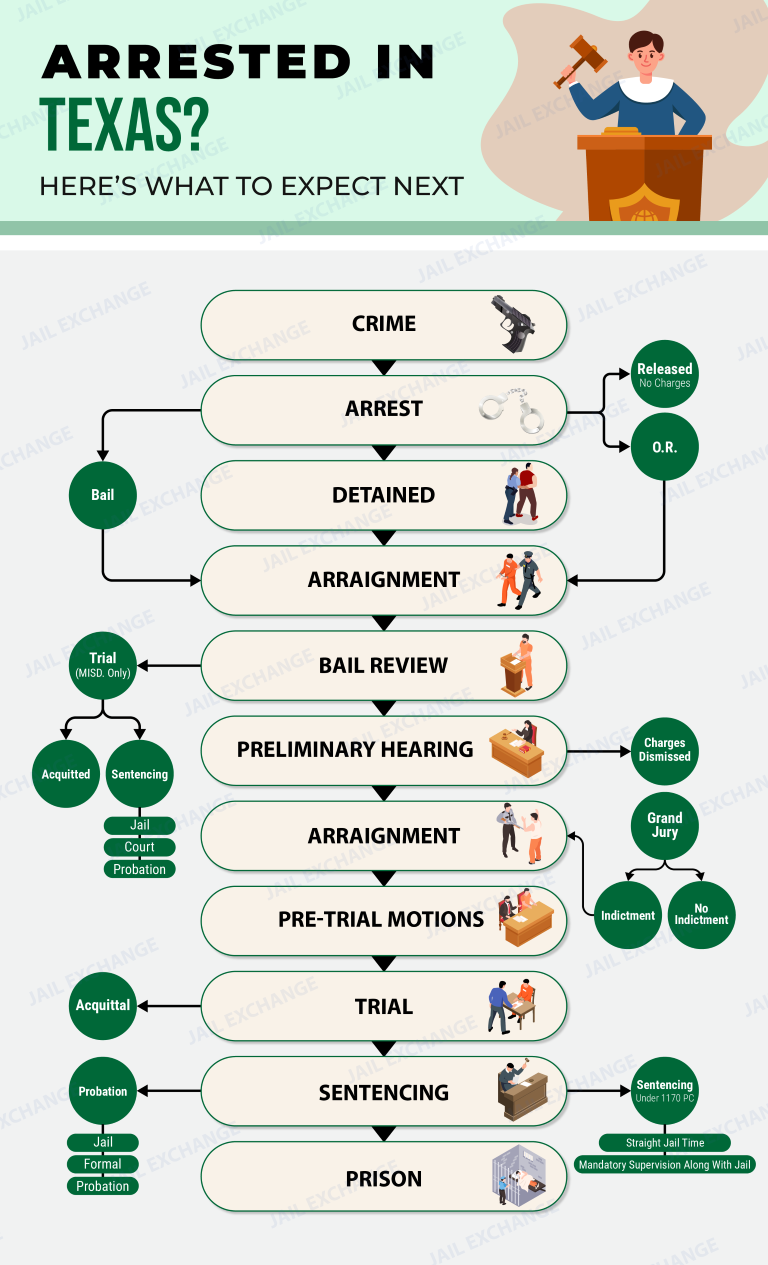
Arrests in Harris County follow a centralized path. No matter which agency made the arrest — Houston police, the Sheriff, one of the eight constables, a suburban department or DPS — the arrestee is ordinarily taken to the Joint Processing Center at 700 North San Jacinto Street. The city of Houston closed its own downtown jail after the center opened in 2019, so Houston arrestees are booked there too. The Harris County Jail housing buildings sit next door.
1. Charging by the District Attorney's intake division
A feature of Harris County practice is that police generally cannot file a misdemeanor or felony charge on their own. Before most cases are filed, the arresting officer contacts an assistant district attorney in the DA's intake division, which works around the clock, and that prosecutor decides whether to accept charges, decline them, or ask for more investigation. If the charge is declined, the person is normally released. Class C offenses are the exception: those are written as citations or filed in the JP or municipal courts without DA intake.
2. Booking
Booking includes fingerprints, photographs, a records check for warrants and holds, property inventory, and medical and mental health screening. A Pretrial Services officer interviews the person about residence, work and prior history. Booking at the Joint Processing Center can take many hours on a busy night. Families looking for someone who was just arrested can use the Sheriff's inmate information line at (713) 755-5300; a new arrestee may not appear in the system until booking is complete.
3. Probable-cause hearing and magistration
State law sets an outer limit of 48 hours between arrest and the magistrate's warnings, and Harris County usually moves faster. In Harris County, that role is filled mainly by Criminal Law Hearing Officers who hold hearings at the Joint Processing Center 24 hours a day, every day. At that hearing the officer rules on probable cause, gives the statutory warnings, notes whether the arrestee wants a court-appointed lawyer, and fixes bail along with any release conditions. These hearings are typically conducted by video from the jail and are open to the public; a lawyer from the Public Defender's Office is usually present to speak for people at the hearing. Protective orders in family violence cases are often issued at this stage.
4. Release or detention
After the hearing, a person may be released on a personal bond, may post a cash or surety bond, or may stay in custody. Someone who stays in jail is moved from the processing center into one of the Sheriff's housing buildings and will be brought to the assigned court for a first setting, usually within a few days. A person released on bond receives a court date and must report to Pretrial Services if the conditions require it.
5. First court setting
The first setting in a County Criminal Court at Law or a felony district court is where the court confirms or appoints counsel, reviews bail if asked, and sets the next date. Very few cases end at this first appearance. Most return several times for discovery, plea negotiations, motions or trial preparation.
Bail in Harris County and the misdemeanor bail settlement
Harris County bail practice has been shaped by years of federal litigation, and the rules for misdemeanors differ from those for felonies. People often hear about this from the news, so it helps to know the general outline.
Kinds of release
- Personal bond — the person signs a promise to return to court and walks out, sometimes under Pretrial Services conditions. No money is paid up front, but a fee or a forfeiture can apply if conditions are broken.
- Cash bond — the full amount is deposited with the county; it is returned, minus some costs, when the case ends if the person appeared as required.
- Surety bond — a licensed bonding company guarantees the full amount and keeps a fee the family pays up front (commonly 10 percent or more), sometimes with collateral. Harris County has a large and active bail bond industry near the jail.
- Conditions — hearing officers and judges may order things like staying away from the complainant, GPS or alcohol monitors, an interlock device after a DWI arrest, a curfew, drug tests or giving up firearms.
The misdemeanor bail settlement
In 2016, a class-action lawsuit known as ODonnell v. Harris County challenged the county's practice of holding people charged with misdemeanors in jail because they could not pay a set money amount. A federal judge found that the system as it then operated violated the constitutional rights of poor arrestees, and in 2019 the county and the misdemeanor judges agreed to a consent decree. Under the court rule adopted as part of that settlement, most people arrested for misdemeanors are released on a personal bond soon after booking. Certain categories, such as many family violence cases, violations of protective orders, repeat DWI arrests and arrests made while already on bond, can be held for an individualized hearing at which a judicial officer may set money bail or conditions. The decree also requires notice of court dates, help for people who miss court, and public reporting by an independent monitor. The details have been revised over time and remain the subject of public debate, so anyone with a pending case should ask the defense lawyer how the current rules apply.
Felony bail
Felony bail is set individually. The hearing officer weighs the offense, any record, the public safety report that the 2021 Damon Allen Act made mandatory, and what the person can afford. The same act rules out personal bonds for a long list of violent charges, and a constitutional amendment adopted by Texas voters in 2025 permits outright denial of release for some violent-crime defendants. Separate federal litigation over felony bail in Harris County has also been brought; outcomes in those cases can change local practice. A felony defendant who remains in jail can ask the district court for a bail reduction. There is also the 90-day rule in article 17.151: a felony detainee whose prosecutor cannot announce ready by day 90 is usually owed a personal bond or a lower figure, subject to carve-outs for many violent charges, with tighter deadlines in misdemeanor cases.
Paying or posting bond
Cash bonds are posted with the Sheriff at the jail or through the District Clerk, depending on the stage of the case. A surety company handles its own paperwork with the Sheriff's bonding desk. Release can take several hours after a bond is posted because of paperwork, warrant checks and processing out of the jail.
The Harris County Jail buildings and outsourced inmates
The Harris County Jail is one of the largest local jails in the United States, routinely holding many thousands of people, most of them awaiting trial rather than serving a sentence. It is operated by the Harris County Sheriff's Office, whose headquarters is at 1200 Baker Street. The jail is not one building but several, connected by tunnels and sally ports and spread over a few downtown blocks.
Downtown facilities
- Joint Processing Center — 700 North San Jacinto Street, Houston, TX 77002. Central booking, intake screening, probable-cause hearings and release processing.
- 701 North San Jacinto (also listed as 711 North San Jacinto) — Houston, TX 77002. A large housing building across the street from the processing center.
- 1200 Baker Street — Houston, TX 77002. The main high-rise jail building, which also holds Sheriff's administrative offices.
- 1307 Baker Street — Houston, TX 77002. An older housing building near the Baker Street complex.
The Sheriff's office lists these locations as in-person only for visits and property matters; the phone line handles custody status, charges, bond figures and housing assignments at (713) 755-5300. People in the jail are identified by a System Person Number (SPN), which appears on court and jail records and is the most reliable way to look someone up.
Outsourced inmates
When the downtown population exceeds what the buildings can safely hold, the county has contracted for beds elsewhere. Facilities the Sheriff has listed for outsourced Harris County inmates include the Jefferson County Downtown Jail at 1001 Pearl Street in Beaumont, the LaSalle Correctional Center in Olla, Louisiana, the Natchitoches Parish Detention Center in Natchitoches, Louisiana, and the Tallahatchie County Correctional Facility in Tutwiler, Mississippi. These arrangements change with jail population and county contracts. A person sent to one of them remains a Harris County inmate: the case stays in the Harris County court, the person is transported back for court, and the defense lawyer can still arrange legal calls or visits. Families should check the Sheriff's housing information before traveling.
Visits, money and mail
Visitation is scheduled in advance, and much of it takes place by video. Money can be deposited to an inmate's account for commissary and phone calls through the jail's approved vendors. Mail must include the person's full name and SPN and follow the jail's content rules; anything sent to a person housed at an outsourced facility goes to that facility's address. Legal mail from a lawyer is handled separately and is not read by staff.
Medical and mental health care
Medical and mental health services inside the jail are provided through the county's public health system. People with serious mental illness may be diverted at booking or referred to the mental health court programs described below. If a family member takes medication or has a serious medical condition, the family can tell the defense lawyer, who can raise it with the court and the jail.
Public defender and appointed lawyers in Harris County
For decades Harris County relied almost entirely on judges appointing private lawyers to represent people who could not afford one. That changed in 2011, when the county opened the Harris County Public Defender's Office, and again in 2020, when it created the Office of Managed Assigned Counsel. Today a person who cannot afford a lawyer may be represented by either one, depending on the type of case and the court. Part of the money, and the statewide rules both offices follow, come from the Texas Indigent Defense Commission.
Harris County Public Defender's Office
The Public Defender's Office is located in the Anderson Clayton Building at 1310 Prairie Street, Suite 400, Houston, TX 77002, phone (713) 274-6700. It employs staff lawyers, investigators and social workers and represents clients in felony, misdemeanor, juvenile, mental health and appellate matters. Its lawyers also appear at many of the probable-cause hearings at the Joint Processing Center to argue for release. The office cannot take every case; when it has a conflict or has reached its caseload limits, the court appoints a private lawyer instead.
Managed Assigned Counsel
The Harris County Office of Managed Assigned Counsel, at 1310 Prairie Street, Suite 1600, phone (832) 927-3949, is an independent office that oversees appointments of private lawyers for a growing share of cases. Rather than each judge choosing appointed lawyers directly, the office assigns lawyers from qualified lists, reviews their work, and provides access to investigators and social workers. Which courts and case types it covers has been expanding since it began, so a defendant should ask the court which system applies.
How to ask for a lawyer
- At the probable-cause hearing, tell the hearing officer you want a court-appointed lawyer and answer the financial questions. A request made there starts the appointment process.
- Missed the chance at the hearing, or already out of jail? Make the request at the first setting, or call the coordinator of the court handling your case.
- Bring proof of income and household size if you have it. Eligibility depends on the county's indigent defense plan, which looks at income, expenses and whether you are in custody.
- Once a lawyer is appointed, you receive the lawyer's name and contact information. Keep in touch with that lawyer and attend every setting.
For jailed defendants, Texas sets short deadlines for ruling on a lawyer request and naming counsel. A person who is released can still qualify but may need to apply at the court. Hiring a private lawyer is always an option, and the court will not appoint counsel for someone who has retained one.
The District Attorney, pretrial diversion and specialty courts
The Harris County District Attorney's Office, at 1310 Prairie Street, phone (713) 274-5800, is one of the largest local prosecutor's offices in the country. Unlike many Texas counties, where a county attorney handles misdemeanors, Harris County's elected District Attorney prosecutes both misdemeanors in the County Criminal Courts at Law and felonies in the district courts. Its divisions include intake, trial bureaus assigned to each court, family violence, vehicular crimes, juvenile, and a victim services division that keeps crime victims informed about hearings and plea offers.
Pretrial diversion and intervention
Diversion lets some people resolve a case without a conviction by completing a supervised program, after which the charge is dismissed. Eligibility is decided by the DA's office, not by the defendant or the judge, and programs have changed over the years. Common forms in Harris County include:
- Pretrial intervention for many first-time, lower-level misdemeanor and some felony defendants, usually involving supervision for six months to a year, classes, community service, restitution where owed, and staying out of trouble. Successful completion leads to dismissal, and the arrest record can often be expunged afterward.
- DWI pretrial intervention for some first-offense, Class B DWI cases. It generally excludes Class A cases (a breath or blood alcohol concentration of 0.15 or higher), crashes with injuries and people with prior DWI convictions, and it can be used only once. Conditions may include alcohol education or treatment and an ignition interlock. A license suspension imposed separately through the administrative license process is not erased by the diversion.
- Marijuana and other diversion programs for some low-level drug possession cases, often requiring a class rather than prosecution.
A defense lawyer can ask the prosecutor whether a case qualifies. Some applications ask for a written account of the incident, so it is wise to talk with a lawyer before completing one.
Specialty courts
Harris County has a broad set of specialty, or problem-solving, courts. These programs typically involve frequent court appearances before the same judge, intensive supervision by the adult probation department, drug and alcohol testing, treatment, and rewards and sanctions. Many lead to dismissal or a reduced outcome on completion; others are a condition of probation. Programs that have operated in the county include:
- STAR drug court (Success Through Addiction Recovery), which runs several dockets for felony defendants with serious substance use disorders.
- SOAR drug court (Sobriety Over Addiction and Relapse) and Sober Court dockets, which focus on repeat misdemeanor DWI and other alcohol and drug cases.
- Felony Mental Health Court, including a docket for people with co-occurring mental health and substance use disorders, for felony defendants with serious mental illness who are moderate to high risk.
- Veterans courts — a Felony Veterans' Treatment Court and a misdemeanor veterans program in the County Criminal Courts at Law, for veterans and active-duty, reserve or National Guard members whose offense is connected to service-related trauma, mental health or substance use.
- SAFE court, a program for people charged with prostitution, many of whom are survivors of commercial sexual exploitation or trafficking, and the related CARE program (Creating Advocacy Recovery and Empowerment).
- GRIP gang court (Gang Recidivism Intervention Program) and Court 360, which serve young adults and other higher-risk groups with intensive services.
- Felony and misdemeanor DWI courts for people at high risk of drinking and driving again.
Getting in generally takes a referral, a screening assessment and the prosecutor's consent. A person who is interested should raise it with the defense lawyer early in the case, because some programs accept people only before a plea is entered.
Misdemeanor (for example, theft, a first DWI, assault causing bodily injury, criminal trespass)
Jailable misdemeanors in Harris County are prosecuted by the District Attorney in the sixteen County Criminal Courts at Law at 1201 Franklin Street. The process usually moves faster than a felony, but a conviction can still mean jail time, a permanent record and consequences for jobs, housing, immigration status and driving privileges.
Penalty ranges
- Class B — jail of no more than 180 days, a fine no greater than $2,000, or both. Typical Class B charges: theft from $100 up to $750, criminal trespass, a first DWI, and marijuana possession of two ounces or less.
- Class A — jail of no more than one year, a fine no greater than $4,000, or both. Typical Class A charges: theft from $750 up to $2,500, bodily-injury assault (many family violence cases fall here), DWI at 0.15 or above, and trespass into a home or while armed.
- Class C misdemeanor — fine only, up to $500, in a JP or municipal court.
Typical steps
- Arrest and charge acceptance. The DA's intake division approves the charge, and the person is booked at the processing center.
- Release. Under the misdemeanor bail rules adopted in the ODonnell settlement, most misdemeanor arrestees are released on a personal bond within hours, with conditions in some cases. Family violence and certain repeat cases may go to an individualized hearing.
- Lawyer. A request for appointed counsel made at the probable-cause hearing is routed to the Public Defender's Office or to an appointed private lawyer.
- Court settings. The case is set in a numbered County Criminal Court at Law. The first few settings are usually for discovery and plea discussions, and the defendant must attend unless excused.
- Resolution. Cases end in a dismissal, diversion, a plea agreement or a trial before a six-person jury or the judge alone.
Common outcomes
- Dismissal when evidence is weak, a key witness cannot be located, or the person completes a diversion program.
- Deferred adjudication, a form of community supervision in which no conviction is entered if the person completes the terms. Afterward, many people can petition for an order of nondisclosure, which hides the record from most employers and the public, though family violence cases are excluded.
- Probation after a conviction, with conditions such as classes, community service, fees and reporting.
- Jail time, often credited with time already served, sometimes as part of a plea to resolve a case quickly.
- Fines and court costs. Courts can allow payment plans or community service for people who cannot pay.
First DWI in Harris County
By statute a first DWI is Class B, punishable by a jail term between three days and six months plus a fine capped at $3,000. With a 0.15 or higher result the charge rises one class, to A; an open container sets a six-day jail minimum. Probation is common for a first offense and often includes a DWI education program, a victim impact panel, community service and possibly an ignition interlock. A driver's license suspension through the administrative license revocation process is separate from the criminal case and has a short deadline to request a hearing. Some first-time Class B DWI cases are eligible for the DA's pretrial intervention program, which can end in dismissal; others resolve with deferred adjudication or a reduction.
How long it takes
Class C tickets usually wrap up within weeks. A Class A or B misdemeanor in the County Criminal Courts at Law commonly takes two to six months, and longer if there are lab tests, video evidence to review or a trial. For questions about appointed counsel in a misdemeanor case, call the Public Defender's Office at (713) 274-6700.
Felony (for example, burglary, felony theft, drug possession or delivery, aggravated assault)
Once the DA's intake prosecutors accept a felony charge, the case is filed and handed to a felony district court at 1201 Franklin. A felony case usually takes considerably longer than a misdemeanor, and the stakes are higher: a conviction can mean a state jail or prison sentence and the long-term loss of rights such as firearm possession.
Penalty ranges in Texas
- State jail felony — half a year up to two years of state jail confinement, plus a possible $10,000 fine; common examples are theft valued from $2,500 to $30,000 and holding under a gram of cocaine, methamphetamine or similar drugs.
- Third degree — two to ten years in prison, with fines reaching $10,000; repeat family violence assault and a felon carrying a gun are frequent examples.
- Second degree — two to twenty years, with fines reaching $10,000; home burglary and the typical aggravated assault are in this tier.
- First degree — anywhere from five years up to ninety-nine or life, plus a possible $10,000 fine. Delivery of large drug quantities and aggravated assault in some circumstances can reach this level.
Earlier felony convictions move a case into a higher range, and a defendant with two earlier sequential prison terms can be sentenced as a habitual offender to between 25 years and life. Since the grade of a drug charge is set by the substance's statutory group and the amount in grams, one drug can produce anything from a state jail charge up to a first-degree case.
Steps in a felony case
- Booking and probable-cause hearing. A hearing officer at the Joint Processing Center finds probable cause, gives warnings, takes the request for a lawyer and sets bail.
- Court assignment. The case is randomly assigned to a felony district court, which sets the first appearance within a few days for people in custody.
- Grand jury. Prosecutors take the case to one of the county's grand juries, which either indicts or returns a "no bill." In some plea deals the defendant gives up the grand jury step and pleads on an information instead.
- Discovery and negotiations. The defense receives police reports, video, lab results and witness statements under the Michael Morton Act. Plea negotiations happen alongside this.
- Motions and trial setting. The defense may file motions to suppress evidence or dismiss. If no plea is reached, the case is set for a jury trial with twelve jurors who must agree unanimously. Texas also lets the defendant elect jury sentencing instead of leaving punishment to the judge.
- Sentencing or probation. People without a record often get deferred adjudication or probation, while others are sentenced to state jail or prison.
Possible outcomes
- Dismissal, a no bill or acquittal at trial.
- Pretrial intervention or a specialty court program in eligible cases.
- Deferred adjudication community supervision, which avoids a conviction if completed successfully.
- Reduction to a misdemeanor in a plea agreement.
- Probation after conviction, sometimes with time in a treatment facility.
- A state jail or prison sentence, with credit for time already spent in the county jail.
Parole eligibility depends on the offense. Most prisoners can be considered for parole once actual time plus good time adds up to about a quarter of the sentence; "3g" crimes, including a deadly-weapon aggravated assault, demand half the sentence in flat time (two years at minimum) first.
How long it takes
A typical Harris County felony needs six to eighteen months to close, and longer where the post-Harvey backlog still lingers. A person held in jail who cannot post bond may be able to use the 90-day rule or ask for a bond reduction hearing. To ask about an appointed lawyer on a felony, call the Public Defender's Office at (713) 274-6700 or Managed Assigned Counsel at (832) 927-3949.
Violent felony (for example, murder, sexual assault, aggravated robbery)
Murder, capital murder, aggravated robbery, aggravated sexual assault and similar charges are among the most serious cases heard in the Harris County felony courts. They follow the same basic path as other felonies but tend to involve higher money amounts for release, longer pretrial detention, more expert testimony and longer timelines. Harris County historically sent more people to death row than any other county in Texas, although death sentences there have become rare in recent years.
Penalty ranges
- Capital murder — the only sentences for an adult are execution or life with no parole; a person under 18 at the time cannot be executed. The DA decides whether to seek the death penalty, and capital cases require specially qualified defense lawyers.
- Murder — first degree, carrying five to ninety-nine years or life. A sudden-passion finding at punishment lowers murder to a second-degree range.
- Aggravated robbery — first degree and listed under "3g," meaning half the term must be served before parole review.
- Sexual assault — generally a second-degree felony. Aggravated sexual assault is graded at first degree; when the child is very young, some versions require a minimum of 25 years. Many sex offenses require sex offender registration.
- Aggravated assault with a deadly weapon — usually second degree and a "3g" offense when a deadly weapon finding is made.
Bail and detention
For violent charges, the hearing officer at the processing center usually sets a high bail amount with strict conditions, or none at all if the law allows. Under the Damon Allen Act, personal-bond release is barred for many of these charges, and since a 2025 vote amending the Texas Constitution, judges may hold some violent-crime defendants with no release at all. Conditions often include GPS monitoring, no contact with the alleged victim or witnesses, and surrender of firearms. A person charged with a violent felony who stays in custody may wait in the jail for a year or more before trial.
The process
- Investigation by the Houston Police Department homicide or sex crimes divisions, the Sheriff's Office or another agency, often with search warrants and forensic testing.
- Charge acceptance by a prosecutor in the DA's intake division, followed by booking and a probable-cause hearing.
- Indictment by a grand jury, sometimes after the grand jury hears from investigators and reviews forensic results.
- Extended discovery, including DNA results, autopsy reports, phone and video data, and witness interviews. Defense lawyers frequently retain their own experts.
- Plea negotiations or a jury trial before twelve jurors, followed by a separate punishment phase if there is a conviction.
- Any appeal goes to the First Court of Appeals or the Fourteenth Court of Appeals, which both sit in Houston; a death sentence is reviewed directly by the Court of Criminal Appeals in Austin.
Victims' rights
The Texas Constitution's victims' rights provision (article I, section 30) promises fair and respectful treatment, notice of hearings, consultation with the DA's office, and attendance at open court proceedings. The DA's victim services division provides notifications, explains the process and helps victims prepare impact statements.
Timeline
Violent felonies in Harris County commonly take one to three years to resolve, and capital cases can take longer. Defendants without money for a lawyer are defended by the Public Defender's Office, by private counsel appointed through Managed Assigned Counsel or the court, or, for capital charges, by specially qualified appointed lawyers; reach the Public Defender's Office at (713) 274-6700.
Juveniles (under 17) arrested in Harris County
Texas treats anyone 17 or over on the date of the offense as an adult defendant. Juvenile court is reserved for youths aged 10 to 16 when the conduct took place. In Harris County, juvenile cases are heard by three district courts designated as juvenile courts — the 313th, 314th and 315th District Courts — at the Harris County Juvenile Justice Center, 1200 Congress Street, Houston, TX 77002.
Intake and detention
A child taken into custody by police is brought to juvenile intake, run by the Harris County Juvenile Probation Department at the Juvenile Justice Center (intake phone (713) 222-4865). Intake staff look over the police referral, reach a parent or guardian, and choose between sending the youth home and keeping the youth in custody. Children who are held are placed in the Harris County Juvenile Detention Center at the Juvenile Justice Center on Congress Street; they are never housed in the adult jail. Within two working days, a detained youth goes before one of the juvenile judges or a referee for a detention hearing that decides whether custody continues. A lawyer must be present, and the 313th, 314th or 315th appoints one if the parents lack the means.
Prosecution and defense
Prosecutors in the DA's juvenile division screen each case and choose whether to file a petition charging delinquent conduct or conduct indicating a need for supervision. Many first referrals for less serious conduct are handled without a petition through supervisory caution or deferred prosecution. Children who need an appointed lawyer may be represented by the Public Defender's Office, which has a juvenile division, or by appointed private lawyers.
Possible outcomes
- Dismissal or supervisory caution for minor first referrals.
- Deferred prosecution — a supervision period, commonly no longer than six months, that ends in dismissal when the youth finishes it.
- Probation at home or in a county or contract placement. The Juvenile Probation Department operates residential programs such as the Burnett-Bayland Rehabilitation Center in Houston, the Leadership Academy near Katy and the Youth Village in Seabrook.
- Commitment to state custody — for grave or repeated felony-grade conduct, the judge may commit a youth to TJJD, the Texas Juvenile Justice Department, which runs secure campuses.
- Determinate sentencing for certain grave offenses, such as murder, aggravated robbery and aggravated sexual assault, where a sentence of as long as 40 years can begin at a TJJD facility and be completed in the adult prison system.
Certification as an adult
After a diagnostic study and a hearing, a Harris County juvenile judge may waive jurisdiction and send a youth to adult court. As a general rule, certification is possible at 14 for capital, first-degree and aggravated drug felonies, and at 15 for any other felony. The judge looks at how serious the alleged offense was, the youth's history and maturity, and whether juvenile services could adequately protect the public. A certified case is then handled in a Harris County felony district court.
Records
Unlike adult files, Texas juvenile records are mostly closed to public view. Many juvenile records can be sealed, some automatically when the person turns 19 if certain conditions are met, and others by application to the court. Parents with questions about a pending juvenile case should contact the assigned lawyer or the juvenile intake office.
Federal cases (U.S. District Court) from Harris County
Federal prosecutions from Harris County are filed in Houston, in the Southern District of Texas's Houston Division. Federal criminal matters from the county are handled in the Bob Casey courthouse at 515 Rusk Ave. downtown; the clerk's number is (713) 250-5500. Houston is the headquarters of the Southern District, which also has divisions in Galveston, Victoria, Corpus Christi, Laredo, Brownsville and McAllen.
When a case becomes federal
A prosecution becomes federal when the charge rests on a U.S. statute rather than the Texas Penal Code. In the Houston area, common federal prosecutions include drug trafficking conspiracies, firearms cases (especially felons in possession and guns tied to drug activity), bank and wire fraud, health care fraud, identity theft, child exploitation, human trafficking and smuggling, immigration offenses such as illegal reentry, and crimes involving the Port of Houston or the energy industry. Federal investigators — FBI agents, the DEA, ATF, HSI, the Secret Service and others — build these cases, frequently through joint task forces that include Houston police and sheriff's investigators. Some conduct breaks both state and federal law, and it is the prosecutors who choose the forum.
Who prosecutes and who defends
- U.S. Attorney's Office, Southern District of Texas — headquartered at 1000 Louisiana, Suite 2300, in downtown Houston, (713) 567-9000.
- Federal Public Defender — the district's main defender office is in downtown Houston and takes many indigent clients; conflict cases are assigned to private attorneys on the Criminal Justice Act (CJA) panel.
How a federal case moves
- Initial appearance before a U.S. magistrate judge at the Rusk Avenue courthouse, usually the day of arrest or the next court day. The judge explains the charge and rights and appoints counsel if needed.
- Detention hearing, usually held within about three court days if the government asks to detain the person. Commercial bail bonds play no part here. The Bail Reform Act asks whether some set of conditions, overseen by U.S. Pretrial Services, will do; if so, the magistrate judge grants release or orders detention because no conditions would reasonably assure appearance and safety.
- Indictment. When charges start with a complaint, the government ordinarily has 30 days from the arrest to obtain a grand jury indictment.
- Arraignment, discovery and motions. On paper the Speedy Trial Act wants a trial within 70 days, but judges routinely exclude time for complex discovery and plea talks.
- Plea or trial. Most federal cases end in a plea agreement. A trial is before a twelve-person jury whose verdict must be unanimous.
- Sentencing. After a guilty plea or verdict, a probation officer prepares a presentence report. The judge works out the advisory Guidelines range but is bound by any statutory mandatory minimum, which many drug and gun charges carry.
- Prison and supervised release. Federal prisoners serve their sentences in the Bureau of Prisons. Federal parole no longer exists; good-conduct credit trims a sentence to about 85 percent served, after which supervised release starts.
- Appeal — heard in New Orleans by the Fifth Circuit Court of Appeals.
Where federal defendants are held
Many people held before a federal trial in the Houston Division are housed at the Federal Detention Center (FDC) Houston, run by the Bureau of Prisons at 1200 Texas Ave. in downtown Houston, main phone (713) 221-5400. FDC Houston holds men and women appearing before the Southern District of Texas, plus some people in transit or serving short sentences. Inmate mail goes to the person's name and register number at FDC Houston, P.O. Box 526255, Houston, TX 77052.
Locating a federal inmate
Houston-area families tracking a federal prisoner can rely on one official tool, the government-run Federal Bureau of Prisons inmate locator, searchable by register number or simply by name. When the U.S. Marshals Service boards a pretrial federal defendant at a county jail, the person often turns up on that county's inmate list too. Federal charges against juveniles are uncommon, and almost all youth cases from Harris County stay in the state juvenile courts on Congress Street.
This page explains in general terms how criminal cases move through the courts of Harris County, Texas, and is not legal advice. Court assignments, jail locations, diversion programs, bail rules and phone numbers change often in a county this large. If you or a relative has been charged, get advice from a criminal defense attorney who practices at 1201 Franklin. To ask about a court-appointed lawyer, call the Harris County Public Defender's Office at (713) 274-6700 or Managed Assigned Counsel at (832) 927-3949, and confirm court dates with the District Clerk at (832) 927-5800.