Howard County is on Interstate 20 in West Texas, midway between Midland and Abilene, and its county seat is Big Spring. Felony cases are heard in the 118th District Court, which also covers Glasscock and Martin counties, and Class A and B misdemeanors are handled by the county court in the Howard County Courthouse. Class C cases go to three justice of the peace courts or to the Big Spring Municipal Court. The 118th Judicial District Attorney prosecutes felonies, the Howard County Attorney handles misdemeanors, and arrested adults are held at the Howard County Detention Center on the west side of Big Spring.
- Howard County Courthouse (County Judge, County Clerk, justice of the peace courts), 300 South Main Street, Big Spring, TX 79720; County Clerk (432) 264-2213
- 118th District Court, 312 Scurry Street, Big Spring, TX 79720, court (432) 264-2225, District Clerk (432) 264-2223
- 118th Judicial District Attorney (felonies) and Howard County Attorney (misdemeanors), Big Spring; reach either through the courthouse
- Howard County Detention Center (Howard County Sheriff's Office), 3611 West Highway 80, Big Spring, TX 79720, jail (432) 264-6051, Sheriff's Office (432) 264-2231
Which court hears your case. Class C misdemeanors, fine-only offenses such as traffic violations, public intoxication, theft under $100, disorderly conduct and assault without injury, are heard by a justice of the peace or, when Big Spring police issue the citation inside the city, by the Big Spring Municipal Court. Class A and B misdemeanors, including a first DWI, theft of $100 to $2,500, assault causing bodily injury and criminal trespass, go to the Howard County Court, the constitutional county court presided over by the County Judge. Felonies start with magistrate warnings at the Howard County magistrate court and, after grand jury indictment, are tried in the 118th District Court.
Where pretrial inmates are held. The Sheriff's detention center on West Highway 80 is the county's jail. Arrests by deputies, Big Spring police, troopers on I-20 and other agencies are booked there, and people stay until they make bail or their cases end. Call the jail at (432) 264-6051 or the Sheriff's Office at (432) 264-2231 to confirm custody.
- Local courts in Howard County (justice of the peace, municipal and county courts)
- Misdemeanor (for example, theft, a first DWI, assault causing bodily injury, criminal trespass)
- Felony (for example, burglary, felony theft, drug possession or delivery, aggravated assault)
- Violent felony (for example, murder, sexual assault, aggravated robbery)
- Juveniles (under 17) arrested in Howard County
- Federal cases (U.S. District Court) from Howard County
Local courts in Howard County (justice of the peace, municipal and county courts)
Howard County has two justice of the peace courts for Precinct 1 in the Big Spring courthouse and one for Precinct 2 in Coahoma. Those three justices and the Big Spring municipal judge also make up the county's magistrate court, which holds hearings every day of the year to set bond, issue warrants and emergency protective orders, and decide whether there is enough cause to hold an arrested person. The magistrate hearings are streamed live but are not archived.
Justice of the peace courts
- Precinct 1, Place 1, Howard County Courthouse, 300 South Main Street, Room 211, Big Spring, TX 79720, (432) 264-2226
- Precinct 1, Place 2, Howard County Courthouse, 300 South Main Street, Room 200, Big Spring, TX 79720, (432) 264-2228
- Precinct 2, 110 North Main Street, Coahoma, TX 79511, (432) 394-4000
Municipal court
- Big Spring Municipal Court, Howard County Courthouse, 300 South Main Street, 3rd Floor, Big Spring, TX 79720, (432) 264-2530
County court
- Howard County Court (constitutional county court, County Judge), 300 South Main Street, Room 104, Big Spring, TX 79720, through the County Clerk at (432) 264-2213
Tickets written in Coahoma, Forsan or the unincorporated parts of the county usually go to a justice of the peace. A Class C defendant may pay, ask for deferred disposition or a driving safety course, or contest the charge at trial. A conviction can be appealed to the county court for a new trial if the appeal is filed within ten days.
Misdemeanor (for example, theft, a first DWI, assault causing bodily injury, criminal trespass)
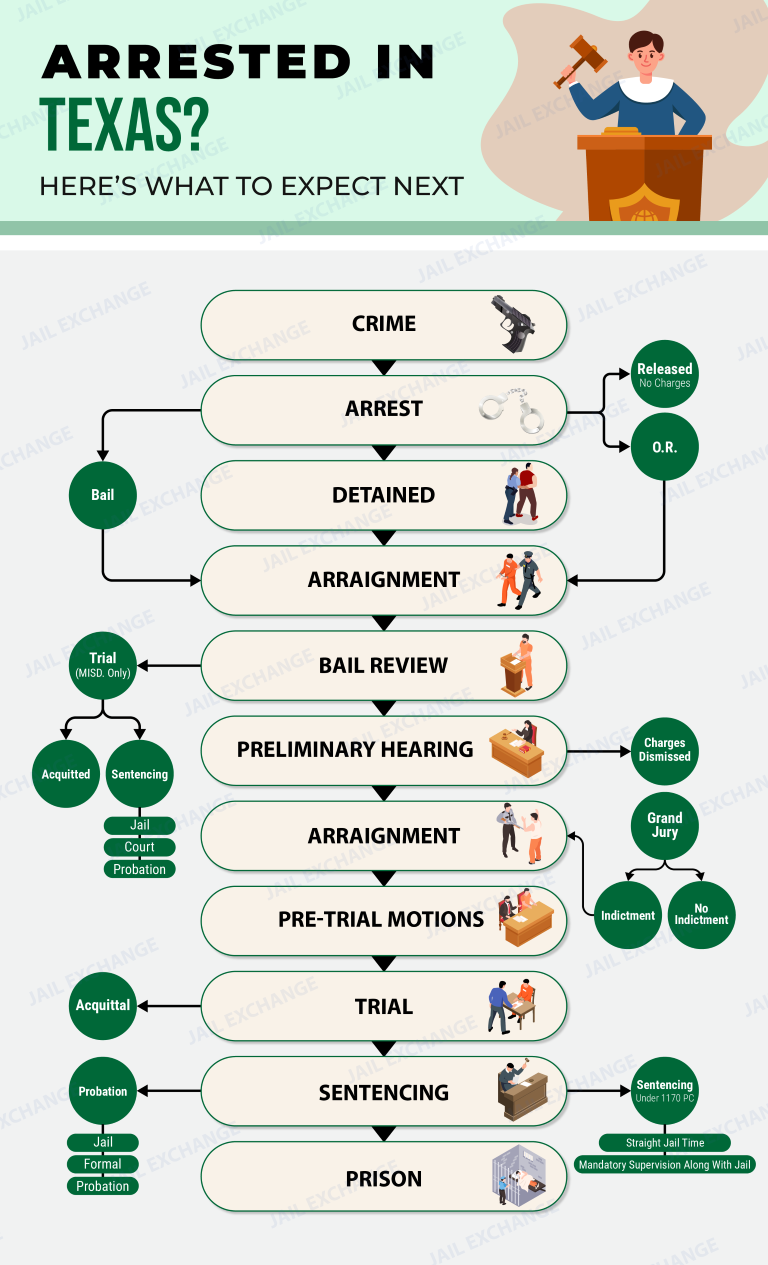
An arrest for a Class A or B misdemeanor leads to booking at the Howard County Detention Center and a hearing before one of the county's magistrates within 48 hours. The magistrate explains the charge and the person's rights, accepts a request for a court-appointed lawyer, reviews the public safety report required by state law and sets bail. Defendants are commonly released on a cash bond, a surety bond from a Big Spring bondsman, or a personal bond.
How a misdemeanor case unfolds
- The County Attorney files a charge in the Howard County Court after reviewing the officer's report.
- The defendant is arraigned, enters a plea and receives the State's evidence through counsel.
- The case ends by dismissal, diversion, deferred adjudication, a plea bargain or a trial before a unanimous six-person jury.
Penalties
- Theft: Class C under $100; Class B for $100 to $750 (up to 180 days and a $2,000 fine); Class A for $750 to $2,500 (up to a year and a $4,000 fine).
- First DWI: Class B. The law allows anywhere from 72 hours to 180 days in jail and a fine of up to $3,000, though most first offenders get probation. At 0.15 or above it becomes Class A, and an open container adds a six-day minimum. A license suspension, DWI education and sometimes an ignition interlock are part of the package.
- Assault causing bodily injury: Class A; with a family-violence finding, a federal gun ban applies.
- Criminal trespass: Class B, or Class A if a habitation or a deadly weapon is involved.
Most misdemeanors in Big Spring wrap up in two to six months. Ask the magistrate for an appointed lawyer, or call the County Clerk at (432) 264-2213.
Felony (for example, burglary, felony theft, drug possession or delivery, aggravated assault)
A felony defendant is held at the Howard County Detention Center until bond is posted. The magistrate sets the starting amount; the 118th District Court judge can hear a motion to lower it or change the conditions. If the State is not ready for trial within 90 days of a felony detention, a defendant can usually seek release on a personal bond or reduced bail, subject to exceptions for violent offenses.
Felony steps
- Examining trial or grand jury. The magistrate court can hold an examining trial on probable cause, but the key step is grand jury review. Nine of twelve Howard County grand jurors must vote to indict.
- Arraignment. The defendant enters a plea in the 118th District Court on Scurry Street.
- Pretrial. Discovery, motions to suppress and lab testing.
- Plea or trial. Most felonies are resolved by agreement. A trial jury of twelve must be unanimous, and the defendant may have the jury set punishment.
Punishment ranges
- State jail felony: 180 days to two years in a state jail plus a fine up to $10,000.
- Third degree: 2 to 10 years. Second degree (for instance, burglary of a habitation or aggravated assault): 2 to 20 years. First degree: 5 to 99 years or life. Up to $10,000 in fines.
- Drug charges are graded by penalty group and quantity, prior felonies can raise the range, and 3g offenses require serving half before parole.
Deferred adjudication can be available for first-time felony defendants. A felony in the 118th District Court usually lasts six to eighteen months. To ask about appointed counsel, tell the magistrate or call the District Clerk at (432) 264-2223.
Violent felony (for example, murder, sexual assault, aggravated robbery)
A violent felony charge generally means a long wait at the Howard County Detention Center. Magistrates set high bail, state law rules out personal bonds for many violent offenses, and under the constitutional amendment Texas voters adopted in 2025, a judge may deny bail entirely in certain violent cases after a hearing.
- Capital murder: death or life without parole.
- Murder: first degree (5 to 99 years or life), or second degree on a sudden-passion finding.
- Sexual assault: second degree; aggravated sexual assault: first degree, and certain child-victim cases carry a 25-year mandatory minimum; registration required.
- Aggravated robbery: first degree and a 3g offense.
Expect one to three years for many of these cases, depending on autopsy, DNA and digital evidence and on the 118th District Court's three-county docket. The Texas Constitution, article I, section 30, gives victims rights to notice, to be present and to speak with the prosecutor. Indigent capital murder defendants are appointed two qualified lawyers.
Juveniles (under 17) arrested in Howard County
Children who were 10 through 16 at the time of an offense go through juvenile court. A 17-year-old arrested in Big Spring is charged as an adult and booked at the Howard County Detention Center.
The Howard County Juvenile Board designates the juvenile court, generally the 118th District Court or the county court. The Howard County Juvenile Probation Department does intake: it reviews police referrals, meets with the family and decides whether to release the child, handle the case informally, or forward it to the prosecutor, who decides whether to file a petition.
Detention
A youth who is not released is typically placed in a contracted juvenile detention center elsewhere in West Texas, since the county does not maintain a large secure facility of its own; the probation department can tell parents where the child is held. The juvenile court must hold a detention hearing within two working days, and the child must have a lawyer.
Possible results
- Deferred prosecution for up to six months.
- Probation with conditions, at home or in placement.
- Commitment to the Texas Juvenile Justice Department (TJJD) for felony conduct, with TJJD's state facilities as the most restrictive option.
- Determinate sentencing for listed serious crimes.
The prosecutor can seek to certify a youth for adult trial, generally from age 14 for capital, first-degree and some aggravated drug felonies and from age 15 for other felonies. The law keeps juvenile files confidential, and a sealing order is often possible after the case.
Federal cases (U.S. District Court) from Howard County
Although Big Spring is closer to Midland, Howard County is assigned by statute to the Abilene Division of the U.S. District Court for the Northern District of Texas, so its federal cases are heard about 105 miles east in Abilene.
- U.S. District Clerk, Abilene: 341 Pine Street, Room 2008, Abilene, TX 79601, (325) 677-6311
- U.S. Attorney's Abilene office: 500 Chestnut Street, Suite 601, Abilene, TX 79602, (325) 271-6700
- Federal Public Defender for the Northern District of Texas or a Criminal Justice Act panel lawyer, appointed for defendants who cannot afford counsel
Federal cases arise from violations of federal law, usually investigated by the DEA, FBI, ATF or federal task forces working with local police. In the Permian Basin and along I-20 that often means methamphetamine and fentanyl trafficking, gun possession by prohibited persons, fraud and child exploitation. Big Spring is also the site of a federal prison, Federal Correctional Institution Big Spring, and crimes committed there are prosecuted federally.
A U.S. magistrate judge holds the first appearance and handles appointment of counsel. Federal court does not take commercial bail bonds; if the government moves for detention, the judge usually holds a hearing within three court days and, applying the Bail Reform Act, either sets conditions supervised by U.S. Pretrial Services or orders the defendant held. After an arrest on a complaint, an indictment must be returned within 30 days, and the Speedy Trial Act calls for trial within 70 days, though extensions are frequent. Federal juries have 12 members and must reach a unanimous verdict. The judge sentences after reviewing a presentence report, the advisory Guidelines and any mandatory minimum. Without parole, federal prisoners serve about 85 percent of their sentences in the Bureau of Prisons and then complete supervised release. Appeals go to the Fifth Circuit.
Search for federal inmates, including those at FCI Big Spring, with the Federal Bureau of Prisons inmate locator for a Howard County defendant by name or register number. A defendant held before trial in a county jail under a Marshals Service agreement may also appear on that jail's roster. Very few juveniles are prosecuted in federal court.
This guide explains the ordinary path of a criminal case in Howard County and is not legal advice; laws and local procedures can change. For advice on a particular charge, talk with a defense lawyer licensed in Texas. Howard County appoints private lawyers for people who cannot afford one under its indigent defense plan: ask the magistrate after arrest, or call the District Clerk at (432) 264-2223 for a felony or the County Clerk at (432) 264-2213 for a misdemeanor, and confirm court dates with the clerk.