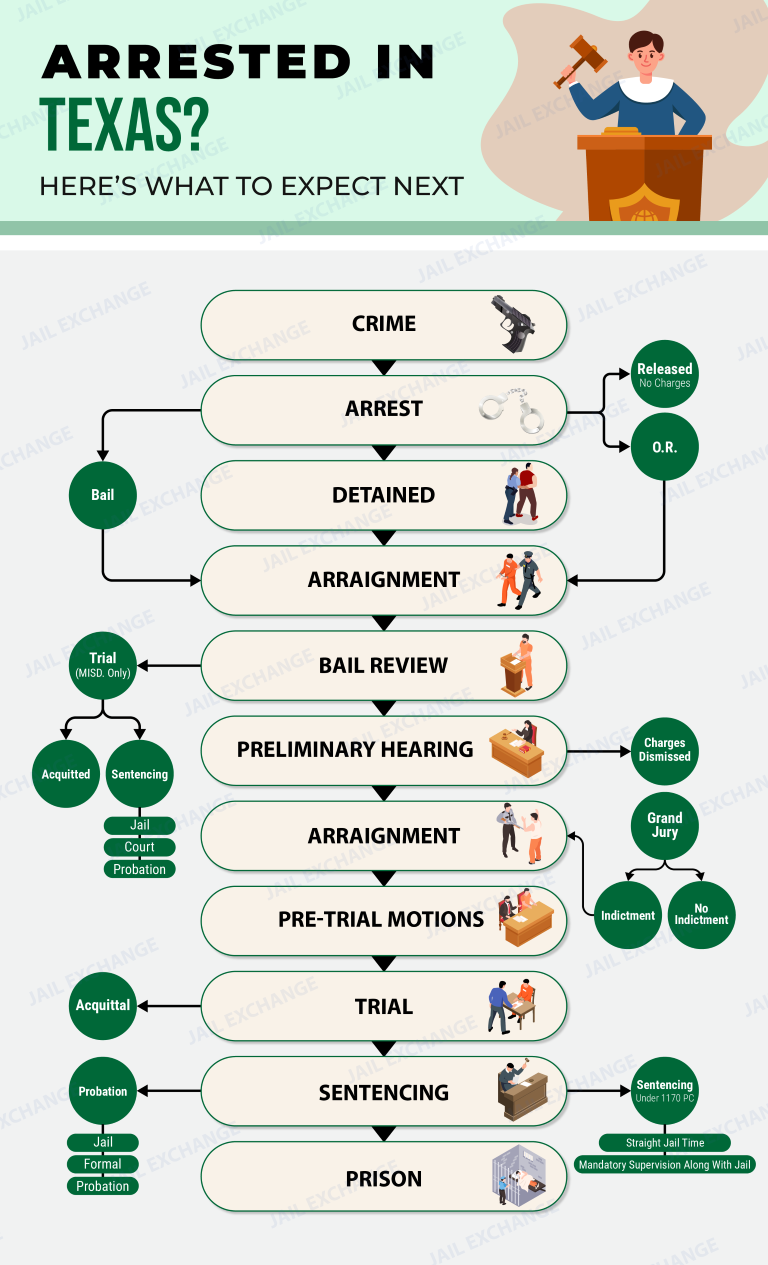
Jacksboro, about 60 miles northwest of Fort Worth, is the county seat of Jack County, and the courthouse on North Main Street hosts every level of local criminal court. Justice of the peace courts and the municipal courts of Jacksboro and Bryson take Class C cases, and the County Judge presides over Class A and B misdemeanors in the constitutional county court. Felonies are tried in the 271st District Court, which serves Jack and Wise counties. The Jack County Attorney prosecutes misdemeanors, while the 271st District Attorney, whose office is in Decatur, prosecutes felonies in both counties. The Sheriff operates the county jail in Jacksboro.
- Jack County Courthouse (271st District Court; County Court), 100 N. Main Street, Jacksboro, TX 76458; main line (940) 567-2111
- 271st District Court and District Clerk (felony files), 100 N. Main Street, Suite 310, Jacksboro, TX 76458, (940) 567-2141
- Jack County Judge and County Clerk (misdemeanors), 100 N. Main Street, Suite 208, Jacksboro, TX 76458, (940) 567-2111
- Jack County Attorney (misdemeanors), Jack County Courthouse, Jacksboro; reached through the courthouse at (940) 567-2111
- 271st District Attorney (felonies in Jack and Wise counties), Decatur, TX
- Jack County Jail (Jack County Sheriff's Office), Jacksboro, TX 76458; ask for the Sheriff's Office through the courthouse at (940) 567-2111
Which court hears your case. Class C misdemeanors, punished only by a fine (moving violations, public intoxication, theft of property worth less than $100, offensive-contact assault), are handled by the Justice of the Peace court for the precinct, or by the municipal court of Jacksboro or Bryson when city officers write the ticket. Class A and B misdemeanors, a first DWI among them, are filed in the Jack County Court. Felonies begin with magistrate warnings and a bail setting; once a Jack County grand jury returns an indictment, the 271st District Court takes the case, holding court in Jacksboro on weeks set aside from its Wise County docket.
Where pretrial inmates are held. Jack County keeps its own jail in Jacksboro, which state jail-standards reports have rated at about 108 beds, more than the county's small population needs on most days. Everyone arrested in the county, including people stopped by state troopers on U.S. 380 and U.S. 281, is booked there. The Sheriff's Office can confirm custody, charges and release terms; call the courthouse at (940) 567-2111 and ask to be connected.
- Local courts in Jack County (justice of the peace, municipal and county courts)
- Misdemeanor (for example, theft, a first DWI, assault causing bodily injury, criminal trespass)
- Felony (for example, burglary, felony theft, drug possession or delivery, aggravated assault)
- Violent felony (for example, murder, sexual assault, aggravated robbery)
- Juveniles (under 17) arrested in Jack County
- Federal cases (U.S. District Court) from Jack County
Local courts in Jack County (justice of the peace, municipal and county courts)
The justice of the peace at the courthouse handles most Class C cases and small claims, and the justices also act as magistrates for people held at the jail, reading the statutory warnings and setting bond. The county also has a second justice precinct; the County Clerk can direct callers to it. Jacksboro and Bryson operate city courts.
Justice of the Peace courts
- Jack County Justice of the Peace, Precinct 1, Jack County Courthouse, 100 N. Main Street, Suite 101, Jacksboro, TX 76458, (940) 567-2001
- Jack County Justice of the Peace, Precinct 2: location and hours through the County Clerk at (940) 567-2111
Municipal courts
- Jacksboro Municipal Court, 112 W. Belknap Street, Jacksboro, TX 76458, (940) 567-6321
- Bryson Municipal Court, P.O. Box 219, Bryson, TX 76427, (940) 392-2241
County court
- Jack County Court (constitutional county court; Class A and B misdemeanors and appeals from the justice and city courts), County Judge's office, second floor of the courthouse in Jacksboro, (940) 567-2111
For a Class C ticket, a defendant can pay, ask whether a driving safety course or deferred disposition is offered, or plead not guilty and set a trial before the judge or a six-person jury. Ignoring the citation can bring an arrest warrant and added costs. A judgment from these courts can be appealed to the County Court within 10 days.
Misdemeanor (for example, theft, a first DWI, assault causing bodily injury, criminal trespass)
A Class A or B misdemeanor arrest in Jack County leads to booking at the Jack County Jail in Jacksboro.
The first 48 hours
A justice of the peace serves as magistrate, warns the defendant of the right to remain silent and the right to counsel, takes any request for an appointed lawyer and sets bail. People commonly post a surety bond through a bondsman, a cash amount or a personal bond. In family-violence cases the magistrate often enters an emergency protective order. A person who remains jailed is generally entitled to a personal bond or reduced amount if the State is not ready for trial within 30 days on a Class A or 15 days on a Class B.
In the Jack County Court
The Jack County Attorney files the formal charge, an information, with the County Clerk. The county appoints private attorneys for indigent defendants under its indigent defense plan; ask the magistrate, or call the County Judge's office at (940) 567-2111. Pleas, pretrial hearings and six-person jury trials are scheduled on the County Court's docket.
Punishment
- A Class B conviction allows up to 180 days in jail and a $2,000 fine; property theft of $100 to $750 and most trespass charges are Class B.
- A Class A conviction allows up to a year and a $4,000 fine; assault causing bodily injury and theft of $750 to $2,500 are Class A, as is trespass into a habitation or while armed with a deadly weapon.
- A first DWI is Class B, with 72 hours to 180 days in jail and a fine of up to $3,000; it becomes Class A at an alcohol concentration of 0.15 or higher, and an open container sets a six-day minimum. Expect DWI education, possible ignition interlock and a license suspension, along with the separate administrative suspension.
Common results are dismissal, deferred adjudication, probation, fines and short jail terms, often with credit for time already served. After deferred adjudication a person may qualify for an order of nondisclosure. Most cases end within two to six months.
Felony (for example, burglary, felony theft, drug possession or delivery, aggravated assault)
The 271st District Court and the 271st District Attorney split their time between Decatur and Jacksboro, so Jack County felony cases run on a docket that the court sets for particular weeks in the Jacksboro courthouse.
- Booking and release terms. The defendant is held at the Jack County Jail. Within 48 hours a magistrate gives the article 15.17 warnings, reviews the public safety report and sets bond with any conditions, such as no contact with a complainant.
- Attorney appointment. If the defendant cannot afford a lawyer, the 271st District Court appoints one from its list. The District Clerk at (940) 567-2141 can explain how to apply.
- Indictment. Prosecutors from the District Attorney's office take the case to a Jack County grand jury. If a jailed defendant's case is not ready for trial after 90 days, the court must generally reduce the bond or grant a personal bond, unless the offense is one of the violent offenses excluded by law.
- Plea or trial. Plea bargains resolve the majority of cases. A trial requires 12 jurors to agree, and the defendant may elect jury sentencing.
Ranges of punishment
- State jail felony: between six months and two years of state jail confinement. Theft of $2,500 to $30,000 is an example.
- Third-degree felony: two to ten years in prison.
- Second-degree felony: two to twenty years; burglary of a habitation and aggravated assault usually fall here.
- First-degree felony: five to 99 years or life. Fines of up to $10,000 are possible for any felony.
Drug charges depend on penalty group and weight. Livestock and equipment theft, a recurring problem in ranch country, is graded by value, and cattle theft can be charged as a felony at lower values. Prior felonies can increase the range. First offenders are often offered deferred adjudication or community supervision. In prison, parole eligibility usually begins after a quarter of the sentence, but "3g" offenses require half, and no less than two years. A felony here usually takes six to eighteen months.
Violent felony (for example, murder, sexual assault, aggravated robbery)
When a homicide, sexual assault or armed robbery happens in Jack County, the Sheriff often works with the Texas Rangers, and the 271st District Attorney prosecutes the case in the 271st District Court.
The defendant is ineligible for a personal bond, and the magistrate tends to set a large amount. Texas voters approved a 2025 amendment to the state constitution that allows judges, in some violent-crime cases, to deny release altogether, so many defendants remain in the Jack County Jail through trial.
- Capital murder: a sentence of death or of life without parole.
- Murder: first degree, five to 99 years or a life sentence.
- Sexual assault: second degree; aggravated sexual assault: first degree, rising to a 25-year minimum for certain offenses against young children.
- Aggravated robbery: first degree, and a prisoner must serve half of the term before becoming eligible for parole.
Court-appointed lawyers in these cases must be qualified for serious felonies; two are required in a capital case. Victims are entitled to notice and to be heard under article I, section 30 of the Texas Constitution, and the District Attorney's office keeps them informed. A violent felony may take one to three years to resolve.
Juveniles (under 17) arrested in Jack County
In Texas, the juvenile system covers young people who were at least 10 and not yet 17 at the time of the alleged offense; 17-year-olds go to adult court.
Juvenile court and probation. The juvenile board for Jack County designates the juvenile court, which in a county of this size is ordinarily the County Court or the 271st District Court. A juvenile probation officer serving Jack County takes each referral, talks with the family and decides whether the child goes home, whether the case can be handled informally, or whether the prosecutor (generally the County Attorney) should review it for a petition.
Detention. The county does not have its own juvenile detention center. A youth who is not released is typically transported to a certified regional detention facility under contract, and the probation officer will tell the family which one. A judge must hold a detention hearing within two working days. Juveniles cannot post bail; the court either releases the child to a parent, often with conditions, or continues detention.
Dispositions. The court may approve deferred prosecution, place the youth on probation at home or in a residential program, or commit the youth to the Texas Juvenile Justice Department (TJJD). Determinate sentencing for the most serious offenses can extend into the adult system.
Adult certification. A juvenile court can transfer a case to adult district court only after a hearing and a complete evaluation, and generally only when the youth was 14 or older for a capital or first-degree felony or certain aggravated drug felonies, or 15 or older for another felony. Each child is entitled to a lawyer, at public expense when needed. Juvenile records are confidential, and many may be sealed.
Federal cases (U.S. District Court) from Jack County
Jack County is part of the Fort Worth Division of the Northern District of Texas. Federal charges from the county are filed in downtown Fort Worth, about an hour and a half's drive from Jacksboro.
- Federal district clerk, Fort Worth, Room 310, 501 West 10th Street, Fort Worth, TX 76102, (817) 850-6600
- U.S. Attorney's Office, Fort Worth, Suite 1700 in Burnett Plaza, 801 Cherry Street, Fort Worth, TX 76102, (817) 252-5200
- Federal Public Defender, Northern District of Texas (Fort Worth office), or a Criminal Justice Act panel lawyer appointed by the court
Kinds of cases. Most federal cases connected to Jack County involve methamphetamine trafficking, firearms possessed by convicted felons, child exploitation offenses, fraud and thefts tied to oilfield operations, and occasionally crimes at federal facilities or on federal land.
Steps in a federal prosecution. The defendant is brought before a U.S. magistrate judge in Fort Worth, told of the charges and given appointed counsel if eligible. Surety bail posted by a commercial company is not part of the federal system. Under the Bail Reform Act, the magistrate judge either orders release under conditions overseen by Pretrial Services or, after a detention hearing generally held within three court days, orders the person held. The government has 30 days after an arrest on a complaint to obtain an indictment, and the Speedy Trial Act sets a 70-day trial deadline that is often extended for complex cases. Pleas are the norm; trials go to a unanimous 12-person jury. A presentence report, the advisory Guidelines and any mandatory minimum shape the sentence, which is served in the Bureau of Prisons at about 85 percent because there is no federal parole, and supervised release follows. Any appeal is taken to the Fifth Circuit Court of Appeals.
Locating someone. Use the Federal Bureau of Prisons inmate locator, which searches by name or register number. If the person is awaiting trial in a county jail under contract with the Marshals Service, that jail's roster may list the person too. Juvenile federal prosecutions are unusual.
This overview of criminal cases in Jack County is general information and not legal advice; procedures and dockets change, so verify dates with the clerk. A person who cannot afford counsel should tell the magistrate, or call the County Judge's office at (940) 567-2111 for a misdemeanor or the 271st District Clerk at (940) 567-2141 for a felony.