Kenedy County, a vast ranching county of only a few hundred residents between Kingsville and the Rio Grande Valley, has its county seat in the small unincorporated community of Sarita. Class C cases go to one of four justice of the peace courts, Class A and B misdemeanors to the constitutional County Court under the County Judge, and felonies to the 105th District Court. The Kenedy County Attorney prosecutes misdemeanors, while felonies are handled by the 105th District Attorney, an office based in Kingsville that also serves Kleberg County. Kenedy County has no jail, so adults arrested here are held in another county's jail under the Sheriff's arrangements.
- Kenedy County Courthouse (County Judge, County Court), 101 E. La Parra Ave., Sarita, TX 78385 (mail: P.O. Box 8), (361) 294-5224
- Kenedy County District and County Clerk (105th District Court and County Court records), Sarita, TX 78385, (361) 294-5220
- Kenedy County Attorney, Sarita, TX 78385, (361) 294-5292
- 105th District Attorney (Kenedy and Kleberg counties), Kingsville, TX, (361) 595-8544
- Kenedy County Sheriff's Office, Sarita, TX 78385, (361) 294-5205
Which court hears your case. Class C misdemeanors, the fine-only offenses such as most traffic tickets on U.S. 77, public intoxication, theft of less than $100 and assault without bodily injury, are filed with the justice of the peace for the precinct where the offense took place; Kenedy County has no incorporated city and therefore no municipal court. Class A and B misdemeanors, a first DWI included, are heard in the Kenedy County Court, where the County Judge presides because there is no county court at law. Felonies begin with magistrate warnings from a justice of the peace and are tried in the 105th District Court after a Kenedy County grand jury indicts.
Where pretrial inmates are held. State jail-standards reports list Kenedy County with no jail beds of its own, yet the county still averages a handful of people in custody at any time because of arrests along the U.S. 77 corridor. Those prisoners are kept at the jail that serves Kenedy County under contract with a neighboring county, and the Sheriff's Office at (361) 294-5205 can say where a particular person has been taken and how to arrange bail. Court appearances still take place in Sarita.
- Local courts in Kenedy County (justice of the peace, municipal and county courts)
- Misdemeanor (for example, theft, a first DWI, assault causing bodily injury, criminal trespass)
- Felony (for example, burglary, felony theft, drug possession or delivery, aggravated assault)
- Violent felony (for example, murder, sexual assault, aggravated robbery)
- Juveniles (under 17) arrested in Kenedy County
- Federal cases (U.S. District Court) from Kenedy County
Local courts in Kenedy County (justice of the peace, municipal and county courts)
For a county with so few residents, Kenedy keeps an unusually busy set of justice courts. Traffic and other citations written by state troopers and deputies on U.S. 77, the main highway between Corpus Christi and the Valley, make up much of the work. All four justices of the peace sit in Sarita, and each can act as a magistrate, issuing warrants and setting bond for people arrested in the county.
Justice of the Peace courts
- Justice of the Peace, Precinct 1, 139 N. Main St., Sarita, TX 78385, (361) 294-5785
- Justice of the Peace, Precinct 2, 139 N. Main St., Sarita, TX 78385, (361) 294-5298
- Justice of the Peace, Precinct 3, 139 N. Main St., Sarita, TX 78385, (361) 294-5786
- Justice of the Peace, Precinct 4, 139 N. Main St., Sarita, TX 78385, (361) 294-5787
The citation shows which precinct court the case was filed in. Many drivers stopped in Kenedy County live elsewhere, and the justice courts can explain options such as paying a fine, requesting a driving safety course or deferral, or setting the case for trial.
Municipal courts
Kenedy County has no incorporated cities, so there are no municipal courts. Sarita and Armstrong are unincorporated communities, and every Class C case filed in the county goes to a justice of the peace.
County and district courts
- Kenedy County Court (County Judge; Class A and B misdemeanors and appeals from the justice courts), 101 E. La Parra Ave., Sarita, TX 78385, (361) 294-5224
- 105th District Court (felonies), sitting in Sarita for Kenedy County cases; files kept by the District and County Clerk, (361) 294-5220
An appeal from a justice court conviction goes to the County Court for a new trial and must be filed within a short period after judgment.
Misdemeanor (for example, theft, a first DWI, assault causing bodily injury, criminal trespass)
A jailable misdemeanor arrest in Kenedy County means transport to the out-of-county contract jail, a magistrate hearing, and then a case in the County Court in Sarita prosecuted by the County Attorney, (361) 294-5292. Because many people arrested here are traveling through, out-of-town defendants should plan on returning to Sarita for court dates.
Getting released
A magistrate must see the arrested person within 48 hours, explain the charge and rights, take any request for a court-appointed lawyer, and set bail. Release can be on a cash deposit, a surety bond from a licensed bondsman, or a personal bond. The magistrate can attach conditions, for example an ignition interlock after a DWI arrest.
In County Court
The County Attorney files an information, and the County Judge sets the case on the court's docket. Defendants can negotiate a plea, try the case to the judge, or ask for a six-person jury, which must be unanimous and can also decide punishment if the defendant elects it. Possible results are dismissal, pretrial diversion, deferred adjudication, probation, a fine or a jail sentence.
Ranges for the listed offenses
- Theft: Class C under $100; Class B at $100 to under $750, up to 180 days and $2,000; Class A at $750 to under $2,500, up to one year and $4,000.
- First DWI: Class B with 72 hours to 180 days in jail and a fine up to $3,000, although first offenders are often placed on probation. An alcohol concentration of 0.15 or more makes it Class A, and having an open container sets a six-day minimum. A conviction also brings a license suspension, a DWI education requirement and a state fine; the administrative license suspension is a separate matter with a short window to request a hearing.
- Assault causing bodily injury: Class A, up to a year in jail; a family violence finding brings additional consequences.
- Criminal trespass: Class B, which becomes Class A for a habitation or when a deadly weapon is carried.
Misdemeanors here usually take two to six months. To ask about an appointed lawyer, tell the magistrate or call the County Judge's office at (361) 294-5224.
Felony (for example, burglary, felony theft, drug possession or delivery, aggravated assault)
Felony cases from Kenedy County are prosecuted by the 105th District Attorney, (361) 595-8544, and heard by the 105th District Court when it sits in Sarita. Highway drug seizures make up a meaningful share of the county's felony docket.
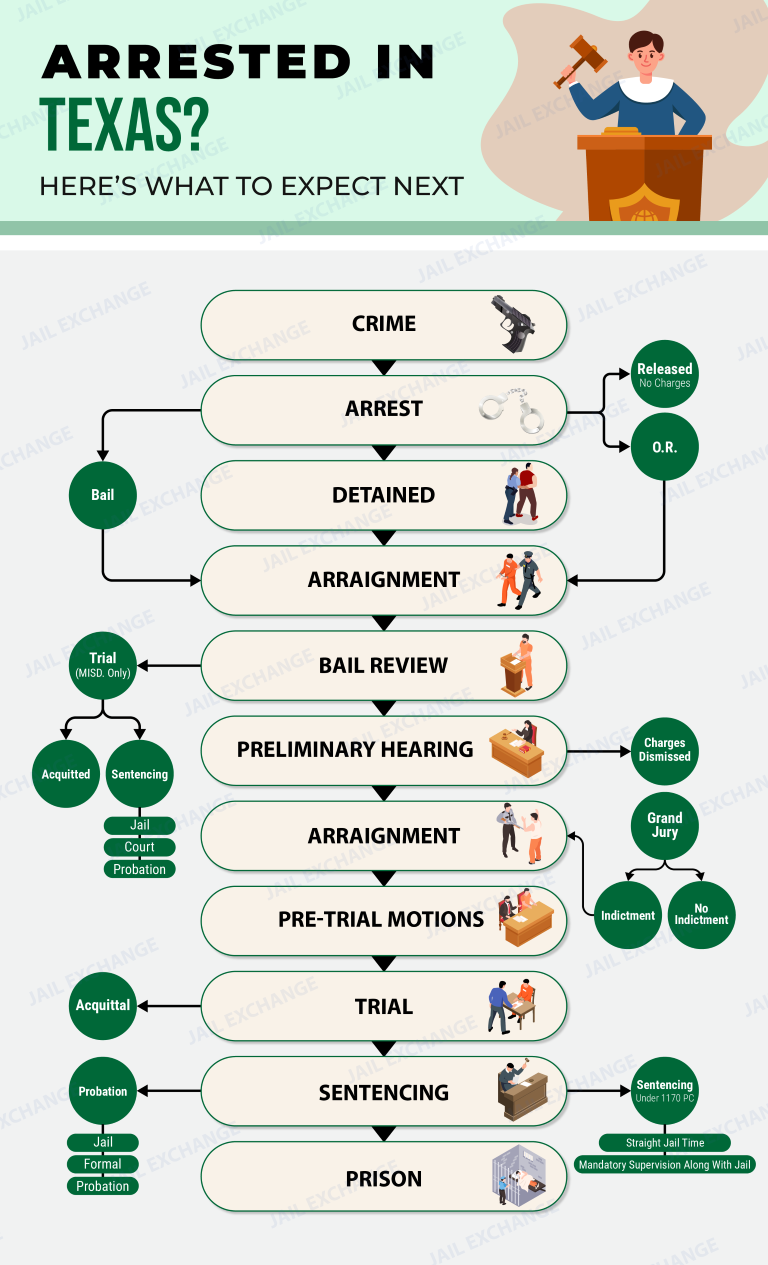
- Magistration. Within 48 hours the arrested person appears before a magistrate, who sets bail and conditions and records any request for appointed counsel.
- Grand jury review. The District Attorney presents the evidence to a Kenedy County grand jury, which meets in secret and decides whether to indict. A defendant may agree to waive indictment to resolve the case sooner.
- District court proceedings. After indictment the defendant is arraigned, receives the State's discovery, and may file motions, such as a challenge to the legality of a traffic stop.
- Plea bargain or trial. A large majority of cases end in a plea agreement. A felony jury has 12 members who must agree unanimously, and the defendant may ask the jury to decide the sentence.
Ranges of punishment
- State jail felony: confinement of 180 days to 2 years and a fine up to $10,000; theft of $2,500 to under $30,000 belongs here.
- Third-degree felony: two to ten years in prison.
- Second-degree felony: from two up to twenty years; burglary of a home and the usual aggravated assault charge are in this class.
- First-degree felony: five to 99 years, or a life sentence.
- Drug possession or delivery: depends on the substance's penalty group and weight; large seizures can be first-degree felonies.
Prior convictions can raise the punishment level, and deferred adjudication is often available to a first offender. Parole eligibility generally begins after one-quarter of a prison sentence including good time, while "3g" offenses require half, with a two-year minimum. A felony case commonly takes six to eighteen months. Indigent defendants receive a private lawyer appointed by the 105th District Court under the county's indigent defense plan, filed with the Texas Indigent Defense Commission; make the request at magistration or through the clerk at (361) 294-5220.
Violent felony (for example, murder, sexual assault, aggravated robbery)
Violent crimes are rare in Kenedy County, but when one is charged the Sheriff's Office typically brings in the Texas Rangers, and the 105th District Attorney handles the prosecution. Bail is usually set high, Texas law rules out personal bonds for violent offenses, and under the 2025 amendment to the Texas Constitution judges may deny bail outright in some violent-crime cases. A defendant who cannot be released remains in the jail that serves Kenedy County.
- Capital murder: either the death penalty or life in prison with no parole.
- Murder: first degree, punished by a term of five to 99 years or by life imprisonment.
- Sexual assault: second degree, plus sex offender registration. Aggravated sexual assault is first degree and carries a 25-year minimum for certain offenses against children.
- Aggravated robbery: a first-degree "3g" offense; parole cannot be considered until half of the sentence has been served.
Under article I, section 30 of the Texas Constitution, victims are entitled to be informed of proceedings, to confer with the prosecutor and to speak at sentencing. Serious violent cases tend to take one to three years. A judge may move a trial to another county if an impartial jury cannot be found in a community this small. Lawyers appointed in a capital case must meet stricter statewide qualification standards.
Juveniles (under 17) arrested in Kenedy County
The Texas juvenile system covers children who were 10 to 16 years old when the alleged offense was committed. Seventeen-year-olds are prosecuted as adults.
Who handles the case
A juvenile probation officer serving Kenedy County performs intake, decides whether a child may be released to a parent, and recommends how the case should proceed. Petitions are filed by the prosecutor, generally the Kenedy County Attorney, (361) 294-5292. The juvenile court is the court designated by the county's juvenile board, either the County Court or the 105th District Court; the clerk at (361) 294-5220 can tell a family which court has the case.
Detention
There is no juvenile detention center in Kenedy County. A youth who must be held is typically placed in a certified regional detention facility, such as one in the Kingsville or Corpus Christi area, under contract. A detention hearing must be held within two working days, and the child is entitled to a lawyer, appointed at no cost if the family cannot pay.
Outcomes
- Deferred prosecution or informal supervision for a first, less serious offense.
- Probation, possibly including placement outside the home.
- For felony conduct, a commitment to a secure state facility of the Texas Juvenile Justice Department (TJJD).
- Determinate sentencing for certain grave offenses.
For serious felonies, a prosecutor may ask to certify the child as an adult, generally at age 14 or older for capital and first-degree felonies and certain aggravated drug felonies, and at 15 or older for other felonies. Juvenile records are confidential and can usually be sealed later.
Federal cases (U.S. District Court) from Kenedy County
Kenedy County is in the Corpus Christi Division of the Southern District of Texas. Although the county does not touch the Rio Grande, U.S. 77 passes a permanent Border Patrol checkpoint near Sarita, and federal cases from the county are dominated by border-related charges: human smuggling, drug trafficking found at the checkpoint, and immigration offenses.
- Federal courthouse and district clerk, Corpus Christi Division, 1133 N. Shoreline Blvd., Corpus Christi 78401, (361) 888-3142
- Southern District U.S. Attorney, Corpus Christi branch, Suite 500, 800 N. Shoreline Blvd., Corpus Christi 78401, (361) 888-3111
- Federal Public Defender for the Southern District of Texas, or a private lawyer appointed from the Criminal Justice Act panel
How a checkpoint case unfolds
When Border Patrol agents find undocumented passengers or drugs in a vehicle at the checkpoint, the driver is usually charged by federal complaint and taken before a U.S. magistrate judge in Corpus Christi. Federal court has no commercial bail bonds; the magistrate judge applies the Bail Reform Act and either releases the defendant on conditions monitored by U.S. Pretrial Services or keeps the defendant in custody; when prosecutors ask for detention, the hearing normally takes place within three court days. Defendants who are not U.S. citizens are often detained.
An indictment must be returned within 30 days of an arrest on a complaint, and the Speedy Trial Act calls for trial within 70 days, though delays are common. Most cases end with a guilty plea. Sentencing follows a presentence report and the advisory Guidelines, and drug quantities can trigger mandatory minimum terms. With no federal parole, prisoners generally serve about 85 percent of the sentence before supervised release. A unanimous 12-person jury decides any trial, and appeals go to the U.S. Court of Appeals for the Fifth Circuit.
Finding someone in federal custody
A sentenced prisoner from Kenedy County can be found on the Federal Bureau of Prisons inmate locator with a name or register number. People awaiting trial on federal charges may be housed in a county or contract jail used by the U.S. Marshals Service, and they may appear on that facility's inmate roster too. Federal prosecution of juveniles is uncommon even in smuggling cases.
This page describes the criminal process in Kenedy County for general information only; it is not legal advice, and offices, phone numbers and schedules change. To request a court-appointed lawyer, ask the magistrate or call the County Judge's office at (361) 294-5224 for a misdemeanor or the District and County Clerk at (361) 294-5220 for a felony.