McCulloch County Jail Criminal Court Process
Criminal Court Process for McCulloch County Texas
McCulloch County Criminal Court Guide
Each criminal case from McCulloch County gets decided in Brady. Felony and misdemeanor dockets run at the county courthouse, 199 Courthouse Square, Brady, TX 76825, and city tickets go to Brady Municipal Court. Anyone who can't make bail waits at the McCulloch County Jail, 900 East Main Street, Brady, TX 76825. Below you'll find each courtroom, the path a case takes, who prosecutes and defends, and where dockets live.
Is your person still locked up on Main Street? Check the county jail roster. Our Inmate Search page sticks to custody after an arrest: who sits in the jail, recent bookings, outstanding warrants, the charges filed, mugshots, defense lawyers the court appoints and collecting property.
With a felony, the District Clerk is the first call: 325-597-0733, then ask for that office. Jot down the cause number, the next setting and any lawyer the judge has named. Need to work on getting your person out first? The bail page on our site lays out bonds in this county.
1. Brady felony or misdemeanor: which courtroom gets the case?
The charge's class decides the courtroom. For cases from this county:
- Felonies are filed in the 452nd District Court, with the District Clerk as record keeper.
- Class A and B misdemeanors land on the County Court docket. The County Judge hears them, and the County Clerk holds the files.
- Class C charges mean a fine and no jail. The Justice of the Peace takes those cases. When city officers wrote the ticket inside town, the municipal court may hear it instead.
Any appeal travels up to the Texas Court of Criminal Appeals in the end. The Office of Court Administration's judicial system pamphlet draws the full ladder.
↑ Back to the question list2. Where in Brady do the McCulloch County courts and clerks sit?
Nearly all of it sits under one roof at 199 Courthouse Square, Brady, TX 76825. The switchboard number is 325-597-0733.
- District Clerk, 452nd District Court: Room 103. Hours are 8:00 a.m. to 5:00 p.m. Monday through Thursday, and 8:00 a.m. to 3:00 p.m. Friday. The same district judge also rides to Edwards, Kimble, Mason and Menard.
- County Judge, County Court: Room 302, reached as option 4 from the switchboard.
- Justice of the Peace: in the same courthouse, mail to 104 N College, Brady, TX 76825, 325-597-8000. Same hours as the District Clerk.
Two offices sit elsewhere in town. The County Clerk works from 101 N. High, Brady, TX 76825, 325-597-2400, from 8:00 a.m. to 4:45 p.m. Monday through Thursday and until 3:00 p.m. Friday. The city's court shares City Hall at 201 E Main, Brady, TX 76825, 325-597-2156.
↑ Back to the question list3. Do Brady and Melvin run their own city courts?
Only the larger town does. Its municipal court, 201 E Main, Brady, TX 76825, 325-597-2156, takes fine-only tickets and ordinance cases written in the city. The city's court page links an online fine payment portal and a subpoenas and warrants section.
Melvin's town office uses P.O. Box 177, Melvin, TX 76858, 855-481-0144. Tickets from Melvin or from a ranch road go to the Justice of the Peace instead, 325-597-8000. That office has a youth diversion plan for minors with Class C charges.
Short on money for a fine? A Class C judge may allow payments, set community service at $150 for every 8 hours, or waive the amount. Under CCP arts. 45A.252-45A.261, unpaid Class C fines can lead to jail only if a judge, after a hearing, finds that your person made no good-faith effort to pay.
↑ Back to the question list4. What does the Brady magistrate handle at the first hearing?
The 48-hour clock starts at arrest. Inside that window, a magistrate meets your person, face to face or over the jail's camera link (CCP arts. 14.06, 15.17). At that hearing the magistrate covers:
- the charge on file
- the right to hire counsel, and how to request a court-appointed one
- the right to say nothing, to have a lawyer sitting in on any police questioning, and to stop that questioning
- a caution that anything said can come up later in court
- in felony cases, the right to an examining trial
Before the hearing wraps up, the magistrate also sets bail. The magistrate helps with the lawyer request and sends that form on to the judge who appoints counsel, all within 24 hours. An examining trial, if requested, lets a judge test the evidence for probable cause before any indictment (CCP art. 16.01).
↑ Back to the question list5. How does a Brady DWI, theft or assault misdemeanor move along?
Misdemeanor charges reach County Court on a charging paper called an information. Under CCP art. 26.01, the County Court arraignment is where a judge reads out the charge and your person gives an answer to it. Many cases settle with a plea bargain. Texas requires the judge to say up front whether the bargain will be honored. If not, your person is allowed to withdraw that plea under CCP art. 26.13.
Ranges under Penal Code chapter 12:
- Class A: no more than one year behind bars in the county, a fine of up to $4,000, or both (PC 12.21)
- Class B: 180 days or less in the county jail, a fine of up to $2,000, or both (PC 12.22)
- Class C: just a fine, $500 or less, and never jail (PC 12.23)
Deferred adjudication postpones any guilty finding. On a misdemeanor it can last two years, and finishing it leads to dismissal (CCP arts. 42A.101-42A.111). Probation, known in Texas law as community supervision, also tops out at two years for a misdemeanor. The McCulloch CSCD supervises both from 116 W Main St, Brady, TX 76825, 325-597-3416.
↑ Back to the question list6. What are the steps in a McCulloch County felony case?
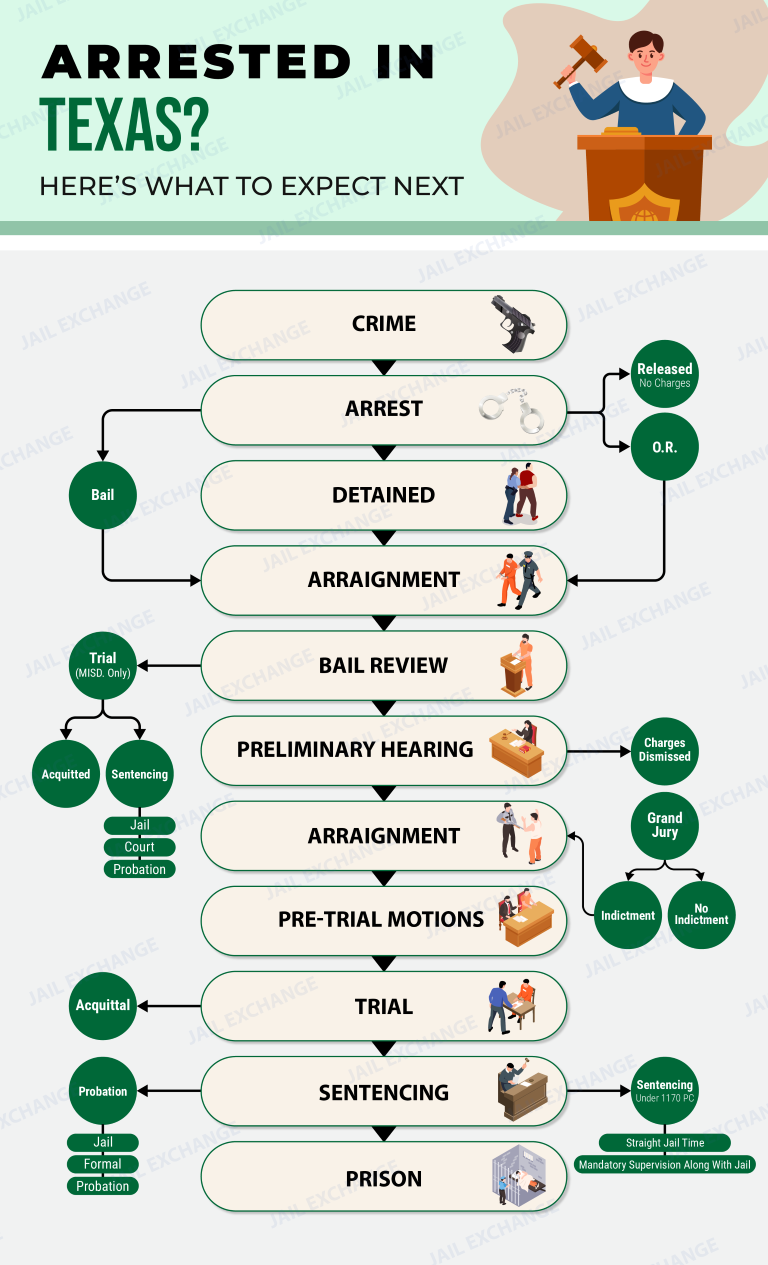
- Magistrate. Within two days of arrest, your person hears the warnings and gets a bail amount.
- Examining trial. Your person may ask for one under CCP art. 16.01 before any indictment.
- Grand jury. In secret, twelve citizens hear the evidence. Under CCP art. 20A.301, no indictment can issue unless nine of them vote for it.
- Arraignment. Your person hears the indictment read in the 452nd District Court and enters a plea.
- Pretrial work. Discovery, motions and plea talks fill this stretch.
- Resolution. Your person either takes a plea or goes to trial before jurors or the judge, and a guilty result leads to sentencing.
Prison ranges in PC chapter 12:
- State jail felony (PC 12.35): a 452nd District judge may order 180 days or up to two years, with that time spent at a state jail site
- Third degree, PC 12.34: between 2 and 10 years with TDCJ
- Second degree, PC 12.33: between 2 and 20 years with TDCJ
- First degree, PC 12.32: between 5 and 99 years with TDCJ, or life
On top of the time, a fine of as much as $10,000 may be added at every felony level. Earlier convictions on a person's record can push the punishment level higher (PC 12.42). In the opposite direction, the 452nd District judge has the option of Class A misdemeanor punishment for certain state jail felonies (PC 12.44). Felony deferred adjudication can stretch to a full decade under CCP art. 42A.103.
↑ Back to the question list7. Are violent charges in the 452nd District treated differently?
They are. A charge from the state's violent offense list blocks a personal bond under CCP art. 17.03. Since November 2025, section 11d of the Texas Constitution has also made judges deny bail in murder, aggravated robbery and similar listed cases. That happens when, at a hearing, the prosecutor shows your person would flee or put others in danger.
Capital murder, under PC 12.31, ends in one of two sentences: a death sentence, or prison for life with parole off the table. Anyone younger than 18 at the offense can only get the life term. Lawyers for capital defendants here come from the regional public defender program that handles only capital cases.
Family violence arrests add steps at the jail. Once bond is posted, the release can wait 4 hours (CCP art. 17.291). A Brady family violence arrest also tends to bring a magistrate's protective order for 61 to 91 days, roughly two or three months (CCP art. 17.292). With a weapon or a serious injury, the order runs longer, from 91 up to 121 days.
↑ Back to the question list8. Which offices take on the prosecution and the defense here?
Prosecution. The 452nd District Attorney's office takes felonies. Its mail goes to a Mason box, P.O. Box 635, Mason, TX 76856. You can also call 325-347-8400. The County Attorney answers on the courthouse switchboard, 325-597-0733, at option 7. On a misdemeanor, ask that office which prosecutor has the file.
Defense. Five counties, including this one, run under one shared indigent defense plan that uses appointed private attorneys. Request forms come from the magistrate, either clerk's office or the Texas Indigent Defense Commission. The County Judge picks counsel for misdemeanor defendants and the District Judge picks it in felony cases. The plan and CCP art. 1.051 set three working days as the outside limit for naming one.
The state commission is at 209 West 14th Street, Room 202, Austin, TX 78701, 512-936-6994.
↑ Back to the question list9. How can I look up a McCulloch County case or court date?
The county links several record tools:
- An Online Records Search shared by the County Clerk and District Clerk
- The District Criminal Docket page for felony settings
- The County Court Docket and the County Court Dispositions page for misdemeanors
Texas courts also run re:SearchTX. After a free sign-up, it shows filed charges and final judgments, but court settings are not on it. To confirm a date, call the District Clerk at 325-597-0733 or the County Clerk at 325-597-2400 and give the full name or cause number.
↑ Back to the question list10. How would I find out about a Brady warrant and take care of it?
Out in the county, Sheriff's deputies, based at 900 East Main Street, Brady, TX 76825, 325-597-0639, carry out warrants all over the county. Inside the city limits, police at 325-597-2121 do that job. Ask the Sheriff's Office by phone if one is out. The municipal court posts a subpoenas and warrants section on its city court page. A DPS list called Texas 10 Most Wanted shows the top fugitives across the state. Before dealing with a warrant, your person should speak with a defense lawyer. Then they can turn themselves in at the Main Street jail, or phone the judge who signed it and ask for a fresh date.
↑ Back to the question list11. What court hears a federal case from the Brady area?
Federal cases from the Brady area are filed in Austin, with the Western District of Texas, Austin Division. Its clerk is at 501 West Fifth Street, Suite 1100, Austin, TX 78701, 512-916-5896.
- A federal judge decides release before trial at a detention hearing, which normally happens at the first court date (18 U.S.C. 3142).
- Federal defendants are moved and held by the U.S. Marshals Service, Austin office, 501 West 5th Street, Suite 3300, Austin, TX 78701, 512-916-5393.
- The Federal Public Defender's Austin branch, 504 Lavaca Street, Suite 960, Austin, TX 78701, 512-916-5025, represents people who qualify.
- After the sentence, find the person on the Federal Bureau of Prisons inmate locator.
12. How does an ICE detainer sit alongside the Brady case?
The Texas case in Brady keeps moving even with an immigration hold. This is the usual sequence:
- The paperwork for an immigration hold, Form I-247A, arrives at the Main Street jail from ICE. That form asks the jail to keep custody past the point when the state case would free the person.
- Jail staff can hold them up to 48 hours after they would otherwise be released (8 CFR 287.7(d)).
- Texas jails must follow these requests (CCP art. 2A.060). The exception is a person who can show lawful status. Since 2017, Texas has also outlawed any local rule that slows immigration enforcement (GC 752.053).
- One more date matters here. The 2025 Legislature told every sheriff in Texas who keeps a jail to file paperwork with ICE seeking 287(g) status. That window shuts on December 1, 2026. To learn this county's choice, call the Sheriff's Office.
- Once ICE has custody, agents move the person to a detention center of their choice.
- Track them with the ICE Online Detainee Locator. ICE's Texas field offices include San Antonio, 3523 Crosspoint Drive, San Antonio, TX 78217, 210-564-3300, and Dallas, 8101 N. Stemmons Freeway, Dallas, TX 75247, 972-367-2200. Ask which one handles a local arrest.
13. Where does TDCJ send someone sentenced in the 452nd District?
A state jail felony sentence sends your person to one of the state jail sites. Bigger felonies, from third degree up, mean TDCJ prison (PC 12.32-12.34). TDCJ starts each new arrival at intake, sorts them by need and risk, and then picks a unit for them.
- The TDCJ inmate search covers only people TDCJ houses right now, and its data updates on working days.
- For background on the state system, our Texas state prisons page explains how it works.
14. What happens in juvenile court for a McCulloch County youth?
Texas handles offenses by kids aged 10 through 16 in juvenile court. Anyone who was 17 at the time goes to adult court (FC 51.02). The county juvenile board chooses which court takes these cases (FC 51.04).
- When a child is taken into custody, a parent has to hear about it from officers without delay (FC 52.02).
- The child gets a lawyer right off. No more than two working days later, a judge holds the detention hearing (FC 54.01).
- Certification to stand trial as an adult needs a full hearing first (FC 54.02). A youth has to be at least 14 for that with the worst felonies, and at least 15 with the others.
- Youth lawyers are named under a separate five-county juvenile board plan.
The 452nd District Juvenile Probation Department, 1000 South Wall Street, Brady, TX 76825, 325-792-4163, covers Edwards, Kimble, Mason, McCulloch and Menard. Staff there know which center is keeping the child and when the next court date falls.
↑ Back to the question list15. Which McCulloch County services help crime victims?
Victims' rights in Texas are spelled out in CCP art. 56A.051. Among them: safety counts when bail is set, notice of hearings is given on request, and a victim impact statement can be read before sentencing.
- Custody and release alerts cost nothing with Texas IVSS-Counties, online or at 866-268-8959, day or night, in English or Spanish.
- Doctor bills, counseling and lost wages can be covered up to $50,000 by the Crime Victims' Compensation program, a Texas Attorney General service. Call 800-983-9933 to ask about it.
- Questions about the case itself belong with the 452nd District Attorney, 325-347-8400.