Menard, a ranching town on the San Saba River with about 1,400 residents, is the county seat of Menard County, one of the least populated counties in the Texas Hill Country. Its courthouse on East San Saba Avenue houses the county's single justice of the peace, who takes Class C cases, and the constitutional County Court, where the County Judge hears Class A and B misdemeanors. Felonies go to the 452nd District Court, a five-county district that also includes Edwards, Kimble, Mason and McCulloch counties. The Menard County Attorney prosecutes misdemeanors, and the 452nd District Attorney handles felonies across the district. Menard County keeps only a very small jail, so people arrested here may be held in another county under contract.
- Menard County Courthouse (County Court; District and County Clerk), 206 E. San Saba Ave. (P.O. Box 1038), Menard, TX 76859, (325) 396-4682
- Justice of the Peace, 206 E. San Saba Ave. (P.O. Box 1095), Menard, TX 76859, (325) 396-2239
- Menard County Jail and Sheriff's Office, Menard, TX 76859, (325) 396-4705
- 452nd District Attorney (felonies in Edwards, Kimble, Mason, McCulloch and Menard counties), (325) 347-8400
- Menard County Attorney (misdemeanors), (325) 396-4682
Which court hears your case. A Class C misdemeanor is any offense punished by a fine alone, such as a speeding ticket, public intoxication, theft under $100 or an assault by offensive contact that causes no injury. In Menard County almost all of these are filed with the Justice of the Peace in the courthouse; the county has no separate municipal court listed in the state's directories, so tickets written inside the City of Menard are also typically handled by the justice court. Class A and B misdemeanors, including a first DWI, go to the Menard County Court, presided over by the County Judge, because the county has no county court at law. A felony begins with a magistrate's warnings and is tried in the 452nd District Court once a Menard County grand jury indicts.
Where pretrial inmates are held. State jail standards records from early 2022 showed the Menard County Jail certified for just eight beds and holding nobody, which suggests the county regularly places arrestees in a larger jail elsewhere under contract. Because the arrangement can change, think of it as the jail that serves Menard County and call the Sheriff's Office at (325) 396-4705 to learn where a person is being held and how to post bond.
- Local courts in Menard County (justice of the peace, municipal and county courts)
- Misdemeanor (for example, theft, a first DWI, assault causing bodily injury, criminal trespass)
- Felony (for example, burglary, felony theft, drug possession or delivery, aggravated assault)
- Violent felony (for example, murder, sexual assault, aggravated robbery)
- Juveniles (under 17) arrested in Menard County
- Federal cases (U.S. District Court) from Menard County
Local courts in Menard County (justice of the peace, municipal and county courts)
Every level of the local court system in Menard County shares one address, the courthouse on East San Saba Avenue. The county is served by a single justice of the peace precinct, and that judge doubles as the local magistrate: after an arrest it is usually the justice of the peace who reads the warnings, takes any request for a lawyer and sets bail. The justice court also hears small claims, debt claims, evictions and truancy cases.
Justice of the Peace court
- Menard County Justice of the Peace, 206 E. San Saba Ave. (P.O. Box 1095), Menard, TX 76859, (325) 396-2239
Municipal court
No municipal court for the City of Menard appears in the state court listings consulted for this guide. If a city officer issued the ticket and the citation names a city court, call Menard City Hall or the justice court above to find out where to answer it.
County and district courts
- Menard County Court (constitutional county court; Class A and B misdemeanors and appeals from the justice court), 206 E. San Saba Ave., Menard, TX 76859, County Judge (325) 396-4789
- 452nd District Court (felonies), sitting at the Menard County Courthouse, 206 E. San Saba Ave., Menard, TX 76859; District Clerk (325) 396-4682
The District and County Clerk is a single combined office in Menard County, so one counter handles both felony and misdemeanor files. Someone who loses before the Menard justice of the peace can start over in front of the County Judge, but only by filing an appeal bond quickly after the judgment.
Misdemeanor (for example, theft, a first DWI, assault causing bodily injury, criminal trespass)
U.S. 83 and U.S. 190 cross in the town of Menard, and many of the county's misdemeanor arrests involve travelers on those highways: DWI, possession of marijuana and driving with an invalid license. Local cases include theft, trespass on ranch land and family violence assaults.
Release
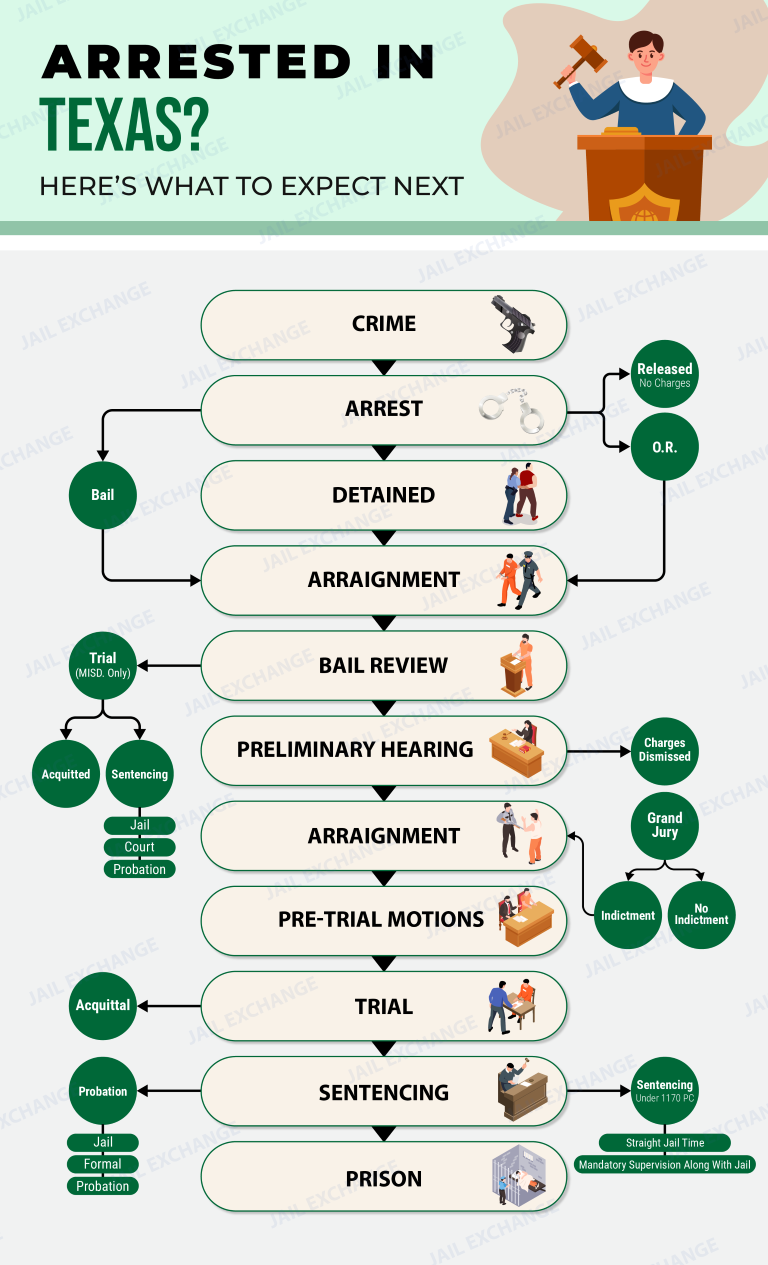
After an arrest, the Sheriff's Office books the person and arranges a magistrate hearing within 48 hours, often in front of the justice of the peace. The person may be housed in Menard County Jail only briefly before being moved to a contract jail. The magistrate sets bail, which can be paid in cash, posted by a licensed bondsman, or replaced by a personal bond. Ask the Sheriff's Office which bondsmen write bonds for Menard County cases.
Case flow
The County Attorney files the charge, and the case goes on the County Judge's docket. Because the County Judge also runs county government, criminal settings happen on scheduled court days rather than daily. Plea bargaining is common. A defendant may demand a jury trial before six local jurors, whose verdict must be unanimous, or ask the judge to decide. A Menard County misdemeanor might be dismissed or diverted, end in deferred adjudication or probation, or bring a fine or a jail term, and any jail time is served in whatever facility the Sheriff is using under contract.
Penalties
- Theft: taking property worth less than $100 is a ticket-level Class C; the County Judge can impose up to 180 days and $2,000 for Class B theft of $100 to under $750, and up to a year and $4,000 for Class A theft of $750 to under $2,500.
- First DWI: a Class B charge on the County Court docket in Menard, carrying three days to six months in jail and a fine as high as $3,000, though first offenders are usually given probation. A 0.15 alcohol level raises it to Class A; an open container carries a six-day minimum. A license suspension, a separate administrative license case, a DWI education class, an ignition interlock and a state traffic fine after conviction are all possible.
- Assault causing bodily injury: Class A; when the victim is a family or household member, firearm restrictions follow and a repeat offense can become a felony.
- Criminal trespass: Class B in most cases, and Class A if it involves a habitation or a deadly weapon.
Misdemeanors in Menard County generally conclude within two to six months. A defendant who cannot afford a lawyer can request appointed counsel from the County Court through the clerk at (325) 396-4682.
Felony (for example, burglary, felony theft, drug possession or delivery, aggravated assault)
Felonies in Menard County are part of a regional system. The 452nd District Court and the 452nd District Attorney each cover five counties, so the judge holds court in Menard on scheduled terms and spends the rest of the time in Brady, Junction, Mason and Rocksprings.
- Arrest and bond. The arrested person sees a magistrate within 48 hours, and the magistrate considers the public safety report required by the Damon Allen Act before setting conditions. Felony defendants can request an appointed lawyer at this hearing.
- Grand jury. The District Attorney presents the case to a Menard County grand jury, which meets only periodically. Waiting for the grand jury is one reason felony cases in small districts take time.
- District court proceedings. After indictment, the 452nd District Court arraigns the defendant and sets hearings for motions and plea discussions on its Menard docket days.
- Plea or trial. Most cases end in a plea agreement. A felony jury has twelve members, the verdict must be unanimous, and the defendant may choose jury sentencing.
Punishment
- State jail felony: six months to two years in a state jail and a fine of no more than $10,000, the level for stealing $2,500 to $30,000 in ranch equipment or holding less than a gram of methamphetamine or cocaine.
- Third degree carries two to ten years in prison. Second degree, the grade for breaking into a home and for most aggravated assaults, carries two to twenty. First degree runs from five years up to 99 or life.
- Drug offenses in the 452nd District rise in seriousness with the substance's penalty group and the quantity seized.
First-time defendants are often eligible for deferred adjudication. Prior felonies can raise the punishment range. Most prison sentences become parole-eligible after one-quarter of the time with good conduct credit, but "3g" offenses require half. Because the judge visits Menard on a rotating schedule, a felony here often takes from six months to a year and a half to finish. Menard County appoints private lawyers for indigent felony defendants under its indigent defense plan; requests go to the 452nd District Court through the District Clerk at (325) 396-4682.
Violent felony (for example, murder, sexual assault, aggravated robbery)
Serious violent crimes are rare in Menard County, but when they occur the 452nd District Attorney's office takes the lead, often with help from the Texas Rangers. A personal bond is not allowed for a violent offense, and the 2025 constitutional amendment permits a judge to deny bail entirely in some violent and sexual cases after a hearing. A defendant who stays in custody is held in the jail that serves Menard County, which may be in another county.
- Capital murder: life without parole or death.
- Murder: punished as a first-degree felony with five to 99 years, or life, in prison.
- Sexual assault: second-degree felony, with sex offender registration; aggravated sexual assault is first degree and can carry a 25-year minimum when the victim is a young child.
- Aggravated robbery: first degree; parole review only after half the sentence.
Such cases often take one to three years, and a trial may require summoning a larger jury panel than the county usually needs. Victims are entitled to notice and a voice in the proceedings under article I, section 30 of the Texas Constitution. Defendants who cannot pay for a lawyer receive appointed counsel; for capital cases, the county can rely on the Regional Public Defender for Capital Cases.
Juveniles (under 17) arrested in Menard County
When a Menard County youngster is accused of an offense, the juvenile system applies only if the child was 10, 11, 12, 13, 14, 15 or 16 on the date in question; a 17-year-old is an adult under Texas criminal law.
Intake
A juvenile probation officer serving Menard County screens every referral from the Sheriff's Office or a school. Like other sparsely populated counties, Menard typically relies on a juvenile probation department shared with neighboring counties. Options at that stage include a warning and release to the family, a deferred prosecution agreement, or a referral that leaves the decision on a formal petition to the prosecutor. The juvenile court is the court the county's juvenile board has designated, usually the County Court or the 452nd District Court; the clerk at (325) 396-4682 can confirm.
Detention
Menard County has no juvenile detention facility of its own. When detention is necessary, the child is usually driven to a certified regional center under contract, for example in San Angelo or Kerrville. Within two working days a juvenile judge reviews whether the child should stay detained, and a lawyer represents the child at that hearing.
Outcomes
- Deferred prosecution with up to six months of supervision.
- Probation, possibly including counseling, community service or a residential placement.
- For felony-level conduct, placement with the Texas Juvenile Justice Department (TJJD) in one of its state-run secure facilities.
- Determinate sentencing for listed serious offenses, which can continue into adult prison.
The State may ask to certify a youth to stand trial as an adult: in general, at 14 or older for capital felonies, first-degree felonies and aggravated controlled substance felonies, and at 15 or older for other felonies. Records from a Menard County juvenile case are shielded from the public, and sealing is frequently possible later.
Federal cases (U.S. District Court) from Menard County
Federal law assigns Menard County to the Northern District of Texas, and within that district to the San Angelo Division, whose courthouse is roughly an hour's drive northwest of Menard.
- U.S. District Court clerk, San Angelo, 33 E. Twohig Ave., Room 202, San Angelo, TX 76903, (325) 655-4506
- U.S. Attorney's Office, Lubbock (the office that covers the San Angelo Division), 1205 Texas Ave., Suite 700, Lubbock, TX 79401, (806) 472-7351
- Appointed counsel: if the defendant cannot pay, the magistrate judge assigns either a federal defender or a lawyer from the district's Criminal Justice Act list
Federal charges from a rural county
Federal prosecutions from Menard County are uncommon. They tend to involve drug or human smuggling loads moving north on U.S. 83, firearms possessed by people with felony records, wildlife or federal land violations, and internet crimes against children. Federal agents and the U.S. Attorney decide whether a case stays local or goes federal.
What to expect
A Menard County defendant's first stop in federal court is a U.S. magistrate judge, who reads the charge and sees that a lawyer is in place. Commercial bail bondsmen, a fixture of county courts, have no part in federal release decisions. A government request to hold the defendant leads to a detention hearing, usually no more than three court days later, at which the magistrate weighs Bail Reform Act factors and either sets conditions for Pretrial Services to enforce or orders custody. A defendant first charged by complaint must face a grand jury indictment within 30 days, and while the Speedy Trial Act aims for trial within 70 days, that clock stops for many routine reasons. Most federal defendants from rural West Texas plead guilty instead of facing a unanimous twelve-member jury. At sentencing the judge relies on a presentence investigation, the advisory Guidelines and any statutory minimum term; federal parole no longer exists, and a Menard County defendant can expect to spend about 85 percent of the sentence locked up before a stretch of supervised release. The Fifth Circuit reviews appeals.
Locating the person
Relatives can look for a Menard County federal defendant in the Federal Bureau of Prisons inmate locator, entering either a full name or the register number. While a case is pending, the U.S. Marshals often board defendants in county jails, and those people can also appear on the roster of the jail where they are kept. Federal juvenile cases are rare; a Menard County youth is nearly always handled under state law.
This guide to criminal courts in Menard County is general information, not legal advice, and arrangements such as where inmates are housed can change. Anyone needing appointed counsel should say so to the magistrate or phone the combined District and County Clerk's office at (325) 396-4682; the Sheriff's Office at (325) 396-4705 answers questions about where a person is held.