Goldthwaite, a small town on U.S. 183 roughly 100 miles northwest of Austin, is the county seat of Mills County, and every one of the county's criminal courts meets in its courthouse on Fourth Street. Class C tickets belong to the county's lone justice of the peace; the County Judge, sitting as the constitutional Mills County Court, takes Class A and B misdemeanors; and the 35th District Court, a two-county district with Brown County, takes felonies. The 35th District Attorney, based in Brownwood, prosecutes felonies in both counties, while misdemeanors are prosecuted locally. The Sheriff keeps a small jail in Goldthwaite and sends some inmates to other counties when space or classification requires it.
- Mills County Courthouse (35th District Court, County Court; District and County Clerk), 1011 Fourth St. (P.O. Box 646), Goldthwaite, TX 76844, (325) 648-2711
- Justice of the Peace, 1011 Fourth St. (P.O. Box 65), Goldthwaite, TX 76844, (325) 648-2278
- Mills County Jail and Sheriff's Office, 2111 Priddy Rd. (P.O. Box 1497), Goldthwaite, TX 76844, (325) 648-2245
- 35th District Attorney (felonies in Brown and Mills counties), Brownwood, (325) 646-0444
Which court hears your case. Class C misdemeanors, offenses punished only by a fine, such as most traffic tickets, public intoxication, theft of less than $100 and an assault that involves contact but no injury, are filed with the Justice of the Peace in Goldthwaite. No separate municipal court for Mills County appears in state court listings, so the justice court handles nearly all local tickets. Without a county court at law in Goldthwaite, every Class A or B misdemeanor, first-offense DWI included, is heard by the County Judge in the Mills County Court. A felony begins with a magistrate's warnings and goes to the 35th District Court after a Mills County grand jury indicts.
Where pretrial inmates are held. The Mills County Sheriff's Office operates a small jail in Goldthwaite, listed by state jail standards in early 2022 at 39 beds with about a dozen inmates and several others housed in other counties under contract. An arrested adult is normally booked locally but may be moved to a contract jail. Anyone who cannot post the bond remains in custody until the case ends or the bond is lowered. Call the Sheriff's Office at (325) 648-2245 to find out where a person is held.
- Local courts in Mills County (justice of the peace, municipal and county courts)
- Misdemeanor (for example, theft, a first DWI, assault causing bodily injury, criminal trespass)
- Felony (for example, burglary, felony theft, drug possession or delivery, aggravated assault)
- Violent felony (for example, murder, sexual assault, aggravated robbery)
- Juveniles (under 17) arrested in Mills County
- Federal cases (U.S. District Court) from Mills County
Local courts in Mills County (justice of the peace, municipal and county courts)
With fewer than 5,000 residents, Mills County keeps its court system compact. One justice of the peace serves the whole county from the courthouse, hearing fine-only offenses, small claims, evictions and truancy cases. The same judge is often the magistrate who sees people after arrest, explains their rights and sets bail.
Justice of the Peace court
- Mills County Justice of the Peace, 1011 Fourth St. (P.O. Box 65), Goldthwaite, TX 76844, (325) 648-2278
Municipal courts
The state directories reviewed for this guide list no municipal court in Mills County. A ticket from a Goldthwaite city officer that names a city court should be answered as the citation directs; call Goldthwaite City Hall or the justice court above for help.
County and district courts
- Mills County Court (constitutional county court; Class A and B misdemeanors and appeals from the justice court), 1011 Fourth St., Goldthwaite, TX 76844, (325) 648-2711
- 35th District Court (felonies; Brown and Mills counties), sitting at 1011 Fourth St., Goldthwaite, TX 76844, (325) 648-2711
The District Clerk and County Clerk duties are handled from the courthouse at the number above. A justice court judgment can be appealed to the Mills County Court for a new trial if an appeal bond is filed shortly after the judgment.
Misdemeanor (for example, theft, a first DWI, assault causing bodily injury, criminal trespass)
Hunting season, ranch traffic and U.S. 183 and U.S. 84 shape the Mills County misdemeanor docket, which leans toward DWI, drug possession, hunting-lease trespass and family violence cases rather than the high-volume theft seen in cities.
After the arrest
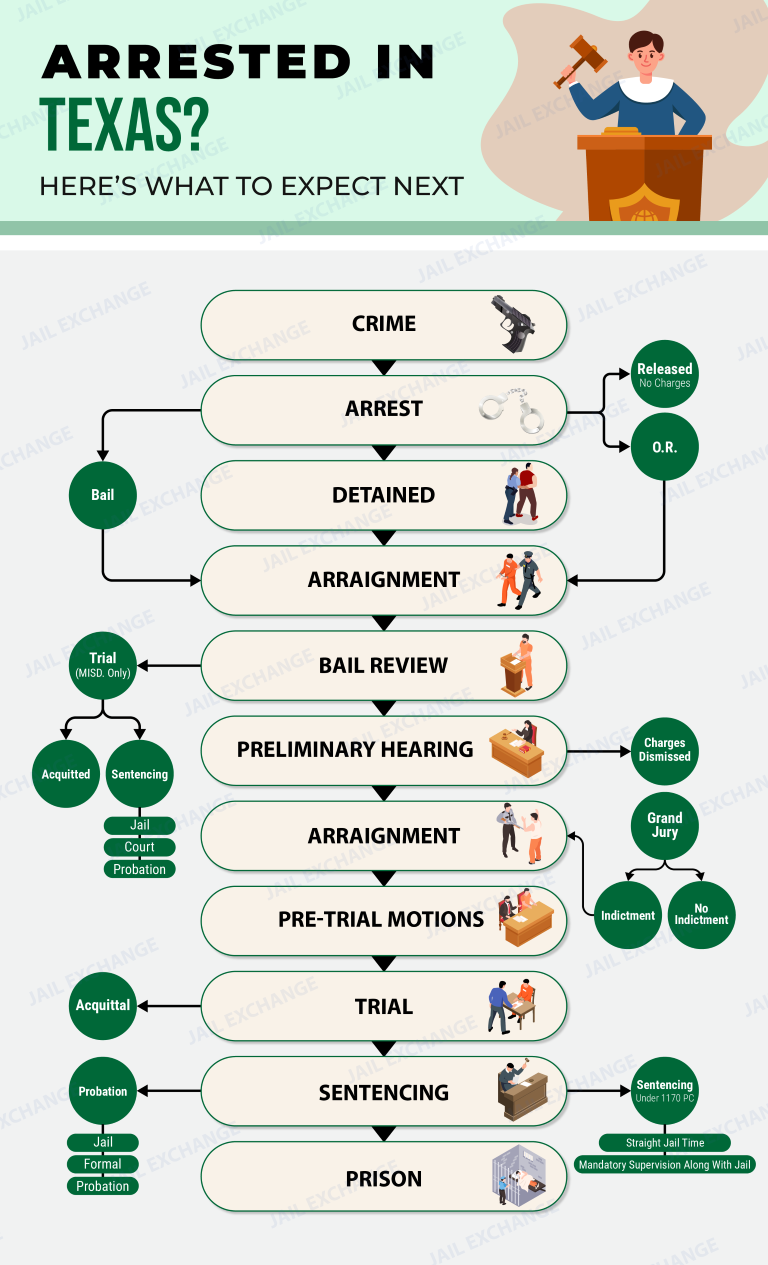
The person is booked at the Mills County Jail and brought before a magistrate within 48 hours, who sets bail and explains the right to an attorney. Cash, a surety bond from a licensed bondsman, or a personal bond can secure release. If the person is moved to a contract jail, release paperwork still runs through the Mills County Sheriff's Office.
Court process
The local prosecutor files an information in the Mills County Court. The County Judge holds criminal settings on scheduled days, and most cases are resolved by agreement after the defense reviews the evidence. Defendants can insist on a jury of six, who must reach a unanimous verdict, or have the judge decide; the jury can also assess punishment if the defendant chooses. Results range from dismissal and pretrial diversion through deferred adjudication and probation to fines and jail time.
Penalties
- Theft: Mills County charges it as a fine-only Class C below $100, as a Class B (up to 180 days and $2,000) from $100 to just under $750, and as a Class A (up to one year and $4,000) from $750 to just under $2,500.
- First DWI: a Class B offense that the County Judge can punish with three to 180 days in jail and a fine reaching $3,000, although probation is the common outcome for a first arrest on U.S. 183 or U.S. 84. If the breath or blood result is 0.15 or higher, the charge is filed as Class A instead, and an open container in the cab sets a six-day jail minimum. Expect a license suspension, possibly an administrative license suspension in a separate case, a DWI education course, an interlock requirement and a state fine on conviction.
- Assault causing bodily injury: Class A; a family violence finding restricts firearm possession and can elevate a future assault to a felony.
- Criminal trespass: normally Class B; Class A if the property is a home or the person carried a deadly weapon.
In Goldthwaite, a misdemeanor case is usually wrapped up within two to six months of the arrest. People who cannot afford a lawyer should ask the magistrate or the County Court, through the clerk at (325) 648-2711, for appointed counsel.
Felony (for example, burglary, felony theft, drug possession or delivery, aggravated assault)
The 35th Judicial District joins Mills County with its larger neighbor, Brown County. The district judge sits mostly in Brownwood and comes to Goldthwaite for Mills County dockets, and the District Attorney's staff in Brownwood prosecutes felonies in both counties.
- Arrest and bond. When booking at the Mills County Jail is done, the Goldthwaite magistrate checks the public safety report that the Damon Allen Act requires and then fixes bond and any conditions. This is the time to ask for a court-appointed lawyer.
- Grand jury. The District Attorney presents the case to a Mills County grand jury, which meets on a set schedule. An indictment sends the case forward; a no bill ends it.
- District court. The 35th District Court arraigns the defendant in Goldthwaite and sets pretrial hearings.
- Plea or trial. Most felonies end with a plea bargain. A trial requires twelve jurors who agree unanimously, and the defendant can choose jury sentencing.
Ranges of punishment
- State jail felony: between six months and two years in a state jail, with a fine of no more than $10,000.
- Third degree: 2 to 10 years in prison.
- Second degree: two to twenty years, which in Mills County is the usual grade for a house burglary or an aggravated assault.
- First degree: a Mills County jury may assess anything from five years to 99 years, or life.
Theft becomes a felony at $2,500, and drug cases are graded by penalty group and weight. Deferred adjudication is often available for first-time offenders. Earlier convictions can raise the range, and parole eligibility generally comes at one-quarter of the sentence, or half for "3g" offenses. A felony case in Mills County usually takes six to eighteen months. Indigent defendants receive private lawyers appointed by the district judge under the county's indigent defense plan; requests can be made through the District Clerk at (325) 648-2711.
Violent felony (for example, murder, sexual assault, aggravated robbery)
Mills County sees few violent felonies, but those it does see are handled with the full weight of the 35th District Attorney's office, often assisted by the Texas Rangers. Personal bonds are off the table for violent offenses, and since voters approved a 2025 constitutional amendment, a judge may deny bail entirely in some of these cases after a hearing. A defendant held before trial stays at the Mills County Jail or a contract jail.
- Capital murder: death or life without parole.
- Murder: a first-degree felony that carries five to 99 years or a life term.
- Sexual assault: second degree, with sex offender registration; aggravated sexual assault: a first-degree charge, and when the victim is a young child some forms of it require a sentence of at least 25 years.
- Aggravated robbery: first degree; a "3g" offense with parole eligibility only after half the sentence.
Because of crime-lab work, expert testimony and the district judge's two-county calendar, these cases commonly take one to three years. A trial may be moved to another county if pretrial publicity makes a fair jury hard to find in a small community. Victims can work with the District Attorney's victim assistance coordinator to exercise their rights under article I, section 30 of the Texas Constitution. Appointed counsel is provided for those who cannot pay.
Juveniles (under 17) arrested in Mills County
The juvenile system handles young people who were 10 to 16 at the time of the offense. A 17-year-old from Mills County is prosecuted in adult court.
Intake and court
A juvenile probation officer serving Mills County performs intake on every referral. Small counties like Mills often share juvenile probation services with a neighboring county such as Brown. From there the officer can let the child go home, propose a deferred prosecution agreement, or pass the case to the prosecutor to consider a formal petition. The case is then heard by the court designated by the county's juvenile board, typically the County Court or the 35th District Court; the clerk at (325) 648-2711 can say which.
Detention
Mills County has no juvenile detention center. When a Goldthwaite youth must be kept in custody, the usual practice is to transport the child to a certified regional facility under contract, perhaps in Brownwood or another nearby city, well apart from adult inmates. A judge reviews that detention within two working days, and a family that cannot afford counsel gets a lawyer for the child at county expense.
Possible results
- Deferred prosecution, up to six months of supervision with no adjudication if completed.
- Probation, including counseling, restitution, community service or residential treatment.
- Commitment to the Texas Juvenile Justice Department (TJJD), available only for conduct that would be a felony.
- Determinate sentencing in cases of serious violence, with possible later transfer to adult prison.
In a very serious Mills County case the prosecutor can petition to certify the youth as an adult. As a rule of thumb, a 14-year-old can be certified only for a capital, first-degree or aggravated drug felony, while from age 15 any felony qualifies. Mills County juvenile files stay out of public view, and in many cases the youth can later have them sealed.
Federal cases (U.S. District Court) from Mills County
Federal prosecutions from Goldthwaite and the rest of Mills County are filed in the Northern District of Texas and heard in its San Angelo Division, roughly 110 miles to the west.
- U.S. District Court, San Angelo, 33 E. Twohig Ave., Room 202, San Angelo, TX 76903, (325) 655-4506
- U.S. Attorney's Office: the San Angelo office is unstaffed, and its cases are handled from Lubbock, 1205 Texas Ave., Suite 700, Lubbock, TX 79401, (806) 472-7351
- Counsel for those who cannot pay: the Federal Public Defender for the Northern District of Texas or a court-appointed Criminal Justice Act attorney
Federal cases from Mills County
Federal charges arising here are infrequent and usually involve drug trafficking, illegal gun possession, child exploitation online, or fraud involving federal agricultural or disaster programs. A local investigation can be turned over to federal agents when the facts fit a federal statute.
Federal procedure in brief
Someone from Mills County charged federally first meets a U.S. magistrate judge in San Angelo, where the surety bail bonds used in Goldthwaite are not accepted. When prosecutors want the defendant held, the detention hearing generally comes within three court days, and the magistrate uses the Bail Reform Act to choose between conditional release under Pretrial Services supervision and custody. If the case was opened by a complaint, the grand jury has 30 days to indict; the Speedy Trial Act then contemplates trial within 70 days, a target that is regularly moved. A conviction at trial takes a unanimous vote of twelve, yet most of these cases are settled by plea. The San Angelo judge sentences with the help of a presentence report, the advisory Guidelines and any mandatory minimum. Federal law allows no parole, so a Goldthwaite defendant serves roughly 85 percent of the sentence in Bureau of Prisons custody and then moves to supervised release. Appeals are taken to the Fifth Circuit.
Finding a federal inmate
To learn where a sentenced Mills County defendant is serving time, try the Federal Bureau of Prisons inmate locator with a name or register number. Before trial, the U.S. Marshals frequently lodge defendants in a county jail under contract, and the person may be listed on that county's jail roster. Federal juvenile prosecutions are rare, and a Mills County youth is almost always handled under state law.
This description of the Mills County criminal courts is general information, not legal advice, and housing arrangements and phone numbers can change. If you need a lawyer appointed, tell the magistrate after the arrest or phone the clerk's office in the Goldthwaite courthouse at (325) 648-2711, and direct questions about custody to the Sheriff's Office at (325) 648-2245.