Real County is a Hill Country county of fewer than 3,000 people along the Frio and Nueces rivers, with its courthouse in Leakey and a second population center in Camp Wood. Class C cases are heard by the county's justices of the peace, and the County Judge hears Class A and B misdemeanors in the constitutional county court. Felonies go to the 38th District Court, whose judge also serves Medina and Uvalde counties, and the 38th District Attorney's Office in Uvalde prosecutes them, while the Real County Attorney handles misdemeanors. The county's own lockup is a holding facility with only a few beds, so most people held on charges are kept in another county's jail under arrangements made by the Sheriff.
- Real County Courthouse (38th District Court; County Court; District and County Clerk), 101 S. Market Street, P.O. Box 750, Leakey, TX 78873, (830) 232-5202
- Real County Attorney (misdemeanors), Real County Courthouse, Leakey
- 38th District Attorney (felonies in Medina, Real and Uvalde counties), Uvalde
- Real County Sheriff's Office, P.O. Box 445, Leakey, TX 78873, (830) 232-5201
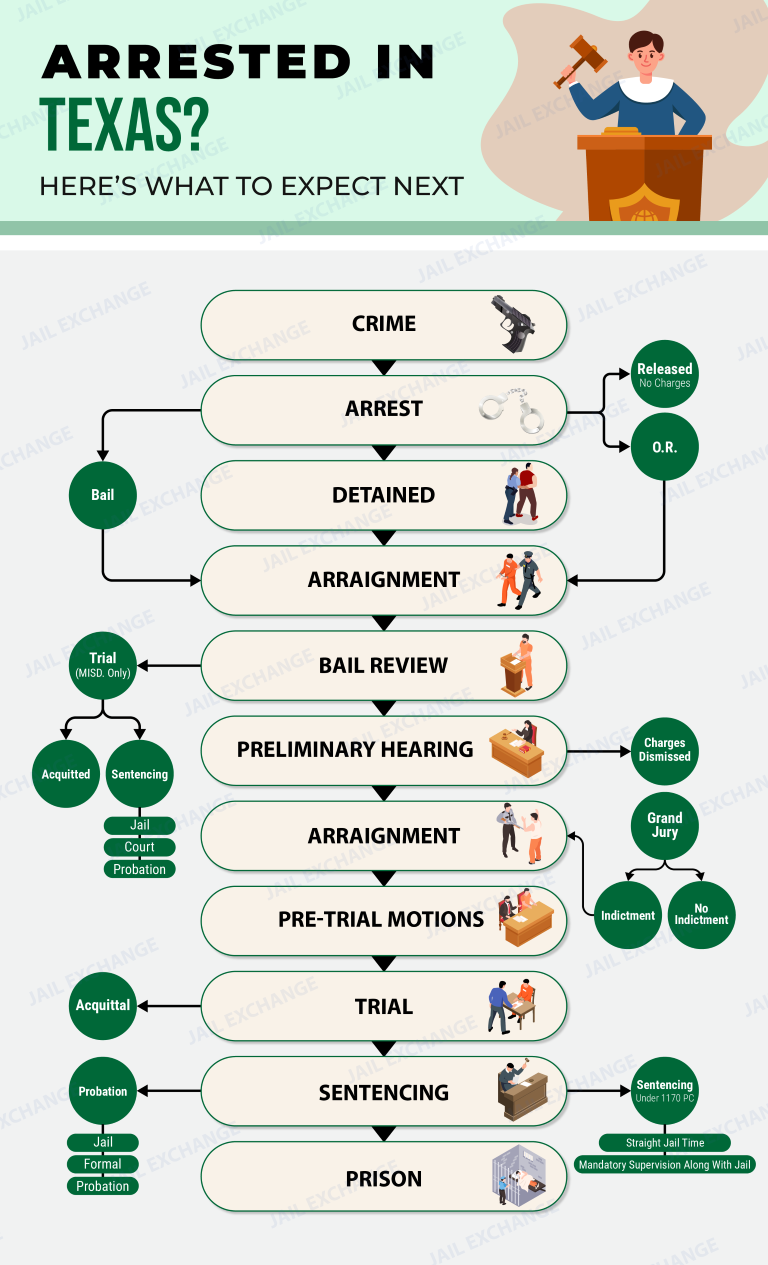
Which court hears your case. Class C misdemeanors, which are punishable only by a fine (for example speeding on U.S. 83, public intoxication, theft of less than $100 or a minor assault without injury), go to the Justice of the Peace court for the precinct: the Leakey office for Precincts 1 and 2, or the Camp Wood office for Precincts 3 and 4. Class C tickets written inside Leakey or Camp Wood generally go to those same justice courts, since the state's court listings show no municipal court operating in Real County. Class A and B misdemeanors, a first DWI included, are heard by the Real County Court. A felony begins with magistrate warnings and a bond decision, then a Real County grand jury, and an indicted case is tried in the 38th District Court when the judge holds court in Leakey.
Where pretrial inmates are held. Texas Commission on Jail Standards figures list Real County's facility at only three beds and typically show no one held there, which means the county keeps few if any prisoners locally. People arrested in Real County are booked and then housed in the jail that serves Real County under contract, usually in a nearby county. Call the Real County Sheriff's Office at (830) 232-5201 to find out where a particular person is being held and how bond can be posted.
- Local courts in Real County (justice of the peace, municipal and county courts)
- Misdemeanor (for example, theft, a first DWI, assault causing bodily injury, criminal trespass)
- Felony (for example, burglary, felony theft, drug possession or delivery, aggravated assault)
- Violent felony (for example, murder, sexual assault, aggravated robbery)
- Juveniles (under 17) arrested in Real County
- Federal cases (U.S. District Court) from Real County
Local courts in Real County (justice of the peace, municipal and county courts)
Real County has four justice of the peace precincts, but they are served from two offices: one in Leakey covering Precincts 1 and 2, and one in Camp Wood covering Precincts 3 and 4. The justices hold court part time, so call before going in. They also act as magistrates and can set bail for people arrested in the county.
Justice of the Peace courts
- Justice of the Peace, Precincts 1 and 2, P.O. Box 1430, Leakey, TX 78873, (830) 232-6630
- Justice of the Peace, Precincts 3 and 4, P.O. Box 106, Camp Wood, TX 78833, (830) 597-6129
Municipal courts
No municipal court for Real County appears in the state's court listings. Leakey and Camp Wood police citations are generally filed in the justice courts above; the citation itself names the court.
County and district courts
- Real County Court (constitutional county court; Class A and B misdemeanors), Real County Courthouse, 101 S. Market Street, Leakey, TX 78873; County Clerk (830) 232-5202
- 38th District Court (felonies), same courthouse; the District and County Clerk is one combined office at the same number
Summer brings river visitors to the Frio, and with them a jump in tickets for public intoxication, minor-in-possession of alcohol, disorderly conduct and traffic violations. A Class C defendant can pay, ask for deferred disposition or a driving safety course, or plead not guilty and get a trial before the justice or a six-person jury. Appeals from a justice court go to the county court for a new trial, and the appeal bond or notice generally has to be filed within 10 days.
Misdemeanor (for example, theft, a first DWI, assault causing bodily injury, criminal trespass)
After an arrest for a Class A or B misdemeanor in Real County, a person is first processed by the Sheriff's Office and then held at the jail that serves Real County until bail is posted.
Magistrate and release
A justice of the peace must see the person within 48 hours. The magistrate reads the warnings, records whether the person wants a lawyer appointed and sets the bond amount and conditions. Release can come through a cash bond, a bail bondsman's surety bond or a personal bond. For family-violence arrests, an emergency protective order is common. If prosecutors are not ready for trial within 30 days on a Class A or 15 days on a Class B, a jailed defendant generally has to be released on a personal bond or a reduced bail.
Getting a lawyer and going to court
Real County does not have a public defender. Its indigent defense plan, filed with the Texas Indigent Defense Commission, provides for the court to appoint private attorneys for people who cannot afford one, and many of those attorneys practice in Uvalde or the Hill Country. Ask at magistration or call the District and County Clerk at (830) 232-5202. The County Attorney files the charge, and the County Judge holds criminal docket days in Leakey. A jury in county court has six members.
Penalties
- Theft: Class B for $100 up to $750 (up to 180 days, $2,000 fine); Class A for $750 up to $2,500 (up to one year, $4,000 fine).
- Assault causing bodily injury: Class A; a family-violence finding has long-term effects on firearm rights and future charges.
- Criminal trespass: typically Class B, upgraded to Class A for a habitation or when a deadly weapon is carried. Trespass on private riverbank and ranch property is a common complaint in Real County.
- First DWI: Class B; 72 hours to 180 days in jail and a fine of up to $3,000; Class A at 0.15 or more; at least 6 days with an open container. A separate license suspension can follow a failed or refused test.
In Leakey, misdemeanor cases close in one of several ways: a dismissal, pretrial diversion, deferred adjudication, probation, a fine, or days in jail. An order of nondisclosure is available after many deferred adjudications. A Real County misdemeanor usually takes two to six months.
Felony (for example, burglary, felony theft, drug possession or delivery, aggravated assault)
Felony practice in Real County depends on the 38th District Court's circuit among three counties, so terms of court in Leakey are periodic.
- Arrest and magistration. The defendant is booked and held at the jail that serves Real County. Within 48 hours a magistrate gives the article 15.17 warnings, reviews the public safety report and sets bail.
- Lawyer appointment. A defendant who cannot afford a lawyer asks the magistrate; the 38th District Court appoints one under the county's plan. The combined District and County Clerk is at (830) 232-5202.
- Grand jury. The 38th District Attorney presents the case to a grand jury drawn from Real County residents. A jailed defendant whose case is not ready for trial within 90 days is generally entitled to release on a personal bond or reduced bail, with exceptions for violent offenses.
- Plea or trial. Most felonies end in plea agreements. If tried, the case goes to a 12-person jury that must reach a unanimous verdict, and the defendant can ask that jurors assess punishment.
Ranges of punishment
- State jail felony: 180 days to 2 years in a state jail, for offenses such as theft of $2,500 to under $30,000.
- Third degree: 2 to 10 years, as for possession of 1 to 4 grams of a Penalty Group 1 drug.
- Second degree: 2 to 20 years, the usual level for burglary of a home and aggravated assault.
- First degree: 5 to 99 years or life imprisonment. A fine of up to $10,000 may be added at any felony level.
Drug cases turn on the substance and its weight, and repeat offenders can face enhanced ranges. A person with a clean record will often be offered probation or deferred adjudication. With good conduct most prisoners become eligible for parole at one-quarter of the sentence, but "3g" offenses require half, and at least two years. Expect a felony case to last roughly six to eighteen months.
Violent felony (for example, murder, sexual assault, aggravated robbery)
A violent felony charge in Real County brings a high bond, and the law prohibits release on a personal bond. Texas voters approved a 2025 constitutional amendment that lets judges deny bail in some violent-crime cases, so a defendant may remain in custody, typically at the contract jail, until trial.
- Capital murder: a conviction means either life imprisonment without parole or, if the State pursues it, death.
- Murder: punishable by 5 to 99 years or a life term as a first-degree felony.
- Sexual assault: second-degree felony. Aggravated sexual assault: first-degree felony, with a 25-year floor in certain cases involving a young child.
- Aggravated robbery: first-degree felony; parole consideration only after half the sentence.
The judge appoints lawyers who meet the state's qualification standards for the charge, two in a capital case. The Texas Rangers commonly assist small Hill Country sheriff's offices with these investigations. Crime victims hold rights under article I, section 30 of the Texas Constitution, including notice of proceedings and the opportunity to give an impact statement; the 38th District Attorney's Office provides victim assistance. Cases of this kind usually run one to three years.
Juveniles (under 17) arrested in Real County
Children who were 10 through 16 years old on the date of an alleged offense are handled in Texas juvenile court, while 17-year-olds are prosecuted as adults. Real County's juvenile board designates the juvenile court, which in a county this size is typically the county court or the 38th District Court.
Intake. Officers notify a parent and bring the youth to an approved intake location. The juvenile probation department serving Real County, which in small Hill Country counties is often a multi-county department, conducts intake and decides whether to release the child, handle the case informally or refer it to the prosecutor for a petition.
Detention. There is no juvenile detention center in Real County. A child who must be held is typically placed in a regional detention center under contract, such as a facility in the Uvalde, Kerrville or San Antonio area. Within two working days a judge must hold a detention hearing.
Possible results. Deferred prosecution, which ends in dismissal if the youth complies, is common for first-time referrals. After an adjudication, the court can order probation, a residential placement or commitment to the Texas Juvenile Justice Department (TJJD). Determinate sentencing for serious offenses can lead to a sentence that continues in an adult prison.
Certification. The juvenile court can transfer a case to adult criminal court after a hearing, generally only for a youth who was at least 14 for a capital felony, first-degree felony or certain aggravated drug felonies, or at least 15 for other felonies. Each child has a right to counsel, with a lawyer appointed if the family cannot pay. Records stay confidential, and many can be sealed when the youth meets the legal conditions.
Federal cases (U.S. District Court) from Real County
Real County is assigned by statute to the Western District of Texas, San Antonio Division, which is also the headquarters of the district.
- Clerk of the U.S. District Court, Room 1-400, 262 W. Nueva St., San Antonio 78207, (210) 472-6550
- U.S. Attorney's Office, Western District of Texas (main office), 601 N.W. Loop 410, Suite 600, San Antonio, TX 78216, (210) 384-7100
- The Federal Public Defender for the Western District of Texas has a San Antonio office, and private Criminal Justice Act panel attorneys also take appointments.
When charges are federal. Federal prosecutors bring cases that violate federal law, usually after investigation by agencies such as the DEA, ATF, FBI, Border Patrol or Homeland Security Investigations. Real County lies north of the border region, and cases from here can include human smuggling and drug transport on U.S. 83 and other highways, illegal firearms possession and offenses on federal land.
Initial appearance and detention. A U.S. magistrate judge in San Antonio advises the defendant of the charges and appoints counsel if needed. A detention hearing, when the government requests one, normally follows within three court days. Federal court does not use commercial bail bonds; under the Bail Reform Act, the judge sets release conditions supervised by U.S. Pretrial Services or orders detention.
Indictment, plea and sentence. When a case starts with a complaint, the government must obtain an indictment within 30 days, and the Speedy Trial Act sets a 70-day trial deadline that is often extended. Guilty pleas end the large majority of these cases; a trial needs a unanimous verdict from 12 jurors. U.S. Probation prepares a presentence report, the judge applies the advisory Sentencing Guidelines and any mandatory minimum, and the sentence is served in the Bureau of Prisons without parole, at roughly 85 percent with good-conduct time, followed by supervised release. Appeals are heard by the Fifth Circuit.
Finding someone. To locate a federal prisoner, enter a name or register number in the Federal Bureau of Prisons inmate locator. If the person is awaiting trial in a county jail that contracts with the U.S. Marshals, that jail's roster may list the person as well. Juveniles are rarely charged in federal court.
This page offers a general explanation of criminal procedure in Real County and is not legal advice. Check every court date with the clerk, because settings in small counties change often. Anyone who cannot afford a lawyer can ask the magistrate for appointed counsel or call the District and County Clerk in Leakey at (830) 232-5202.