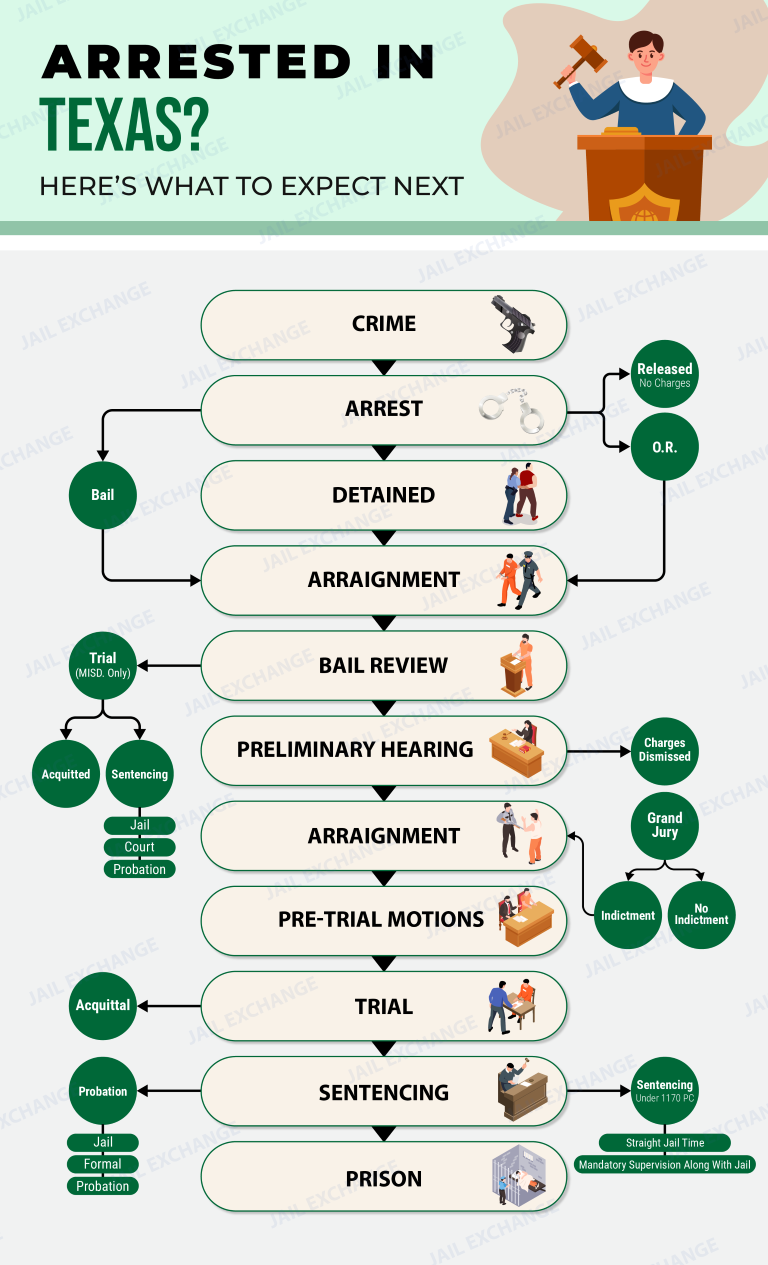
Fort Worth is the county seat of Tarrant County, and Arlington, the county's second-largest city, sits about 15 miles to the east; together with more than thirty smaller suburbs they send every arrest into a single county justice system headquartered on West Belknap Street downtown. Fine-only Class C offenses are heard by eight justice of the peace precincts and by the municipal courts each city runs, Class A and B misdemeanors go to County Criminal Courts No. 1 through No. 10, and felonies are tried in eleven district courts that handle criminal cases only: Criminal District Courts No. 1 through No. 4 plus the 213th, 297th, 371st, 372nd, 396th, 432nd and 485th District Courts. The Tarrant County Criminal District Attorney prosecutes both felonies and misdemeanors, and lawyers for people who cannot afford one are appointed through the county's Office of Attorney Appointments. Adults arrested anywhere in the county are booked by the Sheriff's Office at the Tarrant County Corrections Center on North Lamar Street, one of five buildings that make up the county jail.
- Tim Curry Criminal Justice Center (felony and misdemeanor courts, District Attorney), 401 W. Belknap St., Fort Worth, TX 76196; criminal court support (817) 212-6957
- Tarrant County District Clerk (felony case records), Tim Curry Criminal Justice Center, 401 W. Belknap St., Fort Worth, TX 76196, (817) 884-1574
- Tarrant County Clerk (misdemeanor case records), Tim Curry Criminal Justice Center, 401 W. Belknap St., Fort Worth, TX 76196, (817) 884-1195
- Tarrant County Criminal District Attorney, Tim Curry Criminal Justice Center, 401 W. Belknap St., Fort Worth, TX 76196, (817) 884-1400
- Office of Attorney Appointments (court-appointed lawyers), 401 W. Belknap St., 5th Floor, Room 5043, Fort Worth, TX 76196, (817) 884-2370
- Central Magistration (817) 884-1936; Magistrates Courts (817) 884-2998
- Tarrant County Corrections Center (Sheriff's Office booking and intake), 100 N. Lamar St., Fort Worth, TX 76196, (817) 884-3000
- Tarrant County Sheriff's Office (administration), (817) 884-3099
- Tarrant County Juvenile Services and the 323rd District Court, Scott D. Moore Juvenile Justice Center, 2701 Kimbo Rd., Fort Worth, TX 76111, (817) 838-4600
Which court hears your case. Class C misdemeanors, the offenses punishable by a fine alone (most traffic tickets, public intoxication, theft of something worth under $100, a simple assault that caused no injury, minor in possession), are filed in the Justice of the Peace court for the precinct where the offense occurred, or in a city's municipal court when a police officer from that city issued the citation within its limits. Class A and B misdemeanors, including a first DWI, possession of a small amount of marijuana, theft from $100 up to $2,500 and assault causing bodily injury, are assigned to one of the ten County Criminal Courts (County Criminal Court No. 1 through County Criminal Court No. 10), statutory county courts that sit at the Tim Curry Criminal Justice Center; the County Judge's constitutional court does not try criminal cases here. A felony begins with warnings from a magistrate at the jail and, once a grand jury hands up an indictment, is assigned to one of the eleven felony courts: Criminal District Courts No. 1, 2, 3 and 4 and the 213th, 297th, 371st, 372nd, 396th, 432nd and 485th Judicial District Courts, each of which serves Tarrant County alone and hears criminal matters only.
Where pretrial inmates are held. The Tarrant County Sheriff's Office runs a jail system of five facilities with room for roughly 5,000 people, and it books about 35,000 arrestees a year. Everyone is received, photographed and fingerprinted at the Corrections Center at 100 N. Lamar St., then housed there or moved to Lon Evans Corrections Center, the Belknap facility, Green Bay Jail or Cold Springs Jail depending on classification. Fort Worth police, Arlington police, suburban departments, DPS troopers and constables all bring adult arrestees here, although some city departments hold a person for a few hours in their own lockup first. Magistrates review each case, set bail and take requests for appointed counsel. For custody status, property or visits, call the jail at (817) 884-3000.
- Local courts in Tarrant County (justice of the peace, municipal and county courts)
- The Tim Curry Criminal Justice Center and the subcourthouses
- After an arrest: booking, magistration and release
- The Tarrant County Jail and its five facilities
- Court-appointed lawyers and the Office of Attorney Appointments
- District Attorney diversion programs
- Specialty and treatment courts
- Misdemeanor (for example, theft, a first DWI, assault causing bodily injury, criminal trespass)
- Felony (for example, burglary, felony theft, drug possession or delivery, aggravated assault)
- Violent felony (for example, murder, sexual assault, aggravated robbery)
- Juveniles (under 17) arrested in Tarrant County
- Federal cases (U.S. District Court) from Tarrant County
Local courts in Tarrant County (justice of the peace, municipal and county courts)
Tarrant County has eight justice of the peace precincts, each with one elected justice; Precinct 3 in the northeast keeps two offices, one in Hurst and one in Southlake. Justice courts take Class C cases written by deputy sheriffs, constables, DPS troopers and other agencies working outside a city's own police force, along with evictions, small claims and debt cases. Justices also sign arrest and search warrants and can act as magistrates. Because most of the county is incorporated, though, the bulk of fine-only offenses are filed by city officers in a municipal court. Fort Worth and Arlington run large, full-time courts, and nearly every suburb operates its own, a few of them shared between neighboring towns.
Justice of the Peace courts
- Justice of the Peace, Precinct 1, 1895 Courthouse, 100 W. Weatherford St., Room 450, Fort Worth, TX 76196, (817) 884-1395
- Justice of the Peace, Precinct 2, Southeast Subcourthouse, 700 E. Abram St., Suite 200, Arlington, TX 76010, (817) 548-3925
- Justice of the Peace, Precinct 3 (Hurst office), Northeast Courthouse, 645 Grapevine Hwy., Suite 220, Hurst, TX 76054, (817) 581-3625
- Justice of the Peace, Precinct 3 (Southlake office), Southlake Town Hall, 1400 Main St., Suite 220, Southlake, TX 76092, (682) 732-6589
- Justice of the Peace, Precinct 4, Northwest Subcourthouse, 6713 Telephone Rd., Suite 201, Lake Worth, TX 76135, (817) 238-4425
- Justice of the Peace, Precinct 5, Tarrant County Criminal Justice Annex, 350 W. Belknap St., 1st Floor, Fort Worth, TX 76102, (817) 884-1438
- Justice of the Peace, Precinct 6, Southwest Subcourthouse, 6551 Granbury Rd., Fort Worth, TX 76133, (817) 370-4525
- Justice of the Peace, Precinct 7, Mansfield Subcourthouse, 1100 E. Broad St., Suite 202, Mansfield, TX 76063, (817) 473-5101
- Justice of the Peace, Precinct 8, Poly Subcourthouse, 3500 Miller Ave., Fort Worth, TX 76119, (817) 531-5625
Municipal courts in Tarrant County
- Arlington Municipal Court, 101 S. Mesquite St., Arlington, TX 76010 (mail: P.O. Box 90403, Arlington, TX 76004), (817) 459-6777
- Azle Municipal Court, 613 SE Parkway, Azle, TX 76020, (817) 444-2541
- Bedford Municipal Court, 2000 Forest Ridge Dr., Building A, Bedford, TX 76021, (817) 952-2150
- Benbrook Municipal Court, 911 Winscott Rd., Benbrook, TX 76126, (817) 249-3000, ext. 6131
- Blue Mound Municipal Court, 301 S. Blue Mound Rd., Blue Mound, TX 76131, (817) 232-7097
- Colleyville Municipal Court (court directories list it as the Colleyville/Keller Municipal Court), Colleyville Justice Center, 5201 Riverwalk Dr., Colleyville, TX 76034, (817) 503-1300
- Crowley Municipal Court, 201 E. Main St., Crowley, TX 76036, (817) 297-2201, ext. 1290
- Dalworthington Gardens Municipal Court, 2600 Roosevelt Dr., Dalworthington Gardens, TX 76016, (817) 274-7662
- Edgecliff Village Municipal Court, 1605 Edgecliff Rd., Edgecliff Village, TX 76134, (817) 293-4313
- Euless Municipal Court, 1102 W. Euless Blvd., Euless, TX 76040, (817) 685-1460
- Everman Municipal Court, 212 N. Race St., Everman, TX 76140, (817) 293-0588
- Forest Hill Municipal Court, 3219 California Pkwy. E., Forest Hill, TX 76119, (817) 568-3046
- Fort Worth Municipal Court (main courthouse), 1000 Throckmorton St., Fort Worth, TX 76102, (817) 392-6700
- Fort Worth Municipal Court, southwest location, 3741 SW Loop 820, Fort Worth, TX 76133, (817) 392-6700
- Grand Prairie Municipal Court, 200 W. Main St., Grand Prairie, TX 75050, (972) 237-8663 (the city straddles the Dallas County line, and its court building is on the Dallas County side)
- Grapevine Municipal Court, 307 W. Dallas Rd., Grapevine, TX 76051 (mail: P.O. Box 2413, Grapevine, TX 76099), (817) 410-3284
- Haltom City Municipal Court, 5024 Broadway Ave., Haltom City, TX 76117, (817) 222-7773
- Haslet Municipal Court, City Hall, 101 Main St., Haslet, TX 76052, (817) 439-5931, ext. 108
- Hurst Municipal Court, Hurst Justice Center, 825-B Thousand Oaks Dr., Hurst, TX 76054, (817) 788-7045
- Kennedale Municipal Court, 405 Municipal Dr., Kennedale, TX 76060, (817) 985-2140
- Lake Worth Municipal Court, 3805 Adam Grubb, Lake Worth, TX 76135, (817) 255-7910
- Lakeside Municipal Court, 9830 Confederate Park Rd., Lakeside, TX 76108, (817) 237-1234
- Mansfield Municipal Court, Public Safety Building, 1305 E. Broad St., Mansfield, TX 76063, (817) 276-4716
- North Richland Hills Municipal Court, 4301 City Point Dr., North Richland Hills, TX 76180, (817) 427-6700
- Pantego Municipal Court, 2600 Miller Ln., Pantego, TX 76013, (817) 617-3733
- Pelican Bay Municipal Court, 1300 Pelican Cir., Pelican Bay, TX 76020, (817) 444-1234
- Richland Hills Municipal Court, 3200 Diana Dr., Richland Hills, TX 76118, (817) 616-3825
- River Oaks Municipal Court, 4900 River Oaks Blvd., River Oaks, TX 76114, (817) 626-5421
- Saginaw Municipal Court, 333 W. McLeroy Blvd., Saginaw, TX 76179, (817) 232-4640
- Sansom Park Municipal Court, 5705 Azle Ave., Sansom Park, TX 76114, (817) 626-3791, ext. 100
- Southlake Municipal Court, 600 State St., Suite 1000, Southlake, TX 76092, (817) 748-8188
- Watauga Municipal Court, 7105 Whitley Rd., Watauga, TX 76148, (817) 514-5715
- Westlake Municipal Court, 1301 Solana Blvd., Building 4, Suite 4207, Westlake, TX 76262, (817) 430-0861
- Westworth Village Municipal Court (also hears Westover Hills cases), 311 Burton Hill Rd., Westworth Village, TX 76114, (817) 710-2507
- White Settlement Municipal Court, 214 Meadow Park Dr., White Settlement, TX 76108, (817) 246-4971
A handful of cities reach into Tarrant County from a neighboring county. Burleson's court is in Johnson County, while Trophy Club and Roanoke file their cases in Denton County; a citation from the Tarrant County side of one of those cities still goes to that city's own court. Check the court name printed on the ticket before you travel.
The ten County Criminal Courts (Class A and B misdemeanors)
All ten sit at the Tim Curry Criminal Justice Center, 401 W. Belknap St., Fort Worth, TX 76196.
- County Criminal Court No. 1, (817) 884-1337
- County Criminal Court No. 2, (817) 884-1338
- County Criminal Court No. 3, (817) 884-1374
- County Criminal Court No. 4, (817) 884-1426
- County Criminal Court No. 5, (817) 884-2726
- County Criminal Court No. 6, (817) 884-2745
- County Criminal Court No. 7, (817) 884-2773
- County Criminal Court No. 8, (817) 884-3400
- County Criminal Court No. 9, (817) 884-3410
- County Criminal Court No. 10, (817) 884-3420
Felony courts
Also at 401 W. Belknap St., Fort Worth, TX 76196.
- Criminal District Court No. 1, 5th Floor, (817) 884-1351
- Criminal District Court No. 2, 6th Floor, (817) 884-1347
- Criminal District Court No. 3, 7th Floor, (817) 884-1356
- Criminal District Court No. 4, 8th Floor, (817) 884-1362
- 213th District Court, 8th Floor, (817) 884-1529
- 297th District Court, 5th Floor, (817) 884-1908
- 371st District Court, 6th Floor, (817) 884-2985
- 372nd District Court, 6th Floor, (817) 884-2990
- 396th District Court, 7th Floor, (817) 884-2768
- 432nd District Court, 6th Floor, (817) 884-2935
- 485th District Court, 8th Floor, (817) 212-7143
- Criminal District Courts, auxiliary coordinators, (817) 884-1245
Appeals from a justice court or a municipal court that is not a court of record are heard again from the beginning in a County Criminal Court. Fort Worth and Arlington operate municipal courts of record, so an appeal from either goes up on the written record rather than as a new trial. Misdemeanor and felony appeals from the county and district courts go to the Second Court of Appeals in Fort Worth and, above it, the Texas Court of Criminal Appeals in Austin.
The Tim Curry Criminal Justice Center and the subcourthouses
Almost every adult criminal case in Tarrant County is heard in one building: the Tim Curry Criminal Justice Center at 401 W. Belknap St., named for the county's longtime district attorney. Its upper floors hold the eleven felony courtrooms and the ten County Criminal Courts, while the Criminal District Attorney, the District Clerk's criminal records, the County Clerk's misdemeanor records and the Office of Attorney Appointments occupy other floors. Public hours are 8 a.m. to 5 p.m., Monday through Friday. Expect a security screening line at the entrance on busy docket mornings, and leave knives, tools and anything that looks like a weapon at home.
The surrounding block is the county's criminal justice campus. The older Criminal Courts Building (300 W. Belknap) and Criminal Justice Building (200 W. Belknap) house support offices, and the Criminal Justice Annex at 350 W. Belknap holds the Precinct 5 justice court. The Tarrant County Corrections Center, where every arrestee is booked, is a short walk away at 100 N. Lamar St., and the 1895 Courthouse, home to the Precinct 1 justice court, anchors the north end of downtown at 100 W. Weatherford St. Civil cases, including protective orders filed in family court, are heard elsewhere: the Tom Vandergriff Civil Courts Building at 100 N. Calhoun St. and the family courts.
Subcourthouses
Justice courts and some county services are spread across the county so residents do not have to drive downtown for a traffic ticket. The Southeast Subcourthouse in Arlington (700 E. Abram St.), the Northeast Courthouse in Hurst (645 Grapevine Hwy.), the Northwest Subcourthouse in Lake Worth (6713 Telephone Rd.), the Southwest Subcourthouse in Fort Worth (6551 Granbury Rd.), the Mansfield Subcourthouse (1100 E. Broad St.) and the Poly Subcourthouse on Miller Avenue each house a justice of the peace. Misdemeanor and felony cases, however, are not heard at the subcourthouses; if your paperwork lists a County Criminal Court or a district court, you will appear on Belknap Street.
Finding your court date
The county posts daily criminal dockets and offers a court-date lookup by name or case number. Bond paperwork and jail release papers usually list the court and first setting. If you are unsure which courtroom has your case, call the District Clerk at (817) 884-1574 for a felony or the County Clerk at (817) 884-1195 for a misdemeanor, and have your date of birth ready. Missing a setting usually leads to a warrant and can forfeit any bond that was posted.
After an arrest: booking, magistration and release
Booking at the Corrections Center
An officer who makes an arrest in Tarrant County, whether a Fort Worth patrol officer, an Arlington detective, a suburban officer or a deputy, brings the person to the Tarrant County Corrections Center at 100 N. Lamar St., where the Sheriff's Office handles all intake for the county. Booking includes a search, property inventory, photographs, fingerprints, an iris scan, a warrant check, medical and mental health screening, and classification. Officers file a probable cause affidavit describing why the arrest was made. Depending on the jail's volume, booking can take from a few hours to most of a day.
Central magistration
Texas law requires that every arrested person be taken before a magistrate within 48 hours of arrest. Tarrant County handles this through Central Magistration at the jail, where magistrate judges conduct hearings around the clock, usually by video from a room inside the jail. The magistrate reads the charges, explains the right to remain silent and the right to a lawyer, reviews the probable cause affidavit, and decides on release conditions and the amount of any bail. Under the 2021 Damon Allen Act, the magistrate first reviews a public safety report that lists the person's criminal history, pending cases and any prior failures to appear. People charged with certain violent offenses are not eligible for a personal bond, and only a magistrate who has completed state training may set bail in those cases. Texas voters approved a 2025 constitutional amendment that lets judges deny bail in some violent-crime cases, so release is no longer guaranteed for every serious charge.
Asking for a lawyer
At magistration, tell the magistrate that you want a court-appointed lawyer. Staff from the Office of Attorney Appointments interview people who ask, enter their income and household information into a sworn affidavit, and a calculator applies the county's indigence standard (generally household income at or below 125 percent of the federal poverty guidelines, with limits on liquid assets). Anyone who bonds out before the interview can complete the affidavit online or at the first court setting. Requests are usually reviewed within one business day. Call the Office of Attorney Appointments at (817) 884-2370 with questions.
Ways to get out
- Cash bond: the full amount is posted with the Sheriff and returned, less fees, when the case ends, as long as every court date is kept.
- Surety bond: a licensed bondsman approved by the county bail bond board posts the bond for a nonrefundable premium, often around 10 to 15 percent, and may require collateral or a co-signer.
- Personal bond: release on a written promise to appear, often with conditions such as reporting to pretrial services, drug testing, an ignition interlock or a GPS monitor. A small fee is usually charged.
- Attorney bond: in Texas, a defense lawyer may post a bond for a client in some cases.
Common conditions in family violence cases include a magistrate's order of emergency protection that bars contact with the alleged victim and keeps the defendant away from the home for a set period, even if the alleged victim objects.
If no bond is posted
A person who cannot make bail stays in jail while the case moves forward. Texas's 90-day rule requires release on a personal bond or a reduced bail if the State is not ready for trial within 90 days on a felony (with shorter limits for misdemeanors), although people charged with violent offenses can be excluded. A defense lawyer can also ask the assigned court for a bond reduction hearing. Many misdemeanor defendants who stay in custody are offered a plea at their first court setting, sometimes for time already served; it is worth talking with a lawyer before accepting, because a conviction carries consequences beyond the sentence.
The Tarrant County Jail and its five facilities
The Tarrant County Sheriff's Office Detention Bureau operates one of the largest county jails in Texas, about 5,000 beds spread across five buildings. Intake and booking happen at the Tarrant County Corrections Center, 100 N. Lamar St., Fort Worth, TX 76196, (817) 884-3000. From there, people are assigned to housing based on charge, criminal history, behavior, medical needs and gender.
- Lon Evans Corrections Center, a five-story, maximum-security building opened in 2012 next to the Corrections Center downtown (county building lists give 600 W. Weatherford St.). The kitchen that feeds the entire jail system is here.
- Belknap facility, part of the Belknap Street criminal justice complex downtown.
- Green Bay Jail, 2500 Urban Dr., Fort Worth, TX, on the city's north side.
- Cold Springs Jail and Work Detail, 1815 Cold Springs Rd., Fort Worth, TX, which also serves as the base for inmate work details.
Because housing assignments change, use the Sheriff's online inmate search or call (817) 884-3000 before visiting or sending anything. The inmate search shows the facility, charges, bond amounts and the court assigned to each charge. Visits are generally conducted by video, and they must be scheduled in advance under the Sheriff's rules. Money for commissary and phone accounts can be deposited through the jail's approved vendors; do not send cash or personal checks by mail.
Health, safety and complaints
The jail screens everyone at booking for medical conditions, suicide risk and withdrawal. Families with urgent medical or mental health concerns should call the jail and say so clearly, and a defense lawyer can ask the court to order an evaluation. Complaints that the county does not resolve can be sent to the Texas Commission on Jail Standards, the state agency that inspects every county jail.
City jails
A few larger cities in the county keep short-term holding facilities, and people arrested by those departments may spend several hours there before transfer. Anyone who is not released at the city level ends up in the county system downtown.
Court-appointed lawyers and the Office of Attorney Appointments
Tarrant County is unusual among big Texas counties: rather than relying on a large, full-service public defender office like the ones in Dallas, Harris or Bexar counties, it has long relied mainly on private defense lawyers appointed and paid by the county. That system is run under separate felony and misdemeanor indigent defense plans adopted by the criminal judges and filed with the Texas Indigent Defense Commission. The Office of Attorney Appointments, on the fifth floor of the Tim Curry Criminal Justice Center, carries out the plans: it screens defendants for indigence, keeps the lists of lawyers qualified for each level of case, and makes the appointments. The county has studied and debated adding public defender capacity, so ask at magistration or call the office for the arrangement that applies to your case today.
How to request one
- Ask for a lawyer when you see the magistrate at the jail.
- Answer the screening questions from Office of Attorney Appointments staff truthfully; the information goes into a sworn affidavit of indigence.
- If you are released on bond first, submit the affidavit online or bring it to your first court date. Being out on bail does not by itself disqualify you.
- If your finances change, or you planned to hire a lawyer and could not, tell the court so the office can update your affidavit.
Office of Attorney Appointments: 401 W. Belknap St., 5th Floor, Room 5043, Fort Worth, TX 76196, (817) 884-2370.
Who gets appointed
Lawyers must apply and meet experience and training requirements for each tier, from misdemeanors up to first-degree felonies. Capital murder cases in which the State seeks death are handled by lawyers on the statewide list for the Eighth Administrative Judicial Region. Appointed counsel usually meets the client at the jail or by phone before the first setting; if days pass without contact, call the court coordinator for the assigned court. An appointed lawyer handles the case through trial or plea, and the court can appoint a separate lawyer for an appeal.
If you can pay
People who do not qualify can hire any licensed Texas lawyer. A court can still find someone indigent later and order repayment of some appointment costs at the end of the case if they are able to pay.
District Attorney diversion programs
The Tarrant County Criminal District Attorney's Office offers several pretrial diversion tracks that let an eligible defendant avoid a conviction. In most of them, the person signs an agreement, completes classes, community service, counseling or drug testing under supervision, and pays program fees; when the program is completed, the State dismisses the charge, and the arrest can often be expunged later. Applications typically must be filed within 60 days after the case is filed, and the county states that late applications are not accepted. Most programs expect the applicant to have a lawyer, and an appointed lawyer can file the application. Eligibility is decided by prosecutors, not the judge, and a long criminal history, a violent charge or certain victim objections can rule a person out.
Programs offered
- Deferred Prosecution Program (DPP): for first-time offenders charged with lower-level offenses such as shoplifting or small-quantity drug possession. Successful completion leads to dismissal.
- Felony Alcohol Intervention Program (FAIP): a supervised program for repeat DWI offenders charged with a felony; it operates through a plea and lengthy community supervision rather than a dismissal, and it carries the same 60-day application deadline.
- Veterans diversion: for current service members and veterans, including the Reserves, National Guard and State Guard, with judicially supervised treatment that addresses service-related conditions.
- Mental health diversion: a pretrial track for defendants whose offense is linked to a serious mental illness, with treatment supervised by the court.
- RISE (Reaching Independence through Self-Empowerment): a program for people charged with prostitution offenses that connects them with trauma services, housing help and recovery support.
- Programs for young adults: local practice includes diversion tracks for young first-time defendants charged with simple assault, with counseling and case management.
DWI cases
First-offense DWI defendants are sometimes eligible for a misdemeanor DWI pretrial program or for deferred adjudication; a 2019 change in Texas law allows deferred adjudication for a first DWI in some cases, though not for a commercial driver or a BAC of 0.15 or more. Ignition interlock, alcohol education and a victim impact panel are standard conditions. Ask your lawyer which option the prosecutor will consider before your first setting, because the deadlines are short.
Being placed in a diversion program does not depend on posting bail; people in jail can apply through their lawyer, and acceptance may lead to release on conditions.
Specialty and treatment courts
Separate from prosecutor-run diversion, the criminal judges and the Tarrant County Community Supervision and Corrections Department (adult probation) run specialty dockets in which a judge supervises treatment directly. Participants appear in court regularly, sometimes every week or two at first, and earn rewards for progress or face sanctions such as short jail stays for violations. Most of these dockets are tied to probation or a plea, so a participant typically gives up the right to a trial in exchange for treatment and a possible reduced outcome.
- DIRECT drug court: a felony probation program for defendants whose criminal conduct is driven by substance use. Completion can lead to an early end of supervision or a dismissal under deferred adjudication.
- Felony DWI court (FAIP): intensive supervision with alcohol monitoring and treatment for repeat drunk drivers.
- Misdemeanor DWI court: a post-plea docket for repeat misdemeanor DWI offenders, often with jail time as a condition of probation and some fees reduced.
- Veterans treatment court: a docket in which the VA and volunteer veteran mentors work with the judge on services.
- Mental health court and mental health diversion: supervision with psychiatric treatment and case management for people with serious mental illness.
- SWIFT (Supervision With Intensive enForcemenT): a high-intensity probation docket that responds to violations quickly with short, certain sanctions.
- RISE: a court-supervised program for people charged with prostitution and for those who have been commercially sexually exploited.
Ask your lawyer about eligibility early, because referrals generally need to be made before a plea is entered, and some programs have waiting lists. Failing out of a specialty docket usually means the original sentence or a revocation hearing. People released on bond may be referred while the case is pending; others enter after sentencing as a condition of probation.
Misdemeanor (for example, theft, a first DWI, assault causing bodily injury, criminal trespass)
Classes and penalties
Texas sorts misdemeanors into three classes. A Class C offense is punishable by a fine of up to $500 and no jail; in Tarrant County it goes to a justice of the peace or a city court. A Class B offense carries up to 180 days in county jail and a fine of up to $2,000. A Class A offense carries up to one year in jail and a fine of up to $4,000. Class A and B cases are filed by the Criminal District Attorney in one of the ten County Criminal Courts on Belknap Street.
- Theft: under $100 is Class C; $100 to $750 is Class B; $750 to $2,500 is Class A. Prior theft convictions can raise the level.
- First DWI: Class B, carrying from 72 hours up to 180 days in jail, though probation is common, plus a fine as high as $3,000; a blood or breath alcohol level of 0.15 or more makes it Class A, and an open container in the vehicle raises the minimum jail time to six days. A separate administrative license revocation by DPS follows an arrest, and you have only a short window after arrest to request a hearing.
- Assault causing bodily injury: Class A; a case involving a family member, household member or dating partner carries a family violence finding that affects gun rights and future charges.
- Criminal trespass: Class B in most cases, Class A if it involves a home or a deadly weapon.
The path of a misdemeanor case
After magistration, the person is released on bail or stays in the Tarrant County Corrections Center system. The arresting agency sends the case to the Criminal District Attorney, whose misdemeanor division decides whether to file an information. Once filed, the case is assigned to a County Criminal Court, and the first setting is often within a few weeks. At the early settings, the defense reviews the evidence, including body-camera and dash-camera video, and the prosecutor makes a plea offer. Many cases settle after two to four settings; a contested case can be set for a bench trial before the judge or a jury trial with six jurors who must agree unanimously.
Common outcomes
- Dismissal, sometimes after completing a diversion program or paying restitution.
- Deferred adjudication: a guilty or no-contest plea with community supervision; if completed, the case is dismissed without a conviction, and the person may later ask for an order of nondisclosure.
- Conviction with probation, which can include classes, community service and fees.
- Conviction with a fine or jail time, often with credit for days already served.
A typical Class A or B case in Tarrant County takes two to six months. Defendants who cannot afford a lawyer should ask for one at magistration or call the Office of Attorney Appointments at (817) 884-2370. Class C cases in justice and municipal courts often close in a few weeks with a fine, deferred disposition or a driving safety course.
Felony (for example, burglary, felony theft, drug possession or delivery, aggravated assault)
Penalty ranges
- State jail felony: 180 days to two years in a state jail and a fine of up to $10,000. Theft of $2,500 to $30,000 and possession of less than one gram of most Penalty Group 1 drugs, such as methamphetamine or cocaine, usually fall here.
- Third-degree felony: 2 to 10 years in prison and up to $10,000.
- Second-degree felony: 2 to 20 years and up to $10,000. Most aggravated assaults, along with burglary of a home, fall in this range.
- First-degree felony: 5 to 99 years or life and up to $10,000, including large-quantity drug delivery.
Prior felony convictions can push a case into a higher range, and two prior sequential prison terms can make a person a habitual offender facing 25 years to life. Drug cases depend on the penalty group and the weight, including any mixture; fentanyl cases carry their own heavier thresholds under recent state law.
From arrest to indictment
A felony case starts with magistration at the jail, where conditions and the amount of bail are set and a lawyer can be requested. The arresting agency files the case with the Criminal District Attorney, whose intake prosecutors decide whether to present it to a Tarrant County grand jury. A grand jury of twelve citizens meets in secret; an indictment needs the votes of at least nine of them. A felony must be indicted unless the defendant waives indictment and agrees to proceed by information, which sometimes happens in plea agreements. If the grand jury declines to indict (a "no-bill"), the case ends, although prosecutors can present it again with new evidence. A person held in the Tarrant County Corrections Center system on a felony should usually expect indictment within a few weeks to a few months.
In the district court
After indictment, the case is assigned to one of the eleven felony courts at the Tim Curry Criminal Justice Center. The defendant is arraigned or waives arraignment, and the defense receives discovery under the Michael Morton Act, which requires prosecutors to share police reports, witness statements and evidence. Most cases go through several settings while the lawyers negotiate. A plea agreement may involve deferred adjudication, probation, a state jail sentence or a prison term. If there is no agreement, the case is tried before twelve jurors who must agree unanimously. A defendant may choose to have the jury, rather than the judge, decide the sentence, and that election must be made before trial.
Outcomes and timing
Deferred adjudication is available for many first-time felony defendants, though not for certain offenses. Probation (community supervision) can last up to 10 years for a felony. A prison sentence is served in the Texas Department of Criminal Justice; parole eligibility for most offenses arrives after about one-quarter of the sentence counting good time, while "3g" offenses such as aggravated assault with a deadly weapon require serving half, with a minimum of two years. A typical felony case in Tarrant County takes six to eighteen months from arrest to resolution. Defendants who need a lawyer should call the Office of Attorney Appointments at (817) 884-2370.
Violent felony (for example, murder, sexual assault, aggravated robbery)
Charges and punishment
- Capital murder: punishable by death or life without parole. Tarrant County prosecutors have sought the death penalty in a number of cases over the years, and Texas carries out more executions than any other state. A capital case in which death is sought requires two specially qualified defense lawyers.
- Murder: first degree, punishable by anywhere from 5 to 99 years or by life. A defendant may argue at sentencing that the killing happened in sudden passion arising from adequate cause, which reduces the range to that of a second-degree felony.
- Aggravated robbery: a first-degree felony and a "3g" offense.
- Sexual assault: a second-degree felony; aggravated sexual assault is first-degree, with a 25-year minimum when the victim is under 6, or under 14 with certain aggravating factors.
Bail and pretrial custody
For these charges, the magistrate typically sets high bail or, after the 2025 constitutional amendment, may consider denying bail in qualifying cases following a hearing. Personal bonds are barred for violent offenses under the Damon Allen Act. A person who cannot post bond remains in the Tarrant County jail system, often at the maximum-security Lon Evans Corrections Center, while the case is pending. Because the 90-day release rule does not apply to many violent charges, a defendant can spend a year or more in pretrial custody. A defense lawyer can ask for a bond reduction or an examining trial.
The case
Violent felonies are investigated by the agency that made the arrest, such as the Fort Worth Police Department's homicide unit, Arlington police, or the Sheriff's Office for unincorporated areas, and are prosecuted by specialized units of the Criminal District Attorney's Office. The case is presented to a grand jury, assigned to a felony court and tried in the Tim Curry Criminal Justice Center. These cases involve forensic testing, digital evidence and expert witnesses, so they take longer: one to three years is common, longer for capital cases. Plea offers may still be made, often to a lesser charge or for a set term of years.
Victims' rights
Article I, Section 30 of the Texas Constitution guarantees crime victims the right to be treated with fairness and dignity, to be notified of court proceedings, to confer with the prosecutor and to give a victim impact statement. The Criminal District Attorney's victim assistance staff can explain the process, help with crime victims' compensation applications and register victims for notice of jail release. Defendants have their own rights, including appointed counsel through the Office of Attorney Appointments at (817) 884-2370.
Juveniles (under 17) arrested in Tarrant County
Texas treats 17-year-olds as adults in criminal court, so the juvenile system covers children who were 10 through 16 at the time of the alleged offense. In Tarrant County, delinquency cases are heard by the 323rd District Court, which serves as the county's juvenile court, along with its associate judges. The court sits at the Scott D. Moore Juvenile Justice Center, 2701 Kimbo Rd., Fort Worth, TX 76111, the same campus as Tarrant County Juvenile Services, the county's juvenile probation department, under the Tarrant County Juvenile Board. The main number is (817) 838-4600.
Intake and detention
A child taken into custody by police is brought to juvenile intake rather than the adult jail. Juvenile probation officers decide whether the youth can go home to a parent or guardian or must be held. Youths who are held stay in the Tarrant County juvenile detention center on the Kimbo Road campus of the Scott D. Moore Juvenile Justice Center. A detention hearing before a juvenile judge must take place within two working days, and if the child stays in detention, more hearings follow at regular intervals. The child has the right to a lawyer at the detention hearing, and the court appoints one from its juvenile attorney list if the family cannot afford one. There is no money bail in juvenile court; a judge decides release and conditions such as curfews or electronic monitoring.
Prosecution and possible outcomes
The Tarrant County Criminal District Attorney's juvenile division reviews referrals and decides whether to file a petition. Many first-time and lower-level cases are handled without a petition through supervisory caution or deferred prosecution, in which the child follows rules and completes services for up to six months (longer by extension), after which the case is closed. If a petition is filed, the case proceeds to an adjudication hearing before a judge or a six-person jury. If the court finds that the child engaged in delinquent conduct, the disposition can include:
- probation at home with conditions, counseling, community service or electronic monitoring;
- placement in a county program or a residential treatment facility;
- commitment to the Texas Juvenile Justice Department (TJJD) for felony conduct;
- a determinate sentence for serious offenses, approved by a grand jury, which can begin in TJJD and continue in adult prison up to 40 years for the most serious crimes.
Transfer to adult court
The juvenile judge may waive jurisdiction and certify a youth to stand trial as an adult. Generally, a child who was 14 or older may be certified for a capital felony, a first-degree felony or an aggravated controlled substance felony, and a child 15 or older for any other felony. Certification requires a hearing, a full investigation and a psychological evaluation. A certified youth goes to an adult felony court at the Tim Curry Criminal Justice Center and can be held in an adult facility once certified.
Records
Juvenile records in Texas are generally confidential, and many can be sealed, some automatically at age 19 if certain conditions are met, others by application. A sealed record is treated as though the case never happened for most purposes. Families with questions about a pending case can call Juvenile Services at (817) 838-4600.
Federal cases (U.S. District Court) from Tarrant County
Tarrant County belongs to the Northern District of Texas and is the largest county in its Fort Worth Division, which also includes Comanche, Erath, Hood, Jack, Palo Pinto, Parker and Wise counties. Its cases are tried at the federal courthouse at 501 W. 10th St., Fort Worth, TX 76102, where the clerk's office is in Room 310, (817) 850-6600.
When a case goes federal
A Tarrant County case is prosecuted in federal court when it involves federal law, federal agents or interstate activity. In and around Fort Worth that tends to mean drug-trafficking conspiracies, firearms charges such as a felon in possession of a gun, bank robbery, child exploitation, fraud schemes, identity theft, and crimes on federal property. Agencies including the FBI, DEA, ATF, Homeland Security Investigations and the Postal Inspection Service bring these cases, often working jointly with local police. A defendant can sometimes face both state and federal charges for the same conduct, and the state case may be dismissed once a federal indictment is filed.
Prosecutors and defense
The U.S. Attorney's Office for the Northern District of Texas has a Fort Worth branch at Burnett Plaza, 801 Cherry St., Suite 1700, Fort Worth, TX 76102, (817) 252-5200. The Federal Public Defender for the Northern District of Texas maintains an office in Fort Worth, and when it cannot take a case, the court appoints a private lawyer from its Criminal Justice Act (CJA) panel. A defendant who cannot afford counsel asks the magistrate judge at the first appearance.
From arrest to trial
A person arrested on federal charges appears promptly before a U.S. magistrate judge, who explains the charges and the right to counsel. If the government opposes release on bail, a detention hearing is usually held within three court days. Under the Bail Reform Act, the judge either releases the defendant on conditions supervised by U.S. Pretrial Services, which can include travel limits, drug testing or location monitoring, or orders the person held because no condition will reasonably assure appearance and community safety. Commercial bail bondsmen have no role in federal court. If the case began with a complaint, an indictment must follow within 30 days of arrest, and the Speedy Trial Act sets a 70-day target for trial, which judges routinely extend in complex cases. Most federal defendants plead guilty, often under a plea agreement; a trial is decided by a jury of twelve that must agree unanimously.
Sentencing and custody
Once a defendant pleads guilty or is convicted, a federal probation officer writes a presentence report, and the district judge calculates the advisory Sentencing Guidelines range, subject to any mandatory minimum, which is common in drug and gun cases. Federal prison sentences are served without parole; with good-conduct time, people serve roughly 85 percent of the term in the Bureau of Prisons, followed by supervised release. Appeals are taken to the New Orleans-based Fifth Circuit Court of Appeals.
Tarrant County is also home to Federal Medical Center (FMC) Carswell, a Bureau of Prisons facility on the Naval Air Station Fort Worth Joint Reserve Base that is the only BOP medical center for women. It houses sentenced women from across the country with serious medical or mental health needs, plus a separate minimum-security camp. It is a prison for people already sentenced, not the place where people arrested in Tarrant County are held before trial. Fort Worth also has a separate BOP medical center for men, FMC Fort Worth.
Finding someone in federal custody
Search by name or register number in the Federal Bureau of Prisons inmate locator. A defendant awaiting trial may instead be held in a county jail under a U.S. Marshals Service contract, and that jail's inmate roster may show the person. Federal prosecution of anyone under 18 is rare; offenses by Tarrant County youths are almost always handled by the 323rd District Court.
This guide explains how criminal cases generally move through the Tarrant County courts and is not legal advice. Courtrooms, dockets, phone numbers and programs change, so confirm your setting with the clerk or your paperwork and speak with a defense lawyer about your own case. Anyone who cannot afford a lawyer should ask for one at magistration or call the Office of Attorney Appointments at (817) 884-2370; for case information, call the District Clerk at (817) 884-1574 for felonies or the County Clerk at (817) 884-1195 for misdemeanors, and for jail questions call the Sheriff's Office at (817) 884-3000.