Titus County, in Northeast Texas along Interstate 30, has Mount Pleasant as its county seat, and most of its courts are on West First Street and South Madison Avenue downtown. Class C cases are heard by the county's justices of the peace and by the Mount Pleasant and Winfield municipal courts; Class A and B misdemeanors go to the constitutional county court; and felonies are tried in the 76th District Court (Camp, Morris and Titus counties) or the 276th District Court (Camp, Marion, Morris and Titus counties). The Titus County Attorney prosecutes misdemeanors, and the 76th Judicial District Attorney prosecutes felonies. Adults are jailed by the Titus County Sheriff in Mount Pleasant.
- Titus County Courthouse (County Judge, County Court, County Clerk), 100 W. First St., Suite 200, Mount Pleasant, TX 75455; County Judge (903) 577-6791; County Clerk (903) 577-6796
- Titus County District Clerk (76th and 276th District Courts), 105 W. First St., Suite 102 (P.O. Box 492), Mount Pleasant, TX 75456, (903) 577-6721
- Titus County Attorney (misdemeanors), Mount Pleasant, (903) 572-0382
- 76th Judicial District Attorney (felonies in Camp, Morris and Titus counties), Mount Pleasant, (903) 577-6726
- Titus County Sheriff's Office, Mount Pleasant, (903) 572-6641
- Titus County Jail, Mount Pleasant (about 180 beds), through the Sheriff's Office, (903) 572-6641
Which court hears your case. A fine-only Class C misdemeanor (a traffic ticket, public intoxication, theft under $100, an assault with no injury, and the like) is filed in a Justice of the Peace court for the precinct where it happened, or in the Mount Pleasant Municipal Court or Winfield Municipal Court when city police write it. Class A and B misdemeanors, including a first DWI, are heard in the Titus County Court, the constitutional county court presided over by the County Judge. A felony begins with magistrate warnings and, after indictment by a Titus County grand jury, is assigned to the 76th or 276th District Court.
Where pretrial inmates are held. Defendants who do not make bail stay in the Titus County Jail, which the Sheriff operates in Mount Pleasant. The Texas Commission on Jail Standards lists its capacity at 182; in January 2022 it held about 124 people, around 30 of them for other agencies. For custody status, visitation and release information, call the Sheriff's Office at (903) 572-6641.
- Local courts in Titus County (justice of the peace, municipal and county courts)
- Misdemeanor (for example, theft, a first DWI, assault causing bodily injury, criminal trespass)
- Felony (for example, burglary, felony theft, drug possession or delivery, aggravated assault)
- Violent felony (for example, murder, sexual assault, aggravated robbery)
- Juveniles (under 17) arrested in Titus County
- Federal cases (U.S. District Court) from Titus County
Local courts in Titus County (justice of the peace, municipal and county courts)
The justice courts share the Titus County Justice Center on South Madison Avenue in Mount Pleasant. Justices of the peace also serve as magistrates for people booked into the Titus County Jail, giving the statutory warnings and setting bond, and they handle Class C cases from rural areas and from towns without their own court.
Justice of the Peace courts
- Justice of the Peace, Precincts 1, 3 and 4, Titus County Justice Center, 100 S. Madison Ave., Suite 100, Mount Pleasant, TX 75455, (903) 577-6760
- Justice of the Peace, Precinct 2, Titus County Justice Center, 100 S. Madison Ave., Suite 200, Mount Pleasant, TX 75455, (903) 577-6756
Municipal courts
- Mount Pleasant Municipal Court, 501 N. Madison Ave., Mount Pleasant, TX 75455, (903) 575-4010
- Winfield Municipal Court, P.O. Box 98, Winfield, TX 75493, (903) 524-2020
Citations from Talco, Miller's Cove and unincorporated areas are generally filed with a justice of the peace; city hall in a small town can confirm whether it currently holds municipal court.
County court
- Titus County Court (constitutional county court; Class A and B misdemeanors and appeals from justice and municipal courts), Titus County Courthouse, 100 W. First St., Suite 204, Mount Pleasant, TX 75455; County Clerk (903) 577-6796; County Judge (903) 577-6791
Interstate 30 and U.S. 271 generate a large share of the traffic docket. A person with a Class C citation can pay it, request a driving safety course or deferred disposition, or contest it at a trial before the judge or a six-member jury. Failing to appear can bring an additional charge and a warrant. Appeals from a justice court go to the County Court for a new trial; Mount Pleasant's municipal court handles city ordinance violations as well as traffic and other Class C offenses inside the city.
Misdemeanor (for example, theft, a first DWI, assault causing bodily injury, criminal trespass)
Mount Pleasant police officers, sheriff's deputies and state troopers bring Class A and B arrests to the Titus County Jail. After booking, the person is seen by a justice of the peace acting as magistrate, normally the next morning and always within 48 hours.
Setting and posting bond
The magistrate explains the accusation and the right to an attorney and sets bail, taking into account the public safety report that Texas now requires. Release can come by paying cash, hiring a licensed bondsman to post a surety bond, or receiving a personal bond. Bond conditions in family-violence cases often include no contact with the alleged victim. If prosecutors are not ready for trial, a jailed defendant is generally entitled to a personal bond or reduced bail after 30 days on a Class A or 15 days on a Class B.
Moving through the County Court
The Titus County Attorney's office reviews the offense report and files an information in the County Court. At the first setting the defendant can ask for appointed counsel; Titus County provides private attorneys appointed under its indigent defense plan, filed with the Texas Indigent Defense Commission, and the County Judge's office at (903) 577-6791 can explain how to apply. Plea negotiations take place over one or more settings, and contested cases are tried before six jurors.
Charges and what they carry
- Theft valued from $100 to $750 is a Class B offense (up to 180 days in jail and a $2,000 fine), and from $750 to $2,500 a Class A (up to a year and $4,000).
- Assault causing bodily injury is a Class A misdemeanor; when the victim is a family member or partner, the family-violence finding can make a second offense a felony.
- Criminal trespass is generally a Class B, becoming a Class A if it occurs in a habitation or with a deadly weapon.
- A first DWI is a Class B with 72 hours to 180 days of jail and a fine as high as $3,000, upgraded to Class A at an alcohol concentration of 0.15 or more. With an open container the minimum is six days. A separate administrative license suspension, a DWI education course and an ignition interlock are all possible.
Common results include dismissal, pretrial diversion, deferred adjudication, probation supervised by the local community supervision department, fines and jail time. Plan on two to six months for a typical misdemeanor. After deferred adjudication, many people can seek an order of nondisclosure.
Felony (for example, burglary, felony theft, drug possession or delivery, aggravated assault)
Titus County has two felony courts, the 76th and the 276th, and each also travels to neighboring counties. The 76th Judicial District Attorney's office prosecutes felonies from Titus, Camp and Morris counties.
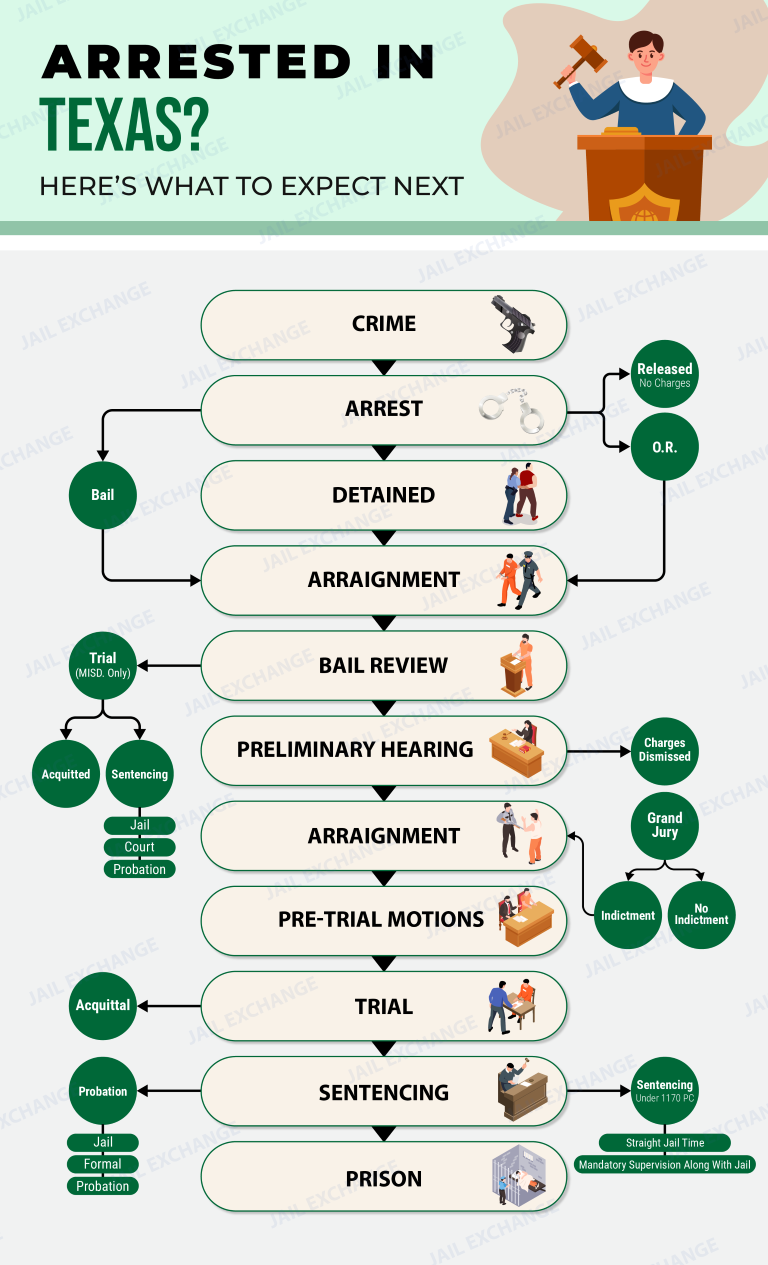
- Booking and magistration. The arrested person is booked into the Titus County Jail and taken before a magistrate within 48 hours for the article 15.17 warnings. Bail, or bond, is set once the magistrate has the public safety report in hand.
- Requesting a lawyer. Indigent felony defendants receive private attorneys appointed by the district courts under the county's plan. A request can be made at magistration or through the District Clerk at (903) 577-6721.
- Grand jury review. A Titus County grand jury hears the State's evidence and either indicts or returns a no-bill. A defendant held 90 days without the State being ready generally must be released on personal bond or reduced bail, except in violent cases.
- Arraignment and settings. After indictment the case is set in the 76th or 276th District Court for arraignment, pretrial hearings and plea negotiations.
- Plea or trial. Most felonies resolve by plea agreement. At trial 12 jurors must agree, and the defendant may elect jury sentencing.
Felony grades
- State jail felony: 180 days to two years in a state jail; small drug possession cases and theft of $2,500 to $30,000 typically fall here.
- Third degree: two to ten years, the level for a third DWI and many weapons offenses.
- Second degree: two to twenty years, including home burglary and aggravated assault.
- First degree: five to ninety-nine years or life; any felony may also bring a fine up to $10,000.
Drug cases depend on the substance's penalty group and weight, and interstate stops on I-30 sometimes produce large-quantity charges. Prior convictions can raise the range. A defendant without prior felonies is often a candidate for deferred adjudication or straight probation. Parole eligibility is generally at one-quarter of the sentence, while "3g" offenses require half with a two-year minimum. Felony cases in Titus County commonly take six to eighteen months.
Violent felony (for example, murder, sexual assault, aggravated robbery)
The most serious cases from Mount Pleasant and the rest of the county, including homicides, sexual assaults and armed robberies, are investigated by the Mount Pleasant Police Department or the Sheriff's Office, sometimes with the Texas Rangers, and prosecuted by the 76th Judicial District Attorney. Defendants are held in the Titus County Jail unless they post bail.
Personal bond is barred for violent offenses under the Damon Allen Act, and bail amounts tend to be substantial. Texas voters also approved a 2025 constitutional amendment allowing judges to refuse bail in certain violent-crime cases.
- Capital murder: life without parole or death, depending on whether prosecutors seek the death penalty.
- Murder: first degree, punishable by imprisonment from 5 to 99 years or for life.
- Sexual assault: second degree; aggravated sexual assault: first degree, with a 25-year minimum for some offenses against young children.
- Aggravated robbery: first degree; as a "3g" crime it requires serving half the term, at least two years, before parole review.
Lawyers appointed in these cases must meet the higher qualification standards in the district courts' plan. Victims have rights under article I, section 30 of the Texas Constitution, including the right to be informed and to give an impact statement. Violent felony cases often last one to three years from arrest to verdict.
Juveniles (under 17) arrested in Titus County
In Texas, an offense committed by a child aged 10 to 16 is handled in juvenile court rather than criminal court. Defendants who were 17 or older at the time are adults in the eyes of the law.
Juvenile court and probation intake. The Titus County juvenile board designates the juvenile court, typically one of the district courts or the County Court. The county's juvenile probation department conducts intake when police bring in or refer a child, contacts the parents, and either handles the matter informally or sends it to the prosecutor, usually the County Attorney, who decides whether to file a petition.
Detention. A child who is not released is held in a certified juvenile detention center, typically a regional facility under contract with Titus County, such as one elsewhere in Northeast Texas. The juvenile court must hold a detention hearing within two working days of the child being taken into custody. Juveniles cannot post bail; the judge decides whether the child can safely go home and may impose conditions.
Possible outcomes. Many cases end in deferred prosecution or probation, with requirements such as school attendance, counseling or community service. Serious or repeated offenses can lead to residential placement or commitment to the Texas Juvenile Justice Department (TJJD). Determinate sentencing for certain grave crimes allows a sentence that may be completed in adult prison.
Certification as an adult. A youth can be transferred to adult criminal court after a hearing, generally only if 14 or older and charged with a capital felony, a first-degree felony or certain aggravated drug felonies, or 15 or older for other felonies. Children are entitled to a lawyer, appointed if the family cannot afford one. Juvenile records are generally confidential, and sealing is available for many of them.
Federal cases (U.S. District Court) from Titus County
By statute, Titus County belongs to the Texarkana Division of the Eastern District of Texas, a four-county division that also includes Bowie, Franklin and Red River counties. Federal criminal cases from Mount Pleasant are heard about 60 miles northeast in Texarkana, at the courthouse that sits on the Texas-Arkansas state line.
- U.S. Courthouse and Post Office, Texarkana (clerk's office), 500 N. State Line Ave., Room 301, Texarkana, TX 75501, (903) 794-8561
- U.S. Attorney's Office, Texarkana, 500 State Line Ave. N., Suite 402, Texarkana, TX 75501 (calls are handled through the Tyler office, (903) 590-1400)
- Federal Public Defender for the Eastern District of Texas, or a private attorney appointed from the Criminal Justice Act panel
Titus County federal cases typically involve methamphetamine and other drug trafficking along the I-30 corridor, firearms possession by people with felony records, child exploitation, and fraud or identity theft. Some begin as joint investigations with the Sheriff's Office or Mount Pleasant police.
The process begins with an initial appearance before a federal magistrate judge, who appoints counsel when the defendant qualifies. There is no money bail through bondsmen; instead, the Bail Reform Act allows release on conditions supervised by Pretrial Services, or detention ordered after a hearing that normally takes place within three court days. An indictment must be returned within 30 days of an arrest on a complaint, and the Speedy Trial Act sets a 70-day deadline for trial, subject to exclusions. Most cases end in a guilty plea; a federal jury of 12 must be unanimous. Sentencing comes after a presentence report and applies the advisory Guidelines along with any mandatory minimums. With no parole in the federal system, a prisoner serves roughly 85 percent of the term in the Bureau of Prisons, followed by supervised release. A conviction from the Texarkana courtroom can be appealed to the U.S. Court of Appeals for the Fifth Circuit.
Families can search the Federal Bureau of Prisons inmate locator by a person's name or register number to see where a sentenced Titus County defendant is held. A pretrial detainee housed in a county jail under contract with the U.S. Marshals may also be listed on that jail's own roster. Federal juvenile prosecutions are rare.
This overview of the criminal courts serving Titus County is general information, not legal advice, and procedures can change; confirm dates and requirements with the appropriate clerk. Anyone who cannot afford a lawyer may request one at magistration, or contact the County Judge's office at (903) 577-6791 for a misdemeanor or the District Clerk at (903) 577-6721 for a felony.