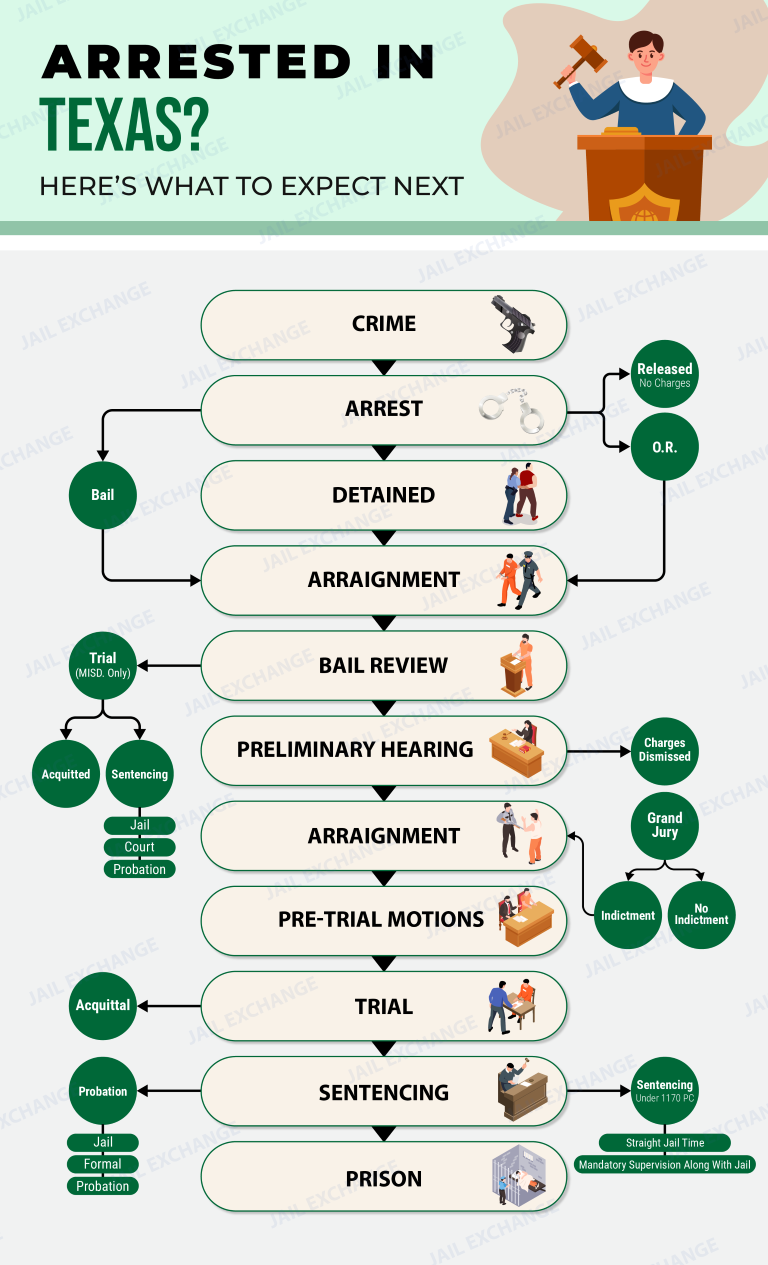
Huntsville, home of Sam Houston State University and the headquarters of the Texas prison system, is the county seat of Walker County, and the county government building at 1100 University Avenue holds its courts. Fine-only Class C cases go to one of four justice of the peace courts or the Huntsville Municipal Court; Class A and B misdemeanors are heard in the Walker County Court at Law or the constitutional county court; and felonies are tried in the 12th District Court and the 278th District Court. Walker County has a Criminal District Attorney, so a single office prosecutes both misdemeanors and felonies. People arrested by Huntsville police, university officers, deputies or troopers are booked into the Walker County Jail on FM 2821 West.
- 12th and 278th District Courts and Walker County District Clerk, 1100 University Avenue, Suite 209, Huntsville, TX 77340, (936) 436-4972
- Walker County Court at Law and Walker County Court (County Judge), 1100 University Avenue, Suite 201, Huntsville, TX 77340, (936) 436-4922
- Walker County Criminal District Attorney (felonies and misdemeanors), Huntsville, TX, (936) 435-2441
- Walker County Sheriff's Office, 717 FM 2821 West, Huntsville, TX 77320, (936) 435-2400
- Walker County Jail, 717 FM 2821 West, Huntsville, TX 77320, (936) 435-2400
Which court hears your case. Class C misdemeanors carry only a fine; in Walker County the usual examples are speeding and other traffic tickets, public intoxication near the university, possession of alcohol by a minor, shoplifting of goods worth less than $100 and an assault by offensive contact that causes no injury. They are filed in the Justice of the Peace court for the precinct where the offense occurred or, when Huntsville police write the citation, in the Huntsville Municipal Court. Class A and B misdemeanors, a first DWI among them, go to the Walker County Court at Law, with the constitutional Walker County Court as the other county-level court. Felonies also start with a magistrate at the FM 2821 jail; once a Walker County grand jury returns an indictment, the case is assigned to the 12th District Court or the 278th District Court. Each of those districts also reaches into neighboring counties, so the two district judges divide their weeks between Huntsville and other courthouses.
Where pretrial inmates are held. Walker County's pretrial detainees are held in the Walker County Jail, which the Sheriff runs at the law enforcement complex on FM 2821 West; the state's January 2022 jail report listed its capacity at 268 beds. The many Texas Department of Criminal Justice prison units around Huntsville hold sentenced state prisoners, not people waiting for a county case, and they are separate from the county jail. After booking, a magistrate gives the statutory warnings and sets bail within 48 hours of arrest. Families can call the Sheriff's Office at (936) 435-2400 to ask about custody or release.
- Local courts in Walker County (justice of the peace, municipal and county courts)
- Misdemeanor (for example, theft, a first DWI, assault causing bodily injury, criminal trespass)
- Felony (for example, burglary, felony theft, drug possession or delivery, aggravated assault)
- Violent felony (for example, murder, sexual assault, aggravated robbery)
- Juveniles (under 17) arrested in Walker County
- Federal cases (U.S. District Court) from Walker County
Local courts in Walker County (justice of the peace, municipal and county courts)
Walker County's four justice courts cover Huntsville, the rural precincts around Lake Conroe's northern arm, and New Waverly in the south. Each justice of the peace handles Class C cases, evictions and small claims, and the justices also take turns as magistrates who issue warrants and set bond for people booked into the county jail.
Justice of the Peace courts
- Justice of the Peace, Precinct 1, 717 FM 2821 West, Huntsville, TX 77320, (936) 436-4966
- Justice of the Peace, Precinct 2, 102 Tam Road, Huntsville, TX 77320, (936) 436-4977
- Justice of the Peace, Precinct 3, 2986-A State Highway 19, Huntsville, TX 77320, (936) 436-4988
- Justice of the Peace, Precinct 4, 9360 Highway 75 South, New Waverly, TX 77358, (936) 435-8750
A Walker County citation names the precinct court and the date to appear. If the ticket is lost, calling any of the four justice courts with the driver's name usually locates the right one.
Municipal court
- Huntsville Municipal Court, 717 FM 2821 West, Suite 200, Huntsville, TX 77320, (936) 291-5476
Huntsville is the only city in Walker County with its own municipal court. Tickets written by deputies, troopers or game wardens in Riverside, New Waverly, Dodge or the national forest areas go to the justice court for that precinct instead. Citations issued by Sam Houston State University police on campus are usually filed in a justice court or the Huntsville court depending on the offense; the ticket itself names the court.
County courts
- Walker County Court at Law (Class A and B misdemeanors and appeals from justice and municipal courts), 1100 University Avenue, Suite 201, Huntsville, TX 77340, (936) 436-4922
- Walker County Court (constitutional county court, County Judge), 1100 University Avenue, Huntsville, TX 77340, (936) 436-4922
District courts
- 12th District Court and 278th District Court (felonies), 1100 University Avenue, Huntsville, TX 77340; District Clerk (936) 436-4972
Someone convicted of a Class C offense in a Walker County justice court can appeal to the county court level for a new trial; the appeal bond is generally due within 10 days of the judgment.
Misdemeanor (for example, theft, a first DWI, assault causing bodily injury, criminal trespass)
A Walker County misdemeanor usually starts with an arrest by Huntsville police, a deputy, a state trooper or a university officer, followed by booking at the county jail on FM 2821 West. Within 48 hours the person sees a magistrate, who reads the warnings required by state law, takes any request for an appointed lawyer and sets bail. Many people charged with Class B offenses such as a first DWI, possession of a small amount of marijuana or criminal trespass are released on a cash or surety bond or a personal bond within a day. For assault involving a family member, the magistrate commonly adds an emergency protective order and no-contact conditions.
Who prosecutes. The Walker County Criminal District Attorney, (936) 435-2441, files the information in Class A and B cases and handles them in the Walker County Court at Law. A Criminal District Attorney's office covers both levels of crime, so the same office that charges misdemeanors also presents felonies to the grand jury.
Penalties. A Class B misdemeanor carries up to 180 days in the county jail and a fine of up to $2,000; a Class A carries up to a year and $4,000. Theft of property worth $100 to $750 is Class B, and $750 to $2,500 is Class A. In Huntsville, as elsewhere in Texas, an assault that causes bodily injury is charged as a Class A offense. Criminal trespass is normally Class B but becomes Class A if it involves a home or a deadly weapon.
A first DWI in Walker County. A first DWI is a Class B misdemeanor with a jail range of 72 hours to 180 days and a fine of up to $3,000; an alcohol concentration of 0.15 or higher makes it Class A, and an open container raises the minimum jail stay to six days. The arrest also starts an administrative license suspension case with the Department of Public Safety, which has its own short deadline to request a hearing. Community supervision is common for a first offense, usually with a DWI education class and sometimes an ignition interlock device. A conviction also brings a state traffic fine.
How Walker County misdemeanor cases end. Possible results include dismissal, pretrial diversion, deferred adjudication (probation without a conviction if completed), probation after conviction, a fine, or county jail time, often with credit for days already served. Some people who finish deferred adjudication may later ask for an order of nondisclosure. A typical Class A or B case in the Court at Law takes two to six months; Class C tickets in the justice and municipal courts are usually resolved within a few weeks.
Lawyers for people who cannot pay. Walker County appoints private attorneys under its indigent defense plan, filed with the Texas Indigent Defense Commission. Ask for a lawyer at magistration, or contact the county court at (936) 436-4922; a judge decides eligibility based on income and expenses.
Felony (for example, burglary, felony theft, drug possession or delivery, aggravated assault)
A felony arrest in Walker County moves through the same jail and magistrate as a misdemeanor, but the bail amount is usually higher and conditions such as drug testing or a GPS monitor are more common. Under the 2021 Damon Allen Act the magistrate reviews a public safety report before setting bond and cannot grant a personal bond to someone charged with a violent offense. If the State is not ready for trial within 90 days of a felony detention, the defendant can generally ask to be released on a personal bond or a lower amount, with exceptions for violent charges.
Grand jury. The Criminal District Attorney's office reviews the investigation and presents felony cases to a Walker County grand jury, which decides whether to indict. Without an indictment the case cannot go forward, unless the defendant waives indictment and agrees to proceed on an information, which sometimes happens as part of a plea agreement. After indictment the case is set in the 12th or 278th District Court for arraignment and pretrial settings.
Penalty ranges. Walker County felony judges sentence within the statewide ranges: a state jail felony brings 180 days to 2 years in a state jail, a third-degree felony 2 to 10 years in prison, a second-degree felony 2 to 20 years and a first-degree felony 5 to 99 years or life, with a fine of up to $10,000 possible at every level. Theft of $2,500 to $30,000 is a state jail felony. The burglary-of-a-home and aggravated assault cases that fill much of the 12th and 278th dockets are usually second-degree felonies. Drug cases depend on the penalty group and weight, from a state jail felony for small amounts up to first degree for large quantities, and prior felony convictions can raise the range.
Offenses tied to the prisons. Because so many state prison units sit in and around Huntsville, Walker County sees cases involving contraband, assaults on staff and other offenses committed inside correctional facilities. Those cases are often handled with the help of the state's Special Prosecution Unit, which assists local prosecutors with prison-related crimes, though they are still indicted by a local grand jury and heard in a Texas district court. A defendant who is already serving a state sentence remains in prison custody while the new case proceeds.
Resolution. Most Walker County felonies end in a plea agreement for deferred adjudication, regular community supervision, state jail time or a prison sentence. A defendant who goes to trial has a 12-person jury that must agree unanimously and may choose to have the jury, rather than the judge, decide punishment. People sentenced to prison may become eligible for parole after serving about one-quarter of the term, counting good time; for "3g" offenses such as aggravated robbery, half the sentence must be served, with a two-year minimum. Most felonies take six to eighteen months from arrest to resolution.
Appointed counsel in felony cases. The 12th and 278th District Courts appoint private attorneys from an approved list under the county's indigent defense plan. A request made at magistration is forwarded to the courts, and the District Clerk at (936) 436-4972 can tell a family whether a lawyer has been assigned.
Violent felony (for example, murder, sexual assault, aggravated robbery)
Murder, sexual assault, aggravated robbery and other violent felonies in Walker County are typically investigated by the Sheriff's Office, Huntsville police or the Texas Rangers and are prosecuted by the Criminal District Attorney in the 12th or 278th District Court. Walker County magistrates cannot grant a personal bond on a violent charge, so release usually requires a substantial cash or surety bond. Texas voters approved a 2025 constitutional amendment that lets judges deny bail in some violent-crime cases, so pretrial detention without bail is possible in certain cases.
Punishment. A capital murder conviction in a Walker County district court means either death or life without parole, and the death penalty is sought in only a small share of capital cases. Texas carries out executions at the Huntsville Unit, the downtown prison often called "the Walls," but the place of execution has nothing to do with where a capital case is tried. A Walker County murder conviction carries a first-degree range of five years up to 99 years or life. Sexual assault is a second-degree felony, aggravated sexual assault is first degree with a 25-year minimum for some offenses against young children, and aggravated robbery is a first-degree felony and a "3g" offense.
What to expect. Violent-felony cases take longer: forensic testing, expert witnesses and plea negotiations often stretch the case to one to three years. Defendants have the right to a jury of 12 and may elect jury sentencing. Crime victims in Walker County have rights under Article I, Section 30 of the Texas Constitution, among them notice of hearings and the chance to give an impact statement, and the Criminal District Attorney's victim services staff explain how to use them.
Defense counsel. Walker County judges appoint qualified attorneys for indigent defendants in serious violent cases, and capital cases require lawyers who meet the state's capital-qualification standards; a regional capital public defender may be appointed in a death-penalty case. Ask for counsel at magistration, or contact the District Clerk at (936) 436-4972.
Juveniles (under 17) arrested in Walker County
Texas juvenile courts take children who were 10 through 16 at the time of the alleged offense, so a Huntsville 17-year-old, even a high-school junior, is charged in the adult system. A Walker County youth who is taken into custody goes through intake with the Walker County Juvenile Probation Department, whose officers decide whether the child can be released to a parent or must be detained. The juvenile board designates the county's juvenile court, typically the County Court at Law or one of the district courts; the county court office at (936) 436-4922 can direct a family to the right court.
Detention. Walker County does not have a large detention center of its own, so a child who must be held is typically placed in a certified juvenile detention facility under contract, such as one in a neighboring county in the Houston or Brazos Valley region. A detention hearing must be held within two working days after the child is detained, and the child has a right to an attorney at that hearing. The judge decides whether continued detention is needed.
The case. The Criminal District Attorney's office reviews the referral and may file a petition alleging delinquent conduct. Many cases end with deferred prosecution (informal supervision for up to six months), and others result in court-ordered probation. Serious or repeat cases can lead to commitment to the Texas Juvenile Justice Department (TJJD). For certain grave offenses, prosecutors may seek a determinate sentence, which can begin in a TJJD facility and later transfer to adult prison.
Certification as an adult. A juvenile judge can waive jurisdiction and transfer a youth to adult court after a hearing. Generally this is possible for a 14-year-old charged with a capital felony, a first-degree felony or certain aggravated drug felonies, and for a 15- or 16-year-old charged with other felonies. Certification is uncommon and requires a full investigation and evaluation.
Records. Juvenile records in Texas are generally confidential, and many can be sealed later. Families who cannot afford a lawyer can ask the court to appoint one for the child.
Federal cases (U.S. District Court) from Walker County
Walker County is part of the Houston Division of the federal court for the Southern District of Texas. Federal cases from the county are heard at the United States Courthouse, 515 Rusk Avenue, Houston, TX 77002 ((713) 250-5500), about 70 miles south on Interstate 45. A matter becomes federal when it breaks a federal law: drug trafficking, firearms offenses by prohibited people, fraud involving federal programs or banks, child exploitation, and crimes on federal property such as the Sam Houston National Forest. Some cases begin with a state arrest and are later adopted by federal prosecutors.
Prosecution and defense. The U.S. Attorney's Office for the Southern District of Texas is at 1000 Louisiana Street, Suite 2300, Houston, TX 77002, (713) 567-9000. Defendants who cannot afford a lawyer are represented by the Federal Public Defender for the Southern District of Texas or by a private Criminal Justice Act panel attorney appointed by the court.
The federal process. After a federal arrest from Walker County, the defendant appears before a U.S. magistrate judge in Houston. A Houston magistrate judge does not set a commercial bail amount the way a Walker County magistrate does. When prosecutors seek to keep a Walker County defendant locked up, the detention hearing is usually held within three court days, and under the Bail Reform Act the magistrate judge either orders release on conditions that U.S. Pretrial Services supervises or orders the person held. Detained defendants in the Houston Division are commonly held at the Federal Detention Center, 1200 Texas Avenue, Houston, or in a contract jail. A case started by complaint must be indicted within 30 days, and the Speedy Trial Act sets a 70-day trial deadline that is often extended. Most Walker County federal defendants plead guilty, and those who go to trial face a 12-member jury whose verdict must be unanimous. Sentencing follows a presentence report, with the advisory Sentencing Guidelines and any mandatory minimum applying. There is no federal parole, so people serve about 85 percent of a prison term in the Bureau of Prisons, followed by supervised release. Appeals go to the U.S. Court of Appeals for the Fifth Circuit.
Relatives of a Walker County federal defendant can search the Federal Bureau of Prisons inmate locator for a Walker County defendant by name or register number. Someone awaiting a federal trial while boarded in a county jail under a Marshals Service contract may also be listed on that county jail's roster. Federal prosecution of juveniles from Walker County is rare.
This Walker County page offers general information about how criminal cases move through the Huntsville courts and is not legal advice. Offices and phone numbers can change; confirm details with the District Clerk at (936) 436-4972 or the county court at (936) 436-4922. A person who cannot afford a lawyer can request appointed counsel at magistration or through those offices.