Wichita Falls is the county seat of Wichita County and the largest city on the Red River between Dallas and Amarillo, and nearly every criminal case filed in the county is heard in the courthouse at 900 Seventh Street. Five justice of the peace courts and the municipal courts of Wichita Falls, Burkburnett, Iowa Park and Electra take Class C cases; County Court at Law No. 1 and County Court at Law No. 2 handle Class A and B misdemeanors; and the 30th, 78th and 89th District Courts, each serving only Wichita County, try felonies. One elected official, the Wichita County Criminal District Attorney, handles prosecution at every level from misdemeanor to capital felony. Adults arrested anywhere in the county are booked by the Wichita County Sheriff, whose detention bureau runs the county's jail facilities in Wichita Falls.
- Wichita County Courthouse (30th, 78th and 89th District Courts; County Courts at Law No. 1 and No. 2; District Clerk), 900 Seventh Street, Wichita Falls, TX 76301; District Clerk and courts (940) 766-8100, ext. 5
- Wichita County Criminal District Attorney (felonies and misdemeanors), Wichita County Courthouse, 900 Seventh Street, Wichita Falls, TX 76301; county switchboard (940) 766-8100
- Court Administrator and Indigent Defense Coordinator (applications for appointed lawyers), 900 Seventh Street, Room 350, Wichita Falls, TX 76301, (940) 766-8100, ext. 8601
- Wichita County Public Defender's Office, reached through the county switchboard at (940) 766-8100
- Wichita County Jail (Wichita County Sheriff's Office), Sheriff's Office at 2815 Central Freeway East, Wichita Falls, TX 76302, (940) 766-8170
- Wichita County Juvenile Probation Department, 510 Lamar Street, Wichita Falls, TX 76301, (940) 766-8225
Which court hears your case. Class C misdemeanors, the fine-only offenses such as speeding, public intoxication, theft of less than $100 and assault by contact without injury, are filed in a Justice of the Peace court (Precinct 1 has two places in Wichita Falls; Precincts 2, 3 and 4 sit in Burkburnett, Iowa Park and Electra) or, when a city officer writes the citation inside city limits, in the municipal court of Wichita Falls, Burkburnett, Iowa Park or Electra. Class A and B misdemeanors, a first DWI included, are tried in County Court at Law No. 1 or County Court at Law No. 2; the constitutional county court, led by the County Judge, mainly handles county business. Felonies begin with magistrate warnings and, once a Wichita County grand jury returns an indictment, are assigned to the 30th, 78th or 89th District Court.
Where pretrial inmates are held. The Sheriff's detention bureau holds adults awaiting trial at the Wichita County Jail, which operates as a main jail plus a second, downtown facility near the courthouse, the Wichita County Jail Downtown Facility. People arrested by Wichita Falls police, Burkburnett and Iowa Park officers, deputies and state troopers all end up in the county's custody. Call the Sheriff's Office at (940) 766-8170 to learn which building a person is in and whether a bond has been set.
- Local courts in Wichita County (justice of the peace, municipal and county courts)
- What happens after an arrest in Wichita County
- The Wichita County jail facilities
- Public defender and appointed lawyers
- The Criminal District Attorney, diversion and specialty dockets
- Misdemeanor (for example, theft, a first DWI, assault causing bodily injury, criminal trespass)
- Felony (for example, burglary, felony theft, drug possession or delivery, aggravated assault)
- Violent felony (for example, murder, sexual assault, aggravated robbery)
- Juveniles (under 17) arrested in Wichita County
- Federal cases (U.S. District Court) from Wichita County
Local courts in Wichita County (justice of the peace, municipal and county courts)
Wichita County is divided into four justice precincts, and the busy Precinct 1 in Wichita Falls has two separate judges, so there are five justice courts in all. Justices of the peace also serve as magistrates for people booked into the jail, which is where many first bail amounts are set.
Justice of the Peace courts
- Justice of the Peace, Precinct 1, Place 1, 900 Seventh Street, Room 281, Wichita Falls, TX 76301, (940) 766-8141
- Justice of the Peace, Precinct 1, Place 2, 900 Seventh Street, Room 282, Wichita Falls, TX 76301, (940) 766-8143
- Justice of the Peace, Precinct 2, 100 W. College Street, Suite 2, Burkburnett, TX 76354, (940) 569-1140
- Justice of the Peace, Precinct 3, 404 N. Wall Street, Iowa Park, TX 76367, (940) 592-9388
- Justice of the Peace, Precinct 4, 2023 State Highway 25 North, Electra, TX 76360, (940) 495-2460
Municipal courts
- Wichita Falls Municipal Court, 611 Bluff Street, Wichita Falls, TX 76301, (940) 761-7880
- Burkburnett Municipal Court, 501 Sheppard Road, Burkburnett, TX 76354 (sessions in the municipal courtroom at 208 E. Fourth Street), (940) 569-7331
- Iowa Park Municipal Court, 103 N. Wall Street (P.O. Box 190), Iowa Park, TX 76367 (sessions in the City Council Chambers, 103 E. Cash Street), (940) 213-7133
- Electra Municipal Court, 103 W. Cleveland Avenue, Electra, TX 76360, (940) 495-3536
County courts
- Wichita County Court at Law No. 1 (Class A and B misdemeanors), 900 Seventh Street, Room 303, Wichita Falls, TX 76301, (940) 766-8100, ext. 5
- Wichita County Court at Law No. 2 (Class A and B misdemeanors), 900 Seventh Street, Room 303, Wichita Falls, TX 76301, (940) 766-8100, ext. 5
- Wichita County Court (constitutional county court, County Judge), 900 Seventh Street, Room 250, Wichita Falls, TX 76301, (940) 766-8100, ext. 1
A Class C defendant can pay the fine, ask for deferred disposition or a driving safety course, or enter a not guilty plea and ask for a trial before the judge or a small jury. Anyone found guilty in a justice or city court may appeal to a county court at law for a fresh trial, but the notice must be filed quickly, normally within 10 days of the judgment. Small towns such as Kamay and Cashion Community generally send citations to the justice court for their precinct.
What happens after an arrest in Wichita County
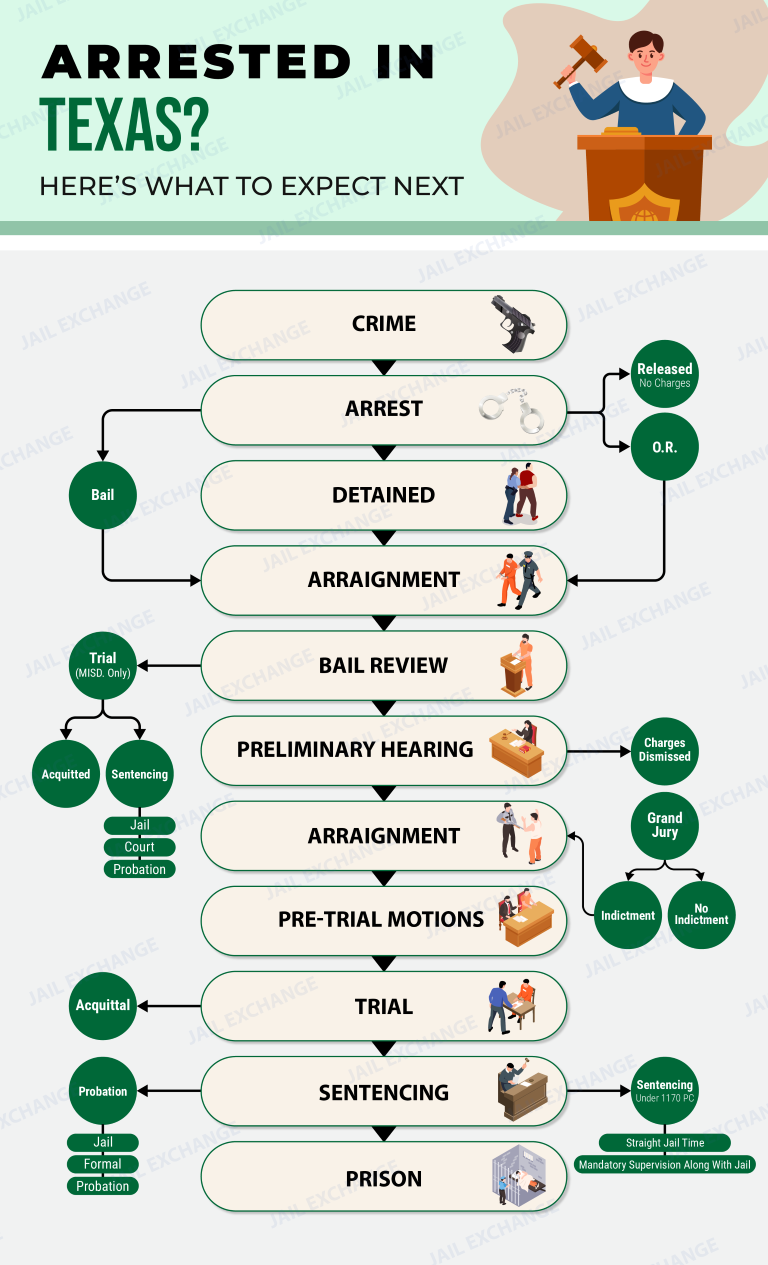
Whatever agency makes the arrest, the person is taken to the Wichita County Jail for booking: fingerprints, a photograph, a records check for holds and warrants, and a property inventory. Officers file a probable cause affidavit that a magistrate reviews.
- Magistration. Within 48 hours the person must see a magistrate, usually one of the justices of the peace. The magistrate gives the article 15.17 warnings, explains the charge, asks whether the person wants a lawyer appointed and sets bail after reviewing the public safety report the state now requires.
- Release options. The choices are a cash bond paid to the jail, a surety bond posted by a licensed bail bondsman, or a personal bond, which is a written promise to appear. Personal bonds are not allowed for many violent charges under the 2021 Damon Allen Act. Family violence arrests usually bring a magistrate's order for emergency protection that keeps the defendant away from the alleged victim.
- Request for counsel. A defendant who asks for a lawyer fills out a financial affidavit, and the Court Administrator's office processes the application and sends it to the appointing judge.
- Filing. The Criminal District Attorney's Office reviews the officer's report and decides what charge to file, whether to reduce it or whether to decline the case.
A person who cannot post the amount set can ask the court to lower it. If the State is not ready for trial within 90 days on a felony, 30 days on a Class A or 15 days on a Class B, the defendant is generally entitled to release on a personal bond or a reduced amount, although the law makes exceptions for violent offenses.
The Wichita County jail facilities
The Sheriff's Office is responsible for every adult held before trial in the county. Detainees are housed at the Wichita County Jail and at the Wichita County Jail Downtown Facility, and the Sheriff moves people between buildings for classification, medical needs and court appearances at the courthouse on Seventh Street.
- Sheriff's Office, 2815 Central Freeway East, Wichita Falls, TX 76302, (940) 766-8170 (business hours Monday through Friday)
The Sheriff posts an inmate roster that lists each person's charges and any bond amounts. Ask the jail staff about visitation, commissary deposits and how to deliver bond paperwork, since procedures can differ between the two facilities. People serving short county jail sentences after a misdemeanor conviction, and people waiting for transfer to a state prison after a felony sentence, are held in the same system as pretrial detainees.
Public defender and appointed lawyers
Wichita County is one of the Texas counties with its own public defender office, which represents many people who cannot afford a lawyer in county and district court. Cases that the Public Defender's Office cannot take, such as those involving a conflict of interest between co-defendants, are assigned to private attorneys from the court-approved appointment lists under the county's indigent defense plan, which is filed with the Texas Indigent Defense Commission.
The simplest way to get a lawyer is to ask for one at magistration. A family member can also call the Indigent Defense Coordinator in the Court Administrator's office at (940) 766-8100, ext. 8601, to check whether an application has been received and who was appointed. Being released on bail does not take away the right to appointed counsel, although the court may look at the person's income again.
The Criminal District Attorney, diversion and specialty dockets
Because Wichita County has a Criminal District Attorney, the same office files misdemeanors in the county courts at law and felonies in the three district courts, and it also prosecutes juvenile cases and handles protective orders. Prosecutors make the plea offers, decide which cases go to the grand jury, and run the office's victim assistance program.
Diversion. First-time offenders charged with lower-level crimes may be eligible for pretrial diversion, under which the charge is dismissed after the person completes conditions such as classes, community service and restitution. Eligibility is set by the prosecutor's office, and violent and family-violence cases are usually excluded. Deferred adjudication, which the judge grants after a guilty or no-contest plea, is a separate route that can also avoid a final conviction.
Specialty dockets. Texas counties of this size often run treatment courts for drug addiction, repeat DWI, veterans and people with mental illness. Participants are supervised closely and appear before the judge on a regular schedule, and successful completion usually brings a dismissal or a reduced outcome. Ask the defense lawyer or the Court Administrator which programs currently operate in Wichita County and whether a bond condition can be tied to treatment.
Misdemeanor (for example, theft, a first DWI, assault causing bodily injury, criminal trespass)
Most jailable misdemeanors in Wichita County come from Wichita Falls police arrests for shoplifting, DWI and family disputes. The defendant is booked into the Wichita County Jail, sees a justice of the peace acting as magistrate, and is usually released on bail within a day or two.
How the case moves
Prosecutors file the formal misdemeanor charge, called an information, in one of the two Wichita County courts at law. At the first setting the defendant confirms whether a lawyer has been hired or appointed through the Public Defender's Office or the appointment list (the Indigent Defense Coordinator is at (940) 766-8100, ext. 8601). Later settings are used for discovery, plea negotiations and motions. Six Wichita County residents sit on a misdemeanor jury, and all six have to agree on the verdict.
Penalties
- Theft: property worth $100 to $750 is a Class B misdemeanor (up to 180 days in jail and a $2,000 fine); between $750 and $2,500 it rises to Class A, punishable by as much as a year in the county jail and a $4,000 fine.
- Assault causing bodily injury: Class A. If the victim is a family member, household member or dating partner, the judgment carries a family-violence finding that affects firearm rights and future charges.
- Criminal trespass: Class B in most cases; it climbs to Class A when the property was someone's residence or the accused had a deadly weapon.
- First DWI: Class B, carrying anywhere from 72 hours to 180 days behind bars plus a fine that can reach $3,000. A blood or breath result of 0.15 or more makes it Class A, and an open container raises the minimum jail time to six days. A driver's license suspension can follow through a separate administrative hearing, and an ignition interlock may be ordered.
Many cases end in dismissal, pretrial diversion, deferred adjudication or probation; others bring a fine or a short jail term. People who complete deferred adjudication on many offenses can petition for an order of nondisclosure that hides the record from most private background checks. A typical Wichita County misdemeanor takes two to six months.
Felony (for example, burglary, felony theft, drug possession or delivery, aggravated assault)
Felony cases in Wichita County are spread among the 30th, 78th and 89th District Courts, all housed in the courthouse on Seventh Street and all serving this county alone, so dockets move more regularly than in rural districts where one judge travels.
- Booking and magistrate. After booking at the Wichita County Jail, a magistrate gives warnings within 48 hours and sets bail and any conditions, such as drug testing or a GPS monitor.
- Lawyer. The defendant asks for appointed counsel at magistration or through the Indigent Defense Coordinator, and the case goes to the Public Defender's Office or an attorney on the felony appointment list.
- Grand jury. The Criminal District Attorney presents the case to a Wichita County grand jury, which can indict, reduce the charge or decline to indict (a "no-bill"). A defendant may waive indictment and proceed on an information as part of a plea.
- Arraignment and settings. After indictment the case is set before one of the three district judges for arraignment, discovery and plea talks. Most felonies end with a negotiated plea.
- Trial. Twelve jurors chosen from Wichita County hear a felony trial and must reach a unanimous verdict. The defendant can ask the jury rather than the judge to decide punishment.
Punishment ranges
- State jail felony: a state jail term of at least 180 days and at most two years, covering offenses such as theft of $2,500 to $30,000 and possession of under one gram of drugs such as methamphetamine.
- Third-degree felony: 2 to 10 years in prison.
- Second-degree felony: 2 to 20 years; the level at which home burglary and the typical aggravated assault are charged.
- First-degree felony: 5 to 99 years or life. Each felony grade also permits a fine as high as $10,000.
Drug cases depend on the penalty group and weight, and prior felonies can raise the range under the habitual-offender statutes. Probation and deferred adjudication are common for first offenses. Parole eligibility generally comes after about a quarter of the sentence, but aggravated "3g" offenses require half the sentence and at least two years. A felony here usually takes six to eighteen months to resolve.
Violent felony (for example, murder, sexual assault, aggravated robbery)
A homicide, sexual assault or armed robbery arrest in Wichita Falls is usually investigated by the police department's detectives or the Sheriff's investigators, sometimes with help from the Texas Rangers. The suspect is held at the Wichita County Jail, and state law bars releasing anyone charged this way on a personal bond. Bail amounts are generally high, and Texas voters approved a 2025 constitutional amendment that lets judges deny bail in some violent-crime cases, so some defendants stay in custody until trial.
- Capital murder: life without parole or, if the State seeks it and the jury agrees, the death penalty.
- Murder: punished as a first-degree offense with five to 99 years or a life term; the defense can argue at sentencing that the killing was in sudden passion, which reduces it to second degree.
- Sexual assault: second-degree felony. Aggravated sexual assault: a first-degree offense, and certain cases involving very young victims carry at least 25 years.
- Aggravated robbery: first-degree felony with no eligibility for parole until half the sentence is served.
The district court appoints lawyers qualified for serious felonies, often from the Public Defender's Office or the felony list; in a capital case two qualified lawyers must be appointed. These cases involve forensic testing, expert witnesses and frequent continuances, so one to three years is a realistic timeline. Victims have rights under article I, section 30 of the Texas Constitution, including notice of hearings and the chance to speak at sentencing, and the Criminal District Attorney's victim services staff can be reached through the county switchboard at (940) 766-8100.
Juveniles (under 17) arrested in Wichita County
Texas juvenile courts handle children who were between 10 and 16 years old when the alleged offense took place. A 17-year-old arrested in Wichita Falls is treated as an adult and booked into the adult jail. The Wichita County Juvenile Board designates which local court sits as the juvenile court, typically one of the county courts at law or a district court.
Intake. Police bring a detained youth to the county's juvenile detention center, the Judge Arthur R. Tipps Juvenile Justice Center, where a juvenile probation officer screens the case, contacts parents and decides whether the child may go home. The Wichita County Juvenile Probation Department, 510 Lamar Street, Wichita Falls, is reached at (940) 766-8225. The Criminal District Attorney reviews referrals and files petitions.
Detention hearing. A child kept in custody must see the juvenile judge within two working days. The judge decides whether continued detention is needed, and the child is entitled to a lawyer at that hearing, appointed at county expense when the family cannot pay.
Outcomes. Many first referrals end with deferred prosecution or supervisory caution. After an adjudication, the court can order probation at home or in a residential program, or commit the youth to the Texas Juvenile Justice Department (TJJD). For serious violent and some repeat offenses, determinate sentencing allows a term that can continue into adult prison after age 19.
Certification. The prosecutor can ask the juvenile court to waive jurisdiction and transfer a youth to adult district court, generally only if the child was at least 14 for a capital felony, a first-degree felony or certain aggravated drug felonies, or at least 15 for other felonies, and only after a hearing with a full diagnostic study. Juvenile records are confidential, and many can be sealed after the youth meets the legal requirements.
Federal cases (U.S. District Court) from Wichita County
Wichita Falls is the namesake and seat of the Wichita Falls Division of the U.S. District Court for the Northern District of Texas, which takes federal cases from Wichita County and eleven neighboring counties. The federal courtroom on Lamar Street is staffed only when court is in session, and the Fort Worth clerk's office processes every filing for the division.
- U.S. District Court, Wichita Falls Division, second floor of the federal building at 1000 Lamar Street, Wichita Falls, TX 76301; filings handled by the Fort Worth clerk, (817) 850-6600
- U.S. Attorney's Office, Northern District of Texas (Wichita Falls cases are covered from Dallas), 1100 Commerce Street, Suite 300, Dallas, TX 75242, (214) 659-8600
How cases become federal. Federal agents such as the FBI, DEA, ATF and Homeland Security Investigations bring cases to federal prosecutors, often in partnership with Wichita Falls police. Common charges include drug trafficking conspiracies, felon-in-possession firearm counts, child exploitation, bank robbery and fraud. Crimes committed on Sheppard Air Force Base, a federal installation in the county, may also be prosecuted in federal court.
First appearance and release. A U.S. magistrate judge informs the defendant of the charge and appoints the Federal Public Defender for the Northern District of Texas or a Criminal Justice Act panel attorney if the person cannot afford a lawyer. Prosecutors who want the defendant held must ask for a detention hearing, which ordinarily takes place within three court days. No commercial bail bondsman is involved in a federal case; under the Bail Reform Act a defendant is either released on conditions overseen by U.S. Pretrial Services or held without release.
From charge to sentence. If the case began with a complaint, an indictment must follow within 30 days, and the Speedy Trial Act sets a 70-day trial clock that judges frequently extend. Guilty pleas resolve the overwhelming share of Wichita Falls Division prosecutions. At trial, all twelve jurors must vote to convict. Before sentencing, U.S. Probation writes a presentence report, and the judge considers the advisory Sentencing Guidelines along with any mandatory minimum. Federal prison has no parole: people generally serve about 85 percent of the term in the Bureau of Prisons and then a period of supervised release. Any appeal goes to the U.S. Court of Appeals for the Fifth Circuit.
Locating someone in federal custody. Type a name or eight-digit register number into the Federal Bureau of Prisons inmate locator. People awaiting a federal trial while housed in a county jail through a U.S. Marshals agreement can also appear on that county's jail roster. Juveniles are seldom charged in the federal system.
This guide gives a general picture of criminal court procedure in Wichita County and is not legal advice. Court schedules and local rules change, so confirm any date with the clerk at (940) 766-8100. To ask about a public defender or appointed lawyer, request one at magistration or call the Indigent Defense Coordinator at (940) 766-8100, ext. 8601.