
Davis County Correctional Facility
Davis County Correctional Facility
Jail Phone Number
801-451-4200Davis County Inmate Search: Custody and Family Contact
To locate an adult in Davis County custody, start with Davis County Correctional Facility, 800 West State Street, Farmington, UT 84025. The Sheriff’s main-jail instructions cover the services below. The former Work Center has a separate ankle-monitor program role, so its address is not interchangeable with the jail for booking, visits, mail or an individual’s reporting instructions.
The Sheriff-designated inmate roster is the local custody resource, and Utah VINELink is a statewide alternative for custody information and alerts. Retain any booking identifier supplied and compare the person’s identifying details. A roster entry is not the same thing as a court disposition, an appointment approval or proof that a particular payment will obtain release.
For a current custody question, call the jail at 801-451-4200, 800 West State Street, Farmington, UT 84025. Ask about the person’s present status and the correct contact for a release, family communication or urgent health concern. Our bail page explains payments and legal conditions; the court page gives the relevant clerk contacts.
Read inmate search answers
 Read inmate search answers
1. How do I find a person in Davis County custody?
The Sheriff identifies its online inmate roster as the resource for people currently in the Correctional Facility’s care and custody. Its inmate-information page also directs families there for bail information. Use Utah VINELink as an additional search/notification route rather than treating a failure to load one website as a custody decision.
For help with a particular person, call 801-451-4200 at the jail, 800 West State Street, Farmington, UT 84025. Have identifying and approximate arrest information ready, and ask for any booking identifier needed for the next inquiry. A custody allegation and later filed court charge are separate records.
↑ Back to the question list2. What happens during intake, and what if no result appears?
The jail describes secure storage of personal belongings, issued clothing and bedding, and an opportunity to contact a chosen person, excluding victims. Its FAQ says intake includes medical assessment; outside medical care and clearance are required when its medical staff determines that care is needed. No fixed first-call or online-posting deadline follows from those descriptions.
If the search does not answer the location question, contact 801-451-4200 with the arrest details and ask which agency currently has custody. Do not infer a transfer, hospitalization, citation release or completed release solely from an empty result. Keep the custody inquiry separate from a request for court records.
↑ Back to the question list3. What is the former Work Center’s current role?
The Davis County Work Release Facility name refers to the former Work Center, separate from the main jail. The Sheriff now identifies the former Work Center, 883 West Clark Lane, Farmington, UT 84025, as the office for its court-ordered ankle-monitor program. The county also lists a deposit kiosk there; neither description is a direction to use that site as an ordinary booking or visiting entrance.
The program is a community alternative for nonviolent participants, with individual court requirements and, when applicable, urinalysis or work-related obligations. Corrections publishes 801-451-4200 for program information. Obtain the participant’s actual reporting and contact instructions rather than applying main-jail mail, visitor or property rules to that separate site.
↑ Back to the question list4. How do Utah VINE notifications work?
The Utah Attorney General describes VINE as a free automated source of jail/prison custody status with notices about release, transfer or escape. Use the Utah service to locate a matching person and register for the notifications you need. Its published registration number is 877-884-8463.
Compare identities carefully, especially where names are shared, and keep any identifiers the service provides. Notification registration is not a visit reservation or a bail payment. Questions about current housing, a blocked communication or the controlling release order still belong with the agency and court handling the person; an alert does not replace those instructions.
↑ Back to the question list5. How can family learn what is required for release?
At the Correctional Facility, ask 801-451-4200 which court order is operative, whether bail is authorized and whether any additional custody authority remains. The Sheriff advertises eligible bail payments 24 hours a day through its designated payment portal, a cash/card kiosk and its other stated methods. Release is processed, not guaranteed at the instant a payment is made.
Utah’s narrow jail-official authority under § 77-20-204 stops authorizing release when a magistrate begins Rule 9 review. The later judicial order governs under § 77-20-205. Our bail page explains those distinctions and the separate purposes of bond, court payments and inmate spending deposits.
↑ Back to the question list6. Where can I check filed charges and hearing results?
Use Xchange for available public court records, or the judiciary’s own-case access service where eligible. Xchange excludes sealed/expunged records and juvenile delinquency cases. A roster allegation is not a substitute for the filed case or final disposition.
Farmington District clerk: 800 West State Street, Farmington, UT 84025, 801-447-3800. County Justice clerk: Courtroom 2, 800 West State Street, Farmington, UT 84025, 801-451-4488. Other District and municipal locations appear on our court page. Follow the court named in the notice; the Sheriff does not release individual inmate transport times.
↑ Back to the question list7. How does someone request a legal defender?
An accused person who cannot afford an attorney should ask the judge for appointment. Davis Legal Defenders explains that the court reviews finances, including dependents, work, assets and debts, and requires the application to be sworn true. The office cannot substitute an informal family request for the court’s appointment.
The office is at Farmington Memorial Courthouse, 28 East State Street, Suite 121, Farmington, UT 84025, 801-451-3010, Monday–Friday, 8 a.m.–5 p.m. Its stated service requires appointment through Davis Justice Court or Second District Court in Farmington. Municipal defendants should ask their own judge about counsel. Use the appropriate professional contact arrangements for legal discussions.
↑ Back to the question list8. How can I ask for a mugshot, report or media information?
For a local booking photograph or report, contact the Sheriff at 800 West State Street, Farmington, UT 84025, 801-451-4100. Its contact page identifies records/GRAMA and media-request routes; its FAQ directs records requests through the county’s records process. Ask for the particular record and applicable access procedure rather than assuming the roster supplies every photo or grants permission to publish it.
U.S. Marshals policy prohibits public disclosure of federal prisoners’ photographs and routes publicity questions to public affairs. ICE records requests use a separate channel from the immigration custody locator. These federal rules do not establish the result of an individual local records request.
↑ Back to the question list9. What are the main jail’s visiting options and times?
The Correctional Facility at 800 West State Street, Farmington, UT 84025, offers paid remote visits and free onsite video visits. Appointments must be made at least 24 hours ahead. Onsite visits are twice weekly for 25 minutes. Published remote windows are daily 9–11:30 a.m., 12:30–5 p.m. and 7–9 p.m.
The onsite timetable lists Sunday 2–5 p.m. and 7–8 p.m.; Monday 10 a.m.–noon; Tuesday 1–5 p.m. and 7–9 p.m.; Wednesday 10 a.m.–noon. No onsite visits are offered Thursday–Saturday, Thanksgiving or Christmas. Use our visitation information for the facility’s arrangements, and ask Jail Administration at 801-451-4299 about the person’s eligibility before making a trip.
↑ Back to the question list10. Which identification and approval rules affect a visit?
The main jail’s public-visiting rules allow two adults, or one adult with two children, and require government identification for visitors aged 18 or over. A minor must be accompanied by a parent or documented legal guardian; minors unrelated to the inmate cannot visit. Housing restrictions, required movement or program participation can affect availability.
Professional visitors have a separate registration and approval process requiring government ID and proof of professional capacity. The agency asks for at least 48 business hours for that review, excluding weekends and holidays. These are Correctional Facility rules, not automatic ankle-monitor-office procedures. The person’s actual approved appointment controls the visit.
↑ Back to the question list11. How can I set up calls, messaging and the mobile apps?
The Sheriff’s main-jail instructions require an account with its designated communications provider for telephone contact and tablet messaging. Use our phone-account information and electronic-message information for those services. The official instructions list support at 800-943-2189. Visiting and e-messaging approval may take up to 48 hours, excluding weekends.
The provider linked by the Sheriff publishes the iPhone/iPad app and Android app. Select the actual facility and person; an available app feature does not mean every option is in the jail’s contract. Ordinary account setup is also different from obtaining a professional legal visit or reporting an urgent health problem.
↑ Back to the question list12. How do I send spending money or order commissary?
Davis designates the online deposit and commissary portal for card deposits and gift packs. Its inmate-information page says funds become available within 24 hours and must arrive before the applicable weekly order deadline, which can vary by housing unit. It lists cash/card deposit kiosks at the main jail, 800 West State Street, and the former Work Center, 883 West Clark Lane, both Farmington, UT 84025.
Use our money instructions and commissary information for these separate tasks. Corrections questions go to 801-451-4200; the county also publishes 706-298-4974 for difficulty depositing online or in person. A spending deposit is not the portal’s bail transaction.
↑ Back to the question list13. What is the main jail’s personal-mail address and format?
The Correctional Facility requires personal mail through USPS, not lobby drop-off. Address it with the inmate’s first/last name and booking number, Davis County Correctional Facility, P.O. Box 130, Farmington, UT 84025. Its ordinary personal-mail rule is postcards, with a complete return address including the sender’s full name; standard-paper personal letters are denied.
The jail prohibits packages and greeting cards and restricts substances, attachments and graphic/sexual content. Photos must come directly from a photo-printing company, on standard 4-by-6-inch photo paper; the possession limit is ten. Our mail instructions distinguish these main-jail rules from other delivery types and from an ankle-monitor participant’s individual contact arrangements. The physical jail is at 800 West State Street, Farmington, UT 84025, 801-451-4200; inmate mail uses the postal box above.
↑ Back to the question list14. Are legal mail, books and subscriptions handled differently?
Yes. The main jail says legal mail is opened only in the inmate’s presence. Books must be new paperbacks sent directly by a bookstore or publisher, no larger than 8½ by 11 inches or thicker than two inches; no more than five may be received at a time. Subscriptions must come from the publisher through USPS, with no more than two subscriptions and one newspaper per person.
The inmate must cancel subscriptions on release. The county says released inmates’ mail is returned to the sender; mail that cannot be returned may be collected by the released person within 30 days, then destroyed. Obtain delivery instructions for the actual legal item instead of treating a postcard rule as permission to mishandle privileged correspondence.
↑ Back to the question list15. How can I collect a main-jail inmate’s belongings?
The Correctional Facility FAQ requires the inmate to send a property-release form to the property officer by Friday before 5 p.m. for release the following Monday, 10 a.m.–3 p.m. The collector must present government-issued photo identification. An incarcerated person may release property once; car/house-key exceptions are considered individually.
The county says property left after transfer can be claimed, but unclaimed property is disposed of after 30 days. At 800 West State Street, Farmington, UT 84025, 801-451-4200, identify the items and the actual property custodian. Seized evidence has a separate ownership/request process; these jail-property rules are not blanket Work Center collection instructions.
↑ Back to the question list16. What should I do about medication, injury or a safety concern?
For someone in the main jail, call 801-451-4200, 800 West State Street, Farmington, UT 84025, and describe the person, medical or safety issue and need for the appropriate staff contact. The jail conducts intake medical assessment. Its instructions allow eyeglasses, contacts and prescription medication in the lobby during regular business hours, but medication requires medical-staff approval; most medication is supplied in-house.
Do not treat a paid message or a future visiting appointment as an urgent-report channel. If custody is elsewhere, obtain that agency’s own medical-contact instructions instead. For an immediate emergency, use 911. Do not assume the ankle-monitor office or a court clerk is providing the jail’s medical services.
↑ Back to the question list17. How do I check and resolve a Davis warrant?
For a local inquiry, call the Sheriff at 801-451-4100, 800 West State Street, Farmington, UT 84025. The online routes are the statewide warrant search and Xchange court records. Court entry/removal determines the statewide file’s accuracy; no result is not a court recall.
Resolve the matter with counsel and the issuing court. Farmington District clerk is at 800 West State Street, Farmington, UT 84025, 801-447-3800; County Justice clerk is in Courtroom 2 at the same full address, 801-451-4488. The court contacts also identify other issuing courts. The Sheriff separately describes its civil bench-warrant work.
↑ Back to the question list18. What if a caller demands money to obtain a release?
The Sheriff’s current pages warn that the office will never call or text requesting money. End that contact and independently reach the Sheriff at 801-451-4100, 800 West State Street, Farmington, UT 84025. Do not treat an incoming display name, text link or claimed program enrollment as proof of an official payment request.
The county’s actual bail and spending channels are described separately above. The ankle-monitor program is court ordered; a stranger’s promised placement does not replace an order or assigned staff directions. Check what transaction the intended payment would perform before sending funds through any service, and retain the court and custody identifiers.
↑ Back to the question list19. How do I track someone held on federal charges?
Davis is in the Northern Division of the U.S. District Court for the District of Utah. The Salt Lake City federal clerk is at 351 South West Temple, Room 1.100, Salt Lake City, UT 84101, 801-524-6100. Use the actual federal notice for the hearing site and the federal detention/release proceeding.
A federal pretrial defendant may be held at a local or contracted jail; a later prison placement is another stage. Search the BOP locator for people in that system. If it does not settle a pretrial location question, ask the responsible custody agency rather than assuming that a state release amount controls the federal case.
↑ Back to the question list20. What steps help after an ICE detainer or pickup?
Follow the actual sequence rather than assuming a fixed immigration jail:
- Ask the current facility about Form I-247A.
- Establish the point when the local authority would otherwise release the person.
- The 8 CFR 287.7(d) request is for up to 48 hours after scheduled release, without counting Saturdays, Sundays or holidays.
- Determine whether ICE took custody and identify the receiving detention site.
- Use the ICE locator or ERO contacts to follow the placement.
Utah § 17-72-505(5) concerns sentence-completion notice and coordination for unlawfully present people with felony or specified class A convictions. Subsequent visiting and contact arrangements belong to the actual receiving agency, not automatically to Davis’s main-jail policy.
↑ Back to the question list21. What changes with Utah state prison custody or supervision?
The Utah Department of Corrections (UDC) search is for people currently supervised by the department; it does not list county defendants awaiting trial or sentencing. Use the Utah prison directory for state-system contacts without presuming a particular intake institution. Keep the state identifier with the court case number if one is assigned.
For Davis, UDC lists Adult Probation and Parole at 883 West 100 North (Clark Lane), Farmington, UT 84025, 801-451-4700. That is a supervision-office role, separate from county pretrial reminders and ankle-monitor reporting. An account payment does not independently discharge the reporting requirements in a supervision order.
↑ Back to the question list22. Who can help locate a child?
Use a juvenile inquiry, not an adult inmate search, for a child’s placement. The state youth-services directory identifies Farmington Bay Youth Center, 907 West Clark Lane, Farmington, UT 84025, 801-447-8000. Ask the arresting agency or youth-services staff where the child is actually placed and what parent communication or appearance instructions apply.
The listed Davis Juvenile Court contact is 800 West State Street, Farmington, UT 84025, 801-334-4700. Juvenile delinquency records are outside public Xchange. A directory contact is not proof of a particular youth placement, and the main adult jail’s postcard, visiting and deposit rules should not be imported into that different process.
↑ Back to the question list23. Which police, Sheriff and jail numbers should I use?
Use the correct office for the task. Municipal telephone contacts and labeled dispatch numbers are:
- Bountiful Police dispatch: 801-298-6000.
- Centerville Police: 801-292-8441.
- Clearfield Police dispatch: 801-525-2806.
- Clinton Police: 801-614-0800.
- Farmington Police: 801-451-5454.
- Kaysville Police: 801-546-1131.
- North Salt Lake Police, 10 East Center Street, first floor, North Salt Lake, UT 84054: 801-335-8650.
- Sunset Police: 801-825-1620.
- Syracuse Police: 801-825-4400.
- West Bountiful Police: 801-292-4487.
- Woods Cross Police: 801-292-4422.
- County Sheriff and Layton Police non-emergency dispatch: 801-497-8300.
Davis Sheriff administration: 800 West State Street, Farmington, UT 84025; 801-451-4100. Main Correctional Facility: that same physical address; 801-451-4200. Police inquiries do not replace custody or court inquiries. For emergencies, dial 911.
↑ Back to the question listDavis County Bail and Release
Davis County bail and release questions start at Davis County Correctional Facility, 800 West State Street, Farmington, UT 84025. The Sheriff operates the adult jail and a separate court-ordered ankle-monitor program. This page distinguishes jail payment options, judicial release decisions and the former Work Center’s current program role, so a family does not mistake one site or account for another.
Locate the person through the county inmate roster, or try Utah VINELink for custody status. The Davis County Inmate Search page brings together arrest, warrant, charge, mugshot, property and defense-counsel help. Keep the roster’s bail entry separate from the court order: a displayed figure does not resolve another agency’s hold.
Call the Correctional Facility at 801-451-4200 and ask which order governs release, whether the charge is bondable and which payment destination applies. The physical jail contact is 800 West State Street, Farmington, UT 84025. Use our court page to match the case to the right clerk rather than sending a court payment into an inmate spending account.
1. How can bail be paid at the Davis County jail?
The Sheriff’s inmate-information page advertises bail service around the clock for an eligible person when the court permits bail. The jail is at 800 West State Street, Farmington, UT 84025; its custody line is 801-451-4200. Published routes include the designated online bail portal using credit or debit cards, a cash/card lobby kiosk, and an eligible licensed bond service.
The county also accepts specified certified checks and typed or stamped money orders through the mail. Some courts can receive bondable bail directly. Identify the person and permitted transaction before paying: the same provider offers spending-account services, and those deposits do not themselves satisfy bail.
↑ Back to the question list2. Does paying online guarantee immediate release?
Payment and release processing are separate tasks. The Sheriff says bail and court-ordered releases occur as they are processed; busy periods can add hours. Its inmate-information page does not supply individual release dates or times for security reasons. A receipt therefore does not establish that every legal reason for custody has ended.
For pickup planning, reach 801-451-4200 with the booking and case identifiers and ask which release requirement remains. Preserve the receipt and recipient details as well. A caller cannot turn a spending-account payment into court authority by promising a release time; compare the requested transaction with the actual jail and court instructions.
↑ Back to the question list3. Is Work Release the same place or program as the main jail?
The Sheriff describes the former Work Center at 883 West Clark Lane, Farmington, UT 84025, as the ankle-monitor program office. Its deposit instructions also identify a kiosk there. The historical Davis County Work Release Facility listing is distinct from the main jail at 800 West State Street; a kiosk address is not an instruction to report for booking or visit a resident.
The ankle-monitor program is court ordered and allows qualifying nonviolent participants to remain in the community. Corrections gives program information through 801-451-4200. Obtain the individual program instructions; main-jail visiting, mail, property and release procedures are not automatically Work Center rules.
↑ Back to the question list4. When can a jail official use Utah’s early-release statute?
Section 77-20-204 concerns the short interval before submission of the probable-cause statement. Its appearance agreement must be signed, and § 77-20-203 recognizance must be unavailable to the person. The misdemeanor branch excludes arrests for domestic violence and DUI; it is not a general right to purchase release at booking.
The felony branch covers only third-degree offenses meeting its stated criteria. It requires failure to appear to be the principal risk. A separate ongoing pretrial release, probation term or parole term disqualifies that felony route. Those limitations matter before discussing a ceiling: the statutory list does not make every Davis detainee eligible for the jail official’s early decision.
↑ Back to the question list5. What ceilings apply before a magistrate begins review?
The limited jail-official figures in § 77-20-204 are ceilings, not prices for every arrest:
- Eligible third-degree felony: $5,000.
- State class A misdemeanor: $1,950.
- State class B misdemeanor: $680; state class C: $340.
- Local class B ordinance: $150; local class C ordinance: $80.
Multiple charges do not create a separate early payment for each count: one figure is limited by the most serious offense level. Once Rule 9 review begins, the magistrate’s involvement ends the jail official’s authority and the old condition no longer permits release. The section also bars this route during its specified 72-hour Corrections hold. A family must identify the legal stage, not merely retain a dollar amount quoted earlier.
↑ Back to the question list6. How is the later judicial financial schedule different?
The later magistrate decision uses a different reference, the § 77-20-205.5 judicial schedule:
- First-degree felony with a minimum mandatory term: $25,000; other first-degree felony: $20,000.
- Second-degree felony: $10,000; third-degree felony: $5,000.
- State class A misdemeanor: $2,000; class B: $700; class C: $350.
The linked statute includes additional categories. Section 77-20-205(7) separates unsecured bonds from the requirements to consult that schedule and consider both nonappearance risk and capacity to pay. For the covered financial requirement, those considerations belong in the judicial decision. The case receives one monetary amount; the earlier jail figure carries no preferred status. Read the signed order for the applicable condition instead of treating the schedule as a family-generated bill.
↑ Back to the question list7. Can the judge use restrictions instead of a cash condition?
Under § 77-20-205, the judge can choose a promise-based release or suitable conditions; statutory grounds and findings are needed to keep the defendant detained. The decision protects attendance, people and the court process. A restriction on travel, contact, treatment or reporting can continue even after a permitted financial requirement has been met.
Davis Pretrial Services, Memorial Courthouse, 28 East State Street, Suite 13, Farmington, UT 84025, 801-451-3475, publishes court-date reminders, monitoring and referral services. Participation and requirements come from the order. The statute does not compel a county to create unavailable services, and a court condition is not permission to ignore another agency’s supervision.
↑ Back to the question list8. How can counsel seek a different release decision?
A party can seek modification of the initial release decision whenever needed under Rule 7(c) or Rule 7A(c). Give notice early enough for preparation by the other party and for alleged victims to receive notice and participate. Any subsequent modification motion requires materially changed circumstances.
A defendant need not let seven days pass before seeking that review. These rules also do not make an amount’s unaffordability an automatic indigency finding. Counsel needs the current written condition and the financial obstacle so the request addresses the actual decision, with proper notice, rather than pursuing an obsolete booking-stage amount.
↑ Back to the question list9. Which local payment limits matter before sending money?
Utah Code § 77-20-401 leaves a receiving jail a choice of established monetary methods in addition to licensed surety bonds. Davis advertises online card transactions and cash/card kiosk payments, but its own corrections instructions reject personal checks. A method’s appearance in the statute’s optional list is not authority to disregard that local restriction.
The county’s corrections page permits money orders, cashier’s checks and specified agency/employer business checks for mailed financial transactions; its bail section specifically lists certified checks and typed or stamped money orders. Use the bail-specific instructions for a bail transaction, and obtain the recipient details from the jail before mailing payment.
↑ Back to the question list11. Which clerk can answer a Davis bail or hearing question?
Second District Court has three county locations:
- Farmington: 800 West State Street, Farmington, UT 84025; 801-447-3800.
- Bountiful: 805 South Main, Bountiful, UT 84010; 801-397-7000.
- Layton: 425 North Wasatch Drive, Layton, UT 84041; 801-444-4300.
Davis County Justice Court is also at 800 West State Street, Farmington, UT 84025, Courtroom 2; 801-451-4488. Its office is open weekdays 8 a.m.–5 p.m., but telephone hours are 9 a.m.–3 p.m. Municipal Justice Courts have separate contacts listed on our court page. Match the court named in the case; a shared campus does not make the jail cashier and clerk interchangeable.
↑ Back to the question list12. Where does a public defender or legal-defender request start?
Ask the judge for a legal defender when private counsel cannot be afforded. The county’s Legal Defenders office says appointment depends on the court’s financial review; information about dependents, employment, assets and debts is part of the application, which must be sworn true. The office cannot simply take over a case because a relative calls.
Davis County Legal Defenders is at the Farmington Memorial Courthouse, 28 East State Street, Suite 121, Farmington, UT 84025, 801-451-3010, weekdays 8 a.m.–5 p.m. Its published appointment service identifies Davis Justice Court and Second District Court in Farmington. For a municipal case, direct the request to that case’s judge rather than assuming this office represents every city defendant.
↑ Back to the question list13. Which contacts help when the person is a child?
A child’s location belongs in a juvenile inquiry, not a search of adult bail amounts. The state youth-services directory identifies Farmington Bay Youth Center at 907 West Clark Lane, Farmington, UT 84025, 801-447-8000. Parents should ask the arresting agency or youth-services staff about the actual placement and applicable instructions.
Davis Juvenile Court’s listed contact is 800 West State Street, Farmington, UT 84025, 801-334-4700. Juvenile court proceedings, services and placement decisions are distinct from the adult jail’s payment process. Neither a named youth-service contact nor a county adult roster guarantees that a particular child is at that location.
↑ Back to the question list14. What if federal authorities control the case?
The federal judiciary places Davis County in the Northern Division of the U.S. District Court for the District of Utah. The federal clerk’s Salt Lake City office is 351 South West Temple, Room 1.100, Salt Lake City, UT 84101, 801-524-6100. The federal notice identifies where the particular hearing will occur.
Federal detention and release follow that proceeding, not Utah’s jail-official dollar ceilings. A defendant awaiting federal trial can be held through a local or contracted detention arrangement. The BOP locator describes people in the federal prison system; a missing result does not settle every federal pretrial location question.
↑ Back to the question list15. How do I follow an immigration detainer after local release?
Track each change of custody separately from the county payment:
- Ask the holding jail whether it received Form I-247A.
- Establish the scheduled release point on the local authority.
- The request under 8 CFR 287.7(d) covers up to 48 hours after scheduled release, leaving Saturdays, Sundays and holidays out of the count.
- Find out whether ICE actually assumed custody and identify the receiving facility.
- Continue the inquiry through the ICE detainee locator or ERO contacts.
Utah § 17-72-505(5) separately addresses notice and coordination near completion of a jail sentence for unlawfully present people with felony or specified class A convictions. No fixed immigration destination follows merely from a Davis arrest.
↑ Back to the question list16. What if there is a Utah corrections or supervision hold?
The UDC offender search covers people presently under state corrections supervision; people awaiting trial or sentence in county jails are excluded. Use the Utah prison directory for state-system contacts rather than assuming an intake prison from the county charge.
UDC lists its Davis Adult Probation and Parole office at 883 West 100 North (Clark Lane), Farmington, UT 84025, 801-451-4700. That supervision contact has a different role from the jail or ankle-monitor office. Identify the authority behind a hold: a court payment, spending deposit or signed bond does not independently end a separate supervision obligation.
↑ Back to the question listDepositing Money in an Inmate's Account so that they can Self Bail

Inmate Canteen (TurnKey Corrections) allows families and approved guarantors to pay court appearance bonds, cash bail, and booking discharge fees online using a credit or debit card. By processing payments remotely, you eliminate the need to obtain cashier's checks or deliver physical cash directly to the detention facility booking window.
Important: Verify Bond Status Before Processing Bail Payments
Bail posting procedures are not uniform across all municipal courts and county detention facilities. While many jails accept card payments around the clock, some require magistrate confirmation or impose physical intake processing periods. Always call the booking desk to verify that booking is complete, an exact cash bond amount has been set, and no additional holds or warrants exist from other jurisdictions, as credit card transaction fees cannot be refunded once authorized.
Step-by-Step Instructions to Pay Cash Bail Online
- Call the jail booking window to confirm the exact dollar amount of the bond and verify that online bail payments are accepted for the defendant.
- Navigate to www.inmatecanteen.com on your computer or mobile device.
- Select Pay Bond / Bail from the main service directory.
- Select the state and facility where the individual is currently detained.
- Search for the defendant using their legal first and last name or assigned booking number.
- Review the active bond requirements, enter your card billing details, and review the non-refundable processing charge.
- Authorize payment, save your confirmation number, and immediately call the booking desk to notify deputies so release paperwork can begin.
What the Inmate Needs to Do
The booking officer verifies payment confirmation in the facility's TurnKey Corrections management terminal. Staff print the official appearance bond and conditions of release. The inmate signs the release paperwork, after which staff complete property return and physical discharge according to facility staffing.
Official Provider: Inmate Canteen Official Website
Customer Service Telephone: 1-715-690-2965
Support Hours: Monday – Friday, 8:00 AM – 5:00 PM CST
Supported Languages: English and Spanish
Other Services Provided by Inmate Canteen (TurnKey Corrections)
In addition to Cash Bail & Bond Payments, Inmate Canteen provides several other communication, financial, and commissary services:
- Trust & Phone Deposits: Deposit money directly into an inmate's jail trust account or phone calling balance.
• Learn more on our website: Trust & Phone Deposits Guide | • Visit official vendor page: Inmate Canteen Deposits - Commissary & Care Packages: Order pre-approved snack boxes, food packages, and clothing directly to the jail.
• Learn more on our website: Commissary Orders Guide | • Visit official vendor page: Inmate Canteen Commissary - Remote Video Visitation: Schedule and join live face-to-face video visits from your computer or smartphone.
• Learn more on our website: Video Visitation Guide | • Visit official vendor page: Inmate Canteen Video Visits - Inmate Tablets & Chirp Units: Learn how handheld devices provide access to messaging, phone calls, and media.
• Learn more on our website: Tablet Programs Guide | • Visit official vendor page: Inmate Canteen Devices
Video visits at Davis County Correctional Facility
Book both visit types through NCIC at least 24 hours ahead. On-site video is at 800 W. State St., Farmington. Call 801-451-4200 with questions. All hours are Mountain.
Free on-site video
The jail allows two 25-minute lobby visits per week.
- Sunday: 2–5 p.m. and 7–8 p.m.
- Monday: 10 a.m.–noon.
- Tuesday: 1–5 p.m. and 7–9 p.m.
- Wednesday: 10 a.m.–noon.
There are no lobby visits Thursday through Saturday, on Thanksgiving or Christmas. This is the on-site rule, not the schedule for home video.
Paid video from home
Book an available slot daily 9–11:30 a.m., 12:30–5 p.m. or 7–9 p.m., up to two scheduled visits per day depending on availability. Check the fee in NCIC. The county says canceling before the visit starts avoids the fee; once it starts, there is no refund for cancellation.
Up to two adults or one adult and two children may visit. Anyone 18 or older needs government-issued ID. Minors must be related to the person in custody and accompanied by a parent or documented legal guardian. People arrested, bailed out, sentenced or held here in the previous calendar year are generally barred, with exceptions for a spouse, child or parent.
Professional visitors must be verified and approved before booking. Call 801-451-4299 for professional visitation questions.

NCIC Video Visitation provides a secure online platform that enables families and loved ones to conduct scheduled face-to-face video visits with incarcerated individuals from home. Using an internet-connected smartphone, tablet, or personal computer equipped with a webcam, visitors can connect directly without traveling to the facility.
Important: Advance Registration and Visitor Clearance Required
Detention centers do not permit unscheduled or unverified video sessions. Correctional facilities require prospective visitors to submit government-issued photo identification and receive administrative clearance before booking an appointment, an approval process that can take up to 48 hours depending on facility staffing. You should verify your visitor approval status with the facility prior to scheduling. If you do not register well in advance, you will miss your loved one's scheduled visiting window for the week.
Step-by-Step Instructions to Register and Schedule a Video Visit
- Visit NCIC Scheduling and sign into your account.
- Register your visitor profile and upload a clear photograph of your government-issued ID (driver's license or passport) for facility background review.
- Wait for email notification confirming facility visitor approval.
- Select Video Visitation, choose the detention facility, and select the inmate.
- Browse the available schedule calendar, select an open time slot, and pay the visitation fee using a credit or debit card.
- Log into the website or mobile app 10 minutes prior to the start time on a device with a functioning camera, microphone, and reliable high-speed internet connection.
What the Inmate Needs to Do
The inmate receives a visitation notification on their housing unit video kiosk or terminal. At the appointed time, they log in with their PIN and sit before the terminal. Inmates and visitors must strictly observe jail dress and conduct rules; sessions are monitored by staff and will terminate immediately upon any violation.
Official Provider: NCIC Official Website
Customer Service Telephone: 1-800-943-2189
Support Hours: 24 hours a day, 7 days a week, 365 days a year
Supported Languages: English and Spanish
Other Services Provided by NCIC Inmate Communications
In addition to Remote Video Visitation, NCIC provides calling and digital messaging services at participating facilities:
- Prepaid Phone Calling Accounts: Prepay for phone calling credits so your loved one can call your telephone directly.
• Learn more on our website: Prepaid Calling Accounts Guide | • Visit official vendor page: NCIC Prepaid Calling - Inmate Messaging Services: Send electronic messages and photos directly to an inmate's housing unit terminal.
• Learn more on our website: Inmate Messaging Guide | • Visit official vendor page: NCIC Messaging
Davis County Court Guide
This Davis County court page identifies the courts, release decisions and hearing contacts that matter after an arrest. Adult detention is handled through Davis County Correctional Facility, 800 West State Street, Farmington, UT 84025. A separate ankle-monitor office operates at the former Work Center; a custody location, program appointment and courtroom are different destinations even when they concern the same person.
Begin a location inquiry with the county’s designated inmate roster; Utah VINELink supplies another custody resource. Our Davis County Inmate Search page addresses arrests, warrants, charges, mugshots, belongings and legal defenders. A roster entry helps identify custody, but the court’s filed case and notice provide the hearing and disposition information.
The jail answers custody and bail-processing questions at 801-451-4200, 800 West State Street, Farmington, UT 84025. Ask which court and order control the person’s release, then use the clerk for that case rather than a different city’s payment page. Our bail page separates the county’s payment channels from the statutory release decision.
1. Where are the three Davis District Court locations?
Second District Court hears adult felonies and class A misdemeanors. Its Davis locations are:
- Farmington District Court: 800 West State Street, Farmington, UT 84025; 801-447-3800.
- Bountiful District Court: 805 South Main, Bountiful, UT 84010; 801-397-7000.
- Layton District Court: 425 North Wasatch Drive, Layton, UT 84041; 801-444-4300.
Use the assigned courthouse and the appearance arrangements in the notice; living in one city or being held at the county jail does not choose a courthouse. Contact the relevant clerk during business hours about the case number, hearing or copy request. Public case information is available through Xchange; eligible parties can use their own case-access service.
↑ Back to the question list2. How do I reach Davis County Justice Court?
Davis County Justice Court is in the Davis Justice Complex, Courtroom 2, at 800 West State Street, Farmington, UT 84025. Its telephone is 801-451-4488; mailed court correspondence uses P.O. Box 618, Farmington, UT 84025. The published office hours are Monday–Friday, 8 a.m.–5 p.m.; phone service is Monday–Friday, 9 a.m.–3 p.m.
The court handles lower-level matters within its jurisdiction, including class B/C misdemeanors and infractions. Keep the case’s court name with its identifier: the same street address also appears for other justice-complex services. A transaction at the jail and a payment credited by this clerk serve different accounts.
↑ Back to the question list3. Which Justice Courts serve the southern cities?
These municipal courts have their own clerk contacts; reach them during business hours for their case and hearing arrangements:
- Centerville Justice Court: 250 North Main, Centerville, UT 84014-1824; 801-295-8344.
- North Salt Lake Justice Court: 10 East Center Street, North Salt Lake, UT 84054; 801-335-8640.
- Woods Cross Justice Court: 1555 South 800 West, Woods Cross, UT 84087; 801-677-1001.
Justice Courts hear class B/C misdemeanors, infractions and other assigned matters, not felony trials. Choose the court shown on the citation or charging paper. Use the statewide public case search for available records rather than assuming that the county jail listing identifies the correct municipal payment account.
↑ Back to the question list4. What are the other municipal Justice Court contacts?
The judiciary also lists the following Davis Justice Courts. These are court contacts, not jail admission or inmate-mail addresses:
- Clearfield: 55 South State Street, Clearfield, UT 84015; 801-525-2760.
- Clinton: 2267 North 1500 West, Clinton, UT 84015; 801-614-0760.
- South Weber: 1600 East South Weber Drive, South Weber, UT 84405; 801-479-3177.
- Sunset: 200 West 1300 North, Sunset, UT 84015; 801-825-3303.
Ask the clerk during business hours about the notice and assigned appearance method. A not-guilty case requires following its court dates even if the person was cited rather than jailed. Public lookup is through Xchange; the court’s record is distinct from a custody notification.
↑ Back to the question list5. What are Syracuse Justice Court’s address and office hours?
Syracuse Justice Court’s own contact page gives 1979 West 1900 South, Syracuse, UT 84075, 801-825-1477. General office hours are Monday–Thursday, 8 a.m.–5 p.m., and Friday, 8 a.m.–1 p.m. The city says its criminal jurisdiction covers class B/C misdemeanors and infractions occurring within city limits.
The city separately publishes shorter filing-acceptance hours and describes appointment-based court sessions. Follow the actual notice for an appearance rather than treating office hours as a walk-in hearing. When using public case records, match the person and Syracuse case identifier before making any court payment.
↑ Back to the question list6. What does the jail do after someone is brought in?
The Correctional Facility at 800 West State Street, Farmington, UT 84025, 801-451-4200, describes intake care, secure storage of belongings and an opportunity to contact a chosen person, excluding victims. Its FAQ also describes medical assessment and outside medical clearance when staff determine it is necessary. An arrest is not a finding of guilt.
A jail custody entry is separate from the charging document and the judge’s release order. Preserve any booking identifier and the case number, then follow the case into its assigned court. The first custody review should not be confused with a later trial setting or a program-office appointment.
↑ Back to the question list7. Does the Work Release listing mean a second ordinary booking jail?
The Sheriff currently calls 883 West Clark Lane, Farmington, UT 84025, the ankle-monitor office in the former Work Center. Its money instructions still name a deposit kiosk at that address. The historical Davis County Work Release Facility listing should not be treated as another courtroom or an instruction that every arrested person reports there.
The ankle-monitor program is a court-ordered community alternative for nonviolent participants. Corrections gives program information at 801-451-4200. The applicable order and program directions govern attendance; main-jail visiting, inmate mail, booking and release arrangements do not automatically apply at the former Work Center.
↑ Back to the question list8. What happens at an initial appearance and custody review?
Rule 7 and Rule 7A address the early appearance, counsel, rights, charges and release status. Rule 9 concerns review of a warrantless arrest. These steps are different from deciding guilt at trial; a person should tell the judge if a lawyer is needed and cannot be afforded.
The resulting pretrial order may require a written promise, conduct restrictions or financial security, or continue detention on the required findings. Read that order as a whole. A case calendar entry, an online bail figure and a condition restricting contact each describe different parts of the process.
↑ Back to the question list9. How does a misdemeanor case proceed after the first hearing?
A class B or C misdemeanor generally belongs in a Justice Court with jurisdiction over the charge; class A matters proceed in District Court. At arraignment the court addresses the accusation and rights and takes the plea. A contested case can involve scheduling, evidence issues and trial; a plea can lead toward sentencing.
The court may impose authorized fines, restitution, supervision, treatment or incarceration according to the offense and judgment. Do not mistake paying an account balance for entering a plea or completing probation. Counsel can explain the effect of a proposed resolution before the defendant accepts it, including any future hearing or release obligation.
↑ Back to the question list10. What is the purpose of the felony preliminary hearing?
District Court handles a felony prosecution. A preliminary hearing concerns probable cause to continue the prosecution, not whether guilt has been proved at a trial. Defense counsel can explain whether that hearing will be held or waived and what effect a conditional waiver would have on the particular case.
Davis Legal Defenders discusses that distinction in its explanation of the criminal process. Later stages can involve review of evidence, motions, plea negotiations and a contested trial. A conviction may lead to sentencing; the charge’s degree, any special statute and the actual judgment matter more than a general description of how serious the allegation sounds.
↑ Back to the question list11. What ordinary sentencing ranges and fines does Utah authorize?
The general individual limits in Utah Code § 76-3-203, § 76-3-204 and § 76-3-301 include:
- First-degree felony: five years to life; ordinary maximum fine $10,000.
- Second-degree felony: one to fifteen years; ordinary maximum fine $10,000.
- Third-degree felony: a term up to five years; ordinary maximum fine $5,000.
- Class A misdemeanor: ordinarily 364 days and $2,500; specified offenses against individuals have a one-year maximum.
- Class B: six months and $1,000. Class C: ninety days and $750.
These are general limits, not promised sentences. Particular offense statutes, enhancements, restitution and surcharges need separate review. Utah prison terms are indeterminate, and later Board of Pardons and Parole decisions can affect time served.
↑ Back to the question list12. How does the judge set or change release conditions?
Section 77-20-205 governs the judicial pretrial choice. Except for an unsecured bond, a financial condition requires consultation of the judicial schedule and consideration of nonappearance risk and ability to pay. The court sets a single case amount without giving deference to a prior jail-official figure. Safety and protection of the proceedings also matter.
The separate limited authority under § 77-20-204 stops authorizing release when the magistrate begins Rule 9 review. Rules 7(c)/7A(c) permit a modification motion at any time with sufficient notice; subsequent motions require materially changed circumstances. There is no compulsory seven-day wait. Our bail page explains actual Davis payment routes.
↑ Back to the question list13. Who handles county pretrial reminders and monitoring?
Davis Pretrial Services is at Memorial Courthouse, 28 East State Street, Suite 13, Farmington, UT 84025, 801-451-3475. It publishes risk-assessment, court-date notification, monitoring and referral functions. The office asks people to schedule an in-person, virtual or telephone appointment.
Its stated role does not include arresting defendants, searching them, contacting employers or schools, home visits or in-office drug testing. Those limits distinguish this office from other supervision or enforcement agencies. The release order and assigned staff instructions determine the defendant’s obligations; missing a court appearance is not cured merely by having an appointment with a different county program.
↑ Back to the question list14. How does an eligible defendant get a legal defender?
Davis County Legal Defenders says to request appointment from the judge when counsel cannot be afforded. The application addresses finances, dependents, work, savings, debt and property, and its contents must be sworn true. Appointment is a judicial decision, not something obtained simply by sending funds to an inmate account.
The office is at 28 East State Street, Suite 121, Farmington Memorial Courthouse, Farmington, UT 84025, 801-451-3010, Monday–Friday, 8 a.m.–5 p.m. Its stated appointment service names Davis Justice Court and Second District Court in Farmington. Ask the assigned judge about representation in a municipal case rather than extending that statement to every city prosecution.
↑ Back to the question list15. How do I check a warrant and address it with the right court?
The Sheriff’s local telephone route is 801-451-4100, 800 West State Street, Farmington, UT 84025. Online, use Utah’s warrant file and public court records; court updates control the statewide file. An empty result does not recall a warrant.
Work with counsel and the issuing court on resolution. Farmington District clerk: 800 West State Street, Farmington, UT 84025, 801-447-3800. County Justice clerk: Courtroom 2 at that same full address, 801-451-4488. For another issuing court, use its complete contact above. The Sheriff’s FAQ also describes its civil bench-warrant service; do not confuse that with every criminal case.
↑ Back to the question list16. Where can the defendant see court records and make court payments?
Xchange provides available public court records, excluding sealed/expunged records and juvenile delinquency cases. The judiciary’s party-access service is a separate route for eligible access to one’s own matters. A jail listing is not the full court history, and a custody notification does not replace the hearing notice.
Davis County Justice Court lists electronic payments through the judiciary’s court-payment service. Use the correct court and case identifier. A court fine, bond transaction and inmate commissary deposit are different transactions; keep the receipt with the obligation it was intended to satisfy.
↑ Back to the question list17. Which court and youth-service contacts serve a child’s case?
Davis Juvenile Court is listed at 800 West State Street, Farmington, UT 84025, 801-334-4700. Juvenile case and placement questions should go to that system rather than an adult release-payment calculation. Public Xchange does not include juvenile delinquency proceedings.
The state youth-services directory lists Farmington Bay Youth Center, 907 West Clark Lane, Farmington, UT 84025, 801-447-8000. Ask the arresting agency or youth-services staff where the child actually is and what parent contact applies. That listing supplies a relevant official contact, not a guarantee of placement in every case or permission to follow the adult jail’s visiting rules.
↑ Back to the question list18. Which federal division serves Davis County?
The federal district map assigns Davis to the Northern Division of the U.S. District Court for the District of Utah. The federal clerk’s Salt Lake City contact is 351 South West Temple, Room 1.100, Salt Lake City, UT 84101, 801-524-6100. The court notice determines the location of the actual appearance.
Federal proceedings have their own detention/release hearing, charging stages, trial or plea and sentencing law. Pretrial placement can involve a local or contracted facility. Use the federal prison locator for BOP custody while directing unresolved pretrial-location questions to the responsible custodial agency. A state jail schedule does not decide a federal detention order.
↑ Back to the question list19. How does an ICE detainer differ from the local court case?
A family can follow the handoff in this order:
- Ask whether the holding jail received I-247A.
- Identify when local release would otherwise take effect.
- Under 8 CFR 287.7(d), the additional request runs up to 48 hours after scheduled release; Saturdays, Sundays and holidays are excluded.
- Determine whether ICE picked the person up and which site received them.
- Follow that placement using the immigration locator or ERO office contacts.
Utah § 17-72-505(5) addresses notice and coordination before sentence completion for unlawfully present people convicted of a felony or specified class A offenses. A local bond payment alone does not identify the later immigration destination.
↑ Back to the question list20. Where do state prison and Adult Probation and Parole inquiries belong?
Use the state corrections search for people currently supervised by UDC, not county defendants awaiting trial or sentence. The Utah prison contacts help with the prison system without assuming an intake destination from the original arrest.
UDC’s Davis Adult Probation and Parole office is 883 West 100 North (Clark Lane), Farmington, UT 84025, 801-451-4700. State supervision is distinct from the county Pretrial Services office, a court clerk and the ankle-monitor program. Reporting or treatment duties depend on the applicable supervision order, not on which account received a court payment.
↑ Back to the question list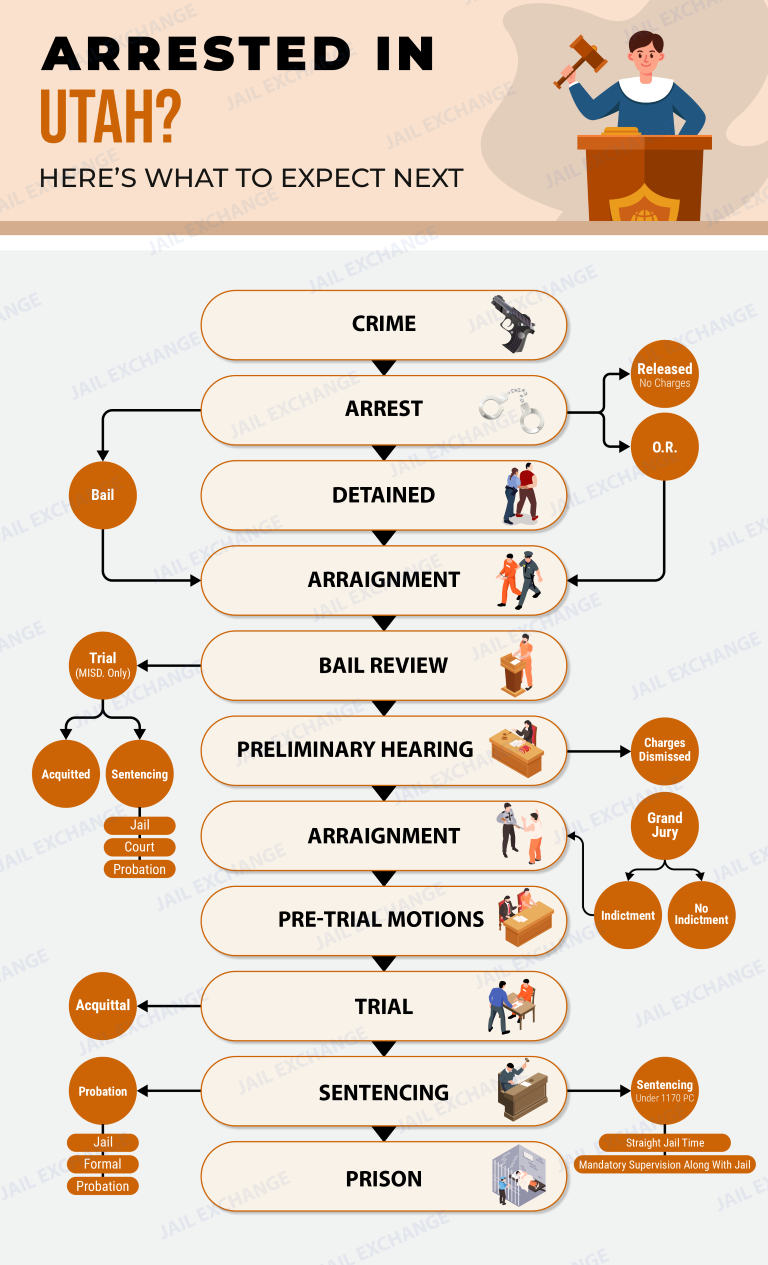
Inmate Canteen (operated by TurnKey Corrections) allows friends and family members to purchase pre-approved commissary packages, including brand-name snacks, confectionery goods, personal hygiene products, stationery, and apparel kits sent directly to an incarcerated loved one. Every package is packed to adhere strictly to facility security regulations, ensuring items pass institutional intake without being rejected at the loading dock.
Important: Package Deadlines and Delivery Windows Vary
Detention centers do not manage care package deliveries under identical schedules. While some facilities allow weekly orders, others restrict deliveries to bi-weekly or monthly distribution windows, and spending limits vary from jail to jail. You should verify the facility's active cutoff schedule and order allowances by calling them directly. If an order is submitted after the weekly processing deadline, delivery will be held until the following cycle, leaving your loved one waiting an extra cycle for fresh snacks, thermal wear, or personal care supplies.
Step-by-Step Instructions to Place a Commissary Package Order
- Confirm the inmate's legal first and last name, date of birth, and assigned booking or inmate ID number.
- Navigate to www.inmatecanteen.com and sign in or create a user profile.
- Select Commissary / Store and choose your state and detention center.
- Search for the inmate to unlock the facility's approved product catalog.
- Select allowable snack foods, candies, personal care goods, and clothing items up to the facility's allowed spending limit.
- Proceed to checkout, enter your debit or credit card billing details, and submit payment.
- Save your digital receipt and confirmation tracking number for your records.
What the Inmate Needs to Do
The inmate does not need an internet account to receive care packages. TurnKey Corrections prepares the order in secure, tamper-evident packaging and delivers it directly to the jail commissary department. Facility staff inspect the shipment and deliver the items during regular housing unit commissary rounds, where the inmate signs for receipt.
Official Provider: Inmate Canteen Official Website
Customer Service Telephone: 1-715-690-2965
Support Hours: Monday – Friday, 8:00 AM – 5:00 PM CST
Supported Languages: English and Spanish
Other Services Provided by Inmate Canteen (TurnKey Corrections)
In addition to Commissary Care Packages, Inmate Canteen provides several other communication, financial, and visitation services:
- Tablets & Chirp Units: Learn how secure handheld devices allow inmates to communicate, read, and message.
• Learn more on our website: Tablet Programs Guide | • Visit official vendor page: Inmate Canteen Devices - Remote Video Visitation: Schedule and join live face-to-face video visits from your computer or smartphone.
• Learn more on our website: Video Visitation Guide | • Visit official vendor page: Inmate Canteen Video Visits - Digital Messaging: Send electronic messages and photos directly to housing pod kiosks and handheld devices.
• Learn more on our website: Digital Messaging Guide | • Visit official vendor page: Inmate Canteen Messaging - Trust & Phone Deposits: Deposit money directly into an inmate's jail trust account or phone calling balance.
• Learn more on our website: Trust & Phone Deposits Guide | • Visit official vendor page: Inmate Canteen Deposits
Buy Commissary for an Inmate in the Davis County Correctional Facility
Davis County Correctional Facility Inmate Commissary - Sending Money or Purchasing Commissary for an Inmate
Davis County Correctional Facility allows inmates to purchase commissary. This can be snacks, hygiene products, stamps, stationary, clothing and even electronics.
You can buy commissary for an inmate using an online service called Inmate Canteen.
Inmate Canteen Customer Service can be reached at 715-690-2965, or by email at support@inmatecanteen.com.

There is a monthly limit of $200-300 on how much inmates can spend on commissary items.
This amount is subject to change so call the facility at 801-451-4200 in order to confirm the amount that cannot be exceeded.
Inmates have access to both an in-house commissary store, and commissary packages that can be purchased and shipped to the inmate by friends and family.
Scroll down for information on the Davis County Correctional Facility's service they use for you being able to purchase commissary items online and have them shipped directly to the inmate.
You can also go to our Inmate Money page for information on how to send money to an inmate.
Inmate Canteen Trust & Phone Deposits allow friends and family members to transfer money directly into an incarcerated person's jail trust account or telephone calling balance using a credit or debit card. Deposited funds give your loved one the financial balance needed to buy personal care goods, over-the-counter medication, snacks, and phone talk time from the facility canteen.
Important: Facility Banking Policies Vary Across Jails
Once a person is booked and moved to a cell, facilities do not always allow cash drop-offs or phone payments directly to the jail window. Some might and you should confirm this by calling the facility and asking. But if you do not register online and fund your loved one's trust account immediately, they may be forced to wait days or weeks for standard paper processing, leaving them without essential soap, clean undergarments, basic medical sundries or snacks.
Step-by-Step Instructions to Register and Deposit Funds
- Confirm the inmate's legal first and last name, date of birth, and assigned booking or inmate ID number.
- Navigate to www.inmatecanteen.com on your computer or mobile device.
- Click on Deposit Funds and select whether to fund the Trust Account (for commissary) or Phone Account (for talk time).
- Select the state and facility where the inmate is currently housed.
- Search for the inmate to confirm their active housing record matches the facility roster.
- Enter your deposit dollar amount, review convenience fees, and enter your debit or credit card billing details.
- Submit payment and save the digital confirmation receipt for your financial records.
What the Inmate Needs to Do
The inmate does not need an internet connection to receive trust funds. Once payment clears, the balance posts directly to their accounting profile in the jail's internal system. The inmate can review their updated balance at the pod kiosk terminal and place their regular weekly commissary order or make outbound phone calls.
Official Provider: Inmate Canteen Official Website
Customer Service Telephone: 1-715-690-2965
Support Hours: Monday – Friday, 8:00 AM – 5:00 PM CST
Supported Languages: English and Spanish
Other Services Provided by Inmate Canteen (TurnKey Corrections)
In addition to Trust & Phone Deposits, Inmate Canteen provides several other communication, financial, and commissary services at participating correctional facilities:
- Commissary & Snack Packs: Order pre-approved snack boxes, food packages, and clothing directly to the jail.
• Learn more on our website: Commissary Orders Guide | • Visit official vendor page: Inmate Canteen Commissary - Remote Video Visitation: Schedule and join live face-to-face video visits from your computer or smartphone.
• Learn more on our website: Video Visitation Guide | • Visit official vendor page: Inmate Canteen Video Visits - Digital Messaging & Chirp Texts: Send electronic messages and photos directly to housing pod kiosks and handheld devices.
• Learn more on our website: Digital Messaging Guide | • Visit official vendor page: Inmate Canteen Messaging
Deposit Money for an Inmate in the Davis County Correctional Facility
Can you mail money to the Davis County Correctional Facility? That's one thing the jail has decided not to put in writing, and staff answer it at 801-451-4200. What it does lay out are three other routes onto a commissary account at the jail, 800 West State Street in Farmington.
- Online through Inmate Canteen, any hour, with a Visa or Mastercard credit or debit card. Commissary gift packs are sold on the same site.
- Cash, Visa or Mastercard at a kiosk, either in the jail lobby or at the Work Release Center, 883 West Clark Lane in Farmington.
- By phone at (706) 298-4974, which the Sheriff's Office offers for anyone who can't use the website or a kiosk.
Most deposits are usable within 24 hours. Miss the weekly commissary deadline and the money waits for the following order.
The Davis County Correctional Facility in Farmington accepts personal mail only as postcards, and a letter written on regular paper is denied. Everything has to come by regular postal mail to the jail's post office box, since mail left at the building is turned away. Mail is handed out Monday through Friday, except holidays.
Postcards, photos, books and legal mail:
Inmate's Full Name & Booking Number
Davis County Correctional Facility
P. O. Box 130
Farmington, UT 84025
- Addressing: Use the inmate's first and last name and their booking number from the inmate roster. Sign with your full name and a complete return address.
- The postcard: A plain white postcard with the stamp already printed on it, the kind sold at the post office. Write in regular ink or pencil, and keep sexual or graphic words and pictures off it.
- Banned on postcards and photos: Glitter, glue, white-out, paint, metallic ink, lipstick, perfume, stains, grease or oil marks, and watermarks. Stickers, sticky notes, tape, loose stamps, staples, paper clips, envelopes and blank paper are refused too.
- Greeting cards and packages: The jail refuses both when mailed. Inmates can buy greeting cards and stamped envelopes through commissary.
- Photos: They must ship straight from a photo printing company, not from a home address, on standard 4 x 6 photo paper. Nothing sexual or criminal. A person may keep 10 photos.
- Books: New paperbacks only, from a bookstore or publisher, no bigger than 8½ x 11 inches and no more than two inches thick. Up to five can be received at a time.
- Magazines and newspapers: Only by publisher subscription through the mail. Each person may have two subscriptions and one newspaper, and must cancel them when released.
- Legal mail: Staff open it only with the inmate there to watch.
- Denied or late mail: Denied mail goes back to you with a short reason. Mail that comes after someone is released is returned, or held 30 days for pickup and then destroyed.
To add money, use the lobby kiosk at the Work Release Center on West Clark Lane or deposit online, and use electronic messages for quick notes.
NCIC Inmate Communications provides telecommunications services that allow incarcerated individuals to place outbound voice calls from dayroom telephones to family and friends. Because correctional facilities do not permit incoming phone calls, establishing an NCIC prepaid calling account connects calls directly to your cell phone or landline without being blocked by wireless carriers.
Important: Mobile Phones Automatically Block Inmate Calls
Cellular phone carriers automatically reject standard collect calls originating from jail phone systems. While some residential landlines might permit direct monthly billing, mobile devices and internet-based telephone lines require an active prepaid calling balance, which you can verify by checking with your provider. If you do not register online and fund an NCIC account right away, your loved one will receive an automated disconnect announcement when attempting to call your number.
Step-by-Step Instructions to Register and Fund an Account
- Visit account.ncic.com or call NCIC customer care at 1-800-943-2189.
- Click Create Account and register using the primary 10-digit telephone number where you want to receive calls.
- Select the state and correctional facility where your loved one is currently detained.
- Search for and add the inmate using their full legal name or booking ID number.
- Select your deposit dollar amount and enter your debit or credit card billing details.
- Submit payment and ensure your mobile phone settings allow calls from automated or unfamiliar correctional numbers.
What the Inmate Needs to Do
The inmate dials your 10-digit number from any dayroom telephone and keys in their assigned PIN. The automated system verifies that your phone number has an active prepaid balance and prompts you to press a digit to accept the call. All personal telephone conversations are recorded and monitored by facility staff.
Official Provider: NCIC Official Website
Customer Service Telephone: 1-800-943-2189
Support Hours: 24 hours a day, 7 days a week, 365 days a year
Supported Languages: English and Spanish
Other Services Provided by NCIC Inmate Communications
In addition to Prepaid Phone Calling, NCIC provides several other digital communication and visitation services at participating facilities:
- Remote Video Visitation: Schedule and join live face-to-face video visits from home using your computer or smartphone.
• Learn more on our website: Video Visitation Guide | • Visit official vendor page: NCIC Video Visits - Inmate Messaging Services: Send electronic messages and photos directly to an inmate's housing unit terminal.
• Learn more on our website: Inmate Messaging Guide | • Visit official vendor page: NCIC Messaging
NCIC Inmate Messaging allows friends and family members to exchange electronic text messages and digital photos directly with an incarcerated loved one. Messages are delivered electronically to housing unit terminals and tablets within hours, avoiding the lengthy transit times associated with physical postal mail.
Important: Electronic Messaging Screening Rules Differ
Inmates cannot receive incoming phone calls, and traditional postal mail rules differ across correctional agencies. While some facilities still allow regular handwritten letters, many jails have transitioned to digital-only mail scanning or restrict postal delivery, which you can verify by checking facility rules. If you do not register online and purchase messaging credits immediately, your loved one may face lengthy periods without direct written contact from family.
Step-by-Step Instructions to Register and Send Messages
- Go to account.ncic.com and sign in or create a user profile.
- Select Messaging from your dashboard options.
- Select your state and detention center, then search for the inmate using their full legal name or booking ID.
- Purchase a messaging credit bundle using a debit or credit card.
- Type your message in the composition window and attach approved JPEG photos if permitted by the facility.
- Submit your message to the facility's screening queue.
What the Inmate Needs to Do
All electronic correspondence is screened by facility staff before delivery. Once approved, messages appear in the inmate's inbox on their housing unit terminal or tablet. The inmate opens the message, reads your note, and types an electronic reply using their available credits.
Official Provider: NCIC Official Website
Customer Service Telephone: 1-800-943-2189
Support Hours: 24 hours a day, 7 days a week, 365 days a year
Supported Languages: English and Spanish
Other Services Provided by NCIC Inmate Communications
In addition to Inmate Messaging, NCIC provides calling and video visitation services at participating facilities:
- Prepaid Phone Calling Accounts: Fund a calling balance tied directly to your phone number.
• Learn more on our website: Prepaid Calling Accounts Guide | • Visit official vendor page: NCIC Prepaid Calling - Remote Video Visitation: Schedule and join live face-to-face video visits from your computer or smartphone.
• Learn more on our website: Video Visitation Guide | • Visit official vendor page: NCIC Video Visits
NCIC Inmate Communications deploys secure, corrections-grade handheld tablets to incarcerated individuals in county detention centers. Operating on a secure internal wireless network, these devices allow inmates to conduct remote video visits, make voice telephone calls, send electronic messages, stream music, read eBooks, and access self-help and educational resources directly from their housing pods.
Important: Tablet Hardware Deployment and Rental Rules Vary
Detention centers do not manage tablet distribution identically. While some agencies issue individual personal tablets to every detainee at booking, others utilize shared pod docking stations or restrict tablet use to specific dayroom hours, which you should confirm with the facility directly. Although core educational and legal resources are generally provided free of charge, sending messages, listening to music, or making phone calls from the tablet requires an active balance funded by outside contacts.
Step-by-Step Instructions to Support and Fund NCIC Tablets
- Verify that NCIC handheld tablets are active at your loved one's specific detention facility.
- Navigate to account.ncic.com on your computer or mobile device.
- Sign into your verified user account and link the inmate's legal name and booking ID number.
- Select Tablet Media / Messaging or Inmate PIN Debit to add funds to their available balance.
- Specify your deposit dollar amount, review convenience fees, and enter your credit or debit card billing details.
- Submit payment, save your confirmation receipt, and notify your loved one that their device balance is available.
What the Inmate Needs to Do
The inmate unlocks their assigned tablet using their PIN or biometric login. Their available balance appears on the screen, allowing them to download songs, read digital books, write messages, and communicate with approved family members. Devices are returned to charging carts during quiet hours and shift counts for overnight recharging.
Official Provider: NCIC Official Website
Customer Service Telephone: 1-800-943-2189
Support Hours: 24 hours a day, 7 days a week, 365 days a year
Supported Languages: English and Spanish
Other Services Provided by NCIC Inmate Communications
In addition to Tablet Services, NCIC provides several other communication, financial, and visitation options:
- Prepaid Phone Calling Accounts: Prepay for phone calling credits so your loved one can call your telephone directly.
• Learn more on our website: Prepaid Calling Accounts Guide | • Visit official vendor page: NCIC Prepaid Calling - Remote Video Visitation: Schedule and join live face-to-face video visits from your computer or smartphone.
• Learn more on our website: Video Visitation Guide | • Visit official vendor page: NCIC Video Visits - Inmate Messaging Services: Send electronic messages and photos directly to an inmate's terminal or tablet.
• Learn more on our website: Inmate Messaging Guide | • Visit official vendor page: NCIC Messaging - Inmate Trust & Commissary Money Deposits: Send canteen funds directly into an incarcerated person's jail trust account.
• Learn more on our website: Trust Deposits Guide | • Visit official vendor page: NCIC Trust Deposits
Davis County County Jails
Davis County Juvenile Facilities
Nearby counties
- Jail (Main): 801-451-4200
The Davis County Correctional Facility serves the following cities and towns of Davis County: Bountiful, Centerville, Clearfield, Clinton, Farmington, Fruit Heights, Kaysville, Layton, North Salt Lake, South Weber, Sunset, Syracuse, West Bountiful, West Point and Woods Cross.