Weber County Correctional Facility Criminal Court Process
Criminal Court Process for Weber County Utah
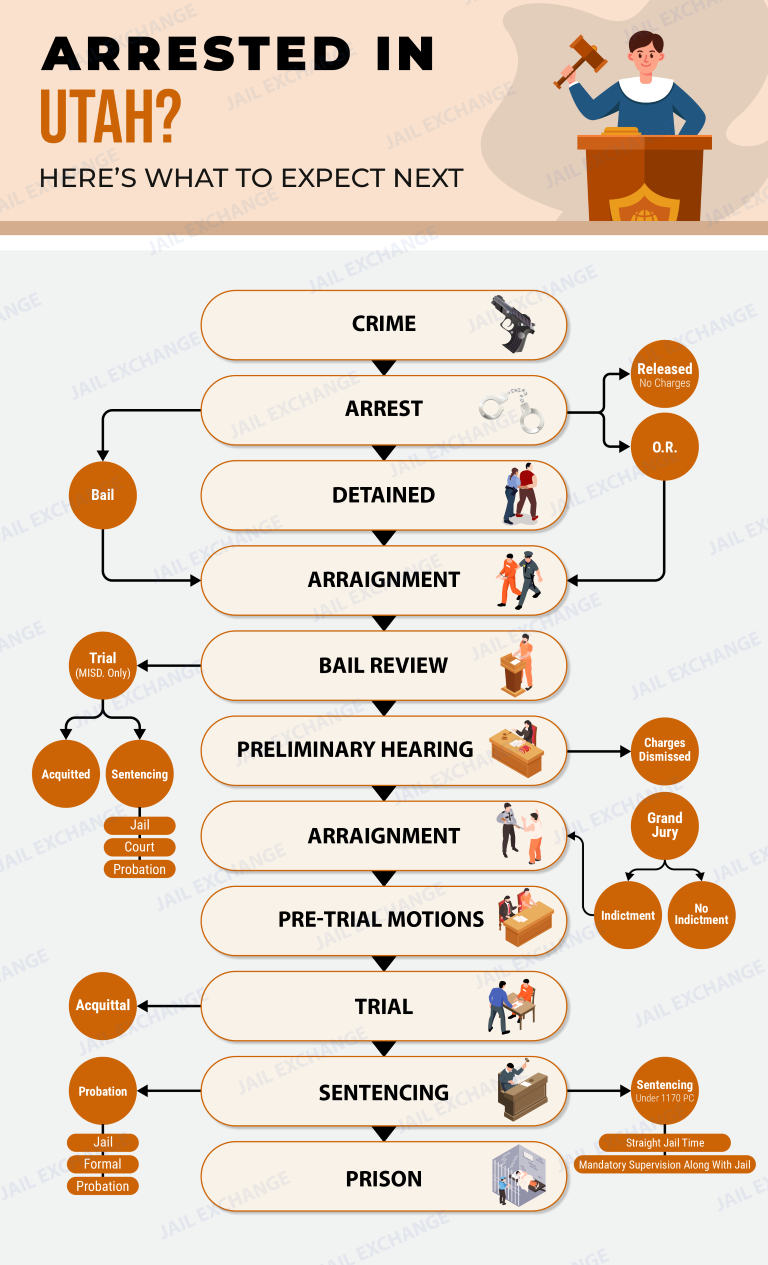
The days after a Weber County arrest can involve several offices, a jail booking, and more than one type of hearing. Here you can learn the difference between Justice Court and District Court, see confirmed court contact details, and understand what might happen next. Additional answers address bail, misdemeanor and felony punishment, juveniles, public defenders, and federal offenses. Read the summons or court notice carefully: the address for one court is not automatically the address for another.
- Where are criminal cases heard, and how can families contact the courts?
- What happens at booking, and where is an arrested person held?
- How does release, bail, or a detention decision work?
- What is the misdemeanor court process?
- How do felony and violent-crime cases move forward?
- What penalties and fines does Utah law allow?
- What happens when a child is accused of a crime?
- How does someone ask for a public defender?
- What local or municipal Justice Courts handle criminal cases?
- What if the accusation is a federal crime?
1. Where are criminal cases heard, and how can families contact the courts?
In Weber County, Utah, District Court handles felony cases and certain other serious matters. Justice Courts ordinarily hear class B and C misdemeanors, many traffic matters, and municipal or county ordinance cases. Court assignment depends on where the charge was filed.
The following physical court locations and published telephone contacts were identified in the Utah Judicial Branch directory:
- Ogden District Court — 2525 Grant Avenue, Ogden, UT 84401, 801-395-1079
- North Ogden Justice Court — 515 East 2600 North, North Ogden, UT 84414, 801-737-2203
- Harrisville Justice Court — 363 West Independence Boulevard, Harrisville, UT 84404, 801-782-4100
For an actual court date, use the name of the court stated on the notice. Family and juvenile hearings may be scheduled at a different building from adult criminal court.
2. What happens at booking, and where is an arrested person held?
After an arrest in Weber County, the officer may take the person for fingerprinting, identification, medical screening and booking. The court charges and any warrant determine what happens next; an arrest does not mean the person has been convicted.
The county detention facility is Weber County Correctional Facility, telephone 801-778-6700. The facility page provides inmate-search and custody information for this county; release depends on the court’s order and the charge.
Have the person’s full legal name and approximate date of birth available when asking about custody. Charges, court dates and release conditions are separate from the jail’s visiting and communication rules.
3. How does release, bail, or a detention decision work?
County jail and custody: Weber County Correctional Facility is the detention facility identified for this county. Its facility page includes a Bail section describing payment and release information.
Utah courts may release someone on a promise to return, set supervision or restrictions, or require financial security when legally justified. A judge considers the charges, the person’s history, public safety and the risk of failing to appear. The exact order—not a general estimate—controls what a family must pay or do.
Ask what kind of release was ordered: cash deposit, a surety bond, nonfinancial restrictions or continued detention. A private bail agent may help with an eligible surety bond, but the court decides whether that bond is allowed.
If detention continues, defense counsel can ask the court to review release conditions. Keep every payment receipt and never send bail funds to an account supplied through an unsolicited message.
4. What is the misdemeanor court process?
A class B or class C misdemeanor is usually tried in a Justice Court. A class A misdemeanor is generally handled in District Court. The judge tells the accused about the charges and rights, accepts a plea, and sets additional dates when the case is contested.
A guilty plea may lead to a fine, probation, restitution, treatment, community service or jail where the law allows it. If the accused denies the charge, the prosecution must prove the case beyond a reasonable doubt; some cases can be tried to a jury.
5. How do felony and violent-crime cases move forward?
A felony is handled in Utah District Court rather than being finally decided by a Justice Court judge. The early stages may include an initial appearance, review of custody, a preliminary hearing or other charging process, and appointment of counsel for those who qualify.
If the case continues, prosecutors and defense lawyers exchange information and may file motions. The person may accept a negotiated plea or go to trial. Murder, aggravated assault, major drug trafficking and other serious allegations may carry special minimum terms or enhancement provisions; the precise statute matters.
6. What penalties and fines does Utah law allow?
Utah’s general misdemeanor limits under Utah Code § 76-3-204 are:
- Class A: usually up to 364 days; some offenses against individuals have a maximum of one year.
- Class B: no more than six months.
- Class C: no more than 90 days.
The general maximum fines under § 76-3-301 are $2,500 for class A, $1,000 for class B and $750 for class C, before applicable surcharges or restitution. Individual statutes can provide different punishments.
For felony imprisonment, § 76-3-203 ordinarily provides first degree: five years to life; second degree: one to 15 years; and third degree: up to five years. Ordinary fine ceilings are $10,000 for first- or second-degree felonies and $5,000 for third-degree felonies. These are statutory limits, not predictions about a particular case.
Utah uses indeterminate felony sentencing. Actual time served can depend on the offense, enhancements, minimum terms, credits and decisions of the Board of Pardons and Parole. The judge may also consider restitution, treatment and supervision where authorized.
How much prison time and how large a fine?
- First-degree felony: ordinary indeterminate prison term of five years to life; ordinary individual fine limit $10,000.
- Second-degree felony: ordinary indeterminate prison term of one to fifteen years; ordinary individual fine limit $10,000.
- Third-degree felony: ordinary prison term of zero to five years; ordinary individual fine limit $5,000.
- Class A misdemeanor: commonly up to 364 days; ordinary maximum fine $2,500.
- Class B misdemeanor: up to six months; ordinary maximum fine $1,000.
- Class C misdemeanor: up to 90 days; ordinary maximum fine $750.
Those figures summarize Utah Code §§ 76-3-203, 76-3-204 and 76-3-301. They are not automatic sentences. Special offenses, mandatory terms, enhancements, restitution, surcharges and the Board of Pardons and Parole can change the practical result.
7. What happens when a child is accused of a crime?
When a person younger than 18 is accused of breaking criminal law in Weber County, the case commonly goes through juvenile intake and Utah Juvenile Court rather than the adult criminal docket. The system may use screening, services, informal adjustment or a formal delinquency petition, depending on the offense.
Parents and guardians should learn whether the child has been released or held under a juvenile detention order. Schooling, treatment, probation and placement decisions are different from an adult jail sentence. Serious charges can sometimes be transferred to adult court under special legal requirements.
8. How does someone ask for a public defender?
A person who cannot afford to hire a defense lawyer can tell the judge at the first appearance and request appointed counsel. Courts review financial eligibility and whether the charge qualifies. A family member cannot automatically apply on an adult defendant’s behalf.
The defense lawyer—not the prosecuting attorney—explains the allegations, evidence, plea offers and possible sentences. If the accused remains in custody, ask jail staff how attorney contact is arranged. An assigned lawyer may be from a county public defender program or a contracted indigent-defense provider.
What a family can do before the next hearing
Help the accused assemble any court notices, proof of income, employment information and household expenses so the judge can assess eligibility for appointed counsel. Ask the court to consider the request for defense counsel before discussing a plea with the prosecution. If an attorney has been assigned, give that lawyer the case number and upcoming hearing date; do not send sensitive facts about the case through a public website.
9. What local or municipal Justice Courts handle criminal cases?
Local Justice Courts can be important because the first court date for a citation or lower-level charge may be here rather than at District Court.
- North Ogden Justice Court — 515 East 2600 North, North Ogden, UT 84414, 801-737-2203
- Harrisville Justice Court — 363 West Independence Boulevard, Harrisville, UT 84404, 801-782-4100
Justice Court is not the same as a police station or jail. A person released on a citation still must attend the hearing printed on that citation.
10. What if the accusation is a federal crime?
A case is federal when a federal criminal law is alleged to have been violated—for example, certain interstate fraud offenses, federal drug trafficking, offenses on federal land or crimes investigated under federal jurisdiction. Serious conduct is not automatically federal merely because it is a felony.
The U.S. District Court for the District of Utah serves Weber County. The relevant federal court location is: United States District Court, 351 South West Temple, Salt Lake City, UT 84101. The official notice or summons controls the required appearance location.
Federal cases can include an initial appearance before a U.S. magistrate judge, a detention hearing, federal charges or indictment, discovery, plea negotiations, trial and sentencing. Federal sentencing follows federal statutes and guidelines, not Utah’s state misdemeanor and felony ranges.
Federal prison sentences are ordinarily served at facilities designated by the Bureau of Prisons. A defendant awaiting federal trial or transfer may instead be held temporarily in a local or contracted detention facility. Search the Federal Bureau of Prisons Inmate Locator for people in its system.
Finding a federal prisoner: The Federal Bureau of Prisons inmate locator can help find people in the BOP system. Federal pretrial detainees may instead be kept temporarily in a local jail or contract facility while the U.S. Marshals Service handles custody.
General information about Utah criminal procedure, not legal advice. Exact charges, court assignments, sentencing enhancements, and detention orders vary by case.