
Weber County Kiesel Jail Facility
Weber County Kiesel Jail Facility
12th Street Facility
801-399-8427Weber County bail and bond: the Ogden jail, the O.R. program, and release
Adults arrested in Weber County are booked into the Weber County Jail, run by the Sheriff's Office at 1400 Depot Drive, Ogden. The jail answers at 801-778-6700. Check custody first with Weber County Inmate Search. A jail official can set a first money condition, a judge can change it, and bail can be paid in cash or through a licensed bond company. Some people qualify for release with no payment through the O.R. program.
1. Is my relative inside the Weber County Jail in Ogden?
Look the name up in Weber County Inmate Search. The record carries the booking and the charges. A person booked within the last hour may not appear yet, and someone who got a citation and walked away will not appear at all. For a hold or a question the record leaves out, call the jail at 801-778-6700.
2. Which Weber County number do I call for what?
The jail line is 801-778-6700. Enforcement is 801-778-6600, records is 801-778-6661, and non-emergency dispatch is 801-395-8221. Office hours at the Sheriff's Office are Monday through Friday, 8 a.m. to 5 p.m., except holidays, so use the jail line at night.
3. Where is the jail, and who is in charge of it?
The Sheriff's Office and Corrections Division are at 1400 Depot Drive, Ogden, UT 84404. Sheriff Ryan Arbon leads the office, and the Sheriff's Office also runs the Kiesel Jail Facility. The Weber County Jail also receives inmates from Morgan County, which has no jail of its own.
4. What will my relative be told at booking?
At booking the person is told the charges and the bail amount. The amount is marked either cash only or bondable. The person may make a collect call to try to arrange bail.
If you have heard nothing, phone 801-778-6700 and ask whether the booking is finished.
5. What is the difference between cash only and bondable?
A cash-only amount must be paid in full as cash or an accepted equivalent, with no bond company in the middle. A bondable amount can also be covered by a licensed bond company, which posts a bond for a fee. Ask the jail at 801-778-6700 which label applies to your person.
6. Does Weber County keep a list of bond companies?
Yes. A list of licensed bonding companies is available at each phone for arrestees. Companies that post bonds at the Weber County Jail pay the Sheriff's Office a $5 cash processing fee for each bond, effective September 16, 2025, and a bond without that cash fee cannot be processed. Ask your agent whether the fee is passed on to you.
7. Can my relative leave without paying anything?
Some people qualify for release without bail through the pretrial release program, called O.R. Staff look at an address, employment, and community ties, which are checked through a relative or friend. Classification can take up to 72 hours.
Give the jail a working number for a relative or friend who can answer, and call 801-778-6700 for the status.
8. Who sets the amount in the first place?
A county jail official, the sheriff or a designee, may release eligible people on a signed promise or set a financial condition for certain misdemeanors and eligible felonies. A written sheriff's policy governs the releases.
Later, a magistrate issues a pretrial status order at the first appearance. The magistrate sets any financial condition using the state schedule, weighs risk of missing court and ability to pay, and picks one amount for the case.
9. What forms of payment does Utah allow at a county jail?
Cash, a certified or cashier's check, a money order, a personal check with a check guarantee card, or a credit card if the jail has chosen to accept cards. The money goes to the court within three days.
Weber County's booking staff collect bail and other fees. Call 801-778-6700 for which payments the window takes today.
10. Once bail is paid, how fast is the release?
Staff release the person as soon as possible after bail is posted. Court-ordered releases usually begin around 5 p.m., and completed sentences are usually released around 9 a.m.
Do not expect a pickup before those times for a court-ordered release. Phone 801-778-6700 when you pay and ask for an estimate.
11. What does the Second District Court in Ogden handle?
The Second District Court is at 2525 Grant Avenue, Ogden, UT 84401, 801-395-1079. Felonies and the more serious misdemeanors are heard there. Class B and C misdemeanors and infractions go to a justice court, which the booking sheet or the clerk can identify.
12. How can I get a public defender in Weber County?
Ask the judge for one at the first appearance if you cannot afford a lawyer. The Weber County Public Defender Group, 2380 Washington Boulevard, Suite 360, Ogden, 801-721-0354, provides indigent defense in the county.
13. What can a bail bond agent charge here?
The agent must hold a Utah Insurance Department license. The first premium runs between 10 and 20 percent of the bond, with up to $20 per set for forms and up to 5 percent for card payments.
Receive the written disclosure before release. It must show the amount, the fee breakdown, the collateral, and how collateral is returned.
14. Which cases allow no bail in Utah?
Capital offenses, a felony committed on probation, parole, or bail for an earlier felony, and other crimes the law marks non-bailable when clear and convincing evidence shows danger or flight. Substantial evidence for the charge is required in every one of those categories.
Someone arrested for a protective-order violation cannot be released before the first appearance, and a judge who orders detention must state findings. The person can appeal quickly.
15. What if we cannot pay what was set?
After seven days the person may ask the judge to modify the condition. The law presumes the person cannot pay, and the judge may lower the amount or use non-money conditions.
Ask the Public Defender Group at 801-721-0354 or the court at 801-395-1079 what to file.
16. What happens if a Weber County hearing is missed?
The judge may issue a bench warrant and forfeit the bond. After a willful or repeated no-show, the court must weigh whether a bail bond would improve attendance. Call the court at 801-395-1079 the same day and get a lawyer.
17. Will the court accept my home or land?
Utah's bail statutes list cash and licensed surety bonds. Property is a request for the judge to approve. Phone the Second District Court at 801-395-1079 and ask what papers it wants before you spend money on appraisals.
18. My teenager was arrested in Weber County. Where do I go?
The Division of Juvenile Justice and Youth Services serves Weber County through the Weber Valley Youth Center, 1305 South 700 West, Ogden, 801-612-4901; its home detention line is 801-774-8767. Minors are not on the adult search.
19. My relative is serving a sentence. Does any time come off?
Under Weber County's rule, statutory Good Time is 10 days of credit for every 30 days served. A person is not eligible when the judge orders no Good Time, or when the person is under the jurisdiction of the Utah Department of Corrections or the U.S. Marshals. Ask the jail at 801-778-6700 how the credit applies to a specific sentence.
20. What does a payment scam look like?
A message with a payment link or QR code that claims to be from a court is a scam, since the courts do not request payment that way. Gift cards are another sign. Call 801-778-6700 to check on a booking.
Key contacts for Weber County bail questions
- County jail
- Weber County Jail, 1400 Depot Drive, Ogden, UT 84404; 801-778-6700
- Bail and bond
- Jail list and bail guide
- Custody lookup
- Weber County Inmate Search
- Sheriff's Office
- 1400 Depot Drive, Ogden, UT 84404; enforcement 801-778-6600; non-emergency 801-395-8221
- Records
- 801-778-6661; office hours Monday to Friday, 8 a.m. to 5 p.m.
- District court
- Second District Court, 2525 Grant Avenue, Ogden, UT 84401; 801-395-1079
- Public defender
- Weber County Public Defender Group, 2380 Washington Boulevard, Suite 360, Ogden, UT 84401; 801-721-0354
- Youth detention
- Weber Valley Youth Center, 1305 South 700 West, Ogden, 801-612-4901
Release times, fees, and office hours can change, so confirm with the jail before you pay. This is a general explanation of the process, not legal advice.
The Weber County Sheriff recommends that you might want to use a bail bond agent licensed to do business in Weber County.
However if you don't want to use a bail bond agent:
- You can always pay a cash bond yourself, or use your home in Weber County, or in some cases the state of Utah, but the benefit of using a bail bond agent is that they take responsibility for making sure the inmate shows up for court in Weber County, and if they don't, then they take the financial responsibility.
- The typical fee for a bond in Utah is between 10-20% of the bail amount; usually 15% or less. So if an offender has a bail of $10,000.00, their bond will be $1,500.00.
- Pay by cash, cashier's check, money order or credit card at the Weber County Kiesel Jail Facility, or the courthouse in Weber County where the offense took place.
Call 801-399-8427 to find out the exact bond (plus other fees) amount, or look it up online by looking up the information on the Weber County inmate locator.

Weber County Kiesel Jail Facility Inmate Visitation
Friends and Family – You will not find visiting hours for this Utah jail posted online. Call 801-399-8427 and a staff member will tell you the days and times now in effect. In Utah, many jails mention privacy, security, and per-inmate or per-unit scheduling.
Have the inmate's full name and date of birth, your identification, and a booking number when you have one. Visits are often withheld until the person has been in custody from two days to a week; ask when they become eligible. Open with your name and how you are related, then ask for the hours in a courteous way.
On the call, ask what ID to have with you, how much advance scheduling is required, how long visits are running right now, what days and times you should plan around, and whether you have to register or be placed on an approved list and how to get added. Also ask if minors are allowed, and what you must bring for them, what attire is allowed and what you can have with you, and whether a face-to-face visit, a video visit, or both are allowed.
Common visiting rules at most jails look like the ones below. Check each point when you call 801-399-8427. Most jails ask you to be there at least 15 minutes early. Late arrivals may lose the visit. Bring only your car key and your ID into the visiting area. A person just released from the same jail usually needs permission from the sheriff or the jail administrator before they can visit. Plan on modest clothing.
Tank tops, sleeveless shirts, short skirts or shorts, and revealing or see-through outfits, gang colors, offensive prints, hats, and sunglasses are commonly refused, and shoes are usually required. Most jails may ask you to fill out a visitor application and complete a background check before a visit is allowed. Visits can be cancelled without notice, for example during a lockdown or count.
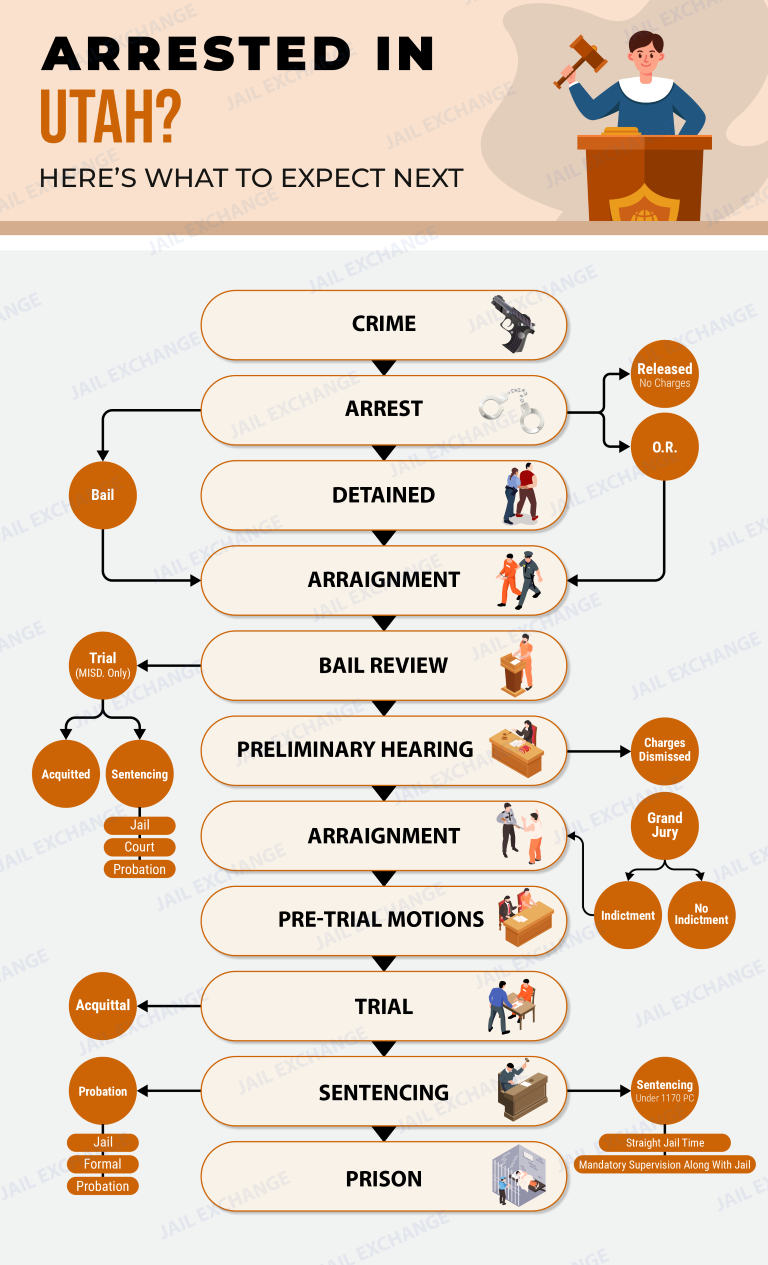
The days after a Weber County arrest can involve several offices, a jail booking, and more than one type of hearing. Here you can learn the difference between Justice Court and District Court, see confirmed court contact details, and understand what might happen next. Additional answers address bail, misdemeanor and felony punishment, juveniles, public defenders, and federal offenses. Read the summons or court notice carefully: the address for one court is not automatically the address for another.
- Where are criminal cases heard, and how can families contact the courts?
- What happens at booking, and where is an arrested person held?
- How does release, bail, or a detention decision work?
- What is the misdemeanor court process?
- How do felony and violent-crime cases move forward?
- What penalties and fines does Utah law allow?
- What happens when a child is accused of a crime?
- How does someone ask for a public defender?
- What local or municipal Justice Courts handle criminal cases?
- What if the accusation is a federal crime?
1. Where are criminal cases heard, and how can families contact the courts?
In Weber County, Utah, District Court handles felony cases and certain other serious matters. Justice Courts ordinarily hear class B and C misdemeanors, many traffic matters, and municipal or county ordinance cases. Court assignment depends on where the charge was filed.
The following physical court locations and published telephone contacts were identified in the Utah Judicial Branch directory:
- Ogden District Court — 2525 Grant Avenue, Ogden, UT 84401, 801-395-1079
- North Ogden Justice Court — 515 East 2600 North, North Ogden, UT 84414, 801-737-2203
- Harrisville Justice Court — 363 West Independence Boulevard, Harrisville, UT 84404, 801-782-4100
For an actual court date, use the name of the court stated on the notice. Family and juvenile hearings may be scheduled at a different building from adult criminal court.
2. What happens at booking, and where is an arrested person held?
After an arrest in Weber County, the officer may take the person for fingerprinting, identification, medical screening and booking. The court charges and any warrant determine what happens next; an arrest does not mean the person has been convicted.
The county detention facility is Weber County Correctional Facility, telephone 801-778-6700. The facility page provides inmate-search and custody information for this county; release depends on the court’s order and the charge.
Have the person’s full legal name and approximate date of birth available when asking about custody. Charges, court dates and release conditions are separate from the jail’s visiting and communication rules.
3. How does release, bail, or a detention decision work?
County jail and custody: Weber County Correctional Facility is the detention facility identified for this county. Its facility page includes a Bail section describing payment and release information.
Utah courts may release someone on a promise to return, set supervision or restrictions, or require financial security when legally justified. A judge considers the charges, the person’s history, public safety and the risk of failing to appear. The exact order—not a general estimate—controls what a family must pay or do.
Ask what kind of release was ordered: cash deposit, a surety bond, nonfinancial restrictions or continued detention. A private bail agent may help with an eligible surety bond, but the court decides whether that bond is allowed.
If detention continues, defense counsel can ask the court to review release conditions. Keep every payment receipt and never send bail funds to an account supplied through an unsolicited message.
4. What is the misdemeanor court process?
A class B or class C misdemeanor is usually tried in a Justice Court. A class A misdemeanor is generally handled in District Court. The judge tells the accused about the charges and rights, accepts a plea, and sets additional dates when the case is contested.
A guilty plea may lead to a fine, probation, restitution, treatment, community service or jail where the law allows it. If the accused denies the charge, the prosecution must prove the case beyond a reasonable doubt; some cases can be tried to a jury.
5. How do felony and violent-crime cases move forward?
A felony is handled in Utah District Court rather than being finally decided by a Justice Court judge. The early stages may include an initial appearance, review of custody, a preliminary hearing or other charging process, and appointment of counsel for those who qualify.
If the case continues, prosecutors and defense lawyers exchange information and may file motions. The person may accept a negotiated plea or go to trial. Murder, aggravated assault, major drug trafficking and other serious allegations may carry special minimum terms or enhancement provisions; the precise statute matters.
6. What penalties and fines does Utah law allow?
Utah’s general misdemeanor limits under Utah Code § 76-3-204 are:
- Class A: usually up to 364 days; some offenses against individuals have a maximum of one year.
- Class B: no more than six months.
- Class C: no more than 90 days.
The general maximum fines under § 76-3-301 are $2,500 for class A, $1,000 for class B and $750 for class C, before applicable surcharges or restitution. Individual statutes can provide different punishments.
For felony imprisonment, § 76-3-203 ordinarily provides first degree: five years to life; second degree: one to 15 years; and third degree: up to five years. Ordinary fine ceilings are $10,000 for first- or second-degree felonies and $5,000 for third-degree felonies. These are statutory limits, not predictions about a particular case.
Utah uses indeterminate felony sentencing. Actual time served can depend on the offense, enhancements, minimum terms, credits and decisions of the Board of Pardons and Parole. The judge may also consider restitution, treatment and supervision where authorized.
How much prison time and how large a fine?
- First-degree felony: ordinary indeterminate prison term of five years to life; ordinary individual fine limit $10,000.
- Second-degree felony: ordinary indeterminate prison term of one to fifteen years; ordinary individual fine limit $10,000.
- Third-degree felony: ordinary prison term of zero to five years; ordinary individual fine limit $5,000.
- Class A misdemeanor: commonly up to 364 days; ordinary maximum fine $2,500.
- Class B misdemeanor: up to six months; ordinary maximum fine $1,000.
- Class C misdemeanor: up to 90 days; ordinary maximum fine $750.
Those figures summarize Utah Code §§ 76-3-203, 76-3-204 and 76-3-301. They are not automatic sentences. Special offenses, mandatory terms, enhancements, restitution, surcharges and the Board of Pardons and Parole can change the practical result.
7. What happens when a child is accused of a crime?
When a person younger than 18 is accused of breaking criminal law in Weber County, the case commonly goes through juvenile intake and Utah Juvenile Court rather than the adult criminal docket. The system may use screening, services, informal adjustment or a formal delinquency petition, depending on the offense.
Parents and guardians should learn whether the child has been released or held under a juvenile detention order. Schooling, treatment, probation and placement decisions are different from an adult jail sentence. Serious charges can sometimes be transferred to adult court under special legal requirements.
8. How does someone ask for a public defender?
A person who cannot afford to hire a defense lawyer can tell the judge at the first appearance and request appointed counsel. Courts review financial eligibility and whether the charge qualifies. A family member cannot automatically apply on an adult defendant’s behalf.
The defense lawyer—not the prosecuting attorney—explains the allegations, evidence, plea offers and possible sentences. If the accused remains in custody, ask jail staff how attorney contact is arranged. An assigned lawyer may be from a county public defender program or a contracted indigent-defense provider.
What a family can do before the next hearing
Help the accused assemble any court notices, proof of income, employment information and household expenses so the judge can assess eligibility for appointed counsel. Ask the court to consider the request for defense counsel before discussing a plea with the prosecution. If an attorney has been assigned, give that lawyer the case number and upcoming hearing date; do not send sensitive facts about the case through a public website.
9. What local or municipal Justice Courts handle criminal cases?
Local Justice Courts can be important because the first court date for a citation or lower-level charge may be here rather than at District Court.
- North Ogden Justice Court — 515 East 2600 North, North Ogden, UT 84414, 801-737-2203
- Harrisville Justice Court — 363 West Independence Boulevard, Harrisville, UT 84404, 801-782-4100
Justice Court is not the same as a police station or jail. A person released on a citation still must attend the hearing printed on that citation.
10. What if the accusation is a federal crime?
A case is federal when a federal criminal law is alleged to have been violated—for example, certain interstate fraud offenses, federal drug trafficking, offenses on federal land or crimes investigated under federal jurisdiction. Serious conduct is not automatically federal merely because it is a felony.
The U.S. District Court for the District of Utah serves Weber County. The relevant federal court location is: United States District Court, 351 South West Temple, Salt Lake City, UT 84101. The official notice or summons controls the required appearance location.
Federal cases can include an initial appearance before a U.S. magistrate judge, a detention hearing, federal charges or indictment, discovery, plea negotiations, trial and sentencing. Federal sentencing follows federal statutes and guidelines, not Utah’s state misdemeanor and felony ranges.
Federal prison sentences are ordinarily served at facilities designated by the Bureau of Prisons. A defendant awaiting federal trial or transfer may instead be held temporarily in a local or contracted detention facility. Search the Federal Bureau of Prisons Inmate Locator for people in its system.
Finding a federal prisoner: The Federal Bureau of Prisons inmate locator can help find people in the BOP system. Federal pretrial detainees may instead be kept temporarily in a local jail or contract facility while the U.S. Marshals Service handles custody.
General information about Utah criminal procedure, not legal advice. Exact charges, court assignments, sentencing enhancements, and detention orders vary by case.

Inmate Canteen (operated by TurnKey Corrections) allows friends and family members to purchase pre-approved commissary packages, including brand-name snacks, confectionery goods, personal hygiene products, stationery, and apparel kits sent directly to an incarcerated loved one. Every package is packed to adhere strictly to facility security regulations, ensuring items pass institutional intake without being rejected at the loading dock.
Important: Package Deadlines and Delivery Windows Vary
Detention centers do not manage care package deliveries under identical schedules. While some facilities allow weekly orders, others restrict deliveries to bi-weekly or monthly distribution windows, and spending limits vary from jail to jail. You should verify the facility's active cutoff schedule and order allowances by calling them directly. If an order is submitted after the weekly processing deadline, delivery will be held until the following cycle, leaving your loved one waiting an extra cycle for fresh snacks, thermal wear, or personal care supplies.
Step-by-Step Instructions to Place a Commissary Package Order
- Confirm the inmate's legal first and last name, date of birth, and assigned booking or inmate ID number.
- Navigate to www.inmatecanteen.com and sign in or create a user profile.
- Select Commissary / Store and choose your state and detention center.
- Search for the inmate to unlock the facility's approved product catalog.
- Select allowable snack foods, candies, personal care goods, and clothing items up to the facility's allowed spending limit.
- Proceed to checkout, enter your debit or credit card billing details, and submit payment.
- Save your digital receipt and confirmation tracking number for your records.
What the Inmate Needs to Do
The inmate does not need an internet account to receive care packages. TurnKey Corrections prepares the order in secure, tamper-evident packaging and delivers it directly to the jail commissary department. Facility staff inspect the shipment and deliver the items during regular housing unit commissary rounds, where the inmate signs for receipt.
Official Provider: Inmate Canteen Official Website
Customer Service Telephone: 1-715-690-2965
Support Hours: Monday – Friday, 8:00 AM – 5:00 PM CST
Supported Languages: English and Spanish
Other Services Provided by Inmate Canteen (TurnKey Corrections)
In addition to Commissary Care Packages, Inmate Canteen provides several other communication, financial, and visitation services:
- Tablets & Chirp Units: Learn how secure handheld devices allow inmates to communicate, read, and message.
• Learn more on our website: Tablet Programs Guide | • Visit official vendor page: Inmate Canteen Devices - Remote Video Visitation: Schedule and join live face-to-face video visits from your computer or smartphone.
• Learn more on our website: Video Visitation Guide | • Visit official vendor page: Inmate Canteen Video Visits - Digital Messaging: Send electronic messages and photos directly to housing pod kiosks and handheld devices.
• Learn more on our website: Digital Messaging Guide | • Visit official vendor page: Inmate Canteen Messaging - Trust & Phone Deposits: Deposit money directly into an inmate's jail trust account or phone calling balance.
• Learn more on our website: Trust & Phone Deposits Guide | • Visit official vendor page: Inmate Canteen Deposits
Buy Commissary for an Inmate in the Weber County Kiesel Jail Facility
Weber County Kiesel Jail Facility Inmate Commissary - Sending Money or Purchasing Commissary for an Inmate
Weber County Kiesel Jail Facility allows inmates to purchase commissary. This can be snacks, hygiene products, stamps, stationary, clothing and even electronics.
You can buy commissary for an inmate using an online service called Inmate Canteen.
Inmate Canteen Customer Service can be reached at 715-690-2965, or by email at support@inmatecanteen.com.

There is a monthly limit of $200-300 on how much inmates can spend on commissary items.
This amount is subject to change so call the facility at 801-399-8427 in order to confirm the amount that cannot be exceeded.
Inmates have access to both an in-house commissary store, and commissary packages that can be purchased and shipped to the inmate by friends and family.
Scroll down for information on the Weber County Kiesel Jail Facility's service they use for you being able to purchase commissary items online and have them shipped directly to the inmate.
You can also go to our Inmate Money page for information on how to send money to an inmate.
Inmate Canteen Trust & Phone Deposits allow friends and family members to transfer money directly into an incarcerated person's jail trust account or telephone calling balance using a credit or debit card. Deposited funds give your loved one the financial balance needed to buy personal care goods, over-the-counter medication, snacks, and phone talk time from the facility canteen.
Important: Facility Banking Policies Vary Across Jails
Once a person is booked and moved to a cell, facilities do not always allow cash drop-offs or phone payments directly to the jail window. Some might and you should confirm this by calling the facility and asking. But if you do not register online and fund your loved one's trust account immediately, they may be forced to wait days or weeks for standard paper processing, leaving them without essential soap, clean undergarments, basic medical sundries or snacks.
Step-by-Step Instructions to Register and Deposit Funds
- Confirm the inmate's legal first and last name, date of birth, and assigned booking or inmate ID number.
- Navigate to www.inmatecanteen.com on your computer or mobile device.
- Click on Deposit Funds and select whether to fund the Trust Account (for commissary) or Phone Account (for talk time).
- Select the state and facility where the inmate is currently housed.
- Search for the inmate to confirm their active housing record matches the facility roster.
- Enter your deposit dollar amount, review convenience fees, and enter your debit or credit card billing details.
- Submit payment and save the digital confirmation receipt for your financial records.
What the Inmate Needs to Do
The inmate does not need an internet connection to receive trust funds. Once payment clears, the balance posts directly to their accounting profile in the jail's internal system. The inmate can review their updated balance at the pod kiosk terminal and place their regular weekly commissary order or make outbound phone calls.
Official Provider: Inmate Canteen Official Website
Customer Service Telephone: 1-715-690-2965
Support Hours: Monday – Friday, 8:00 AM – 5:00 PM CST
Supported Languages: English and Spanish
Other Services Provided by Inmate Canteen (TurnKey Corrections)
In addition to Trust & Phone Deposits, Inmate Canteen provides several other communication, financial, and commissary services at participating correctional facilities:
- Commissary & Snack Packs: Order pre-approved snack boxes, food packages, and clothing directly to the jail.
• Learn more on our website: Commissary Orders Guide | • Visit official vendor page: Inmate Canteen Commissary - Remote Video Visitation: Schedule and join live face-to-face video visits from your computer or smartphone.
• Learn more on our website: Video Visitation Guide | • Visit official vendor page: Inmate Canteen Video Visits - Digital Messaging & Chirp Texts: Send electronic messages and photos directly to housing pod kiosks and handheld devices.
• Learn more on our website: Digital Messaging Guide | • Visit official vendor page: Inmate Canteen Messaging
Deposit Money for an Inmate in the Weber County Kiesel Jail Facility
The Easiest and Securest Way of Depositing Money for an Inmate
There are several methods for depositing money on an inmate's account:
1. To send money online to an inmate in the Weber County Kiesel Jail Facility use Inmate Canteen.
2. If you prefer to use your credit or debit card and deposit money over the phone, unfortunately Inmate Canteen does not accept phone calls, but you can ask questions using the chat box on their home page.
3. Deposit cash or use a debit or credit card using a dedicated kiosk for this purpose. The machine is located in the lobby or visitation area of the Weber County Kiesel Jail Facility.
4. The Weber County Kiesel Jail Facility may also allow you to *mail an inmate a money order or cashier’s check from a trusted source such as the Post Office, a local bank, or Western Union. The money order should be be made out to either the inmate or the Weber County Sheriff's Office, with the inmate’s name and ID# on the memo line of the check. To confirm this option call the facility at 801-399-8427.
Inmate Canteen Customer Service can be reached at 715-690-2965, or by email at support@inmatecanteen.com.
*When mailing a money order or cashier’s check, send it an envelope by itself. Never send it with a letter or photos for your inmate, unless the facility allows it. Never send personal checks or cash.
5. The Weber County Kiesel Jail Facility has a reception desk that may accept cash, money orders or cashier checks. Call 801-399-8427 to find out the specific hours for drop off times.
The Kiesel Jail Facility on Kiesel Avenue in downtown Ogden was Weber County's main jail until August 2000, when inmates moved to the 12th Street building. Today Kiesel is the county's work release and community service facility, housing work release, community service and weekend inmates. Their mail follows the same postcard rule as the rest of Weber County Corrections and goes to the Sheriff's post office box, not to Kiesel Avenue.
Mailing address for Kiesel inmates:
Inmate's Full Name & Inmate #
Weber County Corrections
PO Box 14000
Ogden, UT 84412
- Postcards only: Envelopes are returned. Use a white postcard no larger than 3¼ by 5½ inches.
- Postage: The card must be prestamped or metered. Adhesive stamps get it sent back.
- Pictures: Don't send photos with mail. Mail that includes them is returned.
- By mail only: Postcards have to come through the U.S. Postal Service. The lobby window does not take them.
- From line: Your full name and mailing address go in the top left corner, or the card may be destroyed.
- Pen: Blue or black ink, with no crayon, marker, lipstick or perfume.
- Reading material: New books, newspapers and magazines only when they come straight from the publisher.
Use the inmate's name and their inmate number. Because work release and weekend stays can be short, check the roster first, and use online deposits to send money.

Securus AdvanceConnect is a prepaid calling account that links directly to your mobile phone or landline number, allowing you to receive outbound calls from an incarcerated individual. Because correctional phone systems never allow incoming calls, funding an AdvanceConnect balance ensures calls are accepted immediately without being blocked by cell carriers.
Important: Mobile Networks Block Inmate Calls Without Prepaid Funds
Correctional facilities do not allow collect billing to cell phones, and mobile carriers automatically block incoming collect calls from detention centers. While some residential landlines may allow direct billing, mobile phones and VoIP services require an active prepaid AdvanceConnect balance, which you can verify with your phone provider. If you do not register online and fund your account right away, your loved one will hear an automated error message stating that your number cannot accept calls.
Step-by-Step Instructions to Register and Fund AdvanceConnect
- Go to securustech.online or open the Securus mobile app.
- Select Sign Up and create your account using your 10-digit telephone number and email address.
- Search for your facility by state and agency name, then add the inmate using their full legal name or booking ID.
- Select AdvanceConnect under calling accounts.
- Choose your deposit amount, review convenience and transaction fees, and enter your credit or debit card billing details.
- Authorize payment and confirm that your mobile phone allows calls from automated or unknown correctional numbers.
What the Inmate Needs to Do
The inmate picks up any dayroom phone or logs onto their handheld tablet, dials your 10-digit number, and enters their assigned PIN. The automated system verifies that your AdvanceConnect account has an active balance and connects the call. All calls are subject to recording and monitoring by facility staff.
Official Provider: Securus Technologies Official Website
Customer Service Telephone: 1-800-844-6591
Support Hours: 24 hours a day, 7 days a week, 365 days a year
Supported Languages: English and Spanish
Other Services Provided by Securus Technologies
In addition to AdvanceConnect Prepaid Calling, Securus Technologies and its subsidiary JPay provide several other communication, financial, and visitation services:
- Direct Bill Phone Calling: Establish a monthly billed calling account for verified landline numbers.
• Learn more on our website: Direct Bill Phone Calling Guide | • Visit official vendor page: Securus Direct Bill - Securus Video Connect: Schedule and join live video visits from home using your computer or smartphone.
• Learn more on our website: Video Visitation Guide | • Visit official vendor page: Securus Video Connect - JPay Money Deposits (Trust & Canteen): Send money directly into an inmate's jail trust account for commissary store purchases.
• Learn more on our website: Money Deposits Guide | • Visit official vendor page: JPay Money Transfers - JPay Email Messaging & Photos: Send electronic messages, photo attachments, and VideoGrams directly to their tablet or kiosk.
• Learn more on our website: Email Messaging Guide | • Visit official vendor page: JPay Email Services
Securus Direct Bill is an invoiced telephone calling service designed for approved residential landlines, law offices, and commercial businesses. Instead of prepaying funds in advance, calls received from an incarcerated individual are billed directly to your account on a monthly itemized billing invoice.
Important: Direct Bill Requires Credit Approval and Qualifying Lines
Direct Bill is not available for mobile cell phones, internet VoIP numbers, or customers with poor or unestablished telephone credit history. Correctional facilities enforce strict telecommunications billing rules, which you can verify by calling Securus customer care. If your line does not meet credit approval standards, you must open an AdvanceConnect prepaid account instead to receive incoming calls from your loved one.
Step-by-Step Instructions to Set Up a Direct Bill Account
- Contact Securus customer service at 1-800-844-6591 or submit an application via securustech.net.
- Provide your billing name, service address, and qualifying residential or business landline telephone number.
- Submit to a standard credit evaluation performed by Securus to determine billing eligibility.
- Establish your authorized monthly credit limit upon approval.
- When your phone rings with a call from the detention center, follow the recorded operator instructions and press the requested key to accept charges.
- Pay your monthly billing invoice online, by phone, or through the mail.
What the Inmate Needs to Do
The inmate dials your phone number from any dayroom telephone and keys in their assigned PIN. The automated system verifies that your account is in good standing and has not exceeded its monthly spending ceiling before connecting the call. All non-privileged conversations are recorded and monitored.
Official Provider: Securus Technologies Official Website
Customer Service Telephone: 1-800-844-6591
Support Hours: 24 hours a day, 7 days a week, 365 days a year
Supported Languages: English and Spanish
Other Services Provided by Securus Technologies
In addition to Direct Bill Calling, Securus and its subsidiary JPay offer several other communication, financial, and visitation services:
- AdvanceConnect Prepaid Calling: Fund a prepaid calling account tied to your mobile phone number.
• Learn more on our website: AdvanceConnect Calling Guide | • Visit official vendor page: Securus AdvanceConnect - Securus Video Connect: Schedule and join live video visits from home using your computer or smartphone.
• Learn more on our website: Video Visitation Guide | • Visit official vendor page: Securus Video Connect - JPay Money Deposits (Trust & Canteen): Send money directly into an inmate's jail trust account for commissary store purchases.
• Learn more on our website: Money Deposits Guide | • Visit official vendor page: JPay Money Transfers - JPay Email Messaging & Photos: Send electronic letters, photos, and VideoGrams directly to their tablet or kiosk.
• Learn more on our website: Email Messaging Guide | • Visit official vendor page: JPay Email Services
Information for this service is currently unavailable.
Information for this service is currently unavailable.
Weber County County Jails
Weber County Juvenile Facilities
Nearby counties
- Jail (Main): 801-399-8427
- Adult Probation: 801-626-3700
- Jail Administration: 801-778-6602
- Kiesel Facility: 801-399-8427
- Police: 801-395-8221
- Public Defender: 801-392-8247
- Sheriff: 801-778-6600
The Weber County Kiesel Jail Facility serves the following cities and towns of Weber County: Farr West, Harrisville, Hooper, Huntsville, North Ogden, Ogden, Plain City, Pleasant View, Riverdale, Roy, South Ogden, Sunset, Taylor, Uintah, Washington Terrace, West Haven and West Weber.