Blue Ridge Juvenile Detention Criminal Court Process
Criminal Court Process for Albemarle County Virginia
Where Albemarle County criminal cases are heard
Three courts in downtown Charlottesville take Albemarle County criminal matters: General District, Circuit, and the shared juvenile and family court. The first two sit at 350 Park Street, Charlottesville, VA 22902. Adults kept in custody wait at the Albemarle-Charlottesville Regional Jail, 160 Peregory Lane, Charlottesville, VA 22902.
Is your person still in jail? Use the official inmate locator with a full name. Look at Inmates in Custody here for the latest arrests, charges, and mugshots.
To learn a hearing date, dial the General District Court clerk at 434-972-4004 and give the full name. Paying a bond is explained on our Albemarle bail page.
1. Courts in Albemarle County (circuit, general district, and juvenile and domestic relations courts)
Albemarle County wraps around the independent City of Charlottesville, which serves as its county seat even though the city is a separate locality; the Town of Scottsville, on the James River, is the county's only incorporated town. Criminal cases from the county are heard in the Albemarle General District Court and the Albemarle Circuit Court, both in the Court Square area of downtown Charlottesville, and in the Albemarle/Charlottesville Juvenile and Domestic Relations District Court, a court the county shares with the city. Albemarle belongs to Virginia's 16th Judicial Circuit, and the county's own elected Commonwealth's Attorney prosecutes. Adults held after arrest go to the Albemarle-Charlottesville Regional Jail on Peregory Lane, which serves Albemarle, Charlottesville and Nelson County.
- Albemarle Circuit Court and Circuit Court Clerk, Albemarle County Courthouse, Court Square, 350 Park Street, Charlottesville, VA 22902, (434) 972-4083; criminal division (434) 972-4085
- Albemarle General District Court (criminal and traffic), 350 Park Street, Charlottesville, VA 22902, (434) 972-4004
- Albemarle/Charlottesville Juvenile and Domestic Relations District Court, 411 E. High Street, Charlottesville, VA 22902, (434) 979-7165
- Magistrate's office (16th District), 1610 Avon Street Extended, Charlottesville, VA 22901, (434) 977-0220
- Albemarle County Commonwealth's Attorney, 410 E. High Street, Charlottesville, VA 22902, (434) 972-4093
- Charlottesville Public Defender (serves Albemarle County and the City of Charlottesville), 403 E. Market Street, Charlottesville, VA 22902, (434) 951-6300
- Albemarle County Sheriff's Office, 411 E. High Street, Charlottesville, VA 22902, (434) 972-4001; for custody questions call the regional jail, (434) 977-6981
- Albemarle County Police Department, 1600 5th Street, Suite D, Charlottesville, VA 22902, (434) 296-5807
- Albemarle-Charlottesville Regional Jail, 160 Peregory Lane, Charlottesville, VA 22902, (434) 977-6981
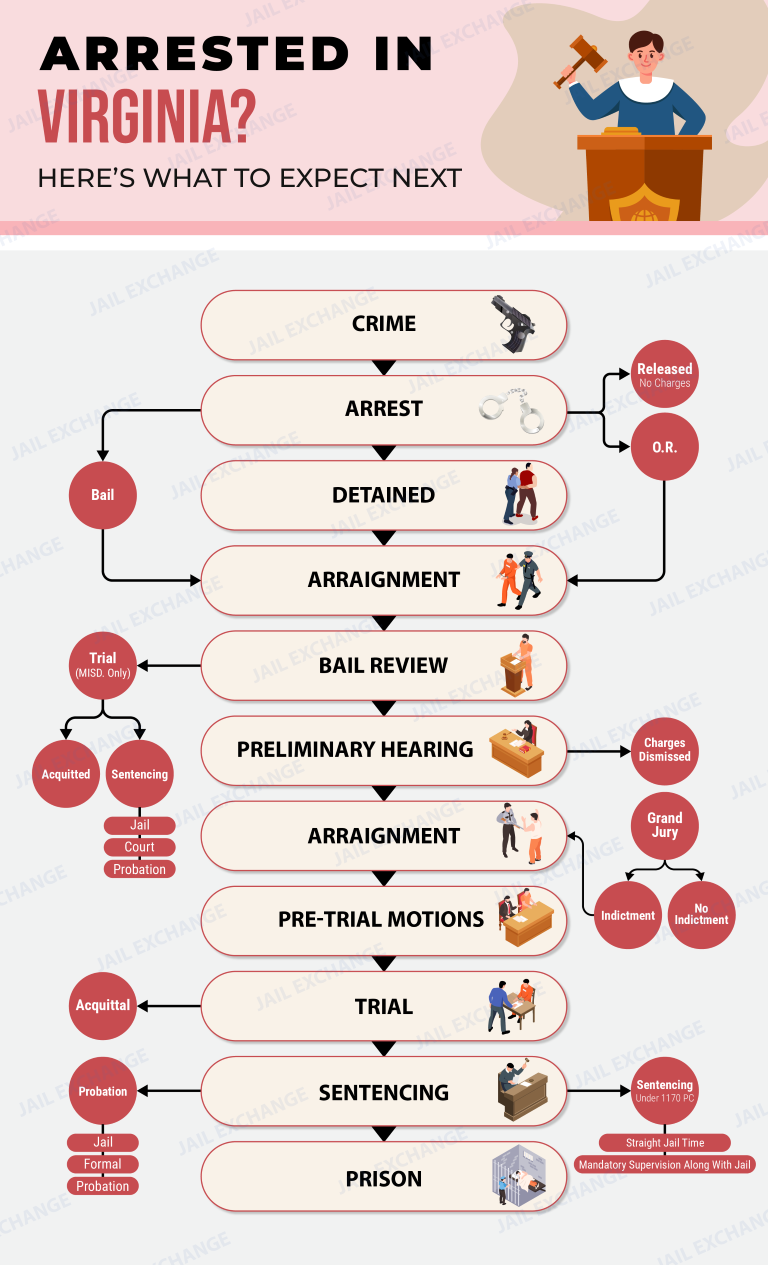
Which court hears your case. A misdemeanor or traffic charge from the county, including one written in Scottsville, is tried by a judge without a jury in the Albemarle General District Court; a defendant who loses there has 10 days to appeal to the Albemarle Circuit Court, where the case starts over and a jury can be requested. Charges against anyone under 18, and adult charges such as assault on a spouse, partner, parent or other family or household member, belong to the Albemarle/Charlottesville Juvenile and Domestic Relations District Court on East High Street. Felonies open with a preliminary hearing in the General District Court (or in the JDR court when the alleged victim is a family member) and, once a grand jury returns an indictment, move to the Albemarle Circuit Court for trial or plea.
Where pretrial inmates are held. The Albemarle-Charlottesville Regional Jail Authority runs the jail at 160 Peregory Lane, off Avon Street Extended just south of Charlottesville, and the facility houses adults from Albemarle County, the City of Charlottesville and Nelson County. A person the magistrate does not release on recognizance or bond is booked there by the arresting agency, whether that is the Albemarle County Police, the Sheriff's Office, Scottsville police or a state trooper. For custody questions, call the jail at (434) 977-6981.
No Virginia town runs a municipal, town or mayor's court. Charges brought by the Scottsville Police Department are therefore filed in the Albemarle General District Court or the Albemarle/Charlottesville JDR court, just like charges from Crozet, Ivy, Earlysville or any other part of the county. Although the county's courts sit inside the city limits of Charlottesville, they are county courts and are separate from the Charlottesville courts a few blocks away.
County courts
- Albemarle Circuit Court, Albemarle County Courthouse, Court Square, 350 Park Street, Charlottesville, VA 22902; Clerk Jon R. Zug; main line (434) 972-4083, criminal division (434) 972-4085; clerk's office open 8:00 a.m. to 4:00 p.m. Felony trials, misdemeanor appeals and the grand jury are handled here.
- Albemarle General District Court, 350 Park Street, Charlottesville, VA 22902; Clerk Leola C. Morse; (434) 972-4004; 8:00 a.m. to 4:00 p.m. Misdemeanors, traffic cases, felony preliminary hearings and bond reviews for adults are heard in this court.
- Albemarle/Charlottesville Juvenile and Domestic Relations District Court, 411 E. High Street, Charlottesville, VA 22902; Clerk Stephanie M. Bunch; (434) 979-7165; 8:00 a.m. to 4:00 p.m. One clerk's office serves both the county and the city.
- Magistrate, 16th Magisterial District, 1610 Avon Street Extended, Charlottesville, VA 22901, (434) 977-0220; magistrates issue warrants and set release terms at all hours
Prosecution, defense and juvenile intake
- Albemarle County Commonwealth's Attorney, 410 E. High Street, Charlottesville, VA 22902, (434) 972-4093
- Charlottesville Public Defender, a Virginia Indigent Defense Commission office that represents eligible defendants in Albemarle County and the City of Charlottesville, 403 E. Market Street, Charlottesville, VA 22902, (434) 951-6300
- 16th District Court Service Unit (juvenile intake), 401-407 E. High Street, Charlottesville, VA 22902, (434) 979-7191
Law enforcement
- Albemarle County Police Department, the main patrol and investigative agency for the county, 1600 5th Street, Suite D, Charlottesville, VA 22902, (434) 296-5807
- Albemarle County Sheriff's Office (courthouse security, civil process, warrant service), 411 E. High Street, Charlottesville, VA 22902, (434) 972-4001; for custody questions call the regional jail, (434) 977-6981
- Scottsville Police Department, 105 Main Street, Scottsville, VA 24590; the town department has a part-time chief, and county police, (434) 296-5807, also patrol Scottsville
- University of Virginia Police Department and the Virginia State Police also make arrests in the county; their county cases go to the same courts.
A person who cannot pay a lawyer should say so to the magistrate or to the judge at the first appearance; the clerk of the General District Court, (434) 972-4004, has the financial statement form used to decide whether the public defender can be appointed. A district court judge can also be asked to change the bail a magistrate set.
↑ Back to the question list2. Misdemeanor (for example, petit larceny, a first DUI, assault and battery, trespassing)
Arrest or summons
For many misdemeanors an Albemarle officer simply hands the person a summons that lists a court date, and no trip to the jail follows. When an arrest is made instead, as is usual for a DUI or a domestic assault, the officer brings the person before the magistrate on Avon Street Extended, often over a video link from the jail.
Release decision
The magistrate chooses among a personal recognizance, an unsecured bond (owed only if the defendant fails to appear) and a secured bond posted in cash or through a licensed bondsman. Release can come with conditions, such as no contact with the complaining witness or supervision by the local pretrial services agency. Since 2021 Virginia has had no presumption against bail for any listed offense; the magistrate weighs the chance the person will flee and any danger to others. A defendant who cannot meet the terms waits at the Albemarle-Charlottesville Regional Jail and can ask a district court judge to reconsider them.
Court dates
A jailed defendant is usually brought before the Albemarle General District Court, or the JDR court in family cases, on the next day that court is in session. This first hearing is an advisement: the judge reads the charge, asks about a lawyer and appoints the Charlottesville Public Defender if the defendant qualifies. Trial follows at a later date before a judge alone. Albemarle misdemeanor cases tend to close within about one to three months of the charge.
Possible penalties
- Petit larceny (property under $1,000), trespass and assault and battery are Class 1 misdemeanors, punishable by up to 12 months in jail, a fine of up to $2,500, or both.
- A Class 2 misdemeanor carries up to six months and up to $1,000; No jail is possible for Class 3 or Class 4 offenses, whose fines stop at $500 and $250.
- Assault on a family or household member goes to the JDR court. A first offender may be offered a deferred disposition that can end in dismissal, but a third such conviction can be prosecuted as a felony.
- A first DUI is a Class 1 misdemeanor with a mandatory $250 minimum fine, a one-year license revocation and enrollment in VASAP. The license is suspended for seven days at arrest. A blood-alcohol reading of 0.15 to 0.20 brings 5 mandatory days in jail, and a reading above 0.20 brings 10. A restricted license with an ignition interlock may be allowed.
Results range from dismissal or a first-offender deferral to a fine, a suspended sentence with probation, or active jail time. Anyone convicted in either district court can appeal to the Albemarle Circuit Court within 10 days and receive a new trial, with a jury if requested. Virginia's sealing law may later allow some records to be sealed.
↑ Back to the question list3. Felony (for example, burglary, grand larceny, drug possession or distribution, malicious wounding)
Felony arrests in Albemarle County follow the same first steps as misdemeanors: the magistrate issues the warrant and decides on bail, and anyone not released goes to the Albemarle-Charlottesville Regional Jail. What changes is the route through the courts.
- Advisement. At the first General District Court appearance the judge confirms that the defendant has a lawyer, appointing the Charlottesville Public Defender for those who qualify, and sets a preliminary hearing date.
- Preliminary hearing. A district court judge (in JDR court if a family member is the alleged victim) hears enough evidence to decide whether there is probable cause. A finding of probable cause sends, or certifies, the charge on to the grand jury. The Commonwealth's Attorney may instead take the case straight to a grand jury by direct indictment.
- Indictment and arraignment. The grand jury meets at the Albemarle Circuit Court. After an indictment, the defendant is arraigned in that court and enters a plea.
- Plea or trial. The large majority of cases end in a plea agreement. At trial the defendant may choose a judge or a jury of 12, whose verdict must be unanimous. Since July 2021 the judge decides the sentence unless the defendant asks the jury to do it, and the state's voluntary sentencing guidelines are part of that decision.
Under Code section 19.2-243, a defendant held in custody generally must be tried within five months of the probable-cause finding, and one on release within nine months; continuances requested by the defense and other exceptions stop that clock. A realistic range from arrest to sentencing is four months to a year.
Albemarle felony penalties in brief
- Grand larceny (property worth $1,000 or more): a prison term from one year up to twenty, or, in the alternative, a jail sentence capped at 12 months.
- Burglary: breaking into a dwelling at night is a Class 3 felony (5 to 20 years) and becomes Class 2 if the burglar is armed; the remaining statutory burglary offenses top out at twenty years in prison.
- Drugs: simple possession of a Schedule I or II substance is punished as a Class 5 felony, with one to ten years in prison or a jail term of a year or less; distribution or possession with intent to distribute carries 5 to 40 years on a first offense, and large quantities trigger mandatory minimums. An adult 21 or older may legally possess up to one ounce of marijuana, but selling it remains illegal.
- Malicious wounding is a Class 3 felony; unlawful wounding, which lacks the malice element, is Class 6 (1 to 5 years, or up to 12 months in jail).
Virginia abolished parole for felonies committed on or after January 1, 1995, although earned sentence credits can shorten the time actually served. Sentences longer than 12 months are served in the Department of Corrections rather than the regional jail. A convicted defendant may be charged the court-appointed lawyer's fee as part of court costs.
↑ Back to the question list4. Violent felony (for example, murder, rape, robbery)
Homicide, sexual assault and robbery cases from the county are investigated mainly by the Albemarle County Police Department, sometimes with help from the Virginia State Police and its forensic laboratory, and they are tried in the Albemarle Circuit Court on Court Square. Because these prosecutions rely on lab results, expert testimony and extensive motions practice, one to two years from arrest to verdict is common. The magistrate, and later a judge, may refuse bond for a defendant considered dangerous, which means waiting for trial at the Albemarle-Charlottesville Regional Jail.
What Virginia law provides
- Robbery and rape each carry five years to life in prison.
- Second-degree murder is punished by 5 to 40 years, and first-degree murder, a Class 2 felony, by 20 years to life.
- Aggravated murder, known before 2021 as capital murder, sits at Class 1, the top felony level. Since Virginia ended the death penalty in 2021, its punishment is life imprisonment.
- Aggravated malicious wounding, in which the victim suffers permanent and significant physical impairment, is a Class 2 felony.
The Charlottesville Public Defender represents eligible Albemarle defendants in most felony cases, and for aggravated murder the court appoints counsel qualified for the most serious cases. Crime victims have rights under the Crime Victim and Witness Rights Act, including notice of hearings, a chance to confer with the prosecutor and the opportunity to give an impact statement at sentencing; the Albemarle Commonwealth's Attorney's victim/witness staff help victims use them.
↑ Back to the question list5. Juveniles (under 18) arrested in Albemarle County
Charges against minors from the county are handled by the Albemarle/Charlottesville Juvenile and Domestic Relations District Court, 411 E. High Street, Charlottesville ((434) 979-7165), the same court that hears city juvenile cases.
Intake
Before a case reaches a judge, an intake officer of the 16th District Court Service Unit, part of the Department of Juvenile Justice, reviews the complaint at 401-407 E. High Street ((434) 979-7191). The officer can resolve a minor matter through diversion, file a petition that starts a court case, or authorize secure detention if the youth poses a danger or is unlikely to return to court. The Albemarle County Commonwealth's Attorney prosecutes petitions that go forward.
Detention
Detained Albemarle youths are usually taken to the Blue Ridge Juvenile Detention Center, 195 Peregory Lane, Charlottesville, VA 22902, (434) 951-9340, next to the adult regional jail. A detention hearing must take place within 72 hours, on the next day the JDR court sits, and the judge then decides whether the youth stays in or goes home, possibly with conditions. A child whose family cannot afford counsel can be represented by the Charlottesville Public Defender or an appointed lawyer.
Outcomes
Possible results include dismissal, diversion, probation supervised by the court service unit, and community programs such as counseling, restitution or community service. For serious or repeated offenses the court may commit the youth to the Department of Juvenile Justice, which places committed youths at the Bon Air Juvenile Correctional Center or in a community placement program.
Adult prosecution
A juvenile aged 14 or older who is charged with certain serious felonies can be transferred to the Albemarle Circuit Court after a transfer hearing in the JDR court. For the most serious offenses, such as murder or aggravated malicious wounding, the Commonwealth's Attorney may be able to certify a 16- or 17-year-old to Circuit Court once a preliminary hearing finds probable cause. Albemarle juvenile court files are, with limited exceptions, closed to the public.
↑ Back to the question list6. Federal cases (U.S. District Court) from Albemarle County
Albemarle County lies in the Western District of Virginia, and its federal criminal cases are assigned to the Charlottesville Division, whose courthouse is on West Main Street in downtown Charlottesville.
- U.S. District Court, Charlottesville Division, U.S. Courthouse, 255 W. Main Street, Room 304, Charlottesville, VA 22902; clerk (434) 296-9284
- U.S. Attorney's Office, Charlottesville branch, 255 W. Main Street, Room 130, Charlottesville, VA 22902, (434) 293-4283
- Federal Public Defender, Western District of Virginia, 401 E. Market Street, Suite 106, Charlottesville, VA 22902, (434) 220-3380; private Criminal Justice Act panel lawyers are appointed when that office has a conflict
Which cases become federal
Federal agents and prosecutors usually take cases involving large-scale drug trafficking, firearm possession by convicted felons or other prohibited people, bank robbery, child sexual exploitation and significant fraud. The eastern edge of Shenandoah National Park lies in the county's western mountains, so crimes in the park, from petty offenses heard by a magistrate judge to serious felonies, are federal matters. The Army's Rivanna Station intelligence facility north of Charlottesville is also federal property.
The federal process
After a federal arrest, the defendant sees a U.S. magistrate judge for an initial appearance. There are no bondsmen in federal court. The Bail Reform Act leaves the judge two choices: release on conditions monitored by U.S. Pretrial Services, or detention ordered after a hearing that is usually held within three court days of the government's motion. If agents filed a criminal complaint first, prosecutors have 30 days to obtain an indictment from a grand jury. The Speedy Trial Act sets a 70-day deadline for trial, though excluded time often stretches it. Guilty pleas end most federal prosecutions from the county, and conviction at trial takes the agreement of all 12 jurors. Before sentencing, a probation officer prepares a presentence report, and the judge considers the advisory Sentencing Guidelines while applying any mandatory minimum. Federal prison has no parole, so inmates serve roughly 85 percent of the sentence in the Bureau of Prisons before a term of supervised release. Appeals are heard by the Fourth Circuit Court of Appeals.
To find a person in federal custody, search the Federal Bureau of Prisons inmate locator by name or register number. Someone awaiting trial may instead be housed in a local or regional jail under a U.S. Marshals Service contract and show up on that jail's roster. Federal prosecution of juveniles is rare.
↑ Back to the question listThis guide describes criminal court procedure in Albemarle County, Virginia, in general terms and is not legal advice. Court schedules, jail arrangements and phone numbers can change, so confirm details with the office involved, and consult a Virginia criminal defense lawyer about any specific case. Defendants who cannot afford a lawyer can ask the magistrate or judge for the Charlottesville Public Defender, (434) 951-6300, or call the Albemarle General District Court clerk at (434) 972-4004.