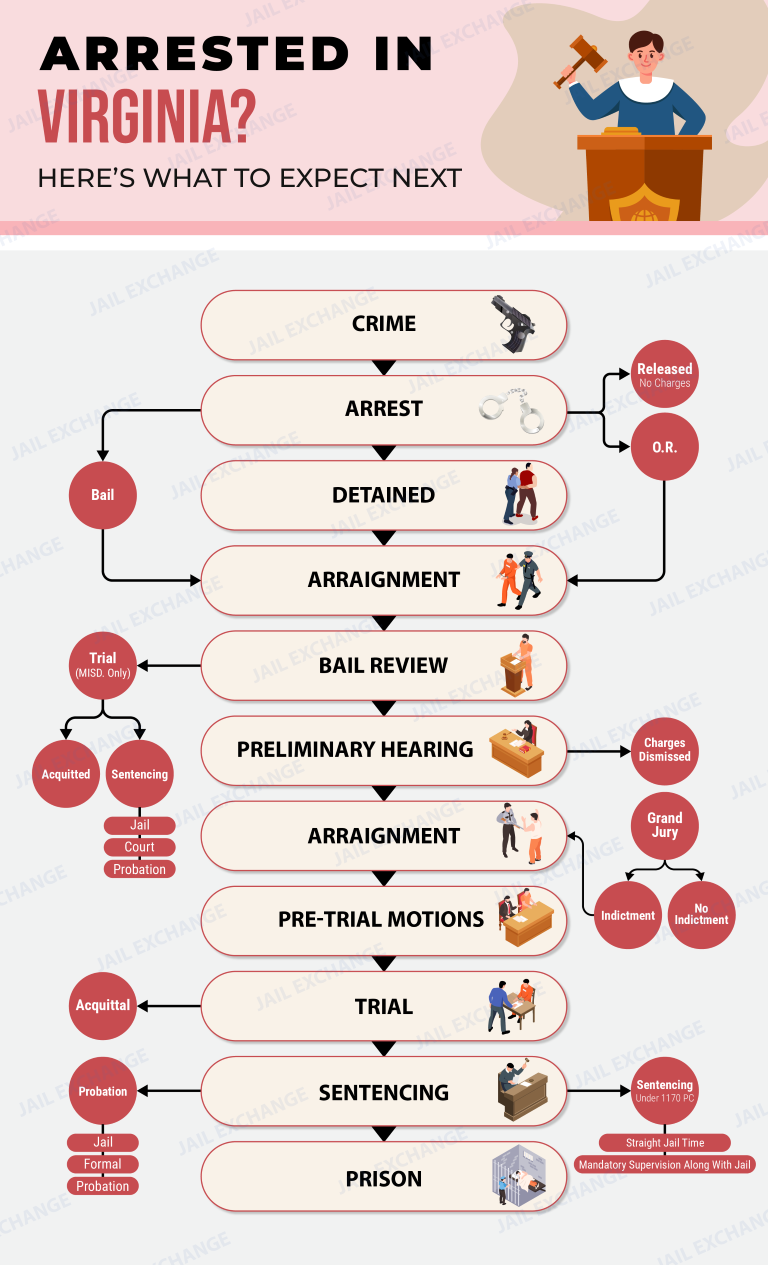
Danville City Jail & Annex Criminal Court Process
Criminal Court Process for Danville City Virginia
Danville's criminal courts and where inmates wait
Three courts hear criminal cases in the city: one for misdemeanors, one for youth and family cases, and one for felonies. All sit at 401 Patton Street, Danville, VA 24543. People held before trial are in the Danville City Jail, 401 Patton Street, Danville, VA 24541.
Not sure where your family member is? Open the city's online jail roster. Our Jail Roster page has arrests, charges and public defender details.
To ask about a hearing, call the General District Court clerk at 434-799-5179. Need the person home first? Our Danville bail page shows how.
1. Courts in the City of Danville (circuit, general district, and juvenile and domestic relations courts)
The City of Danville governs itself apart from any county, so a crime committed inside its limits never goes to the Pittsylvania County courthouse in Chatham. Instead, three city courts in the 22nd Judicial Circuit decide it: the Danville General District Court for misdemeanors and early felony hearings, the Danville Juvenile and Domestic Relations District Court for youth and family cases, and the Danville Circuit Court for felonies and jury trials, all located at 401 Patton Street downtown. A Commonwealth's Attorney elected by city voters handles the prosecution, and the Danville Public Defender Office is appointed for defendants without the means to hire counsel. Anyone kept in custody before trial is held by the city Sheriff at the Danville City Jail.
- Danville City Jail (pretrial detention, operated by the Sheriff), 401 Patton Street, Danville, VA 24541, (434) 799-5130
- Danville Sheriff's Office, P.O. Box 3405, Danville, VA 24543, (434) 799-5135
- Danville Police Department, 1 Community Way, Danville, VA 24541, (434) 799-5111
- Danville magistrate, 22nd District, 401 Patton Street, Danville, VA 24541, (434) 799-5143
- Danville General District Court, James F. Ingram Justice Center, 401 Patton Street, Danville, VA 24543; criminal and traffic clerk (434) 799-5179
- Danville Juvenile and Domestic Relations District Court, 401 Patton Street, Danville, VA 24543, (434) 799-5174
- Danville Circuit Court, 401 Patton Street, Danville, VA 24543; Clerk of Circuit Court (434) 799-5168
- Commonwealth's Attorney, City of Danville, 427 Patton Street, Danville, VA 24541, (434) 797-4809
- Danville Public Defender Office, 315 Lynn Street, Suite A, Danville, VA 24541, (434) 791-5306
- 22nd District Court Service Unit (intake for juvenile complaints), Danville office (434) 799-5001
- Danville Adult Detention Center, 1000 South Boston Road, Danville, VA 24540, (434) 799-5233
Which court hears your case. The Danville General District Court decides misdemeanors and traffic cases from the city, always with a judge rather than a jury. Someone convicted there has 10 days to note an appeal to the Danville Circuit Court, which hears the case over again and allows a jury. Offenses against a family or household member, assaults most often, along with offenses involving juveniles, are filed in the Danville Juvenile and Domestic Relations District Court instead. A felony gets a preliminary hearing in the General District Court, or in the JDR court if the alleged victim is a family member, before a grand jury indictment moves it to the Danville Circuit Court for plea or trial.
Where pretrial inmates are held. Unlike most Southside localities, the City of Danville keeps its own jail instead of sending inmates to a regional facility. The Danville City Jail occupies the Courts and Jail Building on Patton Street, which also houses the magistrate, so an arrested person is usually seen, booked and, if bail is not paid, held without leaving the block. A second city facility, the Danville Adult Detention Center on South Boston Road, is a jail farm used mainly for sentenced inmates. The Sheriff's Office at (434) 799-5135 can confirm where a person is housed.
No locality in Virginia runs a municipal, town or mayor's court; that kind of local court simply does not exist in the state's system. The city contains no incorporated towns, and all criminal charges arising in Danville are heard by the three courts below, which share the James F. Ingram Justice Center.
Where to find each court
- Danville General District Court: 401 Patton Street, Danville, VA 24543; mailing address P.O. Box 3300; (434) 799-5179. Clerk's hours run from 8:30 in the morning to 4:30 in the afternoon. This is where traffic tickets, misdemeanor trials, felony preliminary hearings and reviews of release terms take place.
- Danville Juvenile and Domestic Relations District Court: 401 Patton Street, Danville, VA 24543; P.O. Box 3300; (434) 799-5173 or (434) 799-5174; clerk's hours 8:00 to 4:00. Hearing dates are released only in person, with a photo ID, or by fax.
- Danville Circuit Court: 401 Patton Street, Danville, VA 24543; P.O. Box 3300; clerk (434) 799-5168, open 9:00 to 4:00.
Offices that handle the first hours after arrest
- Magistrate's office (22nd District), Courts and Jail Building, 401 Patton Street, Danville, VA 24541, (434) 799-5143, staffed day and night to issue warrants and protective orders and to set bond.
- 22nd District Court Service Unit (juvenile intake), Danville office (434) 799-5001; main office in Rocky Mount (540) 483-3050.
Lawyers
- Commonwealth's Attorney, City of Danville, 427 Patton Street, Danville, VA 24541, (434) 797-4809. The Victim/Witness Program can be reached at (434) 797-1635.
- Danville Public Defender Office, 315 Lynn Street, Suite A, Danville, VA 24541, (434) 791-5306, a Virginia Indigent Defense Commission office dedicated to city cases. Defendants it cannot represent receive a private attorney appointed from the court's list.
Police and Sheriff
- Danville Police Department, 1 Community Way, Danville, VA 24541, (434) 799-5111: patrol, investigations and most arrests in the city.
- Danville Sheriff's Office, 401 Patton Street, Danville, VA 24541, (434) 799-5135: the jail, courtroom security and service of court papers.
2. Misdemeanor (for example, petit larceny, a first DUI, assault and battery, trespassing)
What the charges can mean
Each of the four offenses named above is a Class 1 misdemeanor in Virginia, the highest misdemeanor level, with a possible penalty of as much as a year in jail and a $2,500 fine.
- Petit larceny covers thefts below $1,000 in value.
- Trespassing usually means remaining on, or returning to, property after being told to stay away.
- Assault and battery against a family or household member is heard in the JDR court rather than the General District Court. First offenders there are sometimes offered a deferred disposition, and a third family-assault conviction may be prosecuted as a felony.
- A first DUI carries a mandatory minimum $250 fine. Jail becomes mandatory at higher readings: 5 days for a blood alcohol concentration from 0.15 to 0.20, and 10 days above 0.20. The court revokes driving privileges for one year, may allow a restricted license with an ignition interlock, and orders the driver into VASAP. At the time of arrest the license is suspended administratively for 7 days.
For comparison, a Class 2 misdemeanor carries up to 6 months and $1,000, and Class 3 and Class 4 misdemeanors are fine-only, at $500 and $250 maximums.
From the arrest to the first hearing
- The officer either issues a summons or makes an arrest and brings the person to the magistrate on Patton Street.
- The magistrate decides on release: a recognizance bond requires only a promise to return; an unsecured bond is a sum owed only for failing to appear; a secured bond must be paid in cash or posted by a state-licensed bondsman. Release conditions, such as staying away from a complaining witness, may be added.
- A person who is not released is booked at the Danville City Jail and may ask a judge to review the terms at a bond hearing.
- At the arraignment on the court's next session day, the judge confirms whether the defendant will hire counsel or needs one appointed. A financial eligibility form is completed for appointment, usually of the Danville Public Defender Office.
Trial and what follows
The General District Court judge decides the case alone. Possible results are a dismissal, a deferred first-offender disposition, a fine, a suspended sentence with probation, or time in jail. An appeal noted within 10 days sends the case to the Danville Circuit Court for a new trial. Misdemeanors generally take one to three months; an appeal lengthens that. Some outcomes may later be eligible for sealing under state law.
↑ Back to the question list3. Felony (for example, burglary, grand larceny, drug possession or distribution, malicious wounding)
Penalties first
- Burglary: a nighttime break-in of a residence is a Class 3 felony, 5 to 20 years, and Class 2 when the offender is armed with a deadly weapon. Statutory burglary charges not involving a dwelling at night generally permit a sentence reaching 20 years.
- Grand larceny: theft valued at $1,000 or above is punished by 1 to 20 years in prison, or by a jail term that cannot exceed 12 months.
- Drug possession or distribution: holding a Schedule I or II drug such as cocaine or fentanyl is a Class 5 felony (1 to 10 years, or a jail term of up to a year). Selling, or possessing with intent to sell, carries 5 to 40 years for a first offense, and mandatory minimums apply to large quantities. Adults who are at least 21 may lawfully possess one ounce or less of marijuana; selling it is still illegal.
- Malicious wounding is a Class 3 felony; without malice, the charge of unlawful wounding is Class 6 (1 to 5 years, or a year or less in jail).
The full scale of felony classes runs Class 1 (life), Class 2 (20 years to life), Class 3 (5 to 20), Class 4 (2 to 10), Class 5 (1 to 10) and Class 6 (1 to 5). Parole is abolished for offenses after January 1, 1995, though earned sentence credits can lower the time actually served, and the Virginia Department of Corrections takes custody of anyone sentenced to more than a year.
How the case moves
- Magistrate. Release depends on the magistrate's view of flight risk and public safety; since 2021 no felony carries an automatic presumption against bail.
- Custody and review. A defendant not released is held at the Danville City Jail and can seek a bond hearing before a General District Court judge, then appeal the result to the Circuit Court.
- Lawyer. The judge at the first appearance appoints the Danville Public Defender Office for an eligible defendant.
- Preliminary hearing. In the General District Court the Commonwealth must show probable cause; a finding in the Commonwealth's favor certifies the charge for the grand jury's consideration. Sometimes the Commonwealth's Attorney goes straight to a grand jury by direct indictment instead.
- Circuit Court. After the grand jury indicts, the defendant is arraigned in the Danville Circuit Court. Most cases then end in a plea agreement. If there is a trial, a jury verdict requires all 12 jurors; the judge sentences, using Virginia's voluntary guidelines, unless the defendant has asked for the jury to fix the sentence.
Deadlines and duration
Virginia's speedy-trial law, Code §19.2-243, generally requires trial within five months of the probable-cause ruling when the defendant is jailed and nine months when the defendant is free, apart from delays the defense requests or consents to. A Danville felony typically lasts four to twelve months.
↑ Back to the question list4. Violent felony (for example, murder, rape, robbery)
In the City of Danville, the police department's investigators take the lead on homicides, robberies and sexual assaults, and the city's Commonwealth's Attorney tries those cases in the Danville Circuit Court. They proceed through the same preliminary hearing, grand jury and Circuit Court stages as other felonies.
Possible punishment
- A conviction for aggravated murder, which replaced capital murder when Virginia abolished the death penalty in 2021, is a Class 1 felony and requires life imprisonment.
- First-degree murder brings 20 years to life as a Class 2 felony; second-degree murder brings 5 to 40 years.
- Rape is punishable by a prison term of 5 years up to life.
- Robbery has the same 5-to-life range, and using a firearm adds a separate charge with its own mandatory term.
- Aggravated malicious wounding, which requires a permanent and significant injury, is Class 2.
Release questions
Judges and magistrates give special weight to victim and community safety in these cases, so bond is frequently denied or set at a level the defendant cannot meet. In that event the defendant is held at the Danville City Jail on Patton Street until trial.
Victims and timeline
Victims and their families can rely on the Crime Victim and Witness Rights Act for notice of court dates, information about release, and an opportunity to be heard before sentence is imposed; the city's Victim/Witness Program, at (434) 797-1635, coordinates that help. Allow one to two years for a violent felony to reach a verdict. Convictions may be appealed to the Court of Appeals of Virginia and then to the Supreme Court of Virginia.
↑ Back to the question list5. Juveniles (under 18) arrested in the City of Danville
Where the youth is taken
A child arrested in the city who cannot safely go home is generally brought to the W.W. Moore, Jr. Juvenile Detention Center, 603 Colquhoun Street, Danville, VA 24541, (434) 799-5295. The center is run by the City of Danville and also takes children from Pittsylvania, Halifax, Mecklenburg, Henry and Patrick counties and the City of Martinsville. Within 72 hours, or by the following court day if the period ends on a weekend or holiday, a judge holds a detention hearing to decide whether the child stays in detention or is released to a parent with conditions.
Who decides whether there is a court case
Complaints are screened by an intake officer of the 22nd District Court Service Unit, Danville office (434) 799-5001. Intake has three basic choices: divert a minor first offense to a program outside court, file a petition with the Danville Juvenile and Domestic Relations District Court ((434) 799-5173), or authorize secure detention. When a petition is filed, the Commonwealth's Attorney for the City of Danville presents the case, and the judge appoints a lawyer for the child if the family has not hired one.
Results in juvenile court
- A diversion agreement or informal resolution for low-level conduct.
- Supervised probation, which can require school attendance, curfews, counseling, restitution or community service, along with community-based programs.
- For serious offenses, commitment to the Department of Juvenile Justice, with placement at Bon Air Juvenile Correctional Center or in a community setting.
Circuit Court for a juvenile
A juvenile 14 or older charged with certain serious felonies can be sent to the Danville Circuit Court after a transfer hearing in the JDR court. For the most serious crimes, such as murder or aggravated malicious wounding, the Commonwealth's Attorney may certify a 16- or 17-year-old to Circuit Court once probable cause is found at a preliminary hearing. In nearly all other cases juvenile records remain confidential.
↑ Back to the question list6. Federal cases (U.S. District Court) from the City of Danville
Federal prosecutions arising in the City of Danville belong to the Western District of Virginia and are now handled by its Lynchburg Division. The former federal courthouse in Danville closed to new filings in late 2025, so defendants and families should expect to travel to Lynchburg for federal court.
- Clerk, U.S. District Court (Lynchburg), 1101 Court Street, Suite A66, Lynchburg, VA 24504, (434) 847-5722
- Office of the U.S. Attorney, Western District of Virginia, 310 1st Street SW, Room 906, Roanoke, VA 24011, (540) 857-2250; toll-free 1-877-220-8014
- Federal Public Defender (Western District), 210 First Street SW, Suite 400, Roanoke, VA 24011, (540) 777-0880; private Criminal Justice Act attorneys take the cases it cannot
Why a Danville case might be federal
Investigations by the ATF, DEA, FBI or other federal agencies, frequently working with Danville police, bring cases involving drug distribution conspiracies, firearms possessed by people with felony records or other disqualifications, bank robberies, child pornography or enticement, and fraud schemes. An offense committed on federal property within the city can also be charged federally.
What the federal process looks like
- An initial appearance in front of a U.S. magistrate judge, where counsel is appointed if needed.
- A release decision with no commercial bail bonds involved: under the Bail Reform Act the judge orders release on conditions supervised by U.S. Pretrial Services, or detention after a hearing, ordinarily within three court days of the government's motion.
- Indictment by a grand jury within 30 days if the case began with a complaint, and a Speedy Trial Act target of 70 days to trial, often extended for good reason.
- A guilty plea in most cases, or a trial before 12 jurors whose verdict must be unanimous.
- Sentencing after a presentence report, under the advisory Sentencing Guidelines and any statutory mandatory minimum; no parole, roughly 85 percent of the sentence served in the Bureau of Prisons, then supervised release.
- Any appeal to the U.S. Court of Appeals for the Fourth Circuit.
Finding a federal prisoner
To learn where a person in federal custody is held, search the Federal Bureau of Prisons inmate locator with the person's name or register number. Pretrial federal detainees placed in a local or regional jail through a U.S. Marshals agreement may also be found on that jail's own inmate list. Prosecuting a juvenile in federal court is rare; youth cases from the city almost always stay in the Danville JDR court.
↑ Back to the question listThis page is a general guide to criminal court procedure in the City of Danville and does not provide legal advice; practices and jail assignments are subject to change. Anyone facing a charge in Danville should get individual advice from a defense attorney. A court-appointed lawyer can be requested from the magistrate, from the judge at the first court date, or through the General District Court clerk at (434) 799-5179; the Danville Public Defender Office's number is (434) 791-5306. To ask about someone in custody, call the Sheriff's Office at (434) 799-5135.