
Norfolk Juvenile Detention Center
Norfolk Juvenile Detention Center
Physical Address
1260 Security LaneNorfolk, VA 23502
Jail Phone Number
757-441-5667Norfolk Inmate Search: Track Down Anyone Held Downtown on City Hall Avenue
Adults arrested inside the city limits are taken to the Norfolk City Jail, 811 East City Hall Avenue, Norfolk, VA 23510, which the Sheriff's Office runs. It is the one adult facility we found for the city. Read on to trace a person, spot mugshots and sort out lawyers, money, mail, visits and hearings.
Begin with the Sheriff's online lookup. It accepts a name or an ID number, and it was built so friends and family can buy items for the person. Someone booked only hours ago may not show yet, so phone if you hit a blank.
The jail picks up at 757-664-4700 day and night. Read out the legal name with the birth date, and inquire about booking progress, listed charges and any set bond. See the bail page for getting out and the court page for what happens in front of a judge.
Read inmate search answers
 Read inmate search answers
1. Using the Sheriff's lookup tool, step by step
The tool is simple, but small mistakes hide people. Walk through it like this:
- Open the lookup page in a browser on your phone or laptop.
- Type a surname into the search form. If hundreds of results appear, narrow them with a given name.
- If a letter, receipt or call gave you an ID number, use that. One number leads to one person.
- Click the matching row and jot down the booking number. Staff and the mail system both ask for it.
- Still blank? Swap in a nickname, add a middle initial or flip to another spelling.
The Sheriff's site holds a second tool for pulling up booking numbers. Still stuck? Dial 757-664-4700.
↑ Back to the question list2. The Norfolk city search shows nothing under that name. What now?
An empty result can still have a calm explanation:
- Booking is still underway. Photos, prints and forms take hours.
- Police are still questioning the person. A person may wait at a precinct before transfer.
- A summons instead of a cell. An officer may give the person a court notice and send them home.
- Bond already posted. A magistrate may have set terms and the person left.
- Another agency may have them. Check a neighboring city, federal agents or the state.
Phone 757-664-4700. Staff answer around the clock and can check the books by name.
↑ Back to the question list3. Is the city jail the only place people from here are kept?
For its own arrests, the city relies on one building: the Norfolk City Jail at 811 East City Hall Avenue, Norfolk, VA 23510, 757-664-4700. It takes in men and women who await trial, plus people serving short terms.
We found no second city lockup, work-release building or regional jail tied to the city. If you hear about another unit, ask the desk to confirm.
A person arrested in a different city is held by that city's own jail. Browse the jails on our Virginia jails page to find it. Federal, immigration and state custody work differently and appear in later answers.
↑ Back to the question list4. Where do I find Norfolk city mugshots?
Open a person's record in the Sheriff's lookup and see whether a picture is attached. We can't say what every result holds, so test one yourself.
Virginia's public records law treats an adult's booking photo as something police and sheriffs hand over when asked, as long as the picture was taken at intake. Sharing can be refused if it would harm a felony case still being built. Juvenile pictures stay private. To request mugshots, call the Norfolk Police Department's non-emergency number, 757-441-5610, or the Sheriff at 757-664-4700.
- Photos kept by immigration officers are available by sending in the ICE records request form.
- Other federal offices keep their booking pictures private. The U.S. Marshals Service is the lone exception and might circulate one, for instance to locate a fugitive.
5. Is there a free tool that pings me on a release or transfer?
Yes, through VINE, a free service that keeps watch on Virginia jails and prisons. It sends word when a person is freed or moved, and it can show the place where someone sits now.
- Register at vinelink.com.
- Or phone 800-467-4943, which is answered at all hours.
- Pick text, call or email for the alerts.
Alerts can run a little behind. If you must meet the person at the door, ring the jail at 757-664-4700 that day.
↑ Back to the question list6. How fast does a Norfolk city magistrate set bail, and who is it?
A magistrate does it, usually within hours of the arrest. You can reach the magistrate's office at all hours, at 811 East City Hall Avenue, Room 109, Norfolk, VA 23510, 757-664-4198. It sits in the same complex as the jail.
The magistrate can order release on a written promise, on a bond where no money moves yet, or on a bond that is guaranteed by cash on hand, land equity or a paid bondsman. Virginia aims to free people before trial unless there is strong proof of flight or harm. Conditions may include a curfew, urine tests, GPS tracking or orders to avoid the accuser.
- Bondsmen hold state licenses. Expect to hand over ten to fifteen percent of the bond, money that is not given back.
- A person still held is taken before a district judge when the courthouse opens its next session. A district judge takes a second look at bail and mentions legal help.
- To ask how to pay at the jail, ring 757-664-4700.
Read how release works in the city on our bail page. A broader view of Virginia law is on the bail laws page.
↑ Back to the question list7. Which office spells out the charge in full?
Start with the jail desk at 757-664-4700, which reads out the charge on the booking. Court files then add the full wording.
- The state runs an Online Case Information System that takes a name. It holds district court traffic and criminal files, adult crime cases from family court, and Circuit Court files. Cases about children are kept out.
- District court criminal clerk, 150 St. Paul's Boulevard, Norfolk, VA 23510, 757-664-4915.
- Circuit Court clerk, 7th Floor of that building, 757-389-8942.
Final charging decisions rest with the Commonwealth's Attorney. That prosecutor's office can be found at 800 East City Hall Avenue, Suite 600, Norfolk, VA 23510, 757-664-4444.
↑ Back to the question list8. Who steps in when a family cannot afford counsel?
The person should speak up, first to the magistrate and then to the judge who sees the case. A brief sworn statement of earnings and debts goes before the judge, who decides who gets help. The district court's criminal clerk also handles the form.
Norfolk has a public defender office of its own, run by the Virginia Indigent Defense Commission, at 125 St. Paul's Boulevard, Suite 600, Norfolk, VA 23510, 757-314-2380. Its attorneys work in the district, juvenile and circuit courts. If a conflict blocks that office, the judge assigns an outside lawyer from an approved roster.
Families may also hire their own attorney.
↑ Back to the question list9. When are video visits, and where do they happen in Norfolk city?
Every visit is by video. You can log in from home, use the Visit Now app, or use a monitor in the jail's front lobby, 811 East City Hall Avenue, Norfolk, VA 23510. Reserve a slot on the GettingOut scheduling page, which the Sheriff's Office gives to families.
Lobby times posted by the Sheriff:
- Tuesday and Thursday evenings, 7 to 9 p.m.
- Saturday and Sunday mornings, 9 a.m. to noon, and evenings, 7 to 9 p.m.
Times shift now and then, so confirm at 757-664-4700. Our visiting guide lists extra pointers.
↑ Back to the question list10. How do I fund a canteen account?
Canteen funds buy snacks, soap, stamps and other small items. The Sheriff's Office uses Keefe Commissary Network for this. Pick one route:
- Go online to accesscorrections.com.
- Call 866-345-1884.
- Visit the deposit kiosk inside the Public Safety Building's main lobby, 811 East City Hall Avenue, Norfolk, VA 23510.
A postal money order may be mailed to Resident Canteen, P.O. Box 3908, Norfolk, VA 23514, marked with the inmate's name and TRN number. Do not mail cash. Hot meals are ordered through 811 Marketplace, which also hosts the search page.
Find extra detail in our money page plus the commissary page.
↑ Back to the question list11. How do calls, tablet messages and free minutes work?
Phone service comes from Global Tel Link, the company the Sheriff names. Open an account on connectnetwork.com. Calls can be collect, or paid from a debit or Advanced Pay balance. Each person receives one free five-minute call per month.
A tablet program exists for messaging. Ask at 757-664-4700 which features are running now. Assume a recording is running on every call, and leave case facts for the attorney visit.
Related reading: jail calls and email and text messages.
↑ Back to the question list12. Where should letters to a Norfolk city inmate be addressed?
Regular letters are routed through a P.O. box in Maryland instead of the downtown building. Write the address like this:
Norfolk City Jail
Inmate Name
Inmate Booking #
P.O. Box 247
Phoenix, MD 21131
- Staff scan the pages into the person's tablet.
- Only flat mail is taken.
- Legal mail and subscriptions go straight to 811 East City Hall Avenue, Norfolk, VA 23510.
Never tuck cash inside. You can get the booking number from the lookup tool. Our mail page has more rules of thumb.
↑ Back to the question list13. How do I collect clothes and papers the jail is holding?
Items taken at booking sit in storage. Pickup happens at a window behind the jail, 811 East City Hall Avenue, Norfolk, VA 23510, Monday to Friday from 7 a.m. to 4 p.m. It is closed on weekends and holidays.
Bring all three:
- The intake receipt.
- A photo ID.
- A completed property release form.
If the person is transferred, the jail keeps belongings for 30 days. Questions go to 757-664-4700.
↑ Back to the question list14. How do I reach the jail's nurses about a sick inmate?
Nurses and other medical workers are on site all day and night. Reach the medical office at 757-664-4958. Have the booking number ready, along with medicine names, doses and known conditions.
The inmate can also file a medical slip inside, which leaves a written record.
In a true emergency, call 911. If someone seems unsafe because of their mind or mood, state that clearly. The main jail desk, 757-664-4700, can also relay a message.
↑ Back to the question list15. Where do I ask whether an arrest warrant is active?
Deputies from the Sheriff's Office, 757-664-4700, and city police officers, 757-441-5610, serve warrants. We found no wanted-person page on either site, so phone and ask. Names can also be tried in the state's online court records, or call the district court criminal clerk, 757-664-4915, or the Circuit Court clerk, 757-389-8942. The way to settle a warrant starts with a lawyer's advice. After that, phone the court whose judge signed it. Both clerks work at 150 St. Paul's Boulevard, Norfolk, VA 23510.
↑ Back to the question list16. Where is the next hearing for a Norfolk city case?
Three trial courts share one building at 150 St. Paul's Boulevard, Norfolk, VA 23510:
- General District Court, 757-664-4910: misdemeanors, traffic tickets and early felony hearings.
- Juvenile and family court, 5th Floor, 757-664-7340.
- Circuit Court clerk, 7th Floor, 757-389-8942: felony trials after an indictment, plus appeals.
The first two clerks answer from 8 a.m. to 4 p.m. The Circuit clerk works 8:45 a.m. to 4:45 p.m. Keep both ready before you dial. Our court page walks through every stage.
↑ Back to the question list17. Where do federal arrests from the city go?
Cases from this city go to the Norfolk division of the federal courthouse serving the Eastern District of Virginia, the Walter E. Hoffman Courthouse, 600 Granby Street, Norfolk, VA 23510. The clerk's line is 757-222-7202.
- The first federal appearance may include a detention hearing under 18 U.S.C. 3142, where a judge picks between freedom and a cell until trial day.
- Until trial, the U.S. Marshals Service is in charge of the person. Its Norfolk office shares the courthouse, 757-963-5963.
- The federal public defender is at 500 E. Main Street, Suite 500, Norfolk, VA 23510, 757-457-0800.
- Once a sentence begins, the Bureau of Prisons shows where the person is housed in its online inmate locator.
18. How do immigration holds work, and how do I find a detainee?
A hold tends to unfold in these steps:
- The first paper is Form I-247A, a detainer that Immigration and Customs Enforcement (ICE) addresses to the jail.
- Under 8 CFR 287.7(d), the jail may keep the person up to 48 hours after they would otherwise be released.
- ICE then takes the person to a site it picks.
- Use the ICE Online Detainee Locator. An A-number gives the sharpest match. If none is known, enter the legal name and the birthplace country.
- If the locator fails, contact the ICE field office for Virginia, 14797 Murdock Street, Chantilly, VA 20151, 703-633-2100. It also serves Washington, D.C.
In February 2026 a state executive directive ended 287(g) agreements held by state agencies. Detainer law in Virginia is still in flux, so a lawyer can explain today's rules.
↑ Back to the question list19. Where is a person sentenced to Virginia state time?
For a person sentenced to state prison, Corrections staff run reception, choose the prison and arrange the move once a bed opens. The wait can be spent in the city jail.
- The state's Corrections locator takes a surname or a DOC number. New information is added every day.
- Phone the department at 804-674-3000.
- Our Virginia prisons page explains visiting and mail at each site.
20. How are teenagers and younger children handled?
Adult cells are off limits to anyone below age 18. Holding a youth requires an order, which a judge, intake officer or magistrate can give. The place used is the Norfolk Juvenile Detention Center, 1260 Security Lane, Norfolk, VA 23502, 757-441-5667.
The Juvenile and Domestic Relations court hears the case. Its clerk is on the fifth floor of 150 St. Paul's Boulevard, Norfolk, VA 23510, 757-664-7340. Because children's files are absent from the state's online lookup, phone the clerk. Public defenders represent qualifying youth.
↑ Back to the question list21. Which police agency in Norfolk city made the arrest?
The city contains no separate towns, so a single police force serves it.
- Norfolk Police Department, 100 Brooke Avenue, Norfolk, VA 23510. Non-emergency line: 757-441-5610.
- Sheriff's Office, which operates the jail and courthouse security: 757-664-4700.
- Virginia State Police Division Five, 1557 S. Military Highway, Chesapeake, VA 23320, 757-424-6850. The statewide field line is 804-674-2088.
Officers from a college campus may arrest someone too. Contact that school's police office, or ask the jail desk who brought the person in.
↑ Back to the question listCity of Norfolk: getting someone released
Norfolk runs its own city jail, so people arrested here go to the Norfolk City Jail, 811 East City Hall Avenue, Norfolk, VA 23510. The magistrate works in that same building. This page walks through setting bail, paying a bond and the courts that come next.
Start by finding out if your person is booked. The sheriff's lookup tool accepts a first name, a last name or an ID number. Our Norfolk Inmate Search page adds who is in custody, charges, warrants and how to get property back.
Then phone the jail at 757-664-4700. Ask about the bail figure and when the judge will see them. After that, find out where the case goes by reading about the Norfolk courts.
1. Which jail holds city arrestees?
The Norfolk City Jail, 811 East City Hall Avenue, Norfolk, VA 23510. Phone 757-664-4700.
↑ Back to the question list2. Who decides bail?
The magistrate at 811 East City Hall Avenue, Rm 109, Norfolk, VA 23510, 757-664-4198.
↑ Back to the question list3. Is there pretrial supervision?
Yes. Norfolk judges can release people to a pretrial agency that checks in with them (Va. Code § 19.2-152.4:3).
↑ Back to the question list4. How do I search?
5. How fast does Norfolk city set bail?
Normally the same night. Booking is at the City Jail on East City Hall Avenue, and the magistrate's office is inside that building (Va. Code § 19.2-80). Release might be on a signature alone, on an unsecured sum, or only once money or property backs it (Va. Code § 19.2-123).
↑ Back to the question list6. What can I use to pay a Norfolk city bond?
Cash at the magistrate, open all night (Va. Code § 19.2-48.1), 757-664-4198. Equity in Virginia real estate also counts. Or hire a DCJS-licensed bondsman (Va. Code § 9.1-185), whose 10% to 15% fee isn't refunded (Va. Code § 9.1-185.8).
↑ Back to the question list7. Is Norfolk city bail ever revisited?
Yes. A district judge reviews it the first court day for anyone in custody (Va. Code § 19.2-158) and explains the right to counsel (Va. Code § 19.2-159). Later bail motions and Circuit Court appeals (Va. Code § 19.2-124) are possible.
↑ Back to the question list8. Which courts handle Norfolk city cases?
All are in the St. Paul's Boulevard complex. District court tries misdemeanors, with a 10-day appeal window (Va. Code § 16.1-132), and holds felony preliminary hearings (Va. Code § 19.2-218). Indicted felonies are tried in Circuit Court. Youth and household cases are in JDR (Va. Code § 16.1-241).
↑ Back to the question list9. Can someone in Norfolk city get a court-appointed lawyer?
When jail is possible and they can't pay, a judge appoints one after a sworn finance form (Va. Code § 19.2-159).
↑ Back to the question list10. What follows a no-show in Norfolk city?
A capias, a forfeited bond and possibly a separate charge under state law (Va. Code § 19.2-128).
↑ Back to the question list11. What conditions can a Norfolk city bond include?
Magistrates often bar contact with a victim or order the defendant to keep away from places (Va. Code § 19.2-123); after a household arrest, an emergency protective order is common (Va. Code § 16.1-253.4). Another state's warrant can keep someone jailed after bond (Va. Code § 19.2-102) (Va. Code § 19.2-85).
↑ Back to the question list12. Where are federal arrests from Norfolk city handled?
Downtown, at the Eastern District of Virginia, where a U.S. magistrate judge decides release (18 U.S.C. § 3142).
↑ Back to the question list13. How do I visit or locate a Norfolk city inmate?
Call the jail at 757-664-4700 about visits and deposits. Moves to state prison show up in the inmate search.
↑ Back to the question list14. What happens to Norfolk city bail money afterward?
Cash is returned after the case if all dates were kept, minus fines. Sureties take the risk of paying after a missed date (Va. Code § 19.2-143) and are allowed to surrender the defendant (Va. Code § 19.2-149).
↑ Back to the question list15. Which offices confirm a City of Norfolk bond?
Jail: 757-664-4700. Magistrate: 757-664-4198. Circuit Court clerk: 757-389-8942.
↑ Back to the question listContacts for Norfolk city
- Jail
- Norfolk City Jail, 811 East City Hall Avenue, Norfolk, VA 23510; 757-664-4700
- Magistrate
- 811 East City Hall Avenue, Rm 109, Norfolk, VA 23510; 757-664-4198
- District court
- 150 Saint Paul's Blvd, Room 3202, Norfolk, VA 23510; 757-664-4910
- Circuit court
- 150 St. Paul's Boulevard, 7th Floor, Norfolk, VA 23510; 757-389-8942
- Inmate search
- Norfolk city inmate search
This page is not legal advice.
Norfolk Criminal Courts: Three Courts Under One Roof
Crime cases in Norfolk go to General District, Juvenile and Domestic Relations (JDR) or Circuit Court. All three sit at 150 St. Paul's Boulevard, Norfolk, VA 23510. Anyone held before trial is kept at the Norfolk City Jail, 811 East City Hall Avenue, Norfolk, VA 23510.
Not sure your person is still locked up? Put a name or ID number into the sheriff's lookup tool. Recent arrests, charges and warrants are explained on our Inmates in Custody page.
The criminal desk at General District Court, 757-664-4915, can give you the next hearing date. For felony files, try the Circuit Court clerk, 757-389-8942. To plan a release, read our Norfolk bail guide.
1. Courts in Norfolk City (circuit, general district, and juvenile and domestic relations courts)
The City of Norfolk is one of Virginia's 38 independent cities, governed separately from any county and served by its own courts, prosecutor and sheriff. Three state courts decide criminal matters here, and they share a single downtown building on St. Paul's Boulevard: the Norfolk General District Court for misdemeanors and traffic charges, the Norfolk Juvenile and Domestic Relations District Court for juvenile and family-violence cases, and the Norfolk Circuit Court for felonies and jury trials. Together they make up the 4th Judicial Circuit, a circuit that serves Norfolk City and nowhere else. The city's elected Commonwealth's Attorney brings every state prosecution, and arrested adults who are not released are held by the Norfolk Sheriff's Office in the Norfolk City Jail on East City Hall Avenue.
- Norfolk Circuit Court (Clerk of the Circuit Court, 7th Floor), 150 St. Paul's Boulevard, Norfolk, VA 23510, (757) 389-8942
- Norfolk General District Court, 150 St. Paul's Boulevard, Norfolk, VA 23510; criminal (757) 664-4915, traffic (757) 664-4911
- Norfolk Juvenile and Domestic Relations District Court, 150 St. Paul's Boulevard, 5th Floor, Norfolk, VA 23510, (757) 664-7340
- District 4 Magistrate's Office, 811 East City Hall Avenue, Room 109, Norfolk, VA 23510, (757) 664-4198
- Court Service Unit, 4th District (juvenile intake and probation), 150 St. Paul's Boulevard, 2nd Floor, Norfolk, VA 23510, (757) 664-7601
- Norfolk Commonwealth's Attorney, 800 East City Hall Avenue, Suite 600, Norfolk, VA 23510, (757) 664-4444
- Norfolk Public Defender Office, 125 St. Paul's Boulevard, Suite 600, Norfolk, VA 23510, (757) 314-2380
- Norfolk Sheriff's Office (jail and courts), 24 hours: (757) 664-4700; administration at 538 Front Street, Norfolk, VA 23510
- Norfolk Police Department headquarters, 100 Brooke Avenue, Norfolk, VA 23510, (757) 664-3277; non-emergency calls (757) 441-5610
- Norfolk Criminal Justice Services, Pretrial Services Division, 711 Granby Street, Norfolk, VA 23510, (757) 441-1413
- Norfolk City Jail, 811 East City Hall Avenue, Norfolk, VA 23510, (757) 664-4700
- Norfolk Juvenile Detention Center, 1260 Security Lane, Norfolk, VA 23502, (757) 441-5667
Which court hears your case. Where a Norfolk City charge is heard depends on what it is and who is involved. Traffic offenses and misdemeanors, such as reckless driving on Tidewater Drive or trespassing at a downtown business, go to the Norfolk General District Court, where a judge rules without a jury; a defendant found guilty there has 10 days to note an appeal to the Norfolk Circuit Court, which retries the case from scratch and will seat a jury on request. Charges against a minor, and assaults or other crimes against a family or household member, are filed in the Norfolk Juvenile and Domestic Relations District Court instead. Felony cases begin with a preliminary hearing in one of the two district courts (the JDR court when the complainant is a relative or household member) and are tried in the Norfolk Circuit Court after the grand jury indicts.
Where pretrial inmates are held. Norfolk City keeps its own adult jail rather than belonging to a regional jail authority. The jail stands at 811 East City Hall Avenue, next to the magistrate's office, and the elected Sheriff runs it for Norfolk cases alone; the Portsmouth regional jail that Norfolk once shared with four other cities has shut down. Anyone the magistrate does not release, or who has not yet posted bail, stays there pending trial. Custody questions can be put to the Sheriff's Office around the clock at (757) 664-4700.
No Virginia locality has a municipal or mayor's court, and Norfolk City is no exception. There are also no towns within the city, so the courts listed here receive every criminal case that starts inside Norfolk's boundaries, from a Granby Street citation to a felony warrant served in Ocean View. A Norfolk police officer, a sheriff's deputy, a Virginia State Police trooper or an officer from one of the city's university police forces may make the arrest, but the case still lands in these courts.
The three courts
- Norfolk General District Court (4th Judicial District), 150 St. Paul's Boulevard, Norfolk, VA 23510. Criminal division (757) 664-4915 or (757) 664-4916; traffic division (757) 664-4911 or (757) 664-4912; general line (757) 664-4910. Clerk's hours 8:00 a.m. to 4:00 p.m.
- Norfolk Juvenile and Domestic Relations District Court (4th Judicial District), 150 St. Paul's Boulevard, 5th Floor, Norfolk, VA 23510, (757) 664-7340. Clerk's hours 8:00 a.m. to 4:00 p.m.
- Norfolk Circuit Court (4th Judicial Circuit), Clerk's Office on the 7th Floor, 150 St. Paul's Boulevard, Norfolk, VA 23510, (757) 389-8942. Clerk's hours 8:45 a.m. to 4:45 p.m.
Supporting offices
- Magistrates (District 4): 811 East City Hall Avenue, Room 109, Norfolk, VA 23510, (757) 664-4198; open around the clock for warrants and bail decisions
- 4th District Court Service Unit: 150 St. Paul's Boulevard, 2nd Floor, (757) 664-7601, weekdays 8:15 a.m. to 5:00 p.m.
- Commonwealth's Attorney: 800 East City Hall Avenue, Suite 600, (757) 664-4444
- Public Defender: 125 St. Paul's Boulevard, Suite 600, (757) 314-2380
- Sheriff: (757) 664-4700
- Norfolk Police Department: 100 Brooke Avenue, (757) 664-3277; non-emergency (757) 441-5610
To request a court-appointed lawyer, a defendant tells the magistrate or the judge at the first hearing, or completes the financial eligibility form at the General District Court's criminal clerk's office. In most Norfolk cases the appointment goes to the public defender.
↑ Back to the question list2. Finding your way in the Norfolk courts building
Instead of separate courthouses scattered around town, Norfolk City places all three of its trial courts under one roof at 150 St. Paul's Boulevard, near the corner of City Hall Avenue. Knowing which floor to visit saves time:
- 2nd floor: the Court Service Unit, where juvenile complaints and family petitions begin.
- 5th floor: the Juvenile and Domestic Relations District Court clerk and courtrooms.
- 7th floor: the Circuit Court clerk, which keeps felony indictments, jury-trial files and appeals from the district courts.
- Room 2102: the pretrial services intake office, (757) 664-4972, where people released under supervision check in.
The General District Court's clerk's office handles the criminal, traffic and civil dockets for that court, and the court posts each day's cases by courtroom. Some dockets meet on fixed schedules; probation revocation hearings, for instance, are set at 10:00 a.m. on Thursdays and Fridays.
Expect airport-style screening at the door. Bring the summons or warrant, a photo ID and any paperwork the lawyer requested, and plan for a wait, since many cases share the same docket call.
Three offices that matter after an arrest are outside the building. The magistrate's office and the Norfolk City Jail share the 811 East City Hall Avenue site, the Commonwealth's Attorney is at 800 East City Hall Avenue, and the public defender's lawyers work across the boulevard at number 125. Questions about posting a bond after hours should go to the jail or the magistrate.
↑ Back to the question list3. After an arrest in Norfolk City: magistrate, release and pretrial services
Who decides whether the person goes home?
A magistrate does, usually within hours. Magistrates are judicial officers, not police, and the District 4 office at 811 East City Hall Avenue is staffed every hour of every day. After the arresting officer explains the facts, often over a video link, the magistrate either issues a warrant or summons or declines to, and then sets the terms of bail.
What kinds of release are there?
- Personal recognizance: release on a signed promise to appear, with no money.
- Unsecured bond: a dollar figure is set, but nothing is paid unless the defendant skips court.
- Secured bond: the amount must be put up, either in full in cash or through a bail bondsman licensed by Virginia's Department of Criminal Justice Services, who charges a fee.
- Held without bond: the defendant stays in custody until a judge reviews the decision.
The magistrate can add conditions, such as no contact with an alleged victim, staying away from a location, or reporting to pretrial services. Under the law in effect since 2021, no offense automatically triggers a presumption of detention; the magistrate asks instead whether this defendant will show up for court and whether letting him or her out puts anyone at risk.
What does pretrial services do?
Norfolk Criminal Justice Services, at 711 Granby Street ((757) 441-1413), screens and interviews arrestees, verifies their background, checks criminal records and scores a risk assessment so judges have more information. It recommends but does not decide. People released under its supervision may be required to check in, submit to drug or alcohol tests, or start treatment.
Can the bond be changed?
Yes. A defendant who is held, or whose amount is out of reach, can ask a judge of the General District Court, or of the JDR court for juvenile and family cases, to reconsider at a bond hearing. If that judge says no, the defense can appeal to the Norfolk Circuit Court.
When is the first court appearance?
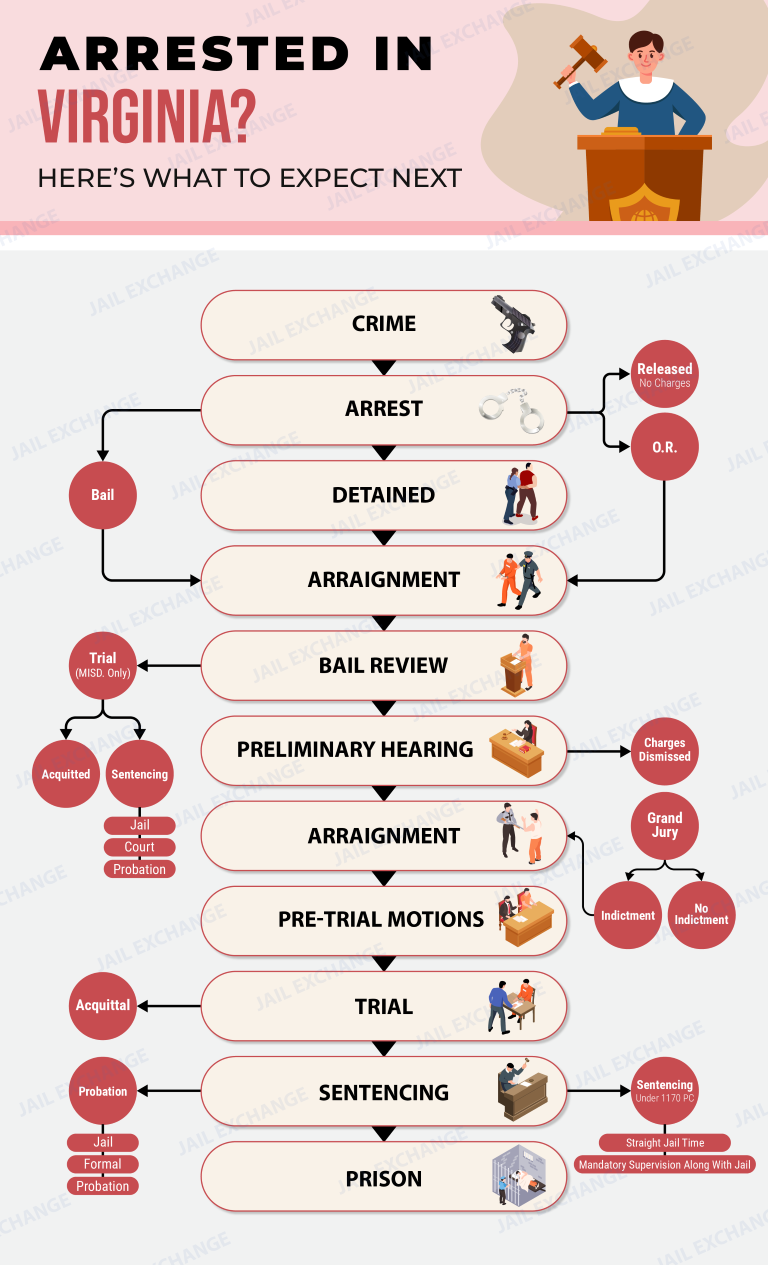
Detained defendants are usually arraigned the next day court is in session, typically by video from the jail. At this advisement the judge confirms the charge, explains the right to counsel and asks how the defendant plans to get a lawyer. The judge may appoint the public defender on the spot after the defendant signs a financial statement, and then schedules trial (for a misdemeanor) or a preliminary hearing (for a felony). Released defendants come to court on the date written on their release papers.
↑ Back to the question list4. Inside the Norfolk City Jail system
Norfolk City's elected Sheriff is responsible for the Norfolk City Jail, a locally run facility at 811 East City Hall Avenue, Norfolk, VA 23510. Its population mixes people awaiting trial, people serving misdemeanor or short felony sentences of up to 12 months, and people already sentenced to prison who have not yet been moved to a state facility. Deputies from the same office guard the courtrooms on St. Paul's Boulevard and serve criminal warrants and subpoenas.
The jail line, (757) 664-4700, is answered 24 hours a day. Callers can find out whether someone has been booked, which charges are listed and what bond was set. The Sheriff's Office also offers an inmate lookup tool, and its administrative offices at 538 Front Street handle records and correspondence.
Until recently, some Norfolk prisoners were housed at a regional jail in Portsmouth that served Norfolk, Chesapeake, Hampton, Newport News and Portsmouth. The authority that ran it voted in October 2023 to close, and inmates were sent back to their home jurisdictions, so Norfolk's pretrial population is now in the city jail. A Norfolk resident arrested on charges from a neighboring city, such as Virginia Beach, will be held by that city instead.
↑ Back to the question list5. Getting a public defender in Norfolk City
Norfolk City has a dedicated public defender office operated by the Virginia Indigent Defense Commission. It is located at 125 St. Paul's Boulevard, Suite 600, Norfolk, VA 23510, and can be reached at (757) 314-2380. Assistant public defenders appear daily in the General District Court, the JDR court and the Circuit Court, representing adults and juveniles who qualify.
How to qualify
The court compares the defendant's household income and assets to state eligibility guidelines, based on a sworn financial statement. That form can be completed when the magistrate sets release, at the first court appearance, or at the General District Court criminal clerk's office, (757) 664-4915.
If the Norfolk Public Defender has a conflict
If the office has a conflict of interest, for example because it represents a co-defendant, the judge appoints a private attorney from the list of lawyers certified for court appointments. The defendant does not choose which lawyer is appointed.
Cost
There is no charge to start, but a defendant who is convicted may have the appointed lawyer's fee added to the court costs. Appointed counsel is offered only when the charge could lead to jail time.
For someone sitting in the Norfolk City Jail, one of the first things a newly appointed public defender often does is ask a judge for a bond review.
↑ Back to the question list6. How the Norfolk prosecutor's office works, including diversion
The Commonwealth's Attorney for Norfolk City is elected by city voters and leads a staff of assistant prosecutors at 800 East City Hall Avenue, Suite 600 ((757) 664-4444). Prosecutors review police charges, decide what to amend or dismiss, negotiate pleas, take felony cases to the grand jury and try cases before judges and juries. In some routine traffic matters the officer who wrote the ticket presents the evidence alone.
Support for victims
Victims and witnesses can contact the office's Victim/Witness Assistance Program at (757) 664-4848 for court-date notices, help with protective orders and restitution, and preparation for testimony, all rights guaranteed by Virginia's Crime Victim and Witness Rights Act. The office also helps lead the Norfolk Family Justice Center, a one-stop location for survivors of domestic violence, sexual assault and related abuse.
Alternatives to a conviction
Virginia law gives judges several first-offender options, and Norfolk prosecutors and defense lawyers use them regularly:
- a deferred disposition for first-time possession of a controlled substance, which leads to dismissal after probation, treatment and testing;
- a deferred finding for a first assault on a family member in the JDR court, conditioned on counseling and good behavior;
- deferral of certain petit larceny and minor property charges in exchange for restitution, classes or community service.
Any other agreement, such as reducing a charge or dismissing it after community service, depends on negotiations in the individual case, which is a reason to have a lawyer. Being held in jail does not prevent those talks, and the defense can still seek a bond modification while they continue.
↑ Back to the question list7. Treatment dockets in the Norfolk Circuit Court
For some adults charged with felonies, the Norfolk Circuit Court offers a supervised treatment track in place of a conventional sentence. Three such dockets operate, and the court's specialty dockets coordinator can be reached at (757) 823-1276.
Drug treatment court
Norfolk's adult drug court was approved in 1998, making it one of Virginia's longest-running. Participants attend treatment, test frequently, appear before the judge on a regular schedule and earn incentives or sanctions depending on progress, with a lighter outcome at the end for those who finish.
Behavioral health docket
This docket, held on Tuesday afternoons, is for defendants with a documented serious mental illness who have pleaded guilty to qualifying nonviolent offenses. The judge works with prosecutors, defense lawyers, probation officers, the Sheriff's Office and the Norfolk Community Services Board to keep each participant in treatment, and graduation leads to unsupervised probation.
Veterans treatment docket
Veterans whose offenses are connected to service-related trauma, mental health conditions or addiction can be considered for this docket, which combines court supervision with veteran mentoring and Veterans Affairs services.
All three are voluntary and selective. The defense lawyer usually starts the referral, the Commonwealth's Attorney must consent, and screening rules out many violent charges. Participation commonly runs a year or longer. Because eligibility is often settled before any plea, a defendant who is still in the Norfolk City Jail or out on bail should ask about these dockets early.
↑ Back to the question list8. Misdemeanor (for example, petit larceny, a first DUI, assault and battery, trespassing)
What the penalties are
Virginia sorts misdemeanors into four classes. A Class 1 offense, the most serious, can bring as much as 12 months in jail plus a fine of up to $2,500; petit larceny of property under $1,000, simple assault and battery, trespassing and a first DUI are all Class 1. A Class 2 offense allows up to six months behind bars and a $1,000 fine. Classes 3 and 4 involve fines alone, capped at $500 and $250.
What happens at arrest
For many misdemeanors in Norfolk City, the officer issues a summons or the magistrate grants release on a personal recognizance bond, and the defendant leaves with a court date. A person kept at the Norfolk City Jail sees a General District Court judge, usually on video, the next day the court is open.
Special rules for a first DUI
- Minimum fine of $250.
- Seven-day administrative license suspension starting at arrest.
- License revocation for one year after conviction, with a restricted license and an ignition interlock possible.
- Required participation in the Virginia Alcohol Safety Action Program (VASAP).
- Mandatory jail of five days if the blood alcohol level was 0.15 to 0.20, and ten days if it topped 0.20.
Domestic assault
When the person allegedly assaulted is a family or household member, the case is heard by the Norfolk Juvenile and Domestic Relations District Court. An emergency protective order is commonly issued at arrest. A first-time defendant may qualify for a deferred disposition that ends in dismissal after counseling, though repeat convictions escalate, and a third can be prosecuted as a felony.
How cases end and how long they take
A General District Court judge, sitting without a jury, may dismiss the charge, defer it under a first-offender provision, impose a fine, or give a jail sentence that is partly or wholly suspended on conditions such as local probation through Norfolk Criminal Justice Services. A defendant unhappy with the result has 10 days to appeal to the Norfolk Circuit Court, where the case is heard anew and can empanel a seven-person jury. Expect one to three months in district court, plus extra time if the case is appealed. The public defender represents many misdemeanor defendants when jail is a possibility.
↑ Back to the question list9. Felony (for example, burglary, grand larceny, drug possession or distribution, malicious wounding)
Step 1: arrest and release decision
After booking at the Sheriff's intake area, a magistrate decides whether a felony defendant can be released and on what terms. Secured bonds and denials of release are more common than in misdemeanor cases, and a defendant who stays in the Norfolk City Jail can ask a General District Court judge to revisit the decision after the first appearance.
Step 2: the preliminary hearing
In the General District Court (or the JDR court if the complaining witness is a family member), a judge hears enough evidence to decide whether probable cause exists. A finding of probable cause sends the case to the Norfolk Circuit Court grand jury; otherwise the charge is dismissed, though prosecutors may still go to the grand jury. The Commonwealth may bypass this hearing altogether with a direct indictment.
Step 3: indictment and arraignment
Once indicted, the defendant is arraigned in the Circuit Court, enters a plea and chooses trial by judge or by a jury of 12, whose verdict must be unanimous.
Step 4: plea or trial, then sentencing
A negotiated plea is how most Norfolk felony cases conclude. Since mid-2021, a judge rather than a jury fixes the sentence unless the defendant elects jury sentencing. The judge looks at Virginia's discretionary sentencing guidelines. Parole was abolished for felonies committed on or after January 1, 1995, but inmates can earn sentence credits that shorten their time; terms beyond 12 months are served in state prison under the Department of Corrections.
Typical penalties
- Grand larceny, which covers stealing anything worth at least $1,000: up to 20 years in prison (minimum one year), or a jail term of up to 12 months.
- Burglary: entering a home at night to commit a crime is a Class 3 felony (5 to 20 years), rising to Class 2 when the burglar is armed; other statutory burglaries are capped at 20 years.
- Possessing a Schedule I or II drug, including cocaine, heroin and fentanyl: Class 5 felony, punishable by 1 to 10 years or by jail of up to a year.
- Distribution or possession with intent to distribute: 5 to 40 years on a first conviction, with mandatory minimums when the quantities are large. Up to an ounce of marijuana is legal for adults 21 and over, but selling it is still a crime.
- Malicious wounding: in the City of Norfolk this Class 3 felony means 5 to 20 years. Unlawful wounding: Class 6 felony, carrying one to five years in prison or a jail sentence of a year or less.
How long it takes
Virginia's speedy trial law requires trial within five months of the probable cause finding for a jailed defendant and nine months for one who is free, with exceptions such as continuances requested by the defense. Most Norfolk felonies take four to twelve months to resolve. Appointed representation comes from the Norfolk Public Defender Office at (757) 314-2380 unless it has a conflict.
↑ Back to the question list10. Violent felony (for example, murder, rape, robbery)
Penalties under Virginia law
- Aggravated murder (Virginia's current name for what used to be capital murder): a Class 1 felony punished by life in prison, since Virginia ended capital punishment in 2021.
- First-degree murder: a Class 2 felony with a range of 20 years to life.
- Second-degree murder: from 5 up to 40 years.
- Rape: from 5 years up to life.
- Robbery: from 5 years up to life.
- Aggravated malicious wounding: the City of Norfolk sees this charged as a Class 2 felony, and the sentence runs from 20 years up to life.
Custody while the case is pending
People charged with these crimes in Norfolk City often leave the magistrate's office without any bail set and remain in the Norfolk City Jail until a judge rules on release at a contested hearing. Judges weigh the strength of the evidence, criminal history, ties to the community and any risk to the victim or witnesses.
The path to trial
Norfolk police detectives investigate, and experienced prosecutors handle the case from the start. The case follows the ordinary felony route through a preliminary hearing (unless the Commonwealth obtains a direct indictment), indictment by the Norfolk Circuit Court grand jury, arraignment and either a plea or a jury trial. If the victim is a family or household member, the preliminary hearing is held in the JDR court. Forensic testing, expert witnesses and pretrial motions lengthen the process, and defense lawyers frequently waive the speedy-trial deadlines to prepare, so one to two years from arrest to verdict is a realistic expectation.
Rights of victims
Virginia's Crime Victim and Witness Rights Act entitles victims to be told about hearings, to be heard at sentencing through a victim impact statement and to request restitution. The Victim/Witness Assistance Program of the Norfolk Commonwealth's Attorney, (757) 664-4848, guides families through the case.
A defendant who cannot pay for a lawyer receives the public defender or, when the office has a conflict, a private attorney certified for serious felonies.
↑ Back to the question list11. Juveniles (under 18) arrested in Norfolk City
Where the case goes
A young person under 18 accused of a crime in Norfolk City is brought before the Norfolk Juvenile and Domestic Relations District Court (150 St. Paul's Boulevard, 5th Floor; (757) 664-7340), not the adult courts. The Norfolk Commonwealth's Attorney prosecutes, and the youth has a right to a lawyer; the Norfolk Public Defender Office at (757) 314-2380 represents many juveniles.
The intake officer's decision
Complaints first reach the 4th District Court Service Unit on the 2nd floor of the same building, (757) 664-7601. An intake officer there chooses among three paths: diverting the case informally (with steps such as counseling, apology, restitution or community service), filing a petition so the case goes before a judge, or, for serious or repeated offenses, authorizing secure detention. The same unit later supervises youths on probation or parole.
Detention and the 72-hour hearing
Juveniles who are detained are taken to the Norfolk Juvenile Detention Center at 1260 Security Lane, Norfolk, VA 23502 ((757) 441-5667), run by the city's Department of Human Services and licensed by the Department of Juvenile Justice. A JDR judge must hold a detention hearing within 72 hours; when that deadline falls on a weekend or holiday, the hearing takes place the next day court is in session. The judge can continue detention or release the youth to a parent, sometimes with electronic monitoring or other conditions.
What can happen at the end
- dismissal or a deferred finding;
- probation supervised by the Court Service Unit;
- community programs, counseling, restitution or community service;
- a Department of Juvenile Justice commitment, which can mean time at the Bon Air Juvenile Correctional Center or a community-based placement.
Transfer to adult court
If a child was at least 14 when an alleged serious felony occurred, the Commonwealth's Attorney may ask the JDR court to hold a transfer hearing and send the case to the Norfolk Circuit Court. For a narrow set of the most serious charges, murder and aggravated malicious wounding among them, a 16- or 17-year-old can be certified to the Circuit Court by the Commonwealth's Attorney after a preliminary hearing finds probable cause. A youth convicted as an adult can receive an adult sentence.
Confidentiality
Juvenile records are kept confidential in most situations, with exceptions for certain serious felonies and for older juveniles convicted of specific offenses.
↑ Back to the question list12. Federal cases (U.S. District Court) from Norfolk City
Norfolk City lies within the Eastern District of Virginia, and its federal criminal cases are assigned to the Norfolk Division. That division's courthouse is the Walter E. Hoffman U.S. Courthouse at 600 Granby Street, Norfolk, VA 23510; the criminal section of the clerk's office answers at (757) 222-7202.
What kinds of cases end up there?
- Large-scale drug distribution and conspiracies, often investigated by the DEA, FBI or a joint task force including Norfolk police.
- Gun cases, especially firearm possession by convicted felons and other prohibited people, frequently brought by ATF.
- Bank robberies, child exploitation cases and fraud schemes, including benefits, mortgage, health care and online fraud.
- Crimes on military property. Naval Station Norfolk is inside the city, and other Hampton Roads bases, such as Joint Expeditionary Base Little Creek–Fort Story, are close by. Naval Criminal Investigative Service agents investigate many of these cases, and service members may face court-martial instead.
Lesser violations on federal installations, such as base traffic tickets or a first DUI at a gate, go to a petty-offense docket before a U.S. magistrate judge in the Granby Street courthouse; courtroom staff for that docket can be reached at (757) 222-7222.
Who prosecutes and who defends?
The U.S. Attorney's Office for the Eastern District of Virginia has a Norfolk branch at 101 West Main Street, Suite 8000, Norfolk, VA 23510, (757) 441-6331. Defendants who cannot pay for counsel are represented by the Federal Public Defender's Norfolk office at 500 East Main Street ((757) 457-0800) or, if that office has a conflict, by a private lawyer appointed under the Criminal Justice Act.
How does a federal case move?
- Initial appearance before a U.S. magistrate judge, generally on the next court day.
- Detention hearing, ordinarily within three court days of a government request. Federal courts use no fixed bail schedule; under the Bail Reform Act, the magistrate judge decides between release on conditions, monitored by U.S. Pretrial Services in Norfolk ((757) 222-7400), and detention.
- Indictment: a case begun by criminal complaint must be presented to a grand jury and indicted within 30 days.
- Speedy trial: the Speedy Trial Act's 70-day limit governs, with excludable delays. The Eastern District's nickname, the "rocket docket," reflects how quickly it keeps cases moving, so continuances are harder to get here than in many districts.
- Plea or trial: the large majority plead guilty; a trial is decided by 12 jurors who must all agree.
- Sentencing: U.S. Probation writes a presentence report, and the judge applies the advisory Sentencing Guidelines and any mandatory minimum term, commonly 5 or 10 years for serious drug and gun offenses.
- Custody: federal sentences carry no parole. Prisoners usually serve around 85 percent of the term in the Bureau of Prisons after good-conduct credit, then begin supervised release.
- Appeal: to the Fourth Circuit Court of Appeals, which sits in Richmond.
How do I find someone in federal custody?
Use the Federal Bureau of Prisons inmate locator, which searches by name or by register number. Before trial, a federal defendant may be housed at a local or regional jail through an agreement with the U.S. Marshals Service, in which case the person may also be listed on that jail's own inmate roster. Federal charges against people under 18 are unusual, and Norfolk City's juvenile cases almost always stay in state court.
↑ Back to the question listThis page offers a general overview of criminal procedure in the courts of Norfolk City, Virginia; it is not legal advice and does not replace a lawyer's guidance. Offices move, programs change and phone numbers are reassigned, so check with the clerk of the court on your summons or warrant, for example the Norfolk General District Court criminal clerk at (757) 664-4915. People who cannot afford a lawyer can request one from the judge or contact the Norfolk Public Defender Office at (757) 314-2380.
Information for this service is currently unavailable.
Information for this service is currently unavailable.
The Norfolk Juvenile Detention Center on Security Lane is a secure center for young people, run by the City of Norfolk's Juvenile Services. The city stresses that youth do better when parents and other caring adults stay involved, and in-person visits are for a parent or legal guardian only, on Thursday evenings from 7 to 8 and Sunday afternoons from 3 to 4.
Letters, cards and books for a youth:
Resident's Full Name
Norfolk Juvenile Detention Center
1260 Security Lane
Norfolk, VA 23502
- Who may write: Family and friends. Letters from a co-defendant, from someone locked up in any jail or prison, or from anyone under a no-contact order are not allowed.
- Your details: The top left corner of the envelope needs your name and full address, or the letter will probably be thrown away.
- Pens: Only black or blue ink. Crayons, felt pens, colored ink, lipstick and perfume are against the rules.
- Keep it plain: Leave out drawings, glitter and confetti, and don't decorate the envelope.
- Cards and books: Any card should be simple and silent, with no music. Books and magazines must be new and sent by the publisher.
- Delivery: Mail is given out on weekdays, and there is no limit on the number of letters.
For visiting times or directions, call the center at 757-441-5667.
Information for this service is currently unavailable.
Information for this service is currently unavailable.
Information for this service is currently unavailable.
- Sheriff: 757-441-5667
At times this facility may also house inmates arrested in the following counties: Norfolk city and Norfolk.