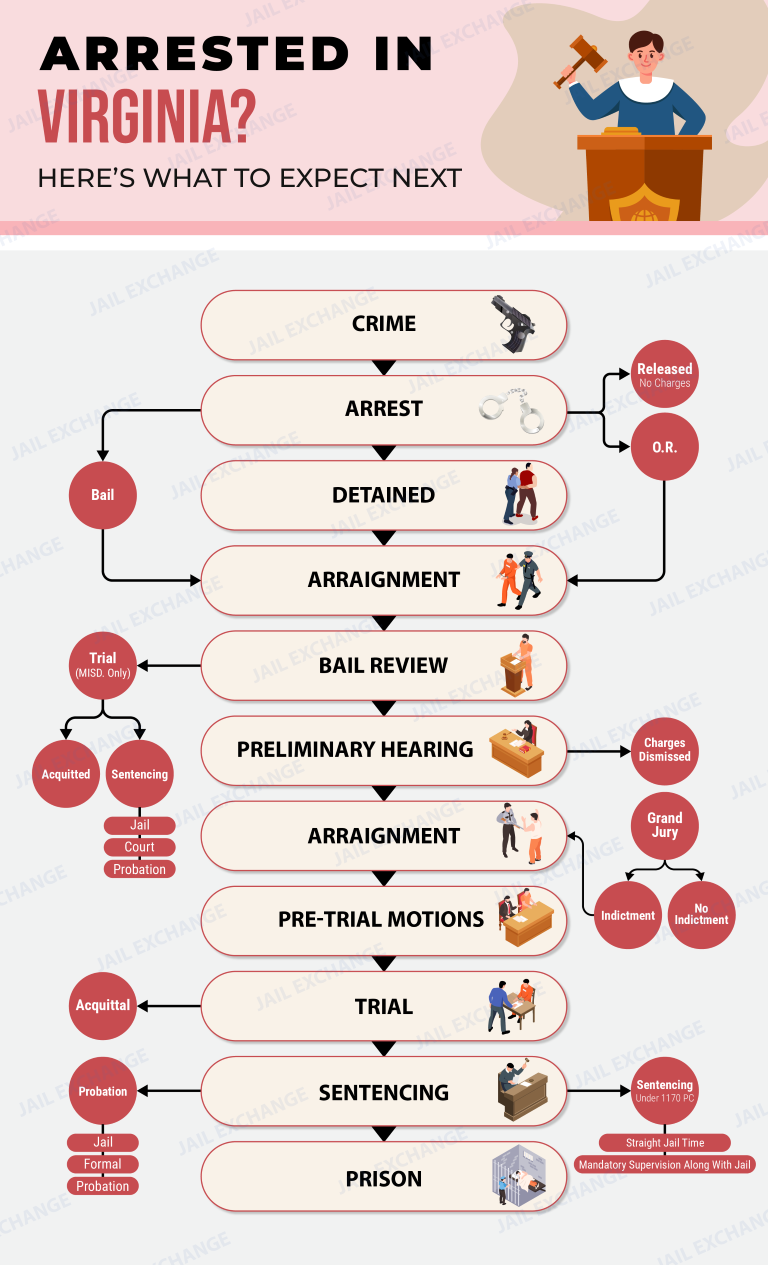
Roanoke County Jail Criminal Court Process
Criminal Court Process for Roanoke County Virginia
Roanoke County criminal courts in Salem and where defendants wait
Roanoke County crime cases are decided in three courts that share the courthouse at 305 East Main Street, Salem, VA 24153. One takes misdemeanors and first hearings, one takes youth and family matters, and one tries felonies. Adults still in custody are kept at the Roanoke County-Salem Jail, 401 East Main Street, Salem, VA 24153. Read on to see which court gets which kind of charge.
Wondering if the person is still inside? Try the jail's online inquiry by name. Our Jail Roster page lists charges, mugshots and open warrants as well.
Looking for a hearing? Phone the district court clerk who handles crime cases at 540-387-6168 or the Circuit Court clerk at 540-387-6205. The jail is at 540-283-3145. Bond questions fit better on our Roanoke County bail page.
1. Courts in Roanoke County (circuit, general district, and juvenile and domestic relations courts)
Roanoke County wraps around the City of Roanoke and the City of Salem in the Roanoke Valley, and its county seat is Salem, even though Salem itself is an independent city with separate courts; the Town of Vinton is the county's only incorporated town. Criminal charges from the county are heard at the Roanoke County Courthouse, 305 East Main Street in Salem, by the Roanoke County General District Court, the Roanoke County Juvenile and Domestic Relations District Court and the Roanoke County Circuit Court, which belong to Virginia's 23rd Judicial Circuit along with the courts of the City of Roanoke and the City of Salem. The county's own elected Commonwealth's Attorney prosecutes, and because no public defender office is assigned to the county, judges appoint private lawyers for defendants who qualify. Adults who are not released after arrest are held at the Roanoke County Jail (also called the Roanoke County/Salem Jail), run by the Sheriff next to the courthouse, and the county is also a member of the regional jail authority that operates the Western Virginia Regional Jail.
- Roanoke County Circuit Court and Circuit Court Clerk, Roanoke County Courthouse, 305 E. Main Street (P.O. Box 1126), Salem, VA 24153, (540) 387-6205
- Roanoke County General District Court (criminal and traffic), 305 East Main Street (P.O. Box 997), Salem, VA 24153, (540) 387-6168
- Roanoke County Juvenile and Domestic Relations District Court, 305 East Main Street, Salem, VA 24153, (540) 387-6160
- Magistrate's office (23rd District, Roanoke County/Salem office), 401 E. Main Street, Room 171, Salem, VA 24153, (540) 387-6092
- 23rd District Court Service Unit (juvenile intake), 215 Church Avenue SW, First Floor, Roanoke, VA 24011, (540) 853-2565
- Roanoke County Commonwealth's Attorney, Roanoke County Courthouse, 305 East Main Street, Salem, VA 24153, (540) 387-6174
- Court-appointed counsel: no public defender office serves the county; ask the magistrate or the judge, and get the financial statement from the General District Court clerk, (540) 387-6168
- Roanoke County Sheriff's Office, 401 East Main Street, Salem, VA 24153, (540) 283-3102
- Roanoke County Police Department, 5925 Cove Road, Roanoke, VA 24019, non-emergency through the Emergency Communications Center, (540) 562-3265
- Vinton Police Department, 311 S. Pollard Street, Vinton, VA 24179, (540) 983-0617
- Roanoke County Jail, 401 East Main Street, Salem, VA 24153, jail docket (540) 283-3162
- Western Virginia Regional Jail, 5885 West River Road, Salem, VA 24153, (540) 378-3700
Which court hears your case. Misdemeanors and traffic offenses committed anywhere in Roanoke County, from Cave Spring and Hollins to Vinton and the Catawba Valley, go to the Roanoke County General District Court, where a judge decides the case without a jury; a defendant convicted there has 10 days to appeal to the Roanoke County Circuit Court and get a fresh trial, with a jury if requested. The Roanoke County Juvenile and Domestic Relations District Court takes charges against people under 18 and charges that an adult assaulted or otherwise harmed a family or household member. A felony starts with a preliminary hearing in the General District Court, or in the JDR court when the alleged victim is a family or household member, and after a grand jury returns an indictment it is tried in the Roanoke County Circuit Court. What matters is where the offense happened: a case from inside Salem's city limits goes to Salem's courts, and one from the City of Roanoke goes to Roanoke's, even though all three court systems share the 23rd Circuit's judges.
Where pretrial inmates are held. A person arrested by the county police, the Sheriff, Vinton officers or state troopers in Roanoke County and not released by the magistrate is booked into the Roanoke County Jail at 401 East Main Street in Salem, the Sheriff's jail that houses inmates from both Roanoke County and the City of Salem. Roanoke County is also one of four members of the Western Virginia Regional Jail Authority, with Franklin County, Montgomery County and the City of Salem, so some county inmates are moved to the Western Virginia Regional Jail on West River Road west of Salem. To learn where someone is held or how to post bond, call the jail docket at (540) 283-3162 or the Roanoke County Sheriff's Office at (540) 283-3102.
Virginia has no municipal, town or mayor's courts, so the Town of Vinton has no court of its own. Charges brought by the Vinton Police Department go to the Roanoke County General District Court, JDR court or Circuit Court, exactly like charges filed by the Roanoke County Police Department, the Sheriff's Office or Virginia State Police troopers on Interstate 81 and Interstate 581.
One point confuses many visitors: the Roanoke County Courthouse sits on East Main Street inside the City of Salem, a few blocks from Salem's own courthouse on East Calhoun Street. The two buildings hold different courts with different clerks. Check the summons or warrant for the name of the court before you go.
Roanoke County Courthouse, 305 East Main Street, Salem
- Roanoke County Circuit Court, clerk (540) 387-6205: felony trials, grand jury, jury trials and appeals from the two district courts; clerk's office 8:30 a.m. to 4:30 p.m.
- Roanoke County General District Court, clerk (540) 387-6168: misdemeanors, traffic cases, felony preliminary hearings and bond hearings; clerk's office 8:00 a.m. to 4:00 p.m.
- Roanoke County Juvenile and Domestic Relations District Court, clerk (540) 387-6160: delinquency petitions, family-member assaults, protective orders; clerk's office 8:00 a.m. to 4:00 p.m.
Magistrate, juvenile intake and prosecutor
- Magistrate, Roanoke County/Salem office, 401 E. Main Street, Room 171, Salem, (540) 387-6092; magistrates issue warrants and make release decisions at all hours, sometimes by video
- 23rd District Court Service Unit, which serves Roanoke County, the Town of Vinton and the cities of Roanoke and Salem, 215 Church Avenue SW, Roanoke, (540) 853-2565
- Roanoke County Commonwealth's Attorney, in the courthouse, (540) 387-6174
Law enforcement
- Roanoke County Police Department (primary patrol agency in the county), 5925 Cove Road, Roanoke, (540) 562-3265
- Roanoke County Sheriff's Office (jail, courthouse security, civil process), 401 East Main Street, Salem, (540) 283-3102
- Vinton Police Department, 311 S. Pollard Street, Vinton, (540) 983-0617
Getting a lawyer appointed
The Virginia Indigent Defense Commission's Roanoke office represents clients in the City of Roanoke, not in Roanoke County. A county defendant who cannot afford a lawyer and faces possible jail asks the magistrate or the judge at the first court date for appointed counsel and completes a sworn financial statement. A judge who finds the person eligible appoints a private attorney from the court's list. The General District Court clerk, (540) 387-6168, has the form. If the person is convicted, the appointed lawyer's fee can be added to the court costs.
↑ Back to the question list2. Misdemeanor (for example, petit larceny, a first DUI, assault and battery, trespassing)
From arrest to release
Plenty of misdemeanors in the county begin with a summons that the officer hands over at the scene, and the person simply comes to court on the date shown. When an officer makes a custodial arrest instead, for example in a DUI case on Route 419, the person is brought before the magistrate on East Main Street. The magistrate may release on a personal recognizance, set an unsecured bond that is owed only if the person skips court, or require a secured bond paid in cash or posted by a licensed bail bondsman. Conditions such as pretrial supervision, no contact with a complainant or no alcohol can be attached. A person who cannot meet the terms stays at the Roanoke County Jail and can ask a General District Court judge to reconsider, and an unfavorable ruling can be appealed to the Circuit Court.
Court dates and trial
Someone held in jail usually sees a judge on the next day the General District Court is in session. At that advisement the judge reads the charge, asks whether the defendant has hired a lawyer or wants one appointed, and sets a trial date. Trials in this court are heard by the judge alone. Many cases settle by agreement with the assistant Commonwealth's Attorney, and others end in dismissal, a deferred disposition for a first offender, a fine, a suspended jail term with probation, or active jail time. Expect one to three months from arrest to result. A conviction can be appealed within 10 days to the Roanoke County Circuit Court, which hears the case anew.
What the example offenses carry
Each of the four examples is a Class 1 misdemeanor, the most serious class: a maximum of 12 months in jail and a maximum fine of $2,500, alone or together. Below that, a Class 2 misdemeanor can mean as much as 6 months and $1,000, while Class 3 and Class 4 misdemeanors bring only fines, capped at $500 and $250 respectively.
- Petit larceny covers theft of property worth less than $1,000, such as a shoplifting charge from a store along Route 419.
- First DUI: a minimum $250 fine, loss of the license for one year (a restricted license with an ignition interlock may be allowed), the Virginia Alcohol Safety Action Program (VASAP), and a 7-day administrative suspension starting at arrest. A blood alcohol content of 0.15 to 0.20 requires 5 days in jail, and a reading over 0.20 requires 10.
- Assault and battery against a family or household member goes to the JDR court rather than General District Court. A first offender may receive a deferred disposition, while a third family-assault conviction can be prosecuted as a felony.
- Trespass includes going onto or staying on property after being forbidden to do so.
Some charges and convictions may later qualify for sealing under Virginia's record-sealing law, depending on the offense and the outcome.
↑ Back to the question list3. Felony (for example, burglary, grand larceny, drug possession or distribution, malicious wounding)
The Roanoke County Commonwealth's Attorney, (540) 387-6174, prosecutes felonies from the county. These cases begin in the General District Court and finish in the Roanoke County Circuit Court, both at 305 East Main Street.
- Magistrate. After an arrest, the magistrate issues the warrant and decides whether the person is released and on what terms, weighing the chance of flight and any danger to others. A defendant who stays in custody is held at the Roanoke County Jail or, in some cases, the Western Virginia Regional Jail, and may ask a judge for a hearing on bail.
- Advisement. At the first appearance in General District Court, the judge explains the felony charge and appoints a private lawyer for a defendant who qualifies financially.
- Preliminary hearing. A General District Court judge hears enough evidence to decide whether probable cause exists. When the judge finds probable cause, the charge goes forward to the Roanoke County grand jury. The prosecutor can also skip this step and seek a direct indictment.
- Grand jury and arraignment. Once indicted, the defendant is arraigned in the Roanoke County Circuit Court and the case is scheduled for a plea or trial.
- Plea or trial. Most felony charges end with a plea agreement. A defendant who goes to trial chooses either a judge or a jury of 12, and a jury verdict has to be unanimous. Since July 2021 the judge imposes the sentence, using Virginia's voluntary sentencing guidelines, unless the defendant asks for the jury to sentence.
Virginia's speedy-trial statute generally requires trial within five months of the probable-cause finding for a defendant kept in jail, and within nine months for one on release, though delays requested by the defense do not count against the Commonwealth.
Penalty ranges
- Burglary: breaking into a dwelling at night is a Class 3 felony (5 to 20 years), raised to Class 2 when the burglar is armed; most other statutory burglary offenses allow up to 20 years.
- Grand larceny: theft of $1,000 or more, punished by 1 to 20 years in prison or by up to 12 months in jail.
- Drugs: possessing a Schedule I or II substance such as cocaine, heroin or fentanyl is a Class 5 felony (1 to 10 years). Distribution, or possession with intent to distribute, carries 5 to 40 years for a first offense, with mandatory minimum terms for large quantities. Possession of up to an ounce of marijuana by someone 21 or older is legal in Virginia, though any sale remains a criminal offense.
- Malicious wounding is a Class 3 felony; unlawful wounding, which lacks malice, is a Class 6 felony punishable by 1 to 5 years.
Parole does not exist for felonies committed on or after January 1, 1995, although earned sentence credits can shorten the time served. Anyone sentenced to more than 12 months serves that time in the Virginia Department of Corrections. A typical felony case in the county takes four months to a year.
↑ Back to the question list4. Violent felony (for example, murder, rape, robbery)
Violent felonies follow the same route as any other felony in Roanoke County: magistrate, General District Court for the preliminary hearing (or the JDR court if the victim is a family or household member), grand jury, and trial in the Roanoke County Circuit Court. These cases move more slowly. Waiting on state forensic laboratory results, expert witnesses, mental health evaluations and pretrial motions commonly stretches them to one or two years.
Detention while the case is pending
No statute presumes that a person charged with a violent crime must stay in jail; Virginia removed the presumption against bail for certain offenses in 2021. Even so, a magistrate or judge can refuse release when the evidence points to a risk to the alleged victim or the community, and many defendants facing these charges spend the pretrial period at the Roanoke County Jail.
Possible sentences
- Aggravated murder, which replaced capital murder, is a Class 1 felony with a sentence of life imprisonment; Virginia abolished the death penalty in 2021.
- First-degree murder is a Class 2 felony, 20 years to life. A second-degree murder conviction brings 5 to 40 years.
- Rape can bring anywhere from 5 years to life, and anyone convicted must register as a sex offender.
- Robbery also carries 5 years to life, with the sentence turning largely on whether a weapon was used and whether anyone was hurt.
- Aggravated malicious wounding falls in Class 2, punishable by 20 years to life.
Victims and defense lawyers
Crime victims have rights under Virginia's Crime Victim and Witness Rights Act, including notice of court dates, help with restitution and the chance to give a victim impact statement. The Commonwealth's Attorney's office runs a victim/witness program; start with (540) 387-6174. On the defense side, an eligible defendant receives a court-appointed private lawyer qualified for serious felonies, and in an aggravated murder case the Virginia Indigent Defense Commission's regional capital defender office, which covers Roanoke County, may be assigned.
↑ Back to the question list5. Juveniles (under 18) arrested in Roanoke County
When a young person under 18 is accused of a crime in Roanoke County or Vinton, the case belongs to the Roanoke County Juvenile and Domestic Relations District Court at the courthouse in Salem, (540) 387-6160. Complaints first go through the 23rd District Court Service Unit, the Department of Juvenile Justice office that handles juvenile intake for Roanoke County, Vinton, Salem and the City of Roanoke; its main office is at 215 Church Avenue SW in Roanoke, (540) 853-2565, and it also has a Salem branch.
Intake and detention
The intake officer looks at each complaint and decides whether to handle a minor first offense through diversion, to file a petition that puts the case before a judge, or to authorize secure detention for a youth who poses a danger or may flee. Roanoke County youths who are detained go to the Roanoke Valley Juvenile Detention Center, 498 Coyner Springs Road, Roanoke, VA 24012, (540) 561-3840. A detention hearing before a JDR judge must take place within 72 hours, on the next day the court sits, and the judge then decides whether the child stays in detention or goes home under conditions. The Roanoke County Commonwealth's Attorney prosecutes delinquency petitions, and the court appoints a lawyer for a child whose family has not retained one.
How juvenile cases end
- Diversion at intake, or dismissal after the youth meets agreed conditions.
- Probation supervised by the Court Service Unit.
- Restitution, community service, counseling, and other local programs.
- Commitment to the Department of Juvenile Justice in serious cases, with placement at Bon Air Juvenile Correctional Center or a community placement program.
When a Roanoke County teenager can be tried as an adult
If a juvenile was at least 14 at the time of an alleged serious felony, the prosecutor can ask for a transfer hearing, and the JDR judge may then send the case to the Roanoke County Circuit Court. For the gravest charges, including murder and aggravated malicious wounding, Virginia law generally lets the Commonwealth's Attorney certify a 16- or 17-year-old to Circuit Court once a preliminary hearing finds probable cause. Apart from these transfers and certifications, most juvenile court records in Virginia remain confidential.
↑ Back to the question list6. Federal cases (U.S. District Court) from Roanoke County
Roanoke County lies in the Western District of Virginia, and its federal criminal cases belong to the Roanoke Division, the district's headquarters, whose courthouse stands in downtown Roanoke a short drive from the county line.
- U.S. District Court Clerk, 210 Franklin Road SW, Room 540 (Richard H. Poff Federal Building), Roanoke, VA 24011, (540) 857-5100
- U.S. Attorney's Office (Western District headquarters), 310 1st Street SW, Room 906, Roanoke, VA 24011, (540) 857-2250
- Federal Public Defender, 210 First Street SW, Suite 400, Roanoke, VA 24011, (540) 777-0880
Which cases become federal
Federal agents and prosecutors in Roanoke most often bring charges for drug trafficking, possession of guns by felons and other barred persons, bank robbery, fraud schemes, and online child exploitation, frequently after an investigation that began with county police. Crimes on federal land also go to federal court. The Blue Ridge Parkway crosses the southeastern part of the county, sections of the Jefferson National Forest reach into it, and the Appalachian Trail climbs through the Catawba area near McAfee Knob. Minor offenses on that land are usually handled on a federal magistrate judge's petty-offense docket, while serious ones are prosecuted like any other federal crime.
How a federal case proceeds
A defendant arrested on a federal charge appears first before a U.S. magistrate judge in Roanoke, who explains the charge and, if the defendant cannot pay for a lawyer, appoints the Federal Public Defender or a Criminal Justice Act panel attorney. Commercial bail and bondsmen are not part of the federal system. Applying the Bail Reform Act, the magistrate judge decides between release on conditions, which U.S. Pretrial Services monitors, and detention, usually ruling at a hearing within three court days after the prosecutor asks for one. A case started by criminal complaint must be indicted by a grand jury within 30 days, and the Speedy Trial Act calls for trial within 70 days, a deadline that is often extended.
Most defendants plead guilty. A federal trial jury in Roanoke has 12 members, and all of them must agree on the verdict. Before sentencing, a probation officer writes a presentence report, and the judge considers the advisory Sentencing Guidelines along with any mandatory minimum. Because there is no federal parole, a prisoner serves roughly 85 percent of the sentence in the Federal Bureau of Prisons, followed by supervised release. Appeals go to the U.S. Court of Appeals for the Fourth Circuit. Federal prosecution of juveniles is rare.
Locating a federal prisoner
Families of Roanoke County defendants can check the Federal Bureau of Prisons inmate locator using either a full name or a register number. Pretrial federal detainees housed at a local or regional jail through a U.S. Marshals agreement can appear on that facility's roster as well.
↑ Back to the question listThis guide describes the usual course of a criminal case in the Roanoke County courts and is not legal advice; court procedures, phone numbers and jail arrangements change over time. Anyone charged with a crime in the county should talk with a criminal defense lawyer. Because Roanoke County has no public defender office, a person who cannot afford counsel should ask the magistrate or judge for a court-appointed lawyer or call the Roanoke County General District Court clerk at (540) 387-6168; questions about an inmate go to the Roanoke County Sheriff's Office at (540) 283-3102.