Stafford County is a fast-growing county between Prince William County and the City of Fredericksburg, with its government and courts gathered around Stafford Courthouse on Route 1. Criminal charges are heard at the Stafford Judicial Center, 1300 Courthouse Road, in the Stafford General District Court, the Stafford Juvenile and Domestic Relations District Court and the Stafford Circuit Court, which belongs to Virginia's 15th Judicial Circuit. The county's own elected Commonwealth's Attorney prosecutes. Anyone held after arrest goes to the Rappahannock Regional Jail on Richmond Highway in Stafford, which the county shares with King George, Spotsylvania and Fredericksburg.
- Stafford Circuit Court and Circuit Court Clerk, 1300 Courthouse Road (P.O. Box 69), Stafford, VA 22555-0069, (540) 658-8750
- Stafford General District Court (criminal and traffic), The Judicial Center, 1300 Courthouse Road (P.O. Box 940), Stafford, VA 22555-0940, (540) 658-8935
- Stafford Juvenile and Domestic Relations District Court, 1300 Courthouse Road (P.O. Box 400), Stafford, VA 22555-0400, (540) 658-8775
- Magistrate's Office serving Stafford County (15th Magisterial District), (540) 659-2968; District 15 chief magistrate, c/o Rappahannock Regional Jail, 1745 Richmond Highway, Stafford, (540) 318-5321
- 15th District Court Service Unit (juvenile intake; Stafford branch), main office 615 Princess Anne Street, Fredericksburg, VA 22401, (540) 372-1068
- Stafford County Commonwealth's Attorney, Stafford (includes a Victim Witness Assistance Program)
- Fredericksburg Public Defender (Virginia Indigent Defense Commission; serves Stafford), 2300 Fall Hill Avenue, Suite 300, Fredericksburg, VA 22401, (540) 899-4814
- Stafford County Sheriff's Office, Ford T. Humphrey Public Safety Center, 1225 Courthouse Road, Stafford, VA 22554, non-emergency (540) 658-4400
- Rappahannock Regional Jail, 1745 Richmond Highway, Stafford, VA 22554, (540) 288-5245
Which court hears your case. A misdemeanor or traffic charge in Stafford, whether a speeding ticket on I-95 or a shoplifting arrest near Garrisonville Road, is tried by a judge without a jury in the Stafford General District Court. A defendant convicted there may appeal within 10 days to the Stafford Circuit Court, where the case starts over and a jury can be requested. When the accused is under 18, or when an adult is charged with assaulting or otherwise offending against a family or household member, the case belongs to the Stafford Juvenile and Domestic Relations District Court. Felony charges begin with a preliminary hearing in the General District Court (the JDR court handles that step when a relative or household member is the alleged victim), and they reach the Circuit Court once a grand jury returns an indictment.
Where pretrial inmates are held. Stafford has no county-run jail of its own. The regional jail authority formed by Stafford, Spotsylvania, King George and Fredericksburg runs the jail at 1745 Richmond Highway, just south of the Stafford Courthouse area, and deputies take arrestees there after the magistrate sets terms. Family members can call the jail at (540) 288-5245 for custody questions; for the bond amount, the magistrate's office at (540) 659-2968 is the place to start. Anyone who cannot afford a lawyer can ask the magistrate or the judge for the public defender.
- Courts in Stafford County (circuit, general district, and juvenile and domestic relations courts)
- Misdemeanor (for example, petit larceny, a first DUI, assault and battery, trespassing)
- Felony (for example, burglary, grand larceny, drug possession or distribution, malicious wounding)
- Violent felony (for example, murder, rape, robbery)
- Juveniles (under 18) arrested in Stafford County
- Federal cases (U.S. District Court) from Stafford County
Courts in Stafford County (circuit, general district, and juvenile and domestic relations courts)
Virginia has no municipal, town or mayor's courts, and Stafford has no incorporated towns at all, so every criminal charge in the county lands in one of the three courts at the Judicial Center on Courthouse Road. That includes arrests in Falmouth, Aquia Harbour, North Stafford, Garrisonville, Brooke, Hartwood and White Oak. The Stafford County Sheriff's Office is the county's main police agency; Stafford does not have a separate county police department. Troopers of the Virginia State Police also make many arrests on I-95 and Route 1, and those cases go to the same courts.
Courts
- Stafford Circuit Court (15th Judicial Circuit; felony trials, grand jury, jury trials, misdemeanor appeals), 1300 Courthouse Road, P.O. Box 69, Stafford, VA 22555-0069, (540) 658-8750
- Stafford General District Court (15th Judicial District; misdemeanors, traffic, felony preliminary hearings), 1300 Courthouse Road, P.O. Box 940, Stafford, VA 22555-0940, (540) 658-8935; clerk's office 8:00 a.m. to 4:00 p.m.
- Stafford Juvenile and Domestic Relations District Court, 1300 Courthouse Road, P.O. Box 400, Stafford, VA 22555-0400, (540) 658-8775; clerk's office 8:00 a.m. to 4:00 p.m.
Offices connected to the courts
- Magistrates (Region 6, District 15): the Stafford magistrate's line is (540) 659-2968, and the chief magistrate's office is located at the Rappahannock Regional Jail, 1745 Richmond Highway, (540) 318-5321. Magistrates issue warrants and decide bail at any hour, often by video.
- 15th District Court Service Unit (Department of Juvenile Justice), Stafford branch; district office 615 Princess Anne Street, Fredericksburg, VA 22401, (540) 372-1068
- Stafford County Commonwealth's Attorney, the elected prosecutor for felonies and many misdemeanors, with a Victim Witness Assistance Program
- Fredericksburg Public Defender, 2300 Fall Hill Avenue, Suite 300, Fredericksburg, VA 22401, (540) 899-4814; this state office covers Stafford, King George, Spotsylvania and Fredericksburg
- Stafford County Sheriff's Office, 1225 Courthouse Road (P.O. Box 189), Stafford, VA 22554, non-emergency (540) 658-4400, information (540) 658-4450
- Virginia State Police, (800) 582-8350
Misdemeanor (for example, petit larceny, a first DUI, assault and battery, trespassing)
Commuter traffic on I-95, the shopping centers along Route 610 and Route 1, and a large suburban population keep the Stafford General District Court's criminal docket busy. Many misdemeanors start with a summons handed out at the scene, which lets the person go home and come to court on the date written on it. Others start with an arrest.
Arrest, the magistrate and release
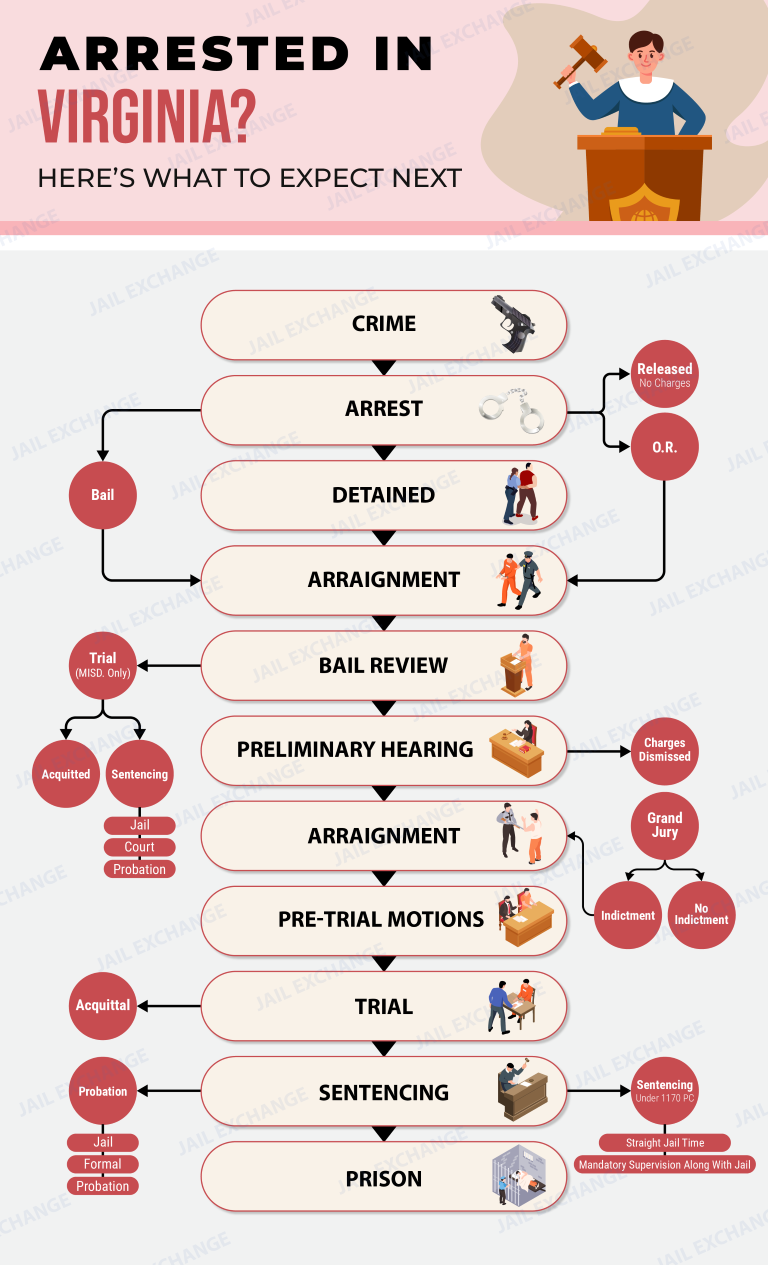
After an arrest, a deputy or trooper brings the person before a District 15 magistrate, usually over a video link from the jail or the Sheriff's Office. The magistrate reviews probable cause, issues the warrant, and picks a form of release: a personal recognizance (a written promise to appear), an unsecured bond that costs nothing unless the person misses court, or a secured bond paid in cash or posted by a licensed bail bondsman. Conditions such as no contact with an alleged victim, no alcohol, or reporting to a local pretrial services officer can be attached. The magistrate considers whether the person is likely to flee or poses a danger. Someone who cannot meet the terms is booked into the Rappahannock Regional Jail and can ask a General District Court judge to review the bond, usually at the first court appearance; a further appeal goes to the Circuit Court.
Arraignment and a lawyer
The first appearance, often called arraignment or advisement, is normally held the next day the court sits, and jailed defendants usually appear by video. The judge reads the charge, explains the right to counsel, and asks whether the defendant will hire a lawyer, wants a court-appointed one, or chooses to go without. When jail time is possible and the defendant cannot pay, the judge can appoint the Fredericksburg Public Defender after the defendant fills out a financial statement; the clerk at (540) 658-8935 can explain the form. A trial date is then set.
Penalties for common charges
- Petit larceny (property worth under $1,000): Class 1 misdemeanor, punishable by up to 12 months in jail and a fine up to $2,500.
- Assault and battery: Class 1. If the alleged victim is a family or household member, the case goes to the Stafford JDR court, a first offender may qualify for a deferred disposition, and a third family-assault conviction can be charged as a felony.
- Trespassing: Class 1.
- First DUI: Class 1 misdemeanor with a mandatory minimum fine of $250, a 7-day administrative license suspension at arrest, and a 1-year revocation on conviction (a restricted license with an ignition interlock is often possible). A blood alcohol level of 0.15 to 0.20 brings a mandatory 5 days in jail, and more than 0.20 brings 10 days. Convicted drivers are referred to VASAP, the Virginia Alcohol Safety Action Program.
- For comparison, a Class 2 misdemeanor carries up to 6 months and $1,000, a Class 3 a fine up to $500, and a Class 4 a fine up to $250.
Trial, outcomes and timeline
There are no juries in General District Court; a judge hears the evidence and decides. Results range from dismissal or a deferred disposition (common for first offenders, and dismissed after the person completes conditions) to a fine, a suspended sentence with probation, or active jail time. A defendant who loses has 10 days to note an appeal to the Stafford Circuit Court for a completely new trial, where a jury of seven may be requested. Most Stafford misdemeanors are resolved in one to three months; an appeal adds more. Virginia's record-sealing law may later allow some dismissed charges and certain convictions to be sealed.
Felony (for example, burglary, grand larceny, drug possession or distribution, malicious wounding)
A Stafford felony starts in the lower court and ends, if it is not dismissed, in the Circuit Court upstairs at the same Judicial Center. The steps below cover the usual path.
From arrest to the preliminary hearing
The magistrate decides release terms for felony arrests just as for misdemeanors, but higher bail or detention is more common, especially with prior convictions, a gun, or an alleged victim who was hurt. Virginia removed the old presumption against release for certain offenses in 2021, so each case turns on flight risk and danger. A person held at the Rappahannock Regional Jail can ask a General District Court judge for a bond hearing and then appeal a denial to the Circuit Court. At arraignment the judge appoints the Fredericksburg Public Defender for those who qualify (or a private lawyer from the court's list when the public defender has a conflict) and schedules a preliminary hearing. At that hearing the Commonwealth must show probable cause; if it does, the judge certifies the charge to the grand jury. The Commonwealth's Attorney may instead skip the hearing by seeking a direct indictment.
Grand jury and Circuit Court
Once a Stafford grand jury indicts, the case is arraigned in the Circuit Court and set for motions, plea talks and trial. Plea agreements settle the large majority of these cases. A trial can be heard by a judge alone or by a unanimous jury of 12. Since July 2021 the judge imposes sentence unless the defendant asks the jury to do it, and Virginia's voluntary sentencing guidelines inform the judge's decision. The speedy-trial statute calls for trial within 5 months of the probable-cause finding for a jailed defendant and 9 months for one on release, with exceptions for continuances the defense requests or agrees to.
What the common Stafford felony charges carry
- Grand larceny (property worth $1,000 or more, such as a stolen trailer from a Hartwood farm): a Stafford judge or jury may impose anywhere from 1 to 20 years in prison, or as little as a jail term of 12 months or less.
- Burglary: a nighttime break-in at a home is charged as a Class 3 felony with a range of 5 to 20 years, rising to Class 2 when a deadly weapon is involved, and the other statutory burglary offenses (daytime entries, sheds, businesses) top out at 20 years in most forms.
- Simple possession of a Schedule I or II drug (fentanyl pills found in a traffic stop on Route 1, for instance) is a Class 5 felony that a Stafford court can punish with 1 to 10 years in prison or, at the judge's discretion, a local jail term up to a year. Marijuana is different: adults 21 and over may lawfully hold up to an ounce, but sales remain illegal.
- Selling, or holding drugs to sell: a first conviction involving a Schedule I or II substance carries 5 to 40 years, and larger quantities trigger mandatory minimum terms.
- Malicious wounding is a Class 3 felony with a 5-to-20-year range. If the jury or judge finds the injury was caused without malice, the lesser charge of unlawful wounding (Class 6) carries 1 to 5 years, or a year or less in jail.
Sentences and timeline
Felonies committed on or after January 1, 1995, carry no parole in Virginia, although earned sentence credits can shorten the time actually served. A Stafford felon whose sentence exceeds a year goes to a state prison run by the Virginia Department of Corrections, while a shorter term is normally served at the regional jail. A typical Stafford felony takes four to twelve months from arrest to sentencing, and an appeal of right goes to the Court of Appeals of Virginia.
Violent felony (for example, murder, rape, robbery)
Serious violent charges in Stafford follow the felony path above but tend to move more slowly and with more contested hearings. They are prosecuted by the Commonwealth's Attorney's senior staff and usually investigated by the Sheriff's Office criminal investigations division.
Custody before trial
Because the magistrate and judges weigh danger to the community, people charged with homicide, rape or armed robbery are often held without bond at the Rappahannock Regional Jail. Defense counsel can still request a bond hearing in the General District Court and appeal to the Circuit Court, and release with strict conditions such as GPS monitoring is sometimes granted.
Penalties
- Aggravated murder (formerly capital murder): a Class 1 felony, punished in Stafford County by life imprisonment. Virginia abolished the death penalty in 2021.
- First-degree murder: Class 2, with a Stafford County sentence of 20 years to life.
- Second-degree murder: 5 to 40 years.
- Rape: 5 years to life.
- Robbery: 5 years to life.
- Aggravated malicious wounding: also Class 2, carrying 20 years to life in Stafford Circuit Court.
Hearings, trial and victims
Expect a preliminary hearing (unless the case is directly indicted), a grand jury indictment, expert evidence and a longer schedule; many of these cases take one to two years to resolve. Jury trials in the Stafford Circuit Court require 12 unanimous jurors. The Commonwealth's Attorney's Victim Witness Assistance Program keeps victims informed under the Crime Victim and Witness Rights Act and helps them attend hearings and give impact statements. Defendants who cannot afford a lawyer are represented by the Fredericksburg Public Defender or, when that office has a conflict, by a court-appointed private lawyer qualified for serious felonies.
Juveniles (under 18) arrested in Stafford County
Charges against anyone under 18 in Stafford go to the Stafford Juvenile and Domestic Relations District Court at 1300 Courthouse Road, (540) 658-8775, and not to the adult courts.
Intake
A complaint against a youth goes first to an intake officer of the 15th District Court Service Unit, a Department of Juvenile Justice office with a Stafford branch and a district office at 615 Princess Anne Street in Fredericksburg, (540) 372-1068. The intake officer decides whether to file a petition, divert a minor first offense to an informal program, or authorize detention. The Stafford Commonwealth's Attorney prosecutes juvenile petitions that go forward.
Detention
A young person who is detained is usually taken to the Rappahannock Juvenile Center at 275 Wyche Road in Stafford, the secure detention home that serves Stafford, Spotsylvania, King George and Fredericksburg. A detention hearing must be held within 72 hours, normally the next day the JDR court sits, where the judge decides whether the child can go home, possibly with conditions or electronic monitoring. Parents should attend. Children have a right to a lawyer, and the judge will appoint the public defender or another lawyer when the family qualifies.
Outcomes
Possible results include dismissal, diversion, probation supervised by the Court Service Unit, community service, restitution, counseling or treatment programs, and short-term detention. For serious or repeat cases the judge can commit a youth to the Department of Juvenile Justice, which may place the child at Bon Air Juvenile Correctional Center or in a community placement. Juvenile records are confidential in most cases.
When a Stafford County juvenile can face adult prosecution
For a youth 14 or older charged with certain serious felonies, the Commonwealth's Attorney can ask for a transfer hearing, after which the JDR judge may send the case to the Stafford Circuit Court for trial as an adult. For the gravest offenses, such as murder or aggravated malicious wounding, a 16- or 17-year-old can generally be certified to the Circuit Court by the prosecutor once the JDR court finds probable cause at a preliminary hearing. These rules are detailed, and a lawyer should explain how they apply.
Federal cases (U.S. District Court) from Stafford County
Stafford falls within the Eastern District of Virginia, and its federal criminal cases are assigned to the Alexandria Division, which sits in the Albert V. Bryan U.S. Courthouse (401 Courthouse Square, Alexandria, VA 22314). Reach the clerk at (703) 299-2107. Stafford is grouped with Northern Virginia for federal purposes, even though its neighbor Fredericksburg is assigned to the Richmond Division.
When a case becomes federal
Typical federal prosecutions from the county involve drug trafficking along the I-95 corridor, firearm possession by people barred from having guns, bank robbery, child exploitation, and fraud or identity theft schemes. Part of Marine Corps Base Quantico lies in northern Stafford, and offenses committed on the base can be charged federally; tickets and minor offenses there go to a magistrate judge's petty-offense docket in Alexandria, (703) 299-3311. Many cases begin with joint task forces that include Sheriff's deputies and federal agents.
Prosecutors and defenders
- U.S. Attorney's Office, Eastern District of Virginia (Alexandria), Justin W. Williams United States Attorney's Building, 2100 Jamieson Avenue, Alexandria, VA 22314, (703) 299-3700
- Federal Public Defender, Eastern District of Virginia, Alexandria office, 1650 King Street, Alexandria, VA 22314. When that office has a conflict, the court appoints a private lawyer from its Criminal Justice Act panel.
How a federal case moves
A Stafford County defendant arrested on federal charges goes first to a federal magistrate judge, who explains the charges and addresses counsel. If the government seeks detention, a detention hearing is usually held within three court days. Applying the Bail Reform Act, the magistrate judge decides between release on conditions that U.S. Pretrial Services monitors and detention until trial. A case begun by complaint must be indicted by a grand jury within 30 days, and the Speedy Trial Act generally requires trial within 70 days of indictment or first appearance. The Eastern District is known as the "rocket docket" because its judges keep cases on a fast schedule and grant few delays. Most defendants plead guilty; trials use a 12-member jury that must agree unanimously. After a guilty plea or verdict, a federal probation officer writes a presentence report that the Alexandria judge reviews alongside the advisory Sentencing Guidelines and any mandatory minimum the statute requires. Federal prison has no parole, so inmates generally serve about 85% of the sentence in the Bureau of Prisons, followed by supervised release. A defendant who wants to challenge a conviction or sentence appeals to the Fourth Circuit, the U.S. Court of Appeals that sits in Richmond. Juveniles are rarely prosecuted federally.
Finding a federal inmate
To find a Stafford County defendant in federal custody, search the Federal Bureau of Prisons inmate locator by name or register number. A defendant held before trial under a U.S. Marshals contract in a local or regional jail may also be listed on that jail's inmate roster.
This guide gives general information about criminal courts in Stafford County and is not legal advice. Laws, court procedures and office locations change, so check with the court clerk before relying on any detail. For help with a case, talk to a lawyer; if you cannot afford one, ask the magistrate or judge for the public defender, or call the Fredericksburg Public Defender at (540) 899-4814 or the Stafford General District Court clerk at (540) 658-8935.