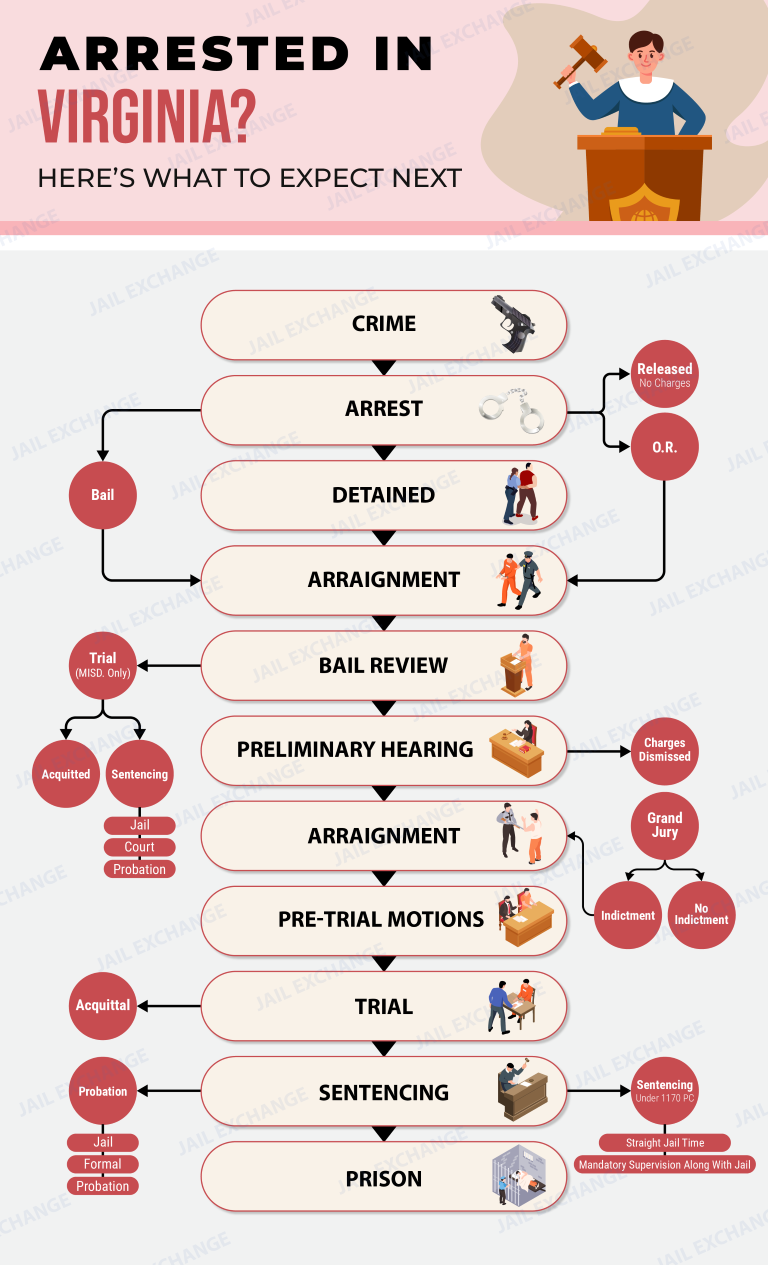
Virginia Beach Correctional Center Criminal Court Process
Criminal Court Process for Virginia Beach city Virginia
Virginia Beach Criminal Courts: Who Hears Your Case
Three state courts hear crime cases here, all at the Judicial Center, 2425 Nimmo Parkway, Virginia Beach, VA 23456. Misdemeanors go to General District, youth and family matters go to Juvenile and Domestic Relations, and felony trials go to Circuit. Adults held before trial wait at the Virginia Beach Correctional Center, 2501 James Madison Boulevard, Virginia Beach, VA 23456.
Is your family member still locked up? The Sheriff's online lookup works by name or booking number. Our Recent Arrests page shows who was just booked, plus warrants, charges and getting belongings back.
To learn a hearing date, call the General District Court criminal desk at 757-385-4707. Felony cases are also tracked by the Circuit Court clerk at 757-385-4181. Worried about getting out? Our bail guide walks through it.
1. Courts in the City of Virginia Beach (circuit, general district, and juvenile and domestic relations courts)
The City of Virginia Beach is an independent city with no county government above it, so it has its own set of state trial courts and its own constitutional officers. Arrests made here are prosecuted by the Commonwealth's Attorney for the City of Virginia Beach before three courts at 2425 Nimmo Parkway: the General District Court, the Juvenile and Domestic Relations District Court and the Circuit Court. For administrative purposes the Circuit Court is grouped with Accomack and Northampton counties in Virginia's 2nd Judicial Circuit, but the city's district courts form a district of their own, the 2nd Judicial District. Adults held before trial stay in the Virginia Beach Correctional Center, which the city's Sheriff operates without any regional partners.
- Circuit Court for the City of Virginia Beach, 2425 Nimmo Parkway, Virginia Beach, VA 23456, (757) 385-4501; Clerk's Office in Buildings 10 and 10B, 3rd Floor, (757) 385-4181; criminal records (757) 385-4188
- General District Court, Building 10, Judicial Center, 2425 Nimmo Parkway, Virginia Beach, VA 23456; criminal (757) 385-4707; traffic (757) 385-8619; clerk (757) 385-8531
- Juvenile and Domestic Relations District Court, Building 10A, Judicial Center, 2425 Nimmo Parkway, Virginia Beach, VA 23456, (757) 385-4391
- Magistrate's Office, Building 7C, 2473 Nimmo Parkway, Virginia Beach, VA 23456 (24 hours, every day), (757) 385-1801 or (757) 385-4724
- Court Service Unit, 2nd District (juvenile intake and probation), Judicial Center, 2425 Nimmo Parkway, Virginia Beach, VA 23456, (757) 385-4361
- Commonwealth's Attorney for the City of Virginia Beach, Building 10B, 2nd Floor, 2425 Nimmo Parkway, Virginia Beach, VA 23456, (757) 385-4401; victim and witness services (757) 385-8301
- Public Defender for the City of Virginia Beach (Virginia Indigent Defense Commission), 3388 Princess Anne Road, Suite 3000, Virginia Beach, VA 23456, (757) 427-6050
- Sheriff of the City of Virginia Beach, 2501 James Madison Boulevard, Virginia Beach, VA 23456, (757) 385-4555
- Virginia Beach Police Department, Second Precinct, 820 Virginia Beach Boulevard, Virginia Beach, VA; non-emergency line (757) 385-5000
- Virginia Beach Correctional Center, 2501 James Madison Boulevard, Virginia Beach, VA 23456, (757) 385-4555
- Virginia Beach Juvenile Detention Center, 2533 George Mason Drive, Virginia Beach, VA 23456, (757) 385-1220
Which court hears your case. The Virginia Beach General District Court decides misdemeanors and traffic offenses, so a charge of petit larceny at a Hilltop store or of driving under the influence on Shore Drive is tried there, by a judge and never by a jury. A defendant convicted in that court can, within 10 days, appeal to the Virginia Beach Circuit Court, where the case starts over and a jury may hear it. Offenses committed by people younger than 18, other offenses involving juveniles, and assaults and similar crimes against a family or household member are instead filed in the Virginia Beach Juvenile and Domestic Relations District Court. For a felony, the probable-cause hearing comes first in the General District Court (the JDR court when the complaining witness is a relative or household member), and the case is tried in the Circuit Court once the grand jury indicts.
Where pretrial inmates are held. Unlike most Virginia localities, which send prisoners to a jail run by a regional authority, the City of Virginia Beach keeps its own jail under its elected Sheriff. That facility stands at 2501 James Madison Boulevard on the Municipal Center campus, a short walk from the courthouse, and it houses adults charged in the city's courts. A person who is refused bail by the magistrate, or who has not paid the amount required, remains there until release is granted or the case concludes. The Sheriff's Office answers questions about inmates at (757) 385-4555.
No municipal, town or mayor's courts exist anywhere in Virginia, which leaves these three state courts as the only local forums for criminal charges in the City of Virginia Beach. There are no towns within the city, and therefore no town police forces; whether an arrest comes from a city patrol officer, a deputy sheriff, a state trooper or a college police officer, the paperwork is filed at the same Judicial Center. Judges of the 2nd Judicial Circuit (which also takes in Accomack and Northampton counties) preside in the Circuit Court, while the General District and JDR courts together form the 2nd Judicial District.
District courts
- Virginia Beach Juvenile and Domestic Relations District Court — charges against minors, family-violence charges against adults, protective orders; Building 10A, 2425 Nimmo Parkway, Virginia Beach, VA 23456, (757) 385-4391; clerk's hours 8:00 a.m. to 4:00 p.m.
- Virginia Beach General District Court — misdemeanor and traffic trials, preliminary hearings on felonies, requests to change bond; Building 10, 2425 Nimmo Parkway, Virginia Beach, VA 23456; criminal division (757) 385-4707, traffic division (757) 385-8619, general information (757) 385-8531; phones answered 8:00 a.m. to 3:30 p.m.
Circuit Court
- Virginia Beach Circuit Court — grand jury, felony cases, jury trials, appeals de novo from the district courts; 2425 Nimmo Parkway, (757) 385-4501
- Clerk of the Circuit Court — Buildings 10 and 10B, 3rd Floor; (757) 385-4181; criminal division (757) 385-4188; hours 8:30 a.m. to 4:00 p.m.
Offices connected to the courts
- Commonwealth's Attorney — Building 10B, 2nd Floor, 2425 Nimmo Parkway, (757) 385-4401
- Public Defender — 3388 Princess Anne Road, Suite 3000, (757) 427-6050
- Magistrate — Building 7C, 2473 Nimmo Parkway, (757) 385-1801; a satellite office at the police Second Precinct, 820 Virginia Beach Boulevard, is not staffed at all hours
- Court Service Unit, 2nd District — (757) 385-4361
- Sheriff's Office — 2501 James Madison Boulevard, (757) 385-4555
- Virginia Beach Police Department — non-emergency (757) 385-5000, detectives (757) 385-4101
To confirm a court date, call the clerk of whichever court appears on the summons or release order. Free counsel can be requested at three points: before the magistrate, at the arraignment, or by submitting a financial statement to the criminal clerk of the General District Court at (757) 385-4707.
↑ Back to the question list2. Finding the courts on Nimmo Parkway
Visitors expecting a courthouse near the resort strip will be surprised: the city's government campus, the Municipal Center, is miles inland in the Courthouse area of southern Virginia Beach. The Judicial Center there is addressed as 2425 Nimmo Parkway, and the public must use the Nimmo Parkway entrance. Inside, the General District Court occupies Building 10, the JDR court is in Building 10A, and the Circuit Court and its clerk use Buildings 10 and 10B, where the clerk's counter is on the 3rd floor. Prosecutors work one floor down in 10B.
Deputies from the Sheriff's Office run the security checkpoint and provide courtroom security. Knives, weapons and similar items are refused at the door, and an electronic device policy restricts phone use in courtrooms. Allow extra time for screening, especially on mornings when the criminal dockets are crowded.
The jail, the Virginia Beach Correctional Center, is on the same campus at 2501 James Madison Boulevard, and the magistrate's Building 7C is part of that complex. Because the court clerks close at 4:00 p.m., anyone posting a bond in the evening or on a weekend does so through the magistrate and the jail. The public defender's office is close by on Princess Anne Road.
↑ Back to the question list3. From arrest to first hearing in the City of Virginia Beach
Summons or custody
Not everyone charged is taken into custody. For many lower-level misdemeanors and traffic crimes, officers write a summons and let the person leave, with a court date already assigned. Those who are arrested are driven to the Virginia Beach Correctional Center, where deputies handle booking: photographs, fingerprints, a records check and an inventory of belongings.
The magistrate's decision
A magistrate is on duty in Building 7C at all hours and may hear the matter in person or over a video link. The first question is probable cause; if the magistrate finds it, a warrant issues and the case formally begins. The second question is release. Virginia magistrates can let a person go on a personal recognizance bond, set an unsecured bond that is owed only if the person skips court, require a secured bond backed by cash or a surety such as a licensed bondsman, or deny release. Since 2021 no offense carries a legal presumption against release; the magistrate assesses whether the person is likely to come back to court and whether release would endanger anyone. When the charge is domestic, the magistrate may issue an emergency protective order at the same time, and no-contact conditions are common.
Commercial bondsmen
Families who cannot post the full amount often turn to a bondsman, licensed in Virginia by the Department of Criminal Justice Services. The bondsman's fee, a percentage of the amount, is not refunded when the case ends.
Supervision while the case is pending
Release can come with pretrial supervision. Someone placed on supervision may have to check in regularly, submit to drug or alcohol tests, wear a monitor or stay away from a person or place. Instructions on where to report are given with the release order.
Arraignment
If still in custody, the defendant is usually arraigned by video the next day the district court is open; otherwise the arraignment happens on the date given at release. The judge explains the charge and the right to counsel. A defendant who asks for a court-appointed lawyer fills out a financial statement under oath, and the court normally assigns the Public Defender for the City of Virginia Beach unless there is a conflict. A misdemeanor is then set for trial, while a felony gets a preliminary hearing date.
Second look at release terms
Defense counsel can ask a judge of the General District Court, or of the JDR court in family and juvenile matters, to lower or modify the conditions. If that request is denied, the Circuit Court can hear an appeal of the decision.
↑ Back to the question list4. The city jail run by the Virginia Beach Sheriff
Pretrial detainees from the City of Virginia Beach are housed at the Virginia Beach Correctional Center, 2501 James Madison Boulevard, Virginia Beach, VA 23456. The facility is a local jail rather than a regional one: the Sheriff, elected by city voters, runs it, and no neighboring county or city shares it. Besides people awaiting trial, it holds inmates serving local sentences of up to 12 months and state-responsible prisoners waiting for a transfer to the Virginia Department of Corrections.
Questions about whether a person is being held, the charges, or how to post a bond can be directed to the Sheriff's staff by phone at (757) 385-4555, and an online inmate lookup is also offered. The Sheriff's Office sets the rules for calls, video visits, mail and money deposits, and offers reentry and modified-incarceration programs to some sentenced inmates.
Two other points are worth knowing. The jail accepts some federal detainees, because the Sheriff has a housing contract with the U.S. Marshals Service. And a person picked up in Virginia Beach on another locality's warrant, from Chesapeake or Norfolk for example, is usually turned over to that locality rather than kept here.
↑ Back to the question list5. Getting a public defender in the City of Virginia Beach
Who qualifies? A defendant whose income and assets fall under the guidelines in Virginia law, and who faces a charge that could lead to jail. Fine-only offenses carry no right to appointed counsel. A defendant may raise the request with the magistrate or the arraignment judge, or put it in writing on the financial statement form kept by the General District Court criminal clerk, (757) 385-4707.
Most eligible defendants are then represented by the Public Defender for the City of Virginia Beach, a Virginia Indigent Defense Commission office at 3388 Princess Anne Road, Suite 3000, Virginia Beach, VA 23456, (757) 427-6050. The office serves this city only. Its attorneys appear in the General District, Circuit and JDR courts, including in juvenile delinquency cases.
When the office has a conflict of interest, such as representing a co-defendant, a private attorney is assigned instead, chosen from the court's roster of lawyers qualified for the type of charge. A person in custody at the Virginia Beach Correctional Center typically learns who the lawyer will be at the video arraignment, and the lawyer may then ask the court to review bail. Representation costs nothing up front, but a court that convicts can include the appointed lawyer's fee in the costs it assesses.
↑ Back to the question list6. Prosecution, victim services and first-offender options
State charges in the city are brought in the name of the Commonwealth by the Commonwealth's Attorney for the City of Virginia Beach, who is elected by city voters and whose office handles no other locality's cases. The staff of assistant prosecutors works from Building 10B, 2nd Floor, at 2425 Nimmo Parkway ((757) 385-4401). They evaluate charges filed by police, amend or dismiss charges when warranted, offer plea agreements, take felonies to the grand jury, and handle trials in each of the three courts. On certain minor traffic dockets an officer may present the case alone.
For victims, particularly of felonies, the office runs a Victim/Witness Program at (757) 385-8301. Advocates keep victims informed about court dates, explain each stage, help prepare restitution requests and impact statements, and can sit with a victim in court; those services put the state's victim-rights statute into practice. Victims working with police detectives can also contact the department's own advocate at (757) 385-8721.
The city has no single prosecutor-run diversion program for adults; instead, the main alternatives to a conviction come from Virginia statutes for first offenders. Under them, a judge may defer a finding in a first drug possession case, a first assault on a family member (in the JDR court) and certain other first offenses, and later dismiss the charge if the defendant finishes the required classes, treatment, community service or restitution and stays out of trouble. Charge reductions and dismissals after community service are also possible, but only by agreement with the prosecutor, usually worked out by defense counsel. Those discussions can take place even while a defendant is held without bond.
↑ Back to the question list7. Treatment dockets in the City of Virginia Beach
Felony defendants whose crimes grow out of a drug or alcohol problem may be referred to the Virginia Beach Adult Drug Treatment Court, which operates in the Circuit Court and received state approval in April 2016. The program asks a great deal: a guilty plea, at least a year of treatment, random testing, frequent appearances in front of the judge, close probation supervision, and incentives for progress and sanctions for setbacks. People who graduate may see their sentence suspended or reduced, or their charge lowered, depending on what the plea agreement provides.
Getting in takes several approvals. Referrals usually come from defense counsel; the prosecutor has to consent; and a treatment team decides whether the applicant is eligible and suitable. Violent offenses and commercial drug dealing generally rule a person out, and openings are limited, so the topic should come up early. A defendant at the Virginia Beach Correctional Center can be evaluated while still in custody and, if accepted, released on bond to begin treatment.
Statewide, Virginia's courts also run behavioral health dockets and veterans treatment dockets, and new ones are approved regularly. With a large population of veterans and active-duty families, Virginia Beach defendants who have served or who live with serious mental illness should ask their lawyer whether any such docket is taking referrals in the city's courts.
People convicted of a first DUI are referred to VASAP, the Virginia Alcohol Safety Action Program, for education or treatment and the program also monitors interlock devices installed as a condition of restricted driving.
↑ Back to the question list8. Misdemeanor (for example, petit larceny, a first DUI, assault and battery, trespassing)
A misdemeanor arrest in the City of Virginia Beach often ends the same night with release on a summons or a recognizance bond. Anyone not released stays in custody at the Virginia Beach Correctional Center and appears by video before a General District Court judge on the following court day. Busy beach seasons add many charges such as drunk in public, disorderly conduct and underage alcohol possession to the docket.
Assault on a family or household member
Domestic assault and battery cases skip the General District Court and are heard by the Virginia Beach Juvenile and Domestic Relations District Court. The magistrate commonly issues an emergency protective order on the night of the arrest. A deferred disposition, leading to dismissal after counseling and a clean period, may be offered to someone with no prior record; a person with two earlier convictions for family assault can face a felony on the third.
First DUI
The law imposes several fixed consequences for a first DUI conviction: a $250 minimum fine, revocation of the driver's license for a year and enrollment in VASAP. A test result between 0.15 and 0.20 requires at least 5 days in jail, and a result over 0.20 requires at least 10. Separately, the license is suspended for 7 days by administrative action at arrest. The judge has discretion to grant a restricted license that requires an ignition interlock.
Possible penalties by class
- Class 1 misdemeanors, which include a first DUI, trespass, assault and battery, and petit larceny of goods worth less than $1,000, carry up to 12 months in jail and up to a $2,500 fine.
- Class 2 misdemeanors carry as much as 6 months in jail and a $1,000 fine.
- Class 3 misdemeanors are punishable only by a fine of $500 or less, and Class 4 misdemeanors by a fine of $250 or less.
Trial, appeal and outcomes
A General District Court judge hears the case and decides guilt. The result may be a dismissal, a deferred disposition, a fine, a jail term that is suspended on conditions of probation, or time to serve. Within 10 days of a conviction, the defendant may appeal to the Virginia Beach Circuit Court for an entirely new trial, before a seven-member jury if desired. A typical misdemeanor case finishes in one to three months; an appeal extends that. Many defendants facing possible jail time are represented by the city's public defender.
↑ Back to the question list9. Felony (for example, burglary, grand larceny, drug possession or distribution, malicious wounding)
Felony suspects go through the same booking process and magistrate hearing, but the magistrate is more likely to require a secured bail amount or to deny release outright. A person who stays at the Virginia Beach Correctional Center is arraigned in the General District Court, where counsel can also ask for better release terms.
Getting to the Circuit Court
The usual route runs through the Virginia Beach General District Court, which holds a preliminary hearing first. The prosecutor presents evidence, and the judge decides only whether there is probable cause; if so, the charge is certified to the Circuit Court's grand jury, and if not, the warrant is dismissed (the prosecutor may still seek an indictment). A preliminary hearing is not guaranteed, because the Commonwealth's Attorney may take the case straight to the grand jury by direct indictment. The defendant is then arraigned in the Virginia Beach Circuit Court.
Typical charges and ranges
- Possession of a Schedule I or II controlled substance, such as cocaine, heroin or fentanyl, is a Class 5 felony with a range of 1 to 10 years, and the judge may substitute up to 12 months in jail.
- Selling a controlled drug, or possessing it with intent to sell, brings 5 to 40 years on a first conviction, and large amounts trigger mandatory minimum terms. Possessing up to one ounce of marijuana is legal for those 21 and over, though selling it is not.
- Grand larceny, meaning theft of $1,000 or more, carries 1 to 20 years, or a jail sentence of 12 months or less.
- Burglary of a home at night is a Class 3 felony with 5 to 20 years, rising to Class 2 when the offender carries a deadly weapon; other forms of statutory burglary can bring up to 20 years.
- Malicious wounding is punished with 5 to 20 years as a Class 3 felony, while unlawful wounding, which lacks malice, is a Class 6 felony with 1 to 5 years or up to a year in jail.
Plea or trial, then sentencing
The great majority of felony prosecutions in the city are settled by plea agreement. A defendant who goes to trial chooses between a judge and a jury, and felony juries have 12 members who must all agree. Juries no longer sentence automatically: since July 2021 the judge does so unless the defendant elects jury sentencing, and the judge refers to the state's discretionary sentencing guidelines. For offenses after January 1, 1995, there is no parole, but earned sentence credits may shorten the time served. Any sentence above 12 months is served in a Virginia Department of Corrections facility.
Time frame
By statute, a defendant held in jail generally must be tried within five months of the probable cause finding, and a released defendant within nine months, with exceptions for delays such as defense continuances. Many felonies in the city take between four months and a year. The Public Defender for the City of Virginia Beach, (757) 427-6050, defends a large portion of them.
↑ Back to the question list10. Violent felony (for example, murder, rape, robbery)
A person arrested for homicide, rape or robbery in the City of Virginia Beach is usually held at the Virginia Beach Correctional Center without bond after the magistrate hearing. Whether release is ever granted is typically decided by a judge after both sides argue the question. Police detectives investigate these offenses, and senior prosecutors in the Commonwealth's Attorney's office take them to court.
Steps and timing
These cases travel the same road as other felonies, only more slowly. The General District Court holds the preliminary hearing, which is moved to the JDR court when the person harmed is a relative or lives in the same household, and skipped altogether if prosecutors obtain a direct indictment; after the grand jury indicts, the Circuit Court handles discovery, lab work, expert witnesses and pretrial motions. Jury trials are more common than in other felony cases. Because defense attorneys often agree to extend the speedy trial deadlines in order to prepare, these prosecutions frequently last a year or two.
Penalties under Virginia law
- Robbery: a term of five years up to life in prison.
- Rape: likewise five years up to life.
- Second-degree murder: between 5 and 40 years.
- First-degree murder: a Class 2 offense punished by at least 20 years and as much as life.
- Aggravated malicious wounding: also Class 2, with a sentence from 20 years up to life.
- Aggravated murder, the offense once called capital murder: Class 1, punished by life in prison, since the death penalty was repealed in 2021.
Victims and families
Virginia's Crime Victim and Witness Rights Act gives crime victims and surviving relatives a right, on request, to notice of court proceedings, the chance to address the court with an impact statement before sentencing, and help in seeking restitution. Those services are coordinated by the Commonwealth's Attorney's Victim/Witness Program at (757) 385-8301.
Defendants without the means to hire a lawyer receive representation from the city's public defender, or from a private attorney qualified for major felonies if the office has a conflict.
↑ Back to the question list11. Juveniles (under 18) arrested in the City of Virginia Beach
Children are not booked into the adult jail. A youth who is ordered held goes to the Virginia Beach Juvenile Detention Center at 2533 George Mason Drive, (757) 385-1220, the secure facility the city operates for its own juveniles. Their cases are heard by the Virginia Beach Juvenile and Domestic Relations District Court in Building 10A of the Judicial Center, (757) 385-4391.
The intake officer's role
Juvenile complaints first go to the Court Service Unit, 2nd District, an office of the Department of Juvenile Justice that can be reached at (757) 385-4361. An intake officer looks at the facts and the child's history and then decides whether to divert the case to an informal program such as community service, counseling or paying restitution, to file a petition that puts the case before a judge, or to seek detention when the offense is serious or the child poses a risk. Probation and parole supervision for juveniles is also handled by this unit.
Within 72 hours
Once detained, a youth is entitled to a detention hearing before a JDR judge within 72 hours, or on the next court day when the deadline falls on a weekend or holiday. The judge may continue detention, send the child home with a parent, or order conditions such as house arrest or electronic monitoring. Parents and guardians should plan to come to every hearing.
Prosecution and defense
The city's Commonwealth's Attorney prosecutes juvenile charges. Children accused of delinquent acts are entitled to counsel; the Public Defender for the City of Virginia Beach, (757) 427-6050, represents many of them, and private lawyers are appointed in conflict cases.
When a Virginia Beach teenager is tried as an adult
If a child was 14 or older at the time of an alleged serious felony, the prosecutor can ask for a transfer hearing in the JDR court, and the judge may send the case to the Virginia Beach Circuit Court. For the most serious offenses, among them murder and aggravated malicious wounding, the Commonwealth's Attorney may be able to certify a 16- or 17-year-old for adult trial, typically after probable cause is found at a preliminary hearing. Adult prosecution exposes the youth to adult penalties, although the sentencing judge can still consider juvenile dispositions.
Dispositions
Possible results in the JDR court range from dismissal or a deferred finding to probation, restitution, counseling and community programs; the most serious step is committing the youth to the custody of the Department of Juvenile Justice. A commitment can mean time at the Bon Air Juvenile Correctional Center or a community placement program.
Virginia generally keeps juvenile records and hearings confidential, though older youths facing grave felony charges receive narrower protection.
↑ Back to the question list12. Federal cases (U.S. District Court) from the City of Virginia Beach
For federal purposes, the City of Virginia Beach is part of the Eastern District of Virginia, and its criminal cases are assigned to the district's Norfolk Division. Federal criminal matters from the city are heard at the Walter E. Hoffman U.S. Courthouse, 600 Granby Street, Norfolk, VA 23510, and the clerk can be reached at (757) 222-7202.
Bases, federal land and petty offenses
Several large military installations lie inside the city: Naval Air Station Oceana, the Dam Neck Annex on the oceanfront south of the resort area, and Joint Expeditionary Base Little Creek–Fort Story, which reaches into Norfolk at Little Creek. Federal wildlife land, including Back Bay National Wildlife Refuge, is also within city limits. Crimes on these properties may be prosecuted federally. Minor violations there, such as base traffic citations and many first-offense DUIs, are heard on a magistrate judge's petty-offense docket in the Norfolk courthouse, reachable at (757) 222-7222. Service members can additionally be disciplined under military law.
Other federal charges
Away from the bases, federal prosecutions in the city tend to involve large drug distribution networks, guns in the hands of convicted felons and other barred people, robberies of banks, the sexual exploitation of children, and fraud. They are investigated by agencies including NCIS, the FBI, ATF, the DEA, the Secret Service and Homeland Security Investigations, often alongside city police.
Who prosecutes and who defends
- U.S. Attorney, Eastern District of Virginia (Norfolk office) — 101 West Main Street, Suite 8000, Norfolk, VA 23510, (757) 441-6331
- Federal Public Defender for the Eastern District of Virginia (Norfolk office) — 500 East Main Street, Norfolk, VA; private attorneys from the Criminal Justice Act panel are appointed when that office cannot take the case
- Norfolk's U.S. Probation and Pretrial Services office — 600 Granby Street, Suite 200, Norfolk, VA 23510
The federal process
After a federal arrest, the defendant first appears before a U.S. magistrate judge, usually on the next day court is open. A request by the government to detain the defendant is normally argued at a hearing no more than three court days later. There is no cash bail schedule in federal court. The Bail Reform Act directs the magistrate judge to release the defendant under conditions, supervised by Pretrial Services, unless no combination of conditions would reasonably protect the community and ensure the defendant returns. When the charge starts with a complaint, an indictment must follow within 30 days; separately, the Speedy Trial Act sets a 70-day target for trial after excludable time is subtracted. The Eastern District's nickname, the "rocket docket," reflects how quickly it moves its cases, and continuances are hard to get.
Guilty pleas end nearly all federal cases. Trials require a jury of 12 and a unanimous decision. A probation officer prepares a presentence investigation, and the judge applies the advisory federal Sentencing Guidelines along with any statutory minimum, commonly 5 or 10 years for many drug and firearm offenses. Federal prison terms carry no parole; good-conduct time typically means serving roughly 85 percent of the sentence in Bureau of Prisons custody, and a term of supervised release follows. Any appeal is taken to the Fourth Circuit, the federal appeals court that sits in Richmond.
Locating a federal prisoner
Family members can search the Federal Bureau of Prisons inmate locator using a name or a register number. Someone awaiting a federal trial may instead be held in a local or regional jail that contracts with the U.S. Marshals, in which case that jail's own inmate listing may show the person too. Federal juvenile prosecutions are uncommon; children charged in the city are almost always handled by the juvenile court.
↑ Back to the question listThe information on this page describes how criminal cases generally proceed in the courts of the City of Virginia Beach; it is not legal advice. Offices move, programs change and phone numbers are reassigned, so check with the clerk of the court listed on your summons or warrant, such as the General District Court's criminal division at (757) 385-4707. Talk with a Virginia criminal defense attorney about any charge; to ask for appointed counsel, contact the Public Defender for the City of Virginia Beach at (757) 427-6050 or raise it with the judge at the first hearing.