Virginia Beach Juvenile Detention Center Criminal Court Process
Criminal Court Process for Virginia Beach city Virginia
Virginia Beach is an independent city, the most populous in Virginia, and like every Virginia city it stands apart from any county. Its criminal cases are heard by three state courts that share the Judicial Center at the Municipal Center on Nimmo Parkway: the Virginia Beach General District Court, the Virginia Beach Juvenile and Domestic Relations District Court and the Virginia Beach Circuit Court. The Circuit Court sits in the 2nd Judicial Circuit, a circuit the city shares with Accomack and Northampton counties on the Eastern Shore, while the two district courts make up the 2nd Judicial District, which covers Virginia Beach alone. The city's own elected Commonwealth's Attorney prosecutes, and adults who are not released are held by the Virginia Beach Sheriff's Office at the Virginia Beach Correctional Center, a city jail rather than a regional one.
- Virginia Beach Circuit Court, Judicial Center, 2425 Nimmo Parkway, Virginia Beach, VA 23456, (757) 385-4501; Circuit Court Clerk's Office, Buildings 10 and 10B, 3rd Floor, main line (757) 385-4181, criminal division (757) 385-4187 or (757) 385-4188
- Virginia Beach General District Court, 2425 Nimmo Parkway, Building 10, Judicial Center, Virginia Beach, VA 23456; criminal division (757) 385-4707, traffic division (757) 385-8619, main line (757) 385-8531
- Virginia Beach Juvenile and Domestic Relations District Court, 2425 Nimmo Parkway, Building 10A, Judicial Center, Virginia Beach, VA 23456, (757) 385-4391
- Virginia Beach Magistrate's Office (Magistrate Region 7), 2473 Nimmo Parkway, Building 7C, Virginia Beach, VA 23456, (757) 385-4724 or (757) 385-1801; open 24 hours
- 2nd District Court Service Unit (juvenile intake), Judicial Center, 2425 Nimmo Parkway, Virginia Beach, VA 23456, (757) 385-4361
- Office of the Commonwealth's Attorney, City of Virginia Beach, 2425 Nimmo Parkway, Building 10B, 2nd Floor, Virginia Beach, VA 23456, (757) 385-4401; Victim/Witness Program (757) 385-8301
- Virginia Beach Public Defender Office (Virginia Indigent Defense Commission), 3388 Princess Anne Road, Suite 3000, Virginia Beach, VA 23456, (757) 427-6050
- Virginia Beach Sheriff's Office, 2501 James Madison Boulevard, Virginia Beach, VA 23456, (757) 385-4555
- Virginia Beach Police Department, non-emergency (757) 385-4141; Detective Bureau (757) 385-4101
- Virginia Beach Correctional Center, 2501 James Madison Boulevard, Virginia Beach, VA 23456, (757) 385-4555
- Virginia Beach Juvenile Detention Center, 2533 George Mason Drive, Virginia Beach, VA 23456, (757) 385-1220
Which court hears your case. A misdemeanor or traffic charge from anywhere in Virginia Beach, whether a shoplifting complaint at Lynnhaven Mall or a reckless driving ticket on Interstate 264, is tried in the Virginia Beach General District Court. No jury sits there; a judge hears the evidence and rules, and a person found guilty has 10 days to note an appeal to the Virginia Beach Circuit Court, which retries the case from the beginning and can seat a jury. Two kinds of cases bypass the General District Court and go to the Virginia Beach Juvenile and Domestic Relations District Court: offenses by anyone under 18 and offenses involving juveniles, and charges such as assault against a family or household member. Felonies begin with a preliminary hearing in the General District Court (in the JDR court if the alleged victim is a family member) and are tried in the Circuit Court after a grand jury indictment.
Where pretrial inmates are held. Virginia Beach never joined a regional jail authority, so the elected Sheriff runs the city's own jail on the Municipal Center grounds at 2501 James Madison Boulevard, and it holds people charged in Virginia Beach courts. The magistrate's main office is inside the same complex, which means most people are booked and see a magistrate without leaving the property. Anyone the magistrate orders held, or who cannot post the bond that was set, stays in the Sheriff's custody until a judge changes the terms or the case is over. Custody questions go to the Sheriff's Office at (757) 385-4555.
- Courts in Virginia Beach (circuit, general district, and juvenile and domestic relations courts)
- The Judicial Center at the Virginia Beach Municipal Center
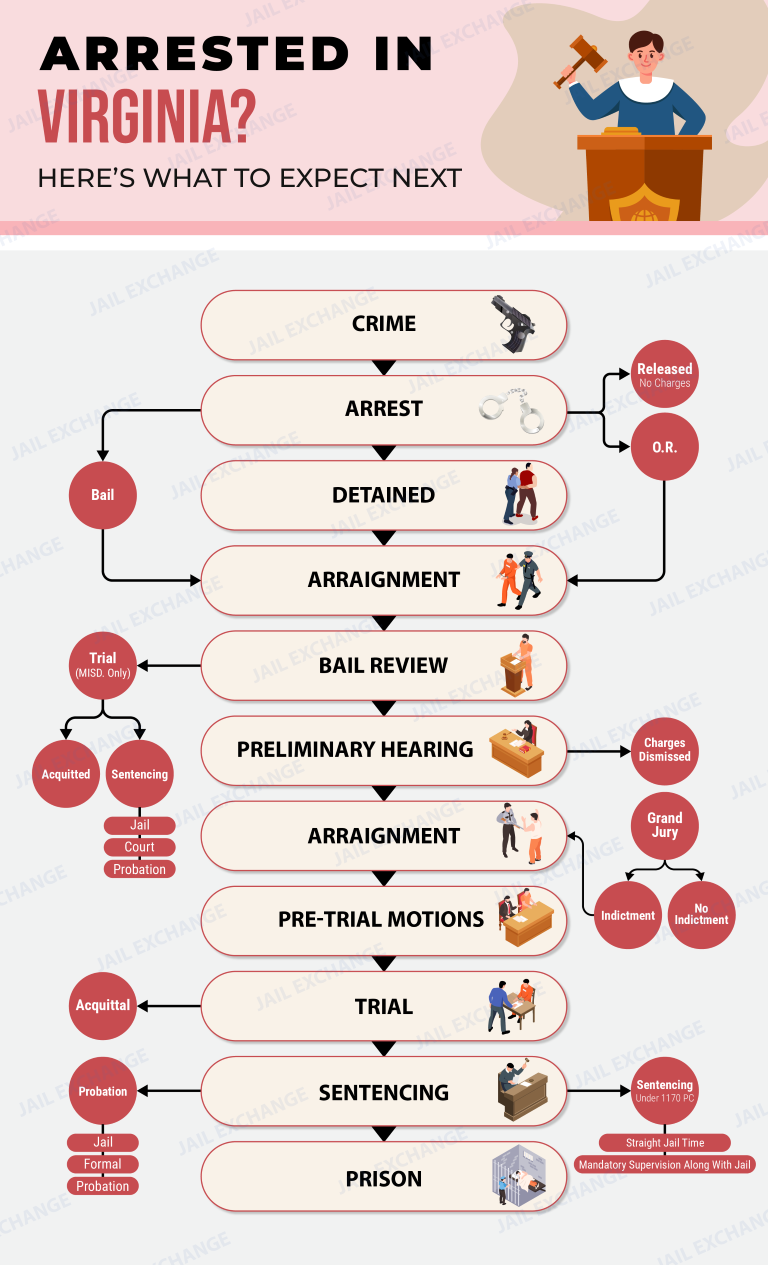
- What happens after an arrest in Virginia Beach
- The Virginia Beach Correctional Center
- The Virginia Beach Public Defender Office and appointed counsel
- The Commonwealth's Attorney and diversion in Virginia Beach
- Specialty dockets in Virginia Beach (drug treatment court and others)
- Misdemeanor (for example, petit larceny, a first DUI, assault and battery, trespassing)
- Felony (for example, burglary, grand larceny, drug possession or distribution, malicious wounding)
- Violent felony (for example, murder, rape, robbery)
- Juveniles (under 18) arrested in Virginia Beach
- Federal cases (U.S. District Court) from Virginia Beach
Courts in Virginia Beach (circuit, general district, and juvenile and domestic relations courts)
Because Virginia has no municipal, town or mayor's courts, every state criminal charge in Virginia Beach is filed in one of the three courts listed here. The city has no incorporated towns inside its borders, so there are no separate town police departments; arrests by Virginia Beach police, sheriff's deputies, Virginia State Police troopers and campus officers all land in the same Judicial Center. The Circuit Court belongs to the 2nd Judicial Circuit (with Accomack and Northampton counties), and the General District and JDR courts form the 2nd Judicial District.
Circuit Court
- Virginia Beach Circuit Court — felonies, grand jury, jury trials and appeals from the two district courts; 2425 Nimmo Parkway, Virginia Beach, VA 23456, (757) 385-4501
- Circuit Court Clerk's Office — Buildings 10 and 10B, 3rd Floor, 2425 Nimmo Parkway; main (757) 385-4181, criminal division (757) 385-4187; open 8:30 a.m. to 4:00 p.m.
District courts
- Virginia Beach General District Court — misdemeanors, traffic, felony preliminary hearings and bond motions; Building 10, Judicial Center, 2425 Nimmo Parkway; criminal (757) 385-4707, traffic (757) 385-8619, main (757) 385-8531; clerk's office 8:00 a.m. to 4:00 p.m.
- Virginia Beach Juvenile and Domestic Relations District Court — juvenile delinquency, adult family-violence charges, protective orders; Building 10A, Judicial Center, 2425 Nimmo Parkway, (757) 385-4391; clerk's office 8:00 a.m. to 4:00 p.m.
Related offices
- Magistrate's Office, 2473 Nimmo Parkway, Building 7C (inside the Correctional Center complex), (757) 385-4724; a second office at the Second Police Precinct, 820 Virginia Beach Boulevard, keeps irregular hours, so call before going
- 2nd District Court Service Unit (juvenile intake), (757) 385-4361
- Commonwealth's Attorney, Building 10B, 2nd Floor, 2425 Nimmo Parkway, (757) 385-4401
- Virginia Beach Public Defender Office, 3388 Princess Anne Road, Suite 3000, (757) 427-6050
- Virginia Beach Sheriff's Office (jail, courthouse security, warrant service), 2501 James Madison Boulevard, (757) 385-4555
- Virginia Beach Police Department, non-emergency (757) 385-4141
The public enters the courthouse from the Nimmo Parkway side. A summons, warrant or bond form lists the court and the date, and the clerk of that court can confirm a hearing time by phone. Anyone who wants a court-appointed lawyer can tell the magistrate, ask the judge at the first appearance, or complete the sworn financial statement at the General District Court criminal clerk's office, (757) 385-4707.
The Judicial Center at the Virginia Beach Municipal Center
Virginia Beach keeps its courts in the southern part of the city, at the Municipal Center near the old Princess Anne Courthouse crossroads, rather than near the Oceanfront. The Judicial Center is a group of connected buildings at 2425 Nimmo Parkway. Building 10 houses the General District Court and its criminal, traffic and civil clerks; Building 10A holds the Juvenile and Domestic Relations District Court; and Buildings 10 and 10B contain the Circuit Court, with the Circuit Court clerk on the 3rd floor and the Commonwealth's Attorney on the 2nd floor of 10B.
The Sheriff's Office supplies the deputies who screen visitors at the entrance and keep order in the courtrooms. The courts have an electronic device policy, so expect phones to be limited in courtrooms, and leave weapons, pocketknives included, at home. On a heavy docket morning the security line can be long; arriving half an hour early is a sensible habit.
Several offices sit a short walk away on the same campus. The Sheriff's administrative offices and the Virginia Beach Correctional Center are at 2501 James Madison Boulevard, and the magistrate works from Building 7C at 2473 Nimmo Parkway, inside the jail complex. The public defender's office is a few minutes away on Princess Anne Road. People trying to post bail after hours deal with the magistrate and the jail, not the courthouse clerks, whose counters close at 4:00 p.m.
What happens after an arrest in Virginia Beach
Booking
Police officers in Virginia Beach take arrested adults to the Sheriff's intake area at the Virginia Beach Correctional Center. Deputies record identifying information, take fingerprints and a photograph, and inventory the person's property. For many minor offenses, an officer may instead issue a summons on the spot and release the person, who then appears in court on the date printed on it.
Seeing the magistrate
The magistrate's office in Building 7C operates around the clock, every day of the year, and hearings there may be held face to face or by video. The magistrate first decides whether there is probable cause for the charge. If so, the magistrate issues the warrant that formally starts the case and turns to the question of release. Magistrates also handle emergency protective orders, which are often issued at the same time as a domestic assault arrest.
Release options
The choices are a recognizance bond (the person's own written promise to appear), an unsecured bond (a dollar amount owed only on a failure to appear), a secured bond (posted in cash or with a surety, often a licensed bail bondsman), or commitment to jail without bond. In deciding, the magistrate looks at the risk that the person will not return to court and the risk to the public or to the alleged victim; since 2021, Virginia law no longer presumes that people charged with certain offenses must be held. Conditions such as no contact with a named person are common. Bondsmen are licensed by the Virginia Department of Criminal Justice Services and charge a nonrefundable premium.
Pretrial supervision
A magistrate or judge may make release depend on supervision by a local pretrial services agency. Typical conditions include reporting in person or by phone, drug or alcohol testing, staying away from certain places, and keeping a job or treatment schedule. The release paperwork tells the person where and when to report.
Getting the terms reviewed
If the magistrate denies release or sets an amount the family cannot raise, a lawyer can ask a Virginia Beach General District Court judge to reconsider, or a JDR court judge when the charge involves a family member or a juvenile. A judge's refusal can be appealed to the Virginia Beach Circuit Court. The public defender often files these motions shortly after being appointed.
The first appearance
People who remain in jail are brought before a district court judge, usually by video, on the next day the court is in session; people who were released see the judge on the date set in their papers. At this arraignment or advisement, the judge tells the person what the charge is and asks about a lawyer. Someone who cannot afford one signs a financial statement, and in Virginia Beach the judge ordinarily appoints the public defender, (757) 427-6050, unless that office has a conflict. The court then sets a trial date for a misdemeanor or a preliminary hearing date for a felony.
The Virginia Beach Correctional Center
The Virginia Beach Correctional Center, 2501 James Madison Boulevard, Virginia Beach, VA 23456, is a local jail operated by the elected Sheriff of the City of Virginia Beach. It holds adults awaiting trial in the city's courts, people serving jail sentences of 12 months or less, and people sentenced to prison who are waiting for the Virginia Department of Corrections to take them. Because the city runs its own jail, it does not send its pretrial inmates to a regional facility the way many smaller Virginia localities do.
The jail also houses some federal detainees under an intergovernmental agreement with the U.S. Marshals Service, so a person facing federal charges in Norfolk may be held here before trial.
The Sheriff's main number, (757) 385-4555, is the place to ask whether someone is in custody and how a bond can be posted; the Sheriff's Office also offers an online inmate lookup. The office publishes rules on phone calls, video visits, mail and commissary deposits, and it runs reentry and modified-incarceration programs for some sentenced inmates. A person arrested in Virginia Beach on a warrant from another city, such as Norfolk or Chesapeake, may be held briefly and then transferred to that locality's jail.
The Virginia Beach Public Defender Office and appointed counsel
The Virginia Indigent Defense Commission operates a public defender office that serves only the City of Virginia Beach. It is located at 3388 Princess Anne Road, Suite 3000, Virginia Beach, VA 23456, near the Municipal Center, and its phone is (757) 427-6050. Staff lawyers represent eligible adults in the General District and Circuit courts and children in delinquency cases in the JDR court.
The office cannot take every case. If it already represents a co-defendant, a witness or the alleged victim, the judge appoints a private attorney from the list of lawyers qualified for that level of charge. Either way, the defendant does not choose the specific lawyer.
To qualify, a person must show that household income and assets fall within the statutory guidelines. Requests can be made to the magistrate, to the judge at the first hearing, or by filling out the financial statement at the General District Court criminal clerk's office, (757) 385-4707. A person held at the Virginia Beach Correctional Center is usually advised on counsel at the video arraignment, and the appointed lawyer can then seek a bond review. Appointed counsel is provided only when jail is a possible punishment, and after a conviction the court can add the lawyer's fee to the court costs.
The Commonwealth's Attorney and diversion in Virginia Beach
Virginia Beach elects its own Commonwealth's Attorney, whose office does not prosecute for any other locality. The office is in the Judicial Center, 2425 Nimmo Parkway, Building 10B, 2nd Floor, and can be reached at (757) 385-4401. Its prosecutors review police charges, decide whether to amend or drop them, negotiate pleas, present felony indictments to the grand jury and try cases in all three courts. In some routine traffic matters the officer who wrote the ticket presents the evidence without a prosecutor.
The Victim/Witness Program, (757) 385-8301, works mainly with victims of felonies. Its advocates explain how the case will proceed, give updates on hearing dates, help with restitution claims and victim impact statements, and can accompany a victim to court, consistent with Virginia's Crime Victim and Witness Rights Act. The police department has its own victim/witness advocate at (757) 385-8721.
Most diversion in Virginia Beach happens through first-offender provisions in state law rather than a separate program run by the prosecutor. A judge can defer a finding for a first drug possession charge, a first family-assault charge in the JDR court, and some other first offenses, then dismiss the case if the person completes classes, treatment, community service, restitution or a period of good behavior. Prosecutors also sometimes agree to reduce a charge, or to dismiss it after conditions are met; such outcomes are negotiated case by case, usually through the defense lawyer. Being held without bail does not prevent those talks from taking place.
Specialty dockets in Virginia Beach (drug treatment court and others)
The best-established treatment program in the city's courts is the Virginia Beach Adult Drug Treatment Court, a Circuit Court docket approved by the Supreme Court of Virginia in 2016. It is meant for adults facing felony charges whose offenses are tied to addiction. Participants plead guilty, then spend a year or more in a structured program that combines substance-use treatment, frequent and random drug testing, regular check-ins with the judge, probation supervision, and graduated rewards and sanctions. Finishing the program can lead to a reduced or suspended sentence, and in some cases to a reduced charge, depending on the terms of the plea agreement.
Admission is selective. A defense attorney normally makes the referral, the Commonwealth's Attorney must agree, and a treatment team screens the person for eligibility; most violent charges and drug distribution for profit are excluded. Space can be limited, so the question is best raised early in the case.
Virginia's statewide specialty docket system also includes behavioral health dockets for people with serious mental illness and veterans treatment dockets for former service members, and the list of approved dockets changes from year to year. Virginia Beach's large veteran and military population makes the question worth asking. A defendant who may qualify for any treatment-based docket should ask the public defender or private lawyer which programs are accepting participants. A person still in the Virginia Beach Correctional Center may be screened while in custody and released on bond into the program.
First DUI cases are handled through the Virginia Alcohol Safety Action Program (VASAP), which provides alcohol education and treatment and monitors ignition interlock use for people granted a restricted license.
Misdemeanor (for example, petit larceny, a first DUI, assault and battery, trespassing)
Plenty of misdemeanor cases in Virginia Beach never involve a night in jail: the officer writes a summons, or the magistrate grants a recognizance bond, and the person goes home. A person who is held at the Virginia Beach Correctional Center sees a General District Court judge by video on the next court day. Summer brings a steady stream of Oceanfront arrests for public intoxication, underage possession of alcohol and disorderly conduct, which are also misdemeanors handled in the General District Court.
Classes and maximum penalties
- Class 1: up to 12 months in jail, a fine of up to $2,500, or both. Petit larceny (property valued under $1,000), assault and battery, trespass and a first DUI belong to this class.
- Class 2: up to 6 months in jail and a fine of up to $1,000, alone or together.
- Class 3 and Class 4: no jail at all, only fines capped at $500 and $250 respectively.
First-offense DUI
A first DUI conviction brings a mandatory minimum $250 fine, a one-year loss of driving privileges and required participation in VASAP. With a blood alcohol level from 0.15 to 0.20, the judge must also impose 5 days in jail; above 0.20, the minimum rises to 10 days. At the moment of arrest the license is administratively suspended for 7 days, and after conviction the judge may approve a restricted license conditioned on an ignition interlock device.
Assault on a family or household member
These charges go to the Virginia Beach Juvenile and Domestic Relations District Court rather than the General District Court, and an emergency protective order is common at the time of arrest. A first offender may be eligible for a deferred disposition that ends in dismissal after counseling and good behavior. A third conviction for family assault can be prosecuted as a felony.
Outcomes and timeline
Results range from dismissal and deferred dispositions to fines, suspended jail time with probation, and active jail sentences. The judge decides guilt without a jury. A defendant who disagrees with the verdict can appeal to the Virginia Beach Circuit Court within 10 days and receive a fresh trial, where a jury of seven is available. Expect most misdemeanors to wrap up in one to three months, longer if appealed. The public defender represents many people charged with jailable misdemeanors.
Felony (for example, burglary, grand larceny, drug possession or distribution, malicious wounding)
Booking and the magistrate hearing are the same for felonies, but the stakes at the release stage are higher. The magistrate may require a secured bond or hold the person without release, in which case the first appearance and any request for different terms take place in the General District Court while the person waits at the Virginia Beach Correctional Center.
Penalty ranges for common felonies
- Grand larceny (property worth $1,000 or more): 1 to 20 years in prison, or a jail term of up to 12 months.
- Burglary: breaking into a dwelling at night is a Class 3 felony (5 to 20 years), or Class 2 if the burglar was armed; other statutory burglary carries up to 20 years.
- Possession of a Schedule I or II drug (fentanyl, heroin, cocaine and similar substances): Class 5 felony, 1 to 10 years, or up to 12 months in jail.
- Distribution, or possession with intent to distribute: 5 to 40 years for a first offense, with mandatory minimums for large quantities. Adults 21 or older may possess up to an ounce of marijuana, but sales remain illegal.
- Malicious wounding: a Class 3 offense carrying 5 to 20 years. Unlawful wounding (no malice): Class 6, 1 to 5 years or up to 12 months in jail.
Preliminary hearing and indictment
At a preliminary hearing in the Virginia Beach General District Court, a judge hears enough evidence to decide whether probable cause exists. A finding of probable cause sends the case to the Circuit Court grand jury; a dismissal ends that warrant, though prosecutors may still go to the grand jury. The Commonwealth's Attorney can also bypass the hearing by seeking a direct indictment. Once indicted, the defendant is arraigned in the Circuit Court.
Resolution
Plea agreements resolve most felony cases in Virginia Beach. If the case goes to trial, the defendant may choose a judge or a jury of 12, whose verdict must be unanimous. Since mid-2021 the judge sets the sentence unless the defendant requests jury sentencing, using Virginia's voluntary sentencing guidelines as a reference point. Parole was abolished for felonies committed on or after January 1, 1995, although earned sentence credits can reduce the time actually served, and sentences longer than 12 months are served in the Virginia Department of Corrections.
How long it takes
Virginia's speedy trial statute generally requires trial within five months after probable cause is found if the defendant is in custody, or nine months if released, with exceptions for continuances and other delays. Four to twelve months is a typical range for a felony in Virginia Beach. The public defender's office at (757) 427-6050 carries a large share of these cases.
Violent felony (for example, murder, rape, robbery)
Investigations of killings, sexual assaults and armed robberies in Virginia Beach are handled by the police department's detectives, and the cases are prosecuted by experienced trial attorneys in the Commonwealth's Attorney's office. Release before trial is uncommon at first: a magistrate frequently holds the defendant without bail, leaving any release decision to a judge after a contested hearing. Meanwhile the defendant stays at the Virginia Beach Correctional Center.
Sentencing ranges
- Aggravated murder (formerly capital murder): Class 1 felony, punishable by life imprisonment; Virginia abolished the death penalty in 2021.
- First-degree murder: a Class 2 offense, with 20 years to life.
- Second-degree murder: 5 to 40 years.
- Rape: 5 years to life.
- Robbery: 5 years to life.
- Aggravated malicious wounding: likewise Class 2, a minimum of 20 years and a maximum of life.
Course of the case
The procedural steps are the familiar ones, stretched over a longer period. A preliminary hearing is held in the General District Court, or in the JDR court if the victim is a family or household member, unless prosecutors obtain a direct indictment. After indictment come discovery, forensic testing, expert reports, motions and, more often than with other felonies, a jury trial in the Virginia Beach Circuit Court. Defense lawyers commonly waive the speedy trial deadlines to prepare, and a year or two between arrest and verdict is not unusual.
Rights of victims
Under the Crime Victim and Witness Rights Act, victims and surviving family members can ask to be told about hearings, can present a victim impact statement before sentencing and can seek restitution. The Commonwealth's Attorney's Victim/Witness Program, (757) 385-8301, arranges these services.
A defendant who cannot pay for a lawyer is represented by the Virginia Beach Public Defender Office or, if it has a conflict, by a private attorney certified to handle serious felonies.
Juveniles (under 18) arrested in Virginia Beach
When a minor is charged with a crime in Virginia Beach, the case belongs to the Virginia Beach Juvenile and Domestic Relations District Court, Building 10A, 2425 Nimmo Parkway, (757) 385-4391. Young people are kept out of the adult jail. A child ordered into secure detention is usually taken to the Virginia Beach Juvenile Detention Center, 2533 George Mason Drive, (757) 385-1220, a city-run facility that serves Virginia Beach.
Intake
Every juvenile complaint passes through the 2nd District Court Service Unit, the state Department of Juvenile Justice's intake and probation office for the city, at (757) 385-4361. An intake officer reviews the complaint and chooses among three paths: filing a formal petition with the court, steering the youth into diversion such as counseling, restitution, community service or another community program, or, for serious or repeat offenses, screening the child for detention. The same unit supervises juveniles on probation and parole.
Detention hearing
A child placed in detention must see a JDR judge within 72 hours; if that period ends on a weekend or holiday, the hearing happens the next day the court sits. At that hearing the judge can keep the child in detention, release the child to a parent, or allow release with conditions such as a curfew or electronic monitoring. A parent or guardian is expected at each court date.
Lawyers on each side
The Virginia Beach Commonwealth's Attorney prosecutes delinquency cases. Every child accused of a delinquent act has a right to a lawyer, and the Virginia Beach Public Defender Office, (757) 427-6050, represents many of them; the court can also appoint private counsel.
Outcomes
A JDR judge has a wide range of options: dismissal, a deferred finding, probation, community programs, counseling, restitution or commitment to the Department of Juvenile Justice. A committed youth may be placed at the Bon Air Juvenile Correctional Center in Chesterfield County or in a community placement program.
Adult prosecution
Some older teenagers can end up in the Virginia Beach Circuit Court. A child who was at least 14 when a serious felony was committed can be transferred after a transfer hearing in the JDR court. For the gravest offenses, such as murder or aggravated malicious wounding, a 16- or 17-year-old may be certified for adult trial on the Commonwealth's Attorney's notice, generally after a judge finds probable cause at a preliminary hearing. A youth convicted as an adult can receive an adult sentence, though the judge may consider juvenile options.
In most cases juvenile court hearings and records are kept confidential, with exceptions that apply mainly to older juveniles charged with serious felonies.
Federal cases (U.S. District Court) from Virginia Beach
Virginia Beach lies in the Eastern District of Virginia, and its federal criminal cases are assigned to the Norfolk Division, which sits at the Walter E. Hoffman U.S. Courthouse, 600 Granby Street, Norfolk, VA 23510. The clerk's office number is (757) 222-7202. There is no federal courthouse in Virginia Beach itself, so defendants and witnesses travel to downtown Norfolk.
What makes a case federal
Federal prosecutions usually start with an investigation by the FBI, DEA, ATF, Homeland Security Investigations, the Secret Service or the Naval Criminal Investigative Service, sometimes in a task force with Virginia Beach detectives. Common charges include drug trafficking conspiracies, firearm possession by a felon or other prohibited person, bank robbery, child sexual exploitation and fraud.
The city's military installations add to the docket. Crimes committed on Naval Air Station Oceana and its Dam Neck Annex, or on Joint Expeditionary Base Little Creek–Fort Story, can be charged in federal court, as can offenses on federal wildlife land such as Back Bay National Wildlife Refuge. Lesser offenses on these properties, including traffic tickets and many first DUIs, go to a petty-offense docket before a U.S. magistrate judge in Norfolk; its staff can be reached at (757) 222-7222. Military members may also face proceedings under military law.
Offices involved
- U.S. Attorney's Office, Eastern District of Virginia, Norfolk, 101 West Main Street, Suite 8000, Norfolk, VA 23510, (757) 441-6331
- Federal Public Defender, Eastern District of Virginia, Norfolk office, 500 East Main Street, Norfolk, VA; if that office has a conflict, the court appoints a private lawyer from its Criminal Justice Act (CJA) panel
- United States Probation and Pretrial Services, Norfolk office: 600 Granby Street, Suite 200, Norfolk, VA 23510
How federal cases move
A person arrested on federal charges makes an initial appearance before a U.S. magistrate judge, normally the next court day. When prosecutors ask that the defendant be held, the detention hearing generally follows within three court days. Federal courts do not use a money schedule for bail; under the Bail Reform Act, the judge either releases the defendant on conditions monitored by U.S. Pretrial Services or orders detention when no conditions will reasonably assure appearance and safety. A defendant charged by complaint must be indicted within 30 days, and the Speedy Trial Act calls for trial within 70 days, minus excludable delays. The Eastern District is widely known as the "rocket docket," and its judges keep cases on tight schedules.
Most defendants plead guilty. A trial uses a 12-person jury that must reach a unanimous verdict. Before any sentence is imposed, a federal probation officer writes a presentence report, and the judge weighs the advisory Sentencing Guidelines and any mandatory minimum, which in many drug and gun cases is 5 or 10 years. There is no federal parole, and good-conduct credit generally leaves a prisoner serving about 85 percent of the term in the Bureau of Prisons before supervised release begins. A defendant who wants to appeal goes to the Richmond-based Fourth Circuit Court of Appeals.
Finding someone in federal custody
Anyone looking for a Virginia Beach defendant in federal custody can search the Federal Bureau of Prisons inmate locator by name or register number. Because the Marshals Service rents bed space in local and regional jails, a federal pretrial detainee can also turn up on the roster of the jail holding him or her, including the Virginia Beach Sheriff's own jail. Federal charges against people under 18 are rare, and nearly all juvenile cases from Virginia Beach stay in the JDR court.
This page offers general information about criminal cases in the Virginia Beach courts and is not legal advice. Courtrooms, programs, office hours and phone numbers can change, so verify details with the court named on your papers, for example the Virginia Beach General District Court criminal division at (757) 385-4707. Anyone charged with a crime should speak with a criminal defense lawyer; to request a free lawyer, call the Virginia Beach Public Defender Office at (757) 427-6050 or ask the judge at your first court date.