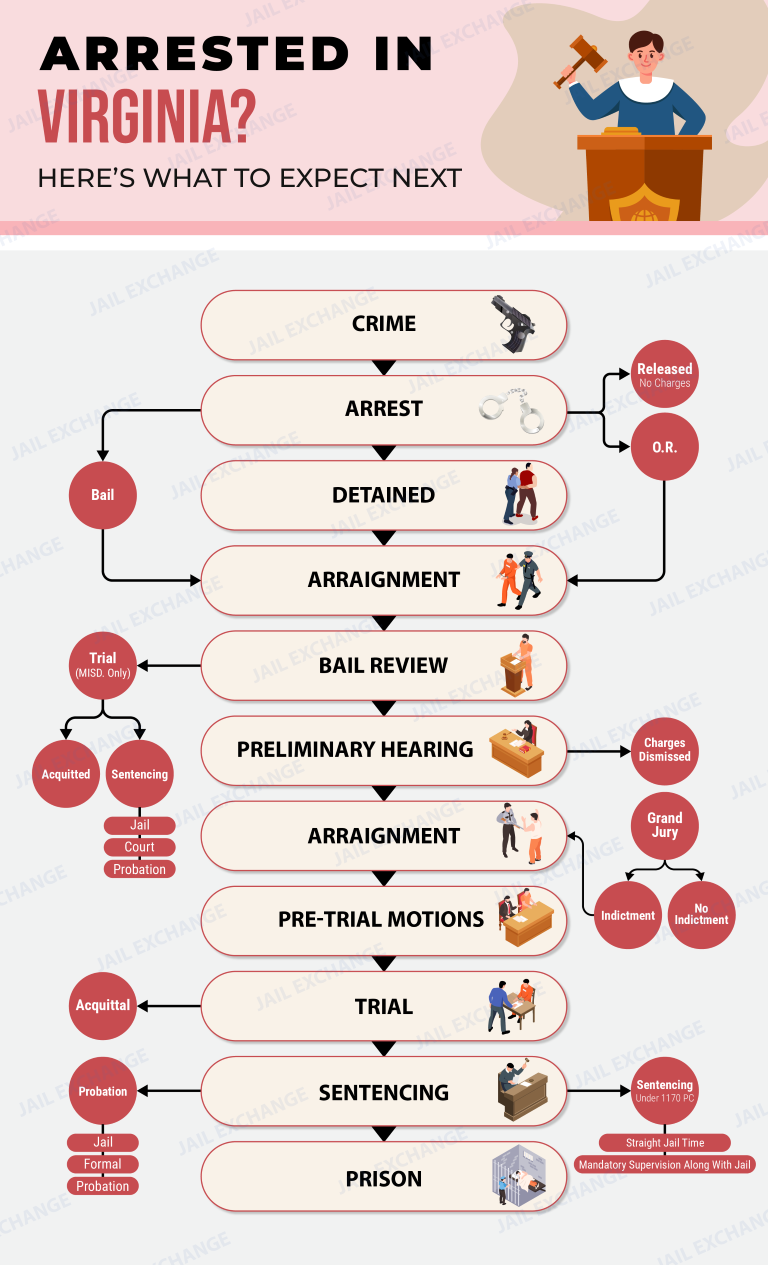
Virginia Peninsula Regional Jail Criminal Court Process
Criminal Court Process for Williamsburg city Virginia
Where Williamsburg Criminal Cases Are Heard: General District, JDR and Circuit Courts
Crimes charged in Williamsburg are handled in one courthouse, 5201 Monticello Avenue, Williamsburg, VA 23188. It holds the General District Court, the family and youth (JDR) court and the Circuit Court, and it also serves James City County. Anyone held before trial is at the Virginia Peninsula Regional Jail, 9320 Merrimac Trail, Williamsburg, VA 23185.
Not sure if your person is still inside? Check the jail's online roster. Our Recent Arrests page also lists charges and how to get belongings back.
Ask the General District Court clerk at 757-564-2400 when the first hearing is. If the person is still inside, read our Williamsburg bond guide next.
1. Courts in the City of Williamsburg (circuit, general district, and juvenile and domestic relations courts)
The City of Williamsburg, Virginia's colonial capital, governs itself apart from any county, but for court purposes it is paired with James City County. Both localities send their criminal cases to one building at 5201 Monticello Avenue, where three courts operate: the General District Court, the Juvenile and Domestic Relations District Court, and the Circuit Court of the 9th Judicial Circuit, each carrying the name "Williamsburg/James City County." Prosecution falls to the jointly elected Commonwealth's Attorney for Williamsburg and James City County. A city resident who is arrested and kept in custody is held at the Virginia Peninsula Regional Jail on Merrimac Trail.
- Williamsburg/James City County Circuit Court (Clerk), 5201 Monticello Avenue, Suite 6, Williamsburg, VA 23188, (757) 564-2242
- Williamsburg/James City County General District Court, 5201 Monticello Avenue, Suite 2, Williamsburg, VA 23188, (757) 564-2400 (criminal and traffic cases)
- Williamsburg/James City County Juvenile and Domestic Relations District Court, 5201 Monticello Avenue, Suite 3, Williamsburg, VA 23188, (757) 564-2200
- Commonwealth's Attorney (Williamsburg and James City County), 5201 Monticello Avenue, Suite 4, Williamsburg, VA 23188, (757) 564-2277; Victim Assistance (757) 564-2299
- Magistrate, 9th District, 9320 Merrimac Trail, Williamsburg, VA 23185, (757) 820-3951
- Court Service Unit, 9th District, 4093 Ironbound Road, Suite D, Williamsburg, VA 23188, (757) 564-2460
- Appointed counsel: private attorneys assigned by the court (there is no public defender office for the city); request through the magistrate, the judge, or the General District Court clerk at (757) 564-2400
- Sheriff, Williamsburg-James City County Sheriff's Office, 5201 Monticello Avenue, Suite 5, Williamsburg, VA 23188, (757) 564-2220
- City police, Williamsburg Police Department, 615 Lafayette Street, Williamsburg, VA 23185, (757) 220-2331
- Virginia Peninsula Regional Jail, 9320 Merrimac Trail, Williamsburg, VA 23185, (757) 820-3900
Which court hears your case. The kind of charge decides the courtroom. If it is a felony, the first stop is a preliminary hearing, normally in the Williamsburg/James City County General District Court, though the JDR court holds it when the person allegedly harmed is a family or household member; after the grand jury indicts, the felony is tried in the Williamsburg/James City County Circuit Court. Family-violence charges and any offense with a juvenile defendant belong to the Williamsburg/James City County Juvenile and Domestic Relations District Court. Everything else at the misdemeanor and traffic level stays in General District Court, where there are no juries; a defendant who loses there has 10 days to appeal to Circuit Court and start over before a jury if desired.
Where pretrial inmates are held. There is no city jail in Williamsburg. Instead, the City of Williamsburg is a member, along with James City County, York County and the City of Poquoson, of the regional jail authority that runs the Virginia Peninsula Regional Jail at 9320 Merrimac Trail, east of the city in James City County. Its main phone is (757) 820-3900. The Williamsburg-James City County Sheriff's Office, (757) 564-2220, does not run the jail but handles warrants and courthouse holding, and it can point families toward the right office for bond questions.
Since Virginia has no municipal, town or mayor's courts, the only local courts for the City of Williamsburg are the three state courts it shares with James City County. They are housed together in the Williamsburg–James City County Courthouse off Monticello Avenue, on the county side of the line, a short drive from the Historic Area.
Courts
- Williamsburg/James City County Circuit Court: Suite 6, 5201 Monticello Avenue, Williamsburg, VA 23188. Clerk (757) 564-2242; criminal department (757) 564-2353; fines and costs (757) 564-2360.
- Williamsburg/James City County General District Court: Suite 2, (757) 564-2400. Thursdays are the main criminal day, and traffic cases are called on Monday mornings.
- Williamsburg/James City County Juvenile and Domestic Relations District Court: Suite 3, (757) 564-2200.
Related offices
- Commonwealth's Attorney: Suite 4, 5201 Monticello Avenue, (757) 564-2277
- 9th District Magistrate: 9320 Merrimac Trail, Williamsburg, VA 23185, (757) 820-3951
- 9th District Court Service Unit: 4093 Ironbound Road, Suite D, Williamsburg, VA 23188, (757) 564-2460
- Colonial Community Corrections (pretrial and probation services): 4093 Ironbound Road, Suite B, Williamsburg, VA 23188, (757) 564-2311
- Williamsburg Police Department: 615 Lafayette Street, Williamsburg, VA 23185, (757) 220-2331
- Williamsburg-James City County Sheriff's Office: Suite 5, 5201 Monticello Avenue, (757) 564-2220
Arrests in the city are made mostly by the Williamsburg Police Department, but the William & Mary campus police and the Virginia State Police also file charges in these courts. For defendants who cannot afford a lawyer, the court relies on a list of private attorneys because no Virginia Indigent Defense Commission office covers the city. You can ask for one when you see the magistrate or at your first hearing, and the General District Court clerk has the financial eligibility form. A request to reduce bail goes to the General District Court, or to the JDR court for a family case.
↑ Back to the question list2. Misdemeanor (for example, petit larceny, a first DUI, assault and battery, trespassing)
What is at stake
Virginia sorts misdemeanors into four classes. The ones most often charged in the City of Williamsburg, including taking merchandise worth less than $1,000 (petit larceny), assault and battery, and trespassing, are Class 1 offenses, where the maximum is a year behind bars and a $2,500 fine. Lower down, a Class 2 offense allows six months and a $1,000 fine, and Class 3 and Class 4 offenses are punished with fines of no more than $500 and $250.
Driving under the influence for the first time is also Class 1. The judge must impose a fine of at least $250, and jail becomes mandatory if the breath or blood test was high: five days for 0.15 through 0.20, ten days for anything above 0.20. The driver loses the license for a year, may qualify for a restricted license with an ignition interlock, must complete VASAP, and will already have served a 7-day administrative suspension that starts on the day of arrest.
When the alleged victim of an assault is a family or household member, the charge is heard in the JDR court. First-time defendants there are sometimes offered a deferred disposition that ends in dismissal, but a third family-assault conviction can become a felony.
From the arrest to the courtroom
For a minor offense, a city officer may simply hand out a summons. After a custodial arrest, the officer goes before a magistrate, frequently by video, who issues the warrant and decides release. The magistrate may let the person go on a promise to return (recognizance), set an unsecured bond that is paid only if court is missed, or require a secured bond backed by cash or a licensed bondsman, and may order pretrial supervision. A person who cannot satisfy those terms is held at the Virginia Peninsula Regional Jail and is arraigned, usually over video, the next day court sits. At arraignment the judge reads the charge, takes up the question of a lawyer, and can revisit release.
Verdict and appeal
The General District Court judge decides guilt without a jury. Cases often end with a dismissal, a plea agreement, a first-offender deferral, a fine, or a suspended sentence and probation, and active jail is possible. A conviction may be appealed to Circuit Court within 10 days for a fresh trial. Expect a typical case to last one to three months. Anyone who cannot afford a lawyer should tell the judge so that counsel can be appointed.
↑ Back to the question list3. Felony (for example, burglary, grand larceny, drug possession or distribution, malicious wounding)
What is at stake
Stealing property valued at $1,000 or more is grand larceny, which the court may punish with 1 to 20 years in prison or with no more than 12 months in jail. Burglary of a home after dark is a Class 3 felony carrying 5 to 20 years, rising to Class 2 if the intruder carried a deadly weapon, and other statutory burglaries have a 20-year ceiling. Simple possession of a Schedule I or II drug, such as cocaine or fentanyl, is a Class 5 felony punishable by 1 to 10 years, while selling or possessing with intent to sell brings 5 to 40 years for a first offense, and large quantities carry mandatory minimums. Adults at least 21 years old may legally have up to an ounce of marijuana, though any sale is still illegal. A malicious wounding is a Class 3 felony with a 5-to-20-year range, and the lesser offense of unlawful wounding is Class 6, punishable by 1 to 5 years or by up to 12 months in jail.
Release
As with any arrest, the magistrate decides first whether the person can be released and on what terms. For a felony, that decision weighs the charge, the person's prior record and local ties, and any danger to others. A person detained at the Virginia Peninsula Regional Jail may ask for a bond hearing before a General District Court judge, and that ruling can be appealed to the Circuit Court.
Court stages
- Preliminary hearing in the General District Court, where the judge decides if probable cause exists. A finding of probable cause certifies the case to the grand jury; without one, the charge is dismissed, though the Commonwealth may still pursue an indictment. Prosecutors may instead seek a direct indictment and skip this step.
- Grand jury in the Williamsburg/James City County Circuit Court, which decides whether to indict.
- Arraignment and plea in Circuit Court. Plea agreements settle most cases.
- Trial, before the judge alone or a jury of 12 whose verdict must be unanimous. Since July 2021, the judge sets the sentence unless the defendant asks for jury sentencing.
- Sentencing, guided by Virginia's voluntary sentencing guidelines. Terms longer than 12 months are served in the Department of Corrections, and there is no parole for felonies committed on or after January 1, 1995, although earned sentence credits can shorten the stay.
Virginia's speedy-trial statute generally sets a five-month deadline after the preliminary-hearing probable cause finding for a jailed defendant, and nine months for one on release, subject to exceptions. Four to twelve months is the usual span. A court-appointed attorney stays with an eligible defendant from the first hearing to the last.
↑ Back to the question list4. Violent felony (for example, murder, rape, robbery)
What is at stake
Virginia's harshest penalties apply here. Aggravated murder, which replaced the old capital murder offense, is a Class 1 felony punished with life in prison, because Virginia has not had a death penalty since 2021. A first-degree murder conviction is a Class 2 felony that brings no less than 20 years and as much as life, and second-degree murder brings between 5 and 40 years. The punishment for rape starts at 5 years and can reach life, and the same range applies to robbery. Causing permanent and significant injury through aggravated malicious wounding is treated as a Class 2 felony, with a sentence of 20 years to life.
What the case looks like
The Williamsburg Police Department investigates, sometimes with the Virginia State Police, and the case follows the felony stages into the Williamsburg/James City County Circuit Court. Since 2021, Virginia law no longer presumes that people accused of violent crimes must be denied bail, yet judges still give heavy weight to the safety of victims and the public. As a result, many defendants in these cases spend the months before trial at the Virginia Peninsula Regional Jail. Lab analysis, expert witnesses and contested motions commonly stretch the case to a year or two.
Victims and their families have rights under the Crime Victim and Witness Rights Act, including notice of proceedings and a voice at sentencing; the Commonwealth's Attorney's victim assistance office at (757) 564-2299 walks them through each step. Defendants who cannot hire a lawyer receive an appointed attorney who meets Virginia's standards for serious felony representation.
↑ Back to the question list5. Juveniles (under 18) arrested in the City of Williamsburg
A minor who is accused of a crime in the City of Williamsburg is not taken to adult court. The case goes instead to the Williamsburg/James City County Juvenile and Domestic Relations District Court, (757) 564-2200, after passing through intake at the 9th District Court Service Unit, whose Williamsburg district office is reachable at (757) 564-2460.
Three options are open to the intake officer: send a first or minor matter to diversion, file a formal petition with the court, or, if the youth is a danger or likely to flee, authorize secure detention. Detained youths from the city are normally held at the Merrimac Juvenile Detention Center, 9300 Merrimac Trail, Williamsburg, (757) 887-0225, a regional facility next to the adult jail. The law requires a detention hearing within 72 hours, ordinarily on the next court day, and the judge then decides whether release to a parent with conditions is appropriate.
At the hearing on the charge itself, the Commonwealth's Attorney prosecutes, the child is represented by a lawyer (court-appointed if the family is eligible), and a judge rules without a jury. A finding of delinquency can lead to probation supervised by the Court Service Unit, restitution, community service, counseling, or, for serious or repeated offenses, commitment to the Department of Juvenile Justice for placement at Bon Air Juvenile Correctional Center or in a community program. Many cases are resolved through diversion or dismissal instead.
Adult prosecution is possible in limited circumstances. For a child at least 14 years old who faces certain serious felony charges, a transfer hearing can move the case to the Williamsburg/James City County Circuit Court. A 16- or 17-year-old charged with one of the gravest offenses, murder or aggravated malicious wounding among them, may be certified to Circuit Court by the Commonwealth's Attorney once probable cause is found at a preliminary hearing. In most other situations, records from juvenile court stay confidential.
↑ Back to the question list6. Federal cases (U.S. District Court) from the City of Williamsburg
Where the case is heard
Federal prosecutions arising in the City of Williamsburg are assigned to the Newport News Division of the United States District Court for the Eastern District of Virginia. Federal criminal hearings for the city take place at the United States Courthouse, 2400 West Avenue, Newport News, VA 23607, clerk's main line (757) 247-0784.
When a case becomes federal
Some conduct is federal because of where it happens. The Colonial Parkway, which links Jamestown, Williamsburg and Yorktown, is National Park Service land within Colonial National Historical Park, and offenses committed on it, from DUI to assault, may be prosecuted in federal court, with lesser violations handled by a magistrate judge. Naval Weapons Station Yorktown and Camp Peary lie just across the York County line, and Fort Eustis is in nearby Newport News. Other cases become federal because of what they involve, such as large drug distribution operations, guns possessed by felons or other prohibited people, bank robberies, child exploitation, or fraud schemes.
Who is involved
- Prosecution: U.S. Attorney's Office, Newport News, One City Center, 11815 Fountain Way, Suite 200, Newport News, VA 23606, (757) 591-4000
- Defense for those who qualify: the Federal Public Defender, Norfolk office, (757) 457-0800, or a Criminal Justice Act panel lawyer
- Release supervision and presentence reports: U.S. Pretrial Services and Probation, Newport News, (757) 223-4640
The process
Following a federal arrest, the defendant is taken to a magistrate judge for an initial appearance, and if prosecutors ask for detention a hearing is held, usually within three court days. Federal courts do not use the commercial bail system, with its private bondsmen, that state courts rely on. Under the Bail Reform Act, the magistrate judge chooses between release on supervised conditions and pretrial detention. A defendant charged by complaint must be indicted within 30 days, and trial is due within 70 days under the Speedy Trial Act; the Eastern District's "rocket docket" earns its name by holding to those deadlines.
Guilty pleas account for most outcomes. If the case is tried, the verdict of a 12-person jury must be unanimous. A probation officer's presentence report helps the judge apply the advisory Sentencing Guidelines and any mandatory minimum sentence. Because federal law has no parole, inmates serve roughly 85 percent of their time in the Bureau of Prisons, then begin supervised release. The U.S. Court of Appeals for the Fourth Circuit hears appeals.
Families trying to find someone in federal prison can type a name or register number into the Federal Bureau of Prisons inmate locator. If the person is awaiting trial in a local or regional jail under a U.S. Marshals agreement, that jail's inmate roster may list them too. Federal juvenile prosecutions are uncommon.
↑ Back to the question listNothing on this page is legal advice; it is a general description of how criminal cases from the City of Williamsburg move through Virginia and federal courts, and the details can change. Talk with a Virginia criminal defense lawyer about your situation, or ask the Williamsburg/James City County General District Court clerk at (757) 564-2400 how to apply for a court-appointed attorney.