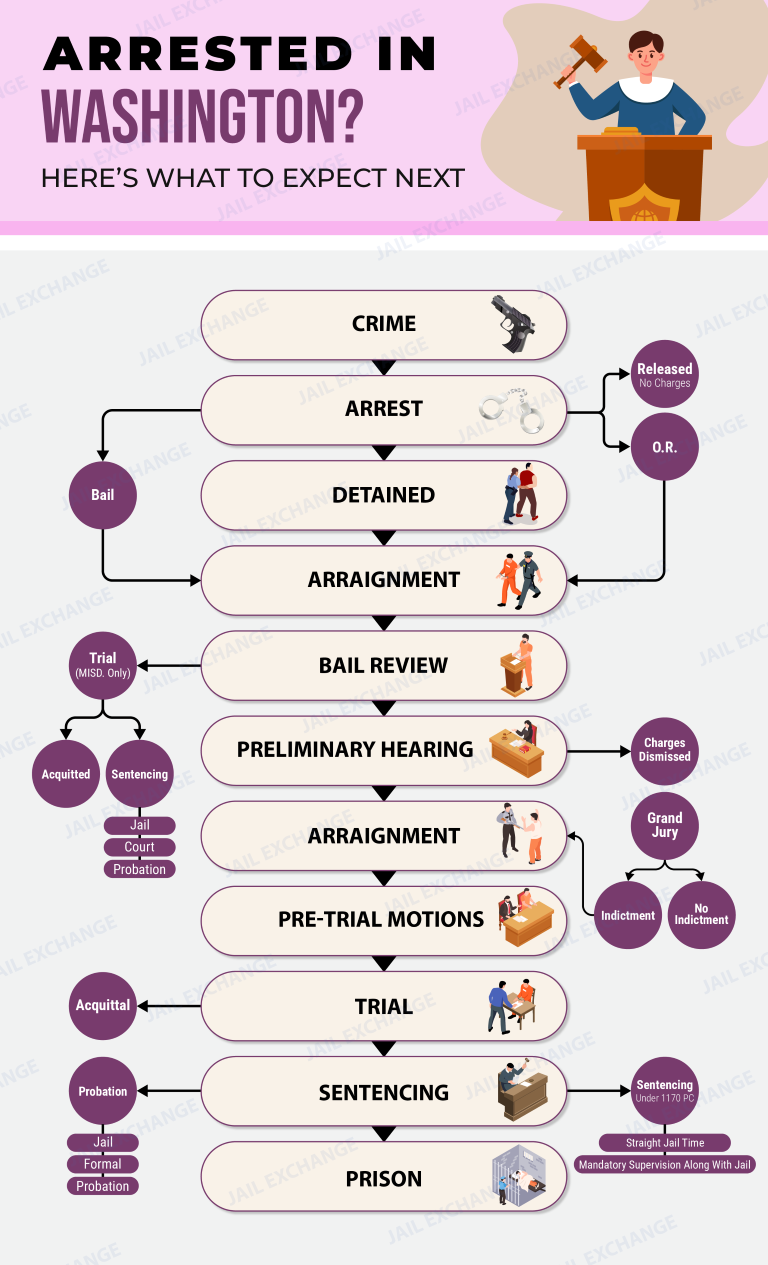
Benton County Jail Criminal Court Process
Criminal Court Process for Benton County Washington
Where Benton County Criminal Cases Are Heard, From Misdemeanors to Felonies
The Justice Center at 7122 W. Okanogan Place, Kennewick, WA 99336, is where nearly every criminal case begins. Benton County District Court takes misdemeanors, including city cases from Kennewick, Richland, West Richland and Prosser, while Superior Court takes felonies. Adults arrested here are held at the Benton County Jail next door.
Not sure your person is in custody? Try the Benton County Inmate Search and enter one name. Our Inmate Lists page covers charges, warrants and public defenders.
For the next hearing, phone the District Court clerk at 509-735-8476 with the full name, then request the court date and case number. Bail questions are answered on our Benton bail help page.
1. Local courts in Benton County (Superior Court and District Court in Kennewick and Prosser)
Prosser is the official Benton County seat, but almost all criminal court business happens at the Benton County Justice Center, 7122 W Okanogan Pl in Kennewick. That campus holds Benton County Superior Court for felonies and Benton County District Court for misdemeanors, and District Court also acts as the city court for Kennewick, Richland, West Richland and Prosser, so the county has no separate municipal courthouse to find. The Benton County Prosecuting Attorney files felonies and county misdemeanors, while each city's attorney prosecutes its own code violations in District Court. Adults are booked into the Benton County Jail on the same campus, and a judge decides release terms or bail at the first appearance.
- Benton County Superior Court, Justice Center, 7122 W Okanogan Pl, Building A, Kennewick, WA 99336, (509) 736-3071
- Benton County Clerk, 7122 W Okanogan Pl, Suite A210, Kennewick, (509) 735-8388
- Benton County District Court, 7122 W Okanogan Pl, Suite A110, Kennewick, (509) 735-8476; Prosser branch, 620 Market St, Prosser, (509) 786-5480
- Benton County Prosecuting Attorney, 7122 W Okanogan Pl, Kennewick, (509) 735-3591; Prosser office (509) 786-5608
- Benton County Sheriff's Office, 7122 W Okanogan Pl, Suite A120, Kennewick, (509) 735-6555
- Benton County Jail, 7122 W Okanogan Pl, Building B, Kennewick, (509) 783-1451
- Benton County Office of Public Defense, 7122 W Okanogan Pl, Building A, Kennewick, (509) 222-3700
- Kennewick City Attorney (city prosecutions), (509) 585-4274
- Benton-Franklin Juvenile Justice Center, 5606 W Canal Pl, Suite 106, Kennewick, (509) 783-2151
Which court hears your case. In Benton County, the agency that wrote the citation matters less than in most counties because almost every misdemeanor goes to the same place. Kennewick, Richland, West Richland and Prosser police file their city-code cases in Benton County District Court, and so do deputies and the State Patrol for county and state charges. District Court hears most Kennewick-area cases at the Justice Center and holds some calendars at its Prosser branch for the west end of the county. Benton City's cases are typically filed in District Court as well; the clerk can confirm. Felonies go to Superior Court. Youth under 18 go to the juvenile division at the Benton-Franklin Juvenile Justice Center on Canal Place.
Where pretrial inmates are held. Benton County runs a single adult jail for the whole county: the Benton County Jail, 7122 W Okanogan Pl, Building B, Kennewick, (509) 783-1451. It is built for about 720 people and averages around 475, and it holds arrestees for every police agency in the county plus outside agencies under contract. The jail lobby is open weekdays from 8 a.m. to 4 p.m. No Benton County city operates its own jail. Youth are held at the Benton-Franklin County Juvenile Detention center, which Benton shares with Franklin County.
Benton County consolidated its lower courts years ago. Rather than each city running its own municipal court, Kennewick, Richland, West Richland and Prosser buy court services from Benton County District Court, and the state court directory lists District Court as the municipal court for all four.
Superior Court
- Benton County Superior Court, 7122 W Okanogan Pl, Building A, Kennewick, (509) 736-3071. Every felony and youth offense in the county, plus District Court appeals. Benton and Franklin counties share one bench of Superior Court judges who rotate between Kennewick and Pasco.
- Benton County Clerk, Suite A210, Kennewick, (509) 735-8388, with a second office at the Prosser courthouse, 620 Market St.
District Court and the cities it serves
- Benton County District Court, Kennewick, Justice Center, 7122 W Okanogan Pl, Suite A110, (509) 735-8476. Misdemeanors, gross misdemeanors and infractions from the Sheriff and State Patrol, and city cases for Kennewick, Richland and West Richland. As of September 2026, clerks are not answering phones on Fridays.
- Benton County District Court, Prosser branch, 620 Market St, Prosser, (509) 786-5480. West-county matters, including Prosser city cases.
- Benton City does not appear in the state directory with its own court; its misdemeanors are typically heard in District Court.
- District Court Probation, Suite A110, (509) 735-8476
Therapeutic courts
Benton County District Court runs a Mental Health Court, a Recovery Court and a Veterans Court, and the Benton-Franklin Superior Court operates its own treatment courts for felony defendants. Admission usually requires a referral from the defense lawyer and agreement from the prosecutor.
Prosecution, defense and police
- Benton County Prosecuting Attorney, Justice Center, (509) 735-3591. City attorneys, such as the Kennewick City Attorney at (509) 585-4274, prosecute city charges.
- Benton County Office of Public Defense, (509) 222-3700. The county office oversees appointed counsel in Superior, District and juvenile court, largely through contracted defense attorneys. A judge appoints the lawyer in court, usually at arraignment, after reviewing the person's finances.
- Law enforcement: Benton County Sheriff's Office, (509) 735-6555; Kennewick, Richland, West Richland, Prosser and Benton City police departments; Washington State Patrol.
- Juvenile intake: Benton-Franklin Juvenile Justice Center, (509) 783-2151
After an arrest in the Tri-Cities: booking, release and first appearance
Whether the arrest happens on a Richland street, in a Kennewick shopping center or on Interstate 82 near Prosser, the person ends up at the Benton County Jail in Kennewick.
- Booking. Photographs, fingerprints, property inventory and a records check. Charges with a preset bail on the court's schedule can sometimes be posted immediately; domestic violence and felony arrests generally wait for a judge.
- Probable cause. A judge must find probable cause within 48 hours for an arrest made without a warrant.
- First appearance. District Court and Superior Court each run in-custody calendars, often by video from the jail. The judge applies the presumption of release on personal recognizance unless there is a substantial risk of flight, danger or interference with witnesses.
- Release options. A judge can release on conditions, require cash, or allow a surety bond through a company licensed by the Washington Department of Licensing. Bond companies usually charge a nonrefundable fee around 10 percent and may require collateral.
- Counsel. If the defendant cannot afford a lawyer, the judge appoints one through the Office of Public Defense. Public defenders cannot meet with a person about the case until they are appointed.
People with outstanding District Court warrants can often turn themselves in at the jail and be seen the next court day, or pay the bail and a warrant fee at the courthouse to get a new date.
↑ Back to the question list2. Misdemeanor (for example, third-degree theft, DUI, violation of a no-contact order, obstructing a law enforcement officer)
Because District Court serves every city, a misdemeanor from Richland and one from unincorporated Finley follow the same path, though the prosecutor may differ. Anyone held in custody stays at the Benton County Jail until released.
Stages
- Arraignment. Usually within about two weeks of a citation, or at the in-custody first appearance. The defendant enters a plea and, if eligible, receives a public defender. If the judge sets bail, the defense can ask for a review at a later hearing.
- Pretrial. Discovery, motions and negotiations. Common resolutions include a reduced charge, a stipulated order of continuance that ends in dismissal if conditions are met, and DUI deferred prosecution for people who complete treatment.
- Trial. If the case does not settle, a six-person jury decides. Defendants in jail must be tried within 60 days of arraignment and others within 90, with excluded periods.
- Sentencing and probation. District Court Probation supervises conditions such as treatment, classes and no-contact orders.
Penalties
A Benton County District Court judge can impose up to 90 days in jail and a $1,000 fine for a misdemeanor, and up to 364 days and $5,000 for a gross misdemeanor. DUI is a gross misdemeanor with mandatory minimum jail or home monitoring, fines, an ignition interlock requirement and license suspension. Under the 2023 state law, drug possession is a gross misdemeanor, and the court is expected to consider treatment-based alternatives. The court's Recovery and Mental Health Courts may be an option for eligible defendants.
↑ Back to the question list3. Felony (for example, theft of a motor vehicle, residential burglary, identity theft, possession of a stolen firearm)
Felony cases from Benton County are heard in Superior Court at the Justice Center. Someone who is not released waits in the Benton County Jail next door.
The usual sequence
- Preliminary appearance in Superior Court, usually the next court day. The judge reviews probable cause, sets conditions or bail, and appoints a lawyer through the Office of Public Defense.
- Charging decision. The Prosecuting Attorney files an information; if nothing is filed within about 72 hours, a jailed defendant must ordinarily be released, though charges can come later.
- Arraignment within three days of the filing if you are jailed, or within 14 days of your next court appearance if you are out.
- Case setting and omnibus. Discovery is exchanged, motions are argued and plea offers are made. The speedy-trial period is 60 days in custody and 90 days out of custody, but continuances are common in a busy two-county system.
- Resolution. Most cases resolve with a plea. A trial uses 12 jurors who must agree unanimously.
Sentencing
Standard ranges come from the state sentencing grid, which combines offense seriousness with the defendant's prior record. Any total sentence of 12 months or less can be served at the Benton County Jail, sometimes with work release or electronic monitoring; longer sentences are served in a Department of Corrections prison. The maximum for a Class C felony in Benton County is five years and $10,000; Class B is ten years and $20,000; Class A is life and $50,000. Eligible defendants may receive the First-Time Offender Waiver, the Drug Offender Sentencing Alternative or the Parenting Sentencing Alternative, and felony drug court is another possibility. Community custody often follows a prison term, with no parole.
↑ Back to the question list4. Violent felony (for example, first-degree murder, second-degree assault with a firearm, first-degree robbery, first-degree rape)
The Benton County Prosecuting Attorney's senior trial deputies handle homicides and other serious violent crimes, and defendants are usually held at the Benton County Jail for the life of the case.
- Custody. Judges often set high bail or deny release when the charge carries a life term and the evidence is strong, as the Washington Constitution permits.
- Representation. State standards require specially qualified defense counsel for the most serious cases, and the Office of Public Defense at (509) 222-3700 assigns lawyers who meet them.
- Length of the case. Expect a year or more for a homicide, with forensic testing at the state crime lab and expert witnesses on both sides.
- Enhancements. Firearm and deadly weapon enhancements add flat time that runs consecutively and is not reduced by good time.
- Victims and families. Victims have constitutional rights to be notified, attend and speak at sentencing, and the prosecutor's victim-witness staff keep them informed.
Persistent offenders convicted of a third most serious offense face life without release. For adults convicted of aggravated first-degree murder, the sentence is life without parole; Washington no longer has the death penalty. Sex offense sentences may be indeterminate, with release decided by the Indeterminate Sentence Review Board.
↑ Back to the question list5. Juveniles (under 18) arrested in Benton County
Benton and Franklin counties share one juvenile court and detention operation, the Benton-Franklin Juvenile Justice Center at 5606 W Canal Pl, Kennewick, (509) 783-2151. Its secure unit, the Benton-Franklin County Juvenile Detention center, also holds youth from Klickitat County and two Oregon counties under contract.
What happens to a young person
- Arrest and screening. Officers release most youth to a parent. Those who are brought in are screened by detention staff.
- Detention hearing. A juvenile court judge or commissioner reviews any continued detention within 72 hours (court days). Juveniles cannot post bail; release turns on conditions such as curfew, school attendance or electronic monitoring.
- Lawyer. A youth charged with an offense is entitled to a lawyer, provided through the Benton County Office of Public Defense when the family qualifies.
- Diversion. First-time, lower-level offenses are often sent to diversion, where completing an agreement means no charge is filed.
- Adjudication. There is no jury in juvenile court. If the judge finds the charge proven, the juvenile sentencing standards apply: local sanctions such as probation, community restitution and up to 30 days of detention, or commitment to Juvenile Rehabilitation under the Department of Children, Youth, and Families. State facilities include Green Hill School, Echo Glen Children's Center and community facilities, including one in Richland.
Adult prosecution
State law sends 16- and 17-year-olds charged with certain serious violent offenses, such as murder, first-degree assault or first-degree robbery with a firearm, directly to adult Superior Court. Other felony cases can be moved to adult court only after a decline hearing where the juvenile judge weighs the youth's background and the seriousness of the offense.
↑ Back to the question list6. Federal cases (U.S. District Court) from Benton County
Benton County is in the Eastern District of Washington, which keeps a courthouse in Richland: the Richland U.S. Courthouse & Federal Building, 825 Jadwin Ave, Room 174, Richland, (509) 943-8170. Tri-Cities cases are typically heard there, though some hearings take place in Yakima or Spokane.
Federal jurisdiction in Benton County
- Hanford Site. The Department of Energy's former plutonium production complex north of Richland is federal property, and crimes there, including theft of government property, security violations and fraud on cleanup contracts, are investigated by federal agents.
- Federal land and waters along the Columbia River, including the Hanford Reach National Monument and McNary National Wildlife Refuge areas.
- Drug trafficking, illegal firearms, child exploitation, bank robbery and immigration crimes investigated by federal agencies working the Tri-Cities.
Who is involved
- U.S. Attorney's Office (Eastern District of Washington), Richland branch, Federal Building, 825 Jadwin Ave, Suite G-60, Richland, (509) 713-8450
- Federal Defenders of Eastern Washington and Idaho, nearest office at 306 E Chestnut Ave, Yakima, (509) 248-8920; Criminal Justice Act panel attorneys from the Tri-Cities take conflict cases.
The federal process
A person arrested on federal charges is brought before a U.S. magistrate judge, usually within a day. Federal court does not use bail bond companies: under the Bail Reform Act, the judge releases on conditions or orders the person held after a detention hearing. An indictment is due within 30 days of arrest and trial within 70 days under the Speedy Trial Act, though extensions are routine. Sentences follow the U.S. Sentencing Guidelines; there is no federal parole, inmates serve about 85% or more in the Bureau of Prisons, and supervised release follows. A Tri-Cities defendant who appeals goes to the Ninth Circuit, which is headquartered in San Francisco and also hears arguments in Seattle.
The U.S. Marshals may house federal defendants in local jails such as the Benton County Jail or the Franklin County Jail in Pasco, so a federal detainee can show up on a county roster. Once a sentence is imposed, track the person through the Federal Bureau of Prisons inmate locator.
This page summarizes how criminal cases usually proceed in Benton County and is not legal advice; court contracts, rules and jail practices change. Talk to a Washington-licensed criminal defense attorney about your specific situation. For appointed counsel, contact the Benton County Office of Public Defense at (509) 222-3700. For custody questions, call the Benton County Jail at (509) 783-1451 or the Sheriff's Office at (509) 735-6555.
↑ Back to the question list