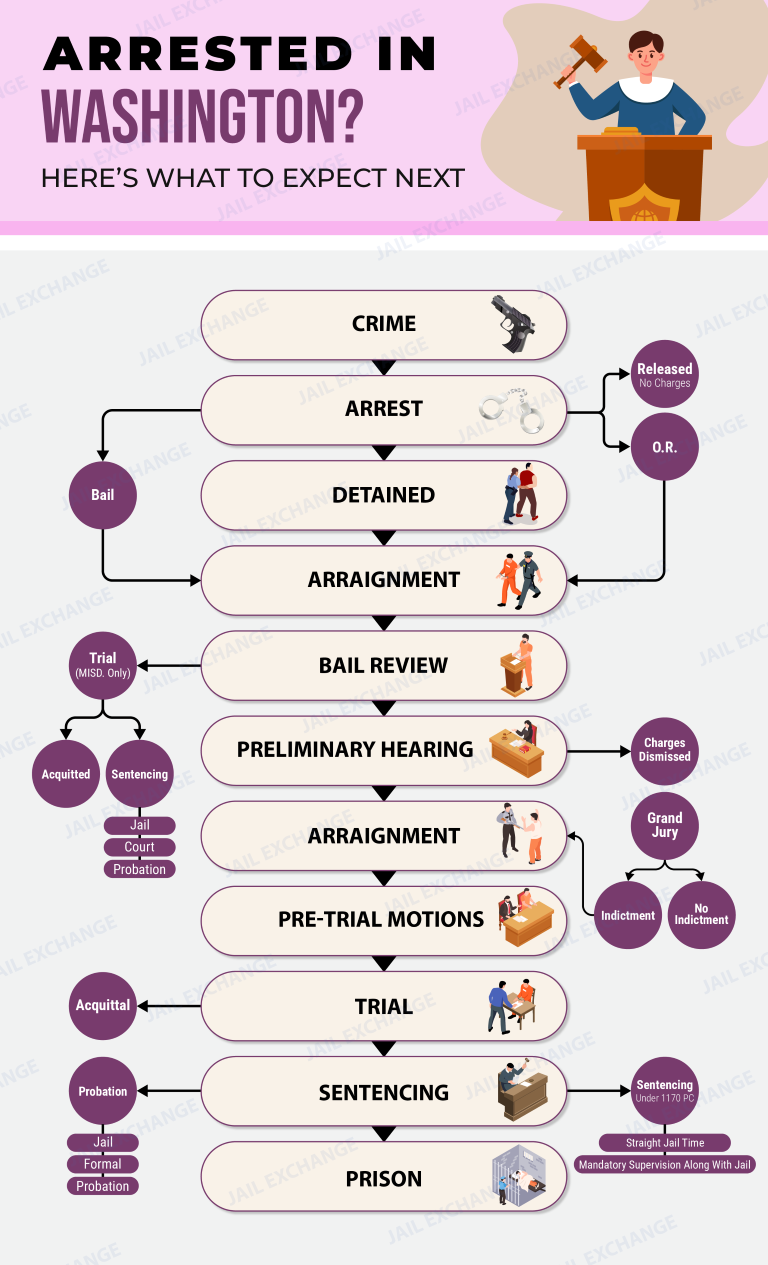
Okanogan County Jail Criminal Court Process
Criminal Court Process for Okanogan County Washington
Okanogan County Courts: Superior, District and City Courts in Okanogan
Felony cases go to Superior Court, and most misdemeanors go to District Court. Both sit at the courthouse, 149 N 3rd Ave, Okanogan, WA 98840. Omak, Brewster and Winthrop run their own municipal courts. Anyone booked by city, county or state officers goes to the Okanogan County Jail, 149 N 4th Ave, Okanogan, WA 98840.
Wondering if a family member sits in the jail? Scan the Okanogan County Inmate Search. It is a daily name list. The Jail Roster page on our site explains warrants, charges and free legal help.
Call the County Clerk at 509-422-7275 for a felony, or the District Court clerk for a misdemeanor. Say the person's whole name, then ask for the case number. If you must pay, our bail and bond page shows the way.
1. Local courts in Okanogan County (county, city and tribal courts)
The town of Okanogan is the seat of Washington's largest county by land area, and its courthouse campus on North 3rd and 4th avenues holds Okanogan County Superior Court (felonies) and Okanogan County District Court (misdemeanors, gross misdemeanors and infractions). Omak, Brewster and Winthrop keep their own municipal courts, while District Court takes city cases for most other towns. The Okanogan County Prosecuting Attorney files felony and county charges. Everyone arrested by any non-tribal agency in the county is booked into the Okanogan County Jail in Okanogan, and a judge sets release conditions or bail at the first hearing; the Colville Tribes run a separate tribal court and jail at Nespelem.
- Okanogan County Superior Court, 149 N 3rd Ave, Okanogan, WA 98840, (509) 422-7130
- Okanogan County Clerk, 149 N 3rd Ave, Okanogan, (509) 422-7275
- Okanogan County District Court, 149 N 3rd Ave, Room 306, Okanogan, (509) 422-7170
- Okanogan County Prosecuting Attorney, Administrative Building, 237 4th Ave N, Okanogan, (509) 422-7280
- Okanogan County Sheriff's Office, 123 5th Ave N, Room 200, Okanogan, (509) 422-7200 (option 1 for corrections)
- Okanogan County Jail (Corrections Center), Okanogan, through the Sheriff's main line (509) 422-7200
- Okanogan County Office of Public Defense, 1240 2nd Ave S, Okanogan, (509) 422-7150
- Colville Tribal Court (tribal cases on the reservation), Nespelem, (509) 634-2500
- Okanogan County Juvenile Court, 237 N 4th Ave, Okanogan, (509) 422-7250; juvenile detention (509) 422-7260
Which court hears your case. A misdemeanor charged by Omak, Brewster or Winthrop under city code is heard in that town's municipal court. Misdemeanors, gross misdemeanors and infractions written by deputies, state troopers, or officers in Okanogan, Oroville, Tonasket, Twisp, Pateros, Riverside, Coulee Dam or Elmer City go to District Court in Okanogan, which handles those towns' cases under contract. Every felony goes to Superior Court. Anyone under 18 goes to the juvenile court on North 4th Avenue. Offenses by tribal members on the Colville Reservation can instead be prosecuted in Colville Tribal Court or in federal court, depending on the crime and the location.
Where pretrial inmates are held. The county's Corrections Center in Okanogan, reached through (509) 422-7200, holds everyone arrested in the county by city, county and state officers. It has 194 beds after several expansions of a 1983 building, and it also runs electronic home monitoring, work release and work crews. No town in the county operates its own jail. On the Colville Reservation, the tribe runs the Colville Tribal Correctional Facility at 44 Schoolhouse Loop Rd in Nespelem, (509) 634-7352, for people charged in tribal court.
Distances matter here: Oroville sits on the Canadian border about 50 miles north of the courthouse, and Methow Valley towns are an hour west over Loup Loup Pass. Most cases still end up in Okanogan, but three cities keep local courtrooms.
County courts
- Superior Court, 149 N 3rd Ave, Okanogan, (509) 422-7130. Felonies, juvenile offenses and appeals.
- District Court, 149 N 3rd Ave, Room 306, (509) 422-7170. County-level misdemeanors and infractions, plus city cases for Okanogan, Oroville, Tonasket, Twisp, Pateros, Riverside, Coulee Dam and Elmer City. Smaller places such as Conconully and Nespelem town are typically handled here too.
- District Court Probation, 149 N 3rd Ave, Room 101, (509) 422-7369.
Municipal courts
- Omak Municipal Court, 2 N Ash St, Omak, (509) 826-2971.
- Brewster Municipal Court, 105 S 3rd St, Brewster, (509) 689-2756.
- Winthrop Municipal Court, 208 Riverside Ave, Winthrop, (509) 996-2320.
Tribal court
Sitting in Nespelem at 38 School Loop Rd, (509) 634-2500, the Colville Tribal Court hears criminal cases against Indians for offenses on the reservation, which covers the southeastern part of the county and extends into Ferry County. The tribes also run a public defender office for tribal court defendants.
Prosecution, defense, police and youth
- Prosecuting Attorney, 237 4th Ave N, Okanogan, (509) 422-7280. Cities with their own courts use city prosecutors.
- Public defense: The Okanogan County Office of Public Defense, 1240 2nd Ave S, (509) 422-7150, provides lawyers through staff attorneys and contracts with dedicated and private-practice attorneys. Until recently the county relied on one contract firm and voted to build its own agency. Omak, Brewster and Winthrop contract separately for municipal court defenders.
- Sheriff's Office, (509) 422-7200. Omak, Okanogan, Oroville, Tonasket, Brewster and several other towns have their own police; the Colville Tribal Police patrol the reservation.
- Juvenile Court and Probation, 237 N 4th Ave, (509) 422-7250.
The county lets families post bail at courthouse offices from 9 a.m. to 4 p.m. on weekdays, or after hours at the lobby of the Okanogan County Jail, which takes cash only. Licensed bonding companies can post instead.
↑ Back to the question list2. Misdemeanor (for example, DUI, disorderly conduct, minor in possession, second-degree criminal trespass)
An officer in Okanogan County can either cite and release or book the person at the Okanogan County Jail. Booking includes fingerprints, photographs and a medical check. The jail posts a daily booking log and an inmate log on weekdays, which families often use to confirm someone is in custody.
First appearance and release
- A judge has to approve probable cause within 48 hours of an arrest made without a warrant.
- The arraignment or first appearance is held in District Court or the city court for the arresting town, usually by the next court day.
- Washington judges begin by presuming release without money. They add conditions where needed and may set bail when there is a substantial risk of missing court or committing a violent offense.
- If you cannot pay a lawyer, ask the judge to appoint one; the county Office of Public Defense covers District Court, and the city's contract defender covers Omak, Brewster and Winthrop cases.
Possible results
Under state law, an Okanogan County court can order up to 90 days and $1,000 for a misdemeanor, and up to 364 days and $5,000 for a gross misdemeanor. DUI brings minimum jail or home detention, fines, an ignition interlock and license suspension, and repeat DUIs inside the lookback period become felonies. Knowing possession of illegal drugs is a gross misdemeanor with a focus on treatment and diversion. Many cases close with a plea, a continuance that ends in dismissal, or a treatment-based deferred prosecution. A six-person jury hears trials. Sentenced inmates may qualify for the jail's work release or electronic monitoring instead of full-time custody.
↑ Back to the question list3. Felony (for example, first-degree trafficking in stolen property, malicious mischief over $5,000, felony harassment, delivery of methamphetamine)
Felony suspects arrested from the Methow Valley to the Canadian border are taken to the Okanogan County Jail. A Superior Court judge then holds a preliminary appearance, ordinarily the next court day, to confirm probable cause, appoint the Office of Public Defense, and set conditions or bail. If the prosecutor does not file charges within the short window allowed, the defendant must be released.
Superior Court stages
- Filing. The Prosecuting Attorney files an information listing each count.
- Arraignment. Required within three days of filing when the defendant is in jail, or 14 days after the next hearing when the defendant is out; a not-guilty plea is entered and a trial date set.
- Trial timing. The rule calls for trial within 60 days of arraignment when the defendant is jailed and 90 days when released, but continuances are routine.
- Omnibus and plea talks. Discovery and motions narrow the case, and most Okanogan County felonies are settled.
- Trial. A unanimous twelve-person jury decides guilt.
Sentencing
Felony sentences come from the state grid, which matches seriousness level against offender score to produce a standard range. Okanogan County judges work within maximums of five years for Class C, ten for Class B and life for Class A felonies, with fines up to $10,000, $20,000 and $50,000. Up to a year is served in the county jail; longer sentences go to state prison under the Department of Corrections, and community custody often follows. Eligible defendants may request the First-Time Offender Waiver, a DOSA or the Parenting Sentencing Alternative. Earned time, not parole, governs early release.
↑ Back to the question list4. Violent felony (for example, first-degree burglary with a weapon, second-degree murder, assault of a child, arson)
In a violent case, the prosecutor will usually argue for substantial bail or conditions tight enough to protect the alleged victim, such as no contact, no weapons and electronic monitoring. Defendants who cannot meet them wait in the Okanogan County Jail. When the alleged offender is a tribal member and the crime happened on the Colville Reservation, the case may instead be charged in federal court in Spokane, sometimes alongside a tribal court case.
What makes violent cases different
- Violent prior convictions are scored more heavily, so ranges climb steeply.
- Firearm and deadly weapon enhancements add consecutive, mandatory time.
- A third "most serious offense" brings life without release under the persistent offender law.
- Washington's death penalty has been abolished; aggravated first-degree murder by an adult means life without parole.
- Victims hold constitutional rights to notice, to attend and to make a statement at sentencing.
These cases move slowly, often a year or longer, while lab tests, experts and investigators do their work. The Office of Public Defense assigns qualified counsel, and conflict lawyers are appointed when co-defendants are involved.
↑ Back to the question list5. Juveniles (under 18) arrested in Okanogan County
Okanogan County still operates its own youth lockup, the Okanogan County Juvenile Detention Center, a 20-bed facility at 227 4th Ave N, behind the historic courthouse. Its control room answers around the clock at (509) 422-7260. Commissioners considered closing it and sending youth out of county in 2016 but kept it open, and it works with the Colville Tribes and other juvenile courts.
Steps in a juvenile case
- Detention hearing. A youth held in detention sees a juvenile judge within 72 hours. Most Okanogan County youths go home to a parent or guardian under court-ordered conditions; money bail rarely drives the decision.
- Diversion. Juvenile probation, (509) 422-7250, handles many first offenses through diversion agreements that avoid a conviction.
- Adjudication. Juvenile trials in Okanogan are bench trials, decided by the judge alone.
- Disposition. Local sanctions include supervision, community service and short detention. Serious or repeat cases can lead to commitment with Juvenile Rehabilitation at state facilities such as Green Hill School or Echo Glen Children's Center.
- Adult court. Sixteen- and seventeen-year-olds accused of serious violent felonies are filed in adult court by law; prosecutors can ask to move other felony cases to adult court through a decline hearing.
Tribal youth may face proceedings in Colville Tribal Court instead. In county juvenile court, the Office of Public Defense provides lawyers for youths whose families cannot afford one.
↑ Back to the question list6. Federal cases (U.S. District Court) from Okanogan County
Okanogan County is part of the Eastern District of Washington, and its federal criminal cases are generally heard in Spokane at the Thomas S. Foley U.S. Courthouse, (509) 458-3400. Federal judges in Spokane have sentenced Omak defendants in Colville Reservation shootings, for example.
Why so many cases here go federal
- Colville Reservation. In 1986 the Legislature authorized returning to the federal government the state's criminal jurisdiction over Indians on Colville trust and allotted lands, and that retrocession took effect in the late 1980s. Serious crimes by or against tribal members there are typically investigated by the FBI and Colville Tribal Police and prosecuted federally under the Major Crimes Act, while lesser offenses go to tribal court. The state keeps some jurisdiction, including over non-Indians; jurisdiction on any given case depends on who was involved and exactly where.
- Canadian border. The Oroville port of entry and the long border to the east and west produce smuggling, illegal reentry and firearms cases handled by Customs and Border Protection and Homeland Security Investigations.
- Federal land. Much of the county is national forest, including the Pasayten Wilderness, and crimes there can be charged federally.
- Drug trafficking and firearm cases built by DEA and ATF.
Federal offices
- U.S. Attorney's Office for the Eastern District, Spokane, (509) 353-2767.
- Federal Defenders of Eastern Washington and Idaho, whose Spokane lawyers represent most eligible defendants from Omak, Oroville and the reservation, (509) 624-7606; a CJA panel lawyer is appointed when the defenders cannot take a case.
The federal process
An arrested person is brought before a magistrate judge for an initial appearance. Money bail is generally not part of the federal system: under the Bail Reform Act the judge sets release conditions or orders detention after a hearing. A grand jury must indict within 30 days of arrest, and the Speedy Trial Act sets 70 days to trial, often extended for good cause. Sentences are based on the U.S. Sentencing Guidelines, and since parole was abolished federally, inmates serve about 85% of their time in Bureau of Prisons custody, then supervised release. An appeal from an Okanogan County federal conviction goes to the Ninth Circuit, headquartered in San Francisco and also holding sessions in Seattle.
Before trial, the U.S. Marshals house many eastern Washington defendants in county jails such as the Spokane County Jail, so a federal prisoner may be listed on a local roster. Once a federal sentence is imposed, locate the person through the Federal Bureau of Prisons inmate locator.
This page describes in general terms how criminal charges typically proceed in Okanogan County. It is not legal advice, and local rules, contracts and jurisdiction questions change. Before deciding anything about a charge, consult a Washington-licensed criminal defense attorney. For appointed counsel, call the Okanogan County Office of Public Defense at (509) 422-7150. For jail and release questions, call the Okanogan County Sheriff's Office at (509) 422-7200 and choose corrections.
↑ Back to the question list