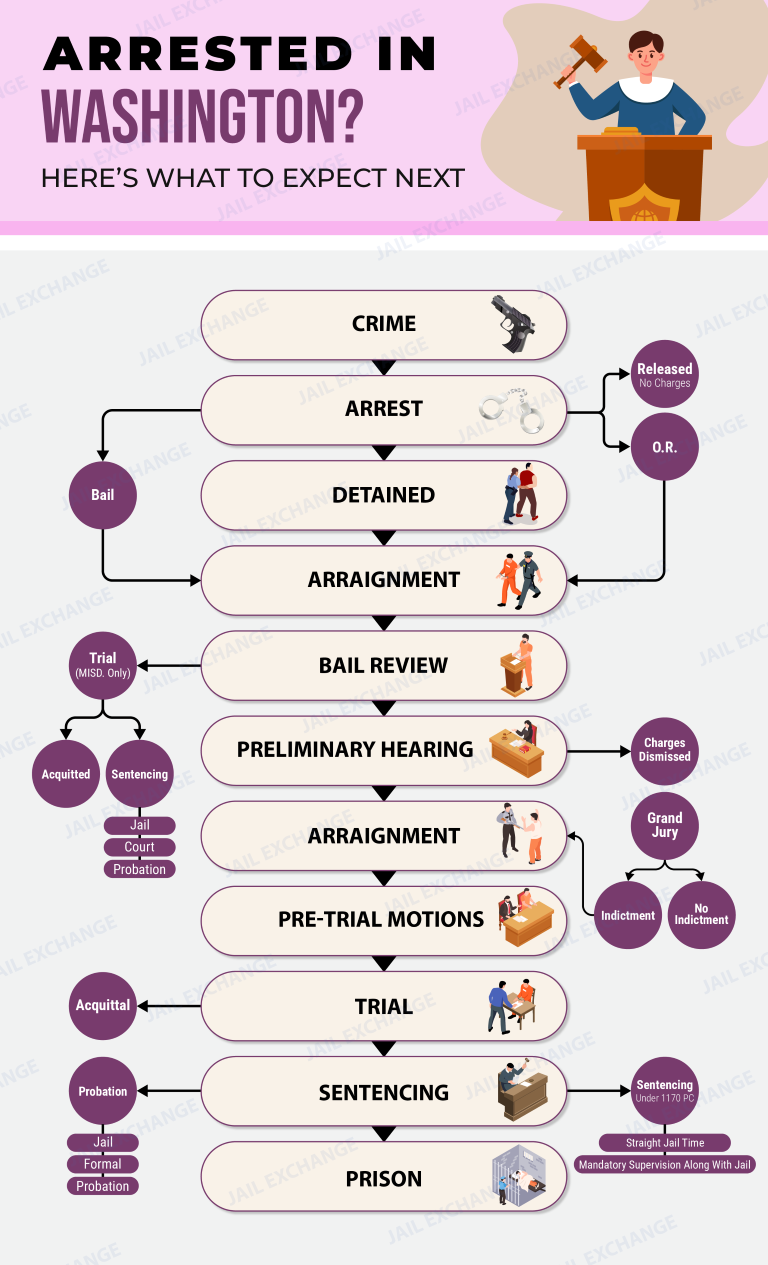
Tacoma is the Pierce County seat, and most criminal cases from this county run through one tower: the County-City Building at 930 Tacoma Ave S. Felonies go to Pierce County Superior Court. County misdemeanors go to Pierce County District Court, and city cases go to Tacoma Municipal Court or one of about a dozen other city courts. The Pierce County Prosecuting Attorney files felony charges, while city attorneys handle most city cases. Adults arrested on county charges are booked into the Pierce County Jail next door, where a judge reviews custody and bail at the first hearing.
- Pierce County Superior Court (felonies), County-City Building, 930 Tacoma Ave S, Room 334, Tacoma, WA 98402, (253) 798-3654
- Pierce County Clerk (Superior Court files), 930 Tacoma Ave S, Room 110, Tacoma, (253) 798-7455
- Pierce County District Court (clerk counter), 930 Tacoma Ave S, Room 239, Tacoma, (253) 798-7487
- Tacoma Municipal Court, 930 Tacoma Ave S, Room 841, Tacoma, (253) 591-5357
- Pierce County Prosecuting Attorney, 930 Tacoma Ave S, Room 946, Tacoma, (253) 798-7400
- Pierce County Department of Assigned Counsel (public defender), 949 Market St, Suite 334, Tacoma, WA 98402, (253) 798-6062
- Pierce County Sheriff's Office, 930 Tacoma Ave S, Tacoma, (253) 798-7530; non-emergency dispatch (253) 287-4455
- Pierce County Jail, Main Jail at 910 Tacoma Ave S (the newer building faces Nollmeyer Lane), Tacoma, booking and in-custody status (253) 798-4590
- Pierce County Juvenile Court and Remann Hall, 5501 6th Ave, Tacoma, WA 98406, (253) 798-7900
Which court hears your case. Location of the arrest and the agency that made it decide the court. A misdemeanor or gross misdemeanor inside Tacoma, Lakewood, Puyallup or another city with its own court is charged under city code in that city's municipal court. The same offense in unincorporated Pierce County, or in Eatonville, Edgewood or University Place, goes to Pierce County District Court. Every felony, wherever it happened in the county, belongs to Superior Court. Anyone under 18 goes to Juvenile Court at Remann Hall unless the law sends the case to adult court. Traffic infractions follow the same city-or-county split.
Where pretrial inmates are held. The Pierce County Jail is a two-building complex beside the courthouse, with room for roughly 1,800 people (staffing has kept the working population lower). It holds felony suspects from every police agency in the county, District Court defendants, and many city prisoners under contract. Smaller lockups exist too: the 51-bed Puyallup City Jail at 311 W Pioneer Ave holds misdemeanor inmates for Puyallup and other cities, (253) 841-5425, and the Puyallup Tribal Jail on the Puyallup Reservation holds people charged in Puyallup Tribal Court. Some cities, including Lakewood, also book misdemeanor prisoners into the Nisqually Tribal Jail in Thurston County, so a missing name on the county roster does not always mean release.
- Local courts in Pierce County (Superior, District, and every municipal court)
- Therapeutic courts in Pierce County
- Misdemeanor (for example, DUI, domestic violence assault in the fourth degree, shoplifting, criminal trespass)
- Felony (for example, residential burglary, auto theft, possession of a stolen vehicle, unlawful possession of a firearm)
- Violent felony (for example, first-degree robbery, drive-by shooting, first-degree assault, murder)
- Juveniles (under 18) arrested in Pierce County
- Federal cases (U.S. District Court) from Pierce County
Local courts in Pierce County (Superior, District, and every municipal court)
Pierce County Superior Court and Pierce County District Court both sit in the County-City Building. District Court now runs all of its criminal calendars from Tacoma (courtrooms on floors 5 through 8), with probation in Room 610 and a Court Resource Center across the street at 925 Tacoma Ave S, (253) 798-7631. Many smaller cities do not keep their own judge; they contract with District Court or with a neighboring city, as shown below. Hearings for people held in the Pierce County Jail are often done by video, and a bail set by a city judge must be posted for that city's case.
Municipal courts and who uses them
- Tacoma Municipal Court, 930 Tacoma Ave S, Room 841, Tacoma, (253) 591-5357. Tacoma Community Court meets at 1102 Tacoma Ave S.
- Lakewood Municipal Court, 6000 Main St SW, Lakewood, (253) 512-2258. Also hears cases from Steilacoom and DuPont.
- Puyallup Municipal Court, 929 E Main, Suite 120, Puyallup, (253) 841-5450. Puyallup's court staff also run the Milton Municipal Court at this address.
- Bonney Lake Municipal Court, 9002 Main St E, Suite 100, Bonney Lake, (253) 862-6606. Also staffs Sumner Municipal Court at the same address and hears South Prairie cases.
- Fife Municipal Court, 3737 Pacific Hwy E, Fife, (253) 922-6635
- Fircrest Municipal Court, City Hall, 115 Ramsdell St, Fircrest, (253) 564-8922. Also covers the Town of Ruston.
- Gig Harbor Municipal Court, 3510 Grandview St, Gig Harbor, (253) 851-7808
- Buckley Municipal Court, 811 Main St, Buckley, (360) 829-2118. Also hears Carbonado cases.
- Orting Municipal Court, Orting City Hall, 104 Bridge St S, Orting, (360) 893-3160
- Roy Municipal Court, 216 McNaught St S, Roy, (253) 843-0463
- Wilkeson Municipal Court, 540 Church St, Wilkeson, (360) 829-0171
- Pierce County District Court hears city cases for University Place, Edgewood and Eatonville (Eatonville moved over from Bonney Lake on January 1, 2024), plus everything from unincorporated areas such as Spanaway, Parkland, Frederickson and the Key Peninsula. Call (253) 798-7487.
Prosecutors, public defense, police and juvenile intake
- Prosecuting Attorney (felonies, District Court misdemeanors, juvenile offenses), (253) 798-7400
- Department of Assigned Counsel: felony division (253) 798-7834; misdemeanor division (253) 798-6975. DAC covers Superior Court, District Court, Juvenile Court, and the Tacoma, Fircrest and Ruston city cases. Other cities hire contract public defenders; the clerk of each court can give the name.
- Sheriff's Office, (253) 798-7530, which also polices University Place and Edgewood under contract
- Lakewood Police Department, 9401 Lakewood Dr SW, (253) 830-5000
- Tacoma, Puyallup, Fife and other city police, reached through South Sound 911 non-emergency at (253) 287-4455; Fife Police front desk (253) 922-6633
- Juvenile intake and probation, Remann Hall, (253) 798-7900
Therapeutic courts in Pierce County
Pierce County runs one of the larger groups of treatment courts in the state. Each is voluntary, needs the prosecutor's agreement, and swaps a regular sentence for close supervision, frequent hearings, drug testing and treatment. Ask your Department of Assigned Counsel lawyer about screening early, ideally before a plea and while any bail question is still open, because some programs are offered as release plans for people in the Pierce County Jail.
- Felony Drug Court (Superior Court, since 1994): for nonviolent felony defendants with addiction, at least 12 months, run with Pierce County Alliance. It has graduated more than 2,700 people and includes a veterans track.
- Felony Mental Health Court (Superior Court): for people whose chronic mental illness drives their offending, at least 18 months; graduates have the felony dismissed.
- District Court therapeutic courts: Veterans Treatment Court, Mental Health Court, the Drug Addiction Reduction Team (DART), and a Community Court, all for misdemeanor cases.
- Tacoma Municipal Court: Community Court at 1102 Tacoma Ave S and other therapeutic calendars for Tacoma city charges.
- Friendship Diversion: a prosecutor-run program in which some first-time defendants do community work and avoid a conviction.
Misdemeanor (for example, DUI, domestic violence assault in the fourth degree, shoplifting, criminal trespass)
Plenty of Pierce County misdemeanor arrests end with a citation and a court date instead of a trip to jail. DUI and domestic violence arrests are different: officers usually book the person, and DV suspects generally stay in custody until a judge sees them. Booking happens at the Pierce County Jail for county cases and Tacoma cases, while a Puyallup or Lakewood officer may take the person to the Puyallup City Jail or the Nisqually Tribal Jail instead.
First appearance and release
A judge must find probable cause within 48 hours of a warrantless arrest, and the first appearance is normally held the next court day, by video from the jail. Washington's court rules presume release on personal recognizance. The judge can instead set bail, add conditions such as alcohol monitoring or no driving, and in DV cases will almost always sign a no-contact order on the spot. Bail can be paid in cash at the jail or posted through a licensed bail bond company. Family members should note the case number and which court set the amount, because Tacoma, District Court and other city holds are separate.
Lawyers, pleas and penalties
If you cannot afford a lawyer, the judge screens you at arraignment. In District Court and in Tacoma, Fircrest and Ruston cases, the Department of Assigned Counsel takes the case; other city courts appoint their contract defenders. Most cases settle through a reduced charge, a stipulated order of continuance, or a deferred sentence; the rest go to a six-person jury. A Pierce County judge can impose up to 90 days and $1,000 for a misdemeanor and up to 364 days and $5,000 for a gross misdemeanor. DUI carries mandatory jail or electronic home monitoring, fines, and license consequences even on a first offense, and repeat DUIs within the state's lookback period can become a felony. Drug possession is now a gross misdemeanor that steers people toward treatment and diversion.
Felony (for example, residential burglary, auto theft, possession of a stolen vehicle, unlawful possession of a firearm)
Every felony arrest in Pierce County, whether made by Tacoma Police, a sheriff's deputy or the State Patrol, ends with booking at the Pierce County Jail. Within about a day the person sees a judicial officer for a preliminary appearance on probable cause, conditions of release and bail. Deputy prosecutors then decide whether to file an information in Superior Court; if nothing is filed within 72 hours, the person is usually released while the investigation continues.
Arraignment to trial
Arraignment comes within three days of filing for someone held in jail and within 14 days of the next appearance for someone released, and the Department of Assigned Counsel felony division, (253) 798-7834, represents people who qualify. Conflict cases go to the county's Public Defense Conflict Office or assigned private counsel. Court rules require trial within 60 days of arraignment for someone in custody and 90 days for someone out, but continuances are routine in a court this busy. Expect omnibus and status hearings, plea talks, and possibly a 12-person jury trial.
Sentencing
Sentences come from the Sentencing Reform Act grid, which sets a standard range from the seriousness of the offense and the person's offender score. A Pierce County Superior Court judge can reach up to 5 years and $10,000 on a Class C felony, 10 years and $20,000 on a Class B, and life and $50,000 on a Class A, but the standard range is usually far lower. Terms of a year or less are served locally; longer terms go to the Department of Corrections, followed by community custody. Alternatives include the First-Time Offender Waiver, the Drug Offender Sentencing Alternative, the Parenting Sentencing Alternative, and Felony Drug Court. There is no parole for crimes committed after 1984.
Violent felony (for example, first-degree robbery, drive-by shooting, first-degree assault, murder)
Serious violent cases follow the felony path above but with far higher stakes at the first hearing. Prosecutors routinely ask for high bail or no release, and defendants frequently spend the entire case in the Pierce County Jail. Victims have a constitutional right under the Washington Constitution to be told about hearings and to speak at sentencing, and the Prosecutor's victim advocates contact them early.
Violent cases are assigned to experienced deputy prosecutors and senior Department of Assigned Counsel attorneys, and homicide cases commonly take a year or more because of forensic testing and expert work. Firearm and deadly weapon enhancements add flat, consecutive time that cannot be reduced for good behavior. Washington no longer has a death penalty: the state Supreme Court struck it down in 2018 and the Legislature repealed it in 2023. Aggravated first-degree murder carries life without parole for adults, though courts have limited that sentence for people who were under 21 at the time of the crime. Most "most serious offenses" also count as strikes under the state's three-strikes law.
Juveniles (under 18) arrested in Pierce County
Youth cases are heard by Pierce County Juvenile Court, a division of Superior Court housed at Remann Hall, 5501 6th Ave in Tacoma, (253) 798-7900. When police hold a young person rather than releasing them to a parent, the youth goes to Remann Hall, the county's juvenile detention center. A detention hearing must take place within 72 hours, where a judge decides whether the youth goes home, stays in detention, or is released with conditions. Washington juvenile courts do not use money bail the way adult courts do; release depends on court-ordered conditions.
The Department of Assigned Counsel represents youth whose families qualify. Many first-time and low-level cases go to the Juvenile Court Diversion Unit, which can assign a class, a Community Accountability Board, or an individual agreement; finishing it keeps the case out of court. Charged cases end in local sanctions (probation, community service, short detention) or, for serious or repeat offenses, commitment to Juvenile Rehabilitation through the state Department of Children, Youth, and Families, at Green Hill School in Chehalis, Echo Glen Children's Center in Snoqualmie, or a community facility. Juvenile Rehabilitation can hold some youth up to age 25.
Some 16- and 17-year-olds begin in adult court automatically when charged with a serious violent offense such as first-degree murder or first-degree robbery, and other youth can be moved to adult court after a decline hearing. A young person charged as an adult may be held at Remann Hall rather than the Pierce County Jail until age 18.
Federal cases (U.S. District Court) from Pierce County
Pierce County is in the U.S. District Court for the Western District of Washington, and most of its federal criminal cases are heard at the Tacoma courthouse in historic Union Station, 1717 Pacific Ave, Tacoma, WA 98402, clerk's office (253) 882-3800. Some cases are assigned to the Seattle courthouse instead.
When a case becomes federal
Crimes on Joint Base Lewis-McChord (civilian offenses there; service members may also face military court-martial), inside Mount Rainier National Park, or involving federal agencies, mail, interstate firearms or drug trafficking, child exploitation, or immigration can be charged federally. On Puyallup and Nisqually tribal lands, whether a case is federal, tribal or state depends on the offense and whether the people involved are tribal members, so the same incident may be prosecuted in more than one system. Federal cases from Pierce County are brought by the U.S. Attorney's Office Tacoma branch, 1201 Pacific Ave, Suite 700, (253) 428-3800.
How a federal case moves
After arrest, the person appears before a U.S. magistrate judge, usually the next court day, and is offered counsel. The Federal Public Defender's Tacoma office, 1331 Broadway, Suite 400, (253) 593-6710, or a court-appointed Criminal Justice Act panel lawyer represents people who cannot pay. Federal court has no commercial bail bond system; release is decided under the Bail Reform Act at a detention hearing, and people held for trial usually stay at the Federal Detention Center SeaTac. Someone held under a U.S. Marshals contract may also show up on a local roster such as the Pierce County Jail list for a short time. An indictment must follow within 30 days of arrest, and the Speedy Trial Act sets 70 days to trial, with frequent exclusions.
Sentences are based on the U.S. Sentencing Guidelines and any mandatory minimums. Federal prison has no parole; people serve roughly 85% of the term after good-conduct credit, then supervised release. Appeals go to the Ninth Circuit Court of Appeals, based in San Francisco, which also hears cases at the Nakamura Courthouse in Seattle. A Pierce County defendant already in federal hands can be found through the Federal Bureau of Prisons inmate locator.
This Pierce County guide is general information, not legal advice, and court locations, contracts and procedures change. Speak with a Washington-licensed criminal defense attorney about any specific case. For a public defender, call the Pierce County Department of Assigned Counsel at (253) 798-6062; to check whether someone is in custody, call Pierce County Jail booking at (253) 798-4590 or the Sheriff's Office at (253) 798-7530.