Spokane County Juvenile Detention Criminal Court Process
Criminal Court Process for Spokane County Washington
Spokane County Courts: Superior, District and City Courts for Criminal Cases
Three kinds of courts hear criminal cases here. Superior Court handles felonies at 1116 West Broadway Avenue, Spokane, WA 99260. District Court and the city Municipal Courts handle misdemeanors. People arrested here are usually held at the Spokane County Jail, 1100 West Mallon Avenue, Spokane, WA 99260.
First, learn where your person is held. Use the Spokane County Inmate Search to find a name. Open warrants and new bookings appear in our Jail Roster section.
Then call the Superior Court clerk at 509-477-2211. Request the court that owns the case, plus the next hearing time. Worried about getting your person out? Our bail page walks you through it.
1. Local courts in Spokane County (Superior, District and municipal courts)
Spokane is the county seat, and nearly every adult criminal case runs through two downtown buildings: the Superior Court courthouse on Broadway and the Public Safety Building on Mallon Avenue. Felonies go to Spokane County Superior Court; county misdemeanors (including Spokane Valley, Liberty Lake, Deer Park and Millwood cases) go to Spokane County District Court; city of Spokane cases go to Spokane Municipal Court; and Airway Heights and Cheney run their own small courts. The Spokane County Prosecuting Attorney files felonies and county misdemeanors, while city prosecutors handle city charges. Nearly everyone arrested is booked into the Spokane County Jail next to the Public Safety Building, and release usually turns on conditions or bail set at the first hearing.
- Spokane County Superior Court, 1116 W Broadway Ave, Spokane, WA 99260, (509) 477-5790
- Spokane County District Court, Public Safety Building, 1100 W Mallon Ave, Spokane, WA 99260, (509) 477-4770
- Spokane Municipal Court, 1100 W Mallon Ave (first floor, Public Safety Building), Spokane, (509) 625-4400
- Spokane County Prosecuting Attorney, 1100 W Mallon Ave, Spokane, (509) 477-3662
- Spokane County Sheriff's Office, 1100 W Mallon Ave, Spokane, (509) 477-2240
- Spokane County Detention Services (jail), 1100 W Mallon Ave, Spokane, (509) 477-2278
- Spokane County Public Defender, 1033 W Gardner Ave, Spokane, WA 99260, (509) 477-4246
- City of Spokane Public Defender, 824 N Monroe St, Spokane, WA 99201, (509) 835-5955
- Crime Check (non-emergency police line for Spokane and the Sheriff), (509) 456-2233
- Spokane County Juvenile Court and Detention, 902 N Adams St, Spokane, (509) 477-4742
Which court hears your case. Traffic infractions, misdemeanors and gross misdemeanors cited by the Sheriff or Washington State Patrol, or by Spokane Valley, Liberty Lake, Deer Park or Millwood officers, go to Spokane County District Court. Spokane police cases charged under city code go to Spokane Municipal Court. Airway Heights and Cheney police cases go to those cities' courts, and Medical Lake cases go to one of them by contract. Every felony goes to Superior Court. Anyone under 18 goes to the juvenile division on North Adams Street unless the law sends the case to adult court.
Where pretrial inmates are held. Adults are booked into the Spokane County Jail, 1100 W Mallon Ave, Spokane, (509) 477-2278, which holds county, city and contract prisoners, including people the city of Spokane pays to house on misdemeanor charges. Lower-risk inmates may be moved to the Geiger Corrections Center, 3507 S Spotted Rd on the West Plains, a minimum-security county facility the county has proposed closing in 2027. No Spokane County city operates its own long-term jail; Airway Heights Corrections Center is a state prison for sentenced inmates, not a booking jail.
The county has one Superior Court, one District Court and three municipal courts. Spokane Valley, Liberty Lake, Deer Park and Millwood send misdemeanors to District Court, and the small towns (Fairfield, Rockford, Spangle, Latah, Waverly) are typically handled there too.
County courts
- Spokane County Superior Court, 1116 W Broadway Ave, Spokane, (509) 477-5790. It hears every felony, the juvenile docket and appeals from District and municipal courts.
- Spokane County District Court, Public Safety Building, 1100 W Mallon Ave, Spokane, (509) 477-4770. Criminal and infraction dockets; civil and small claims clerks sit at 721 N Jefferson St. Infraction hearings long held at the Spokane Valley Precinct, 12710 E Sprague Ave, are moving downtown after commissioners voted in June 2026 to end that lease by year-end.
- District Court Probation, 1100 W Mallon Ave, (509) 477-4753
Municipal courts
- Spokane Municipal Court, 1100 W Mallon Ave, Spokane, (509) 625-4400. City of Spokane misdemeanors and gross misdemeanors; city cases are prosecuted by the City Prosecutor, 909 W Mallon Ave, (509) 835-5988.
- Airway Heights Municipal Court, 13120 W 13th Ave, 2nd floor, Airway Heights, (509) 244-2773. In mid-2025 Airway Heights also agreed to take Medical Lake's cases.
- Cheney Municipal Court, 611 2nd St, Cheney, (509) 498-9231. Cheney heard Medical Lake cases from 2014 until that switch; for a Medical Lake ticket, ask either clerk where the case sits.
- Spokane Valley, Liberty Lake, Deer Park, Millwood: no city court; cases go to Spokane County District Court, (509) 477-4770.
Prosecution, defense, police and juvenile intake
- Spokane County Prosecuting Attorney, 1100 W Mallon Ave, (509) 477-3662; Victim-Witness Unit (509) 477-2203. Spokane Valley contracts with this office for its misdemeanor prosecution.
- Spokane County Public Defender, 1033 W Gardner Ave, (509) 477-4246. A county agency that covers Superior Court, District Court and, by contract, Spokane Valley cases.
- City of Spokane Public Defender, 824 N Monroe St, (509) 835-5955, for Spokane Municipal Court. Cheney contracts with a private attorney, and Airway Heights typically appoints contract counsel; the court clerk can name the current lawyer.
- Spokane County Sheriff's Office, (509) 477-2240; Spokane Valley Police (staffed by the Sheriff under contract), 12710 E Sprague Ave, (509) 477-3300
- Spokane Police Department, (509) 625-4100; Cheney Police (after hours), (509) 498-9230; other city departments, including Airway Heights, Liberty Lake and Medical Lake, can be reached through Crime Check, (509) 456-2233
- Juvenile Court Services, 902 N Adams St, (509) 477-4742
2. Booking, release and the two Spokane County jails
Spokane County Detention Services, part of the Sheriff's Office, runs both adult facilities. The downtown Spokane County Jail handles all booking: fingerprints, photos, property, medical screening and a records check for warrants. Some inmates, mainly lower-risk and sentenced, are later moved to the Geiger Corrections Center near Spokane International Airport.
Geiger's future
Geiger sits on leased airport land, and closing it has been debated since 2012. In fall 2026, Detention Services presented a budget plan to move Geiger's population downtown around June 2027 and demolish the site by the end of 2028; commissioners asked for more numbers before deciding. It would also end some outside-agency housing contracts, including U.S. Marshals beds. Until then, check both rosters.
Getting out
- A judge must find probable cause within 48 hours of a warrantless arrest, and the in-custody person sees a judge at a preliminary appearance, usually by the next court day, often by video from the jail.
- Under Washington's court rules the starting point is release on personal recognizance. A Spokane County judge can instead impose conditions (no-contact orders, alcohol monitoring, check-ins with Pretrial Services at (509) 477-3988) or set bail when there is a real risk of missing court or danger to others.
- Bail can be posted in cash at the jail or through a licensed bail bond agency, which usually charges a nonrefundable fee of about 10%.
The public defender's office often meets clients for the first time at that first hearing; families can call (509) 477-4246 to ask whether a lawyer has been assigned.
↑ Back to the question list3. Therapeutic courts in Spokane County
These programs trade frequent court check-ins, testing and treatment for a reduced or dismissed charge. Admission is voluntary and usually requires a defense lawyer's referral and the prosecutor's agreement.
- Superior Court (felonies): Therapeutic Drug Court, a Co-Occurring Disorders Docket for people with both addiction and mental illness, and a Felony Mental Health Court.
- District Court: DUI Therapeutic Court for high-risk repeat impaired drivers, Veterans Enhanced Treatment Court, and the Spokane Regional Mental Health Court, run jointly with Spokane Municipal Court.
- Spokane Municipal Court: Community Court for quality-of-life offenses, plus city DUI and Veterans courts. Its domestic violence treatment court ended in September 2025 when grant funding dropped.
Someone held in the Spokane County Jail can sometimes be screened while in custody, and release is often tied to entering the program rather than posting bail. Ask the assigned public defender about eligibility early.
↑ Back to the question list4. Misdemeanor (for example, DUI, fourth-degree assault, criminal trespass, third-degree theft)
Where the case lands depends on who made the arrest. A Spokane police officer's case goes to Spokane Municipal Court; a deputy's or Spokane Valley officer's case goes to District Court; Airway Heights and Cheney cases stay in those cities. Municipal and District Court share the Public Safety Building, so check the paperwork for which one is listed.
What to expect
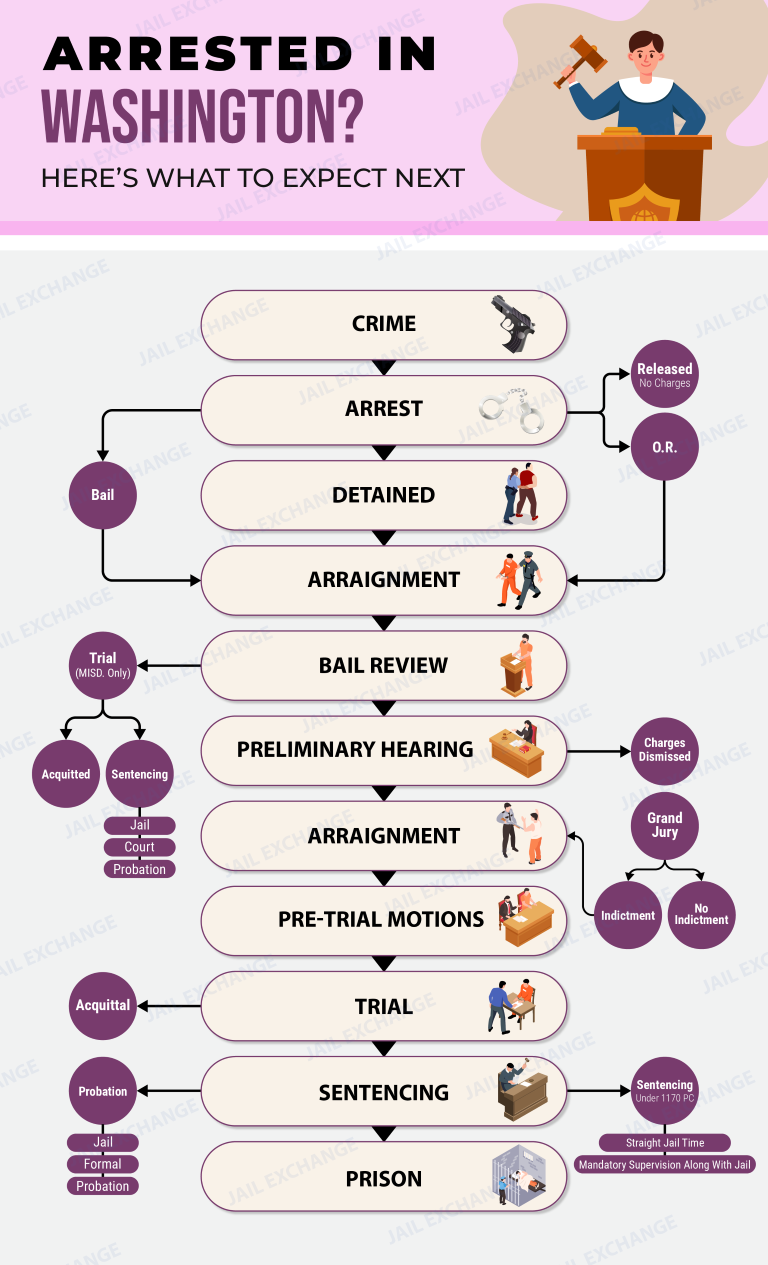
- First appearance or arraignment. People held in the Spokane County Jail see a judge quickly; people cited and released get a mailed arraignment date. A not-guilty plea is entered and release conditions are set or continued, sometimes with bail.
- Lawyer. The Spokane County Public Defender covers District Court and Spokane Valley cases; the City of Spokane Public Defender covers municipal court; Airway Heights and Cheney appoint contract attorneys.
- Pretrial hearings. Most cases settle through negotiation: amended charges, a stipulated order of continuance, or a deferred sentence. DUI cases may qualify for deferred prosecution with long-term treatment.
- Trial. A six-person jury. Speedy-trial rules give 60 days from arraignment for someone in custody and 90 days if out, but continuances are routine.
Penalties
A Spokane County judge can impose up to 90 days in jail and a $1,000 fine for a simple misdemeanor, and up to 364 days and $5,000 for a gross misdemeanor such as DUI or fourth-degree assault involving domestic violence. DUI carries mandatory minimum jail or electronic home monitoring, license consequences and an ignition interlock. A DUI becomes a felony when the driver has three or more prior impaired-driving offenses within a 15-year lookback (formerly 10). Knowing drug possession is a gross misdemeanor under the 2023 law, with pretrial diversion encouraged. Jail time is usually suspended in exchange for probation through District Court Probation or the city's Community Justice Services.
↑ Back to the question list5. Felony (for example, second-degree burglary, possession of a stolen vehicle, residential burglary, unlawful possession of a firearm)
Every felony, from a Deer Park car theft to a downtown burglary, is prosecuted by the Spokane County Prosecuting Attorney in Superior Court at 1116 W Broadway.
How the case moves
- Preliminary appearance. Within a day or so of booking into the Spokane County Jail, a judge reviews probable cause and sets release terms, which may include bail. A public defender is normally appointed at this hearing.
- Charging. The prosecutor files an information. If nothing is filed in time, the person is released, though charges can come later.
- Arraignment within three days of filing if the defendant is jailed or within 14 days of the next hearing if not, where the defendant pleads not guilty and a trial date is set (60 days if held, 90 if out, subject to exclusions).
- Omnibus and negotiation. Discovery, motions and plea offers. Most Spokane County felonies resolve by plea, often to a reduced charge or a referral to a therapeutic court.
- Trial before a 12-person jury, or a bench trial if the defendant waives a jury.
Sentencing
A sentencing grid combines the offense's seriousness level and the person's offender score (prior convictions) into a standard range. Statutory maximums are 5 years and $10,000 for Class C, 10 years and $20,000 for Class B, and life and $50,000 for Class A. A total sentence of 12 months or less is served locally in the Spokane County Jail or at Geiger Corrections Center; longer terms go to the Department of Corrections. Alternatives include the First-Time Offender Waiver, the Drug Offender Sentencing Alternative (DOSA) and the Parenting Sentencing Alternative. There is no parole, but community custody often follows release. The Spokane County Public Defender, (509) 477-4246, handles most appointed felony cases, with conflict cases assigned to contract counsel.
↑ Back to the question list6. Violent felony (for example, first-degree robbery, second-degree assault, drive-by shooting, murder)
Violent cases follow the same Superior Court path but are harder at every step. Prosecutors routinely ask for high bail, and judges weigh danger to the community and any victim heavily, so many defendants stay in the Spokane County Jail for the life of the case instead of being sent to Geiger Corrections Center, which takes only lower-risk inmates.
- No-contact orders are standard, especially in domestic violence cases, and violating one is a separate crime.
- Victims' rights. The Washington Constitution gives victims the right to attend and to speak at sentencing; the prosecutor's Victim-Witness Unit, (509) 477-2203, keeps them informed.
- Firearm and deadly weapon enhancements add flat, consecutive prison time on top of the standard range.
Penalties
Serious violent offenses carry long standard ranges, and a third "most serious offense" conviction under the persistent offender (three-strikes) law means life without release. In a Spokane County aggravated first-degree murder case, the maximum is life without parole for defendants who were 21 or older; Washington courts have barred mandatory life without parole for anyone younger. The death penalty no longer exists in Washington. The county Public Defender assigns its most experienced felony lawyers to these cases.
↑ Back to the question list7. Juveniles (under 18) arrested in Spokane County
Youth cases are heard in the Juvenile Court division of Spokane County Superior Court at 902 N Adams St, (509) 477-4742. Juvenile Court Services runs intake, probation and diversion.
Detention
Spokane County runs its own youth jail, the Spokane County Juvenile Detention Center in the juvenile court complex on North Adams, with 39 beds plus intake cells; the 24-hour line is (509) 477-2462. Youth seen as dangerous or likely to skip court are held; others go home to a parent. Martin Hall in Medical Lake is a regional juvenile detention center that mostly holds youth from smaller northeast Washington counties, though state court listings show Spokane among the counties it can serve.
What happens next
- Detention hearing within 72 hours of being held (not counting weekends and holidays). A judge decides whether the youth stays locked up or goes home with conditions; juvenile courts rarely use bail.
- Diversion for many first-time, lower-level offenses: community service, counseling or classes, with no formal conviction.
- Adjudication. Contested cases go to a fact-finding hearing before a judge, not a jury.
- Disposition. Local sanctions (probation, community service, up to 30 days in detention) or commitment to Juvenile Rehabilitation under DCYF at facilities such as Echo Glen Children's Center or Green Hill School. Some youth can remain in JR custody up to age 25.
Adult court
Sixteen- and 17-year-olds charged with certain serious violent offenses, such as first-degree murder, first-degree assault or first-degree rape, start in adult Superior Court automatically. For other cases, prosecutors can ask a judge to transfer the youth after a decline hearing. Juveniles are entitled to appointed counsel; the Spokane County Public Defender's juvenile unit, (509) 477-4246, typically takes these cases.
↑ Back to the question list8. Federal cases (U.S. District Court) from Spokane County
Spokane is headquarters for the U.S. District Court for the Eastern District of Washington. Federal cases from the county are heard at the Thomas S. Foley U.S. Courthouse, 920 W Riverside Ave, Spokane; clerk's office (509) 458-3400.
When a case becomes federal
- Crimes on Fairchild Air Force Base west of Spokane, a federal enclave; minor base offenses often go before a magistrate judge.
- Drug trafficking, federal firearms charges, child exploitation, bank robbery, fraud and immigration crimes.
- Cases involving tribal members on trust land. The Spokane Tribe's reservation lies in neighboring Stevens County, but both the Spokane and Kalispel tribes hold trust land near Airway Heights; jurisdiction there depends on who is involved and where, so it is decided case by case.
Who is involved
- U.S. Attorney's Office, Eastern District of Washington, 920 W Riverside Ave, Suite 340, Spokane, (509) 353-2767
- Federal Defenders of Eastern Washington and Idaho, 601 W Riverside Ave, Suite 900, Spokane, (509) 624-7606; conflict cases go to private Criminal Justice Act (CJA) panel lawyers.
The federal process
After arrest, the defendant appears before a magistrate judge, usually the same or next day. Under the Bail Reform Act there is no money bail in the usual sense: the judge either releases on conditions or orders detention after a hearing. An indictment must come within 30 days of arrest, and the Speedy Trial Act sets 70 days to trial, though it is often extended. Sentences follow the federal Sentencing Guidelines; with no parole, prisoners serve about 85% of the term in the Bureau of Prisons, then supervised release. Appeals go to the Ninth Circuit Court of Appeals in San Francisco, which also hears cases in Seattle, Portland and Pasadena.
The U.S. Marshals hold many eastern Washington federal detainees in the Spokane County Jail, and the county has also used Geiger Corrections Center beds for them, so a federal defendant may show up on the county roster. After sentencing, use the Federal Bureau of Prisons inmate locator.
This guide is general information about how criminal cases usually move through Spokane County courts, not legal advice, and court rules, contracts and jail operations change. Speak with a Washington-licensed criminal defense attorney about your situation. For appointed counsel, call the Spokane County Public Defender at (509) 477-4246 or, for Spokane Municipal Court, the City of Spokane Public Defender at (509) 835-5955. For custody and release questions, call Spokane County Detention Services at (509) 477-2278.
↑ Back to the question list