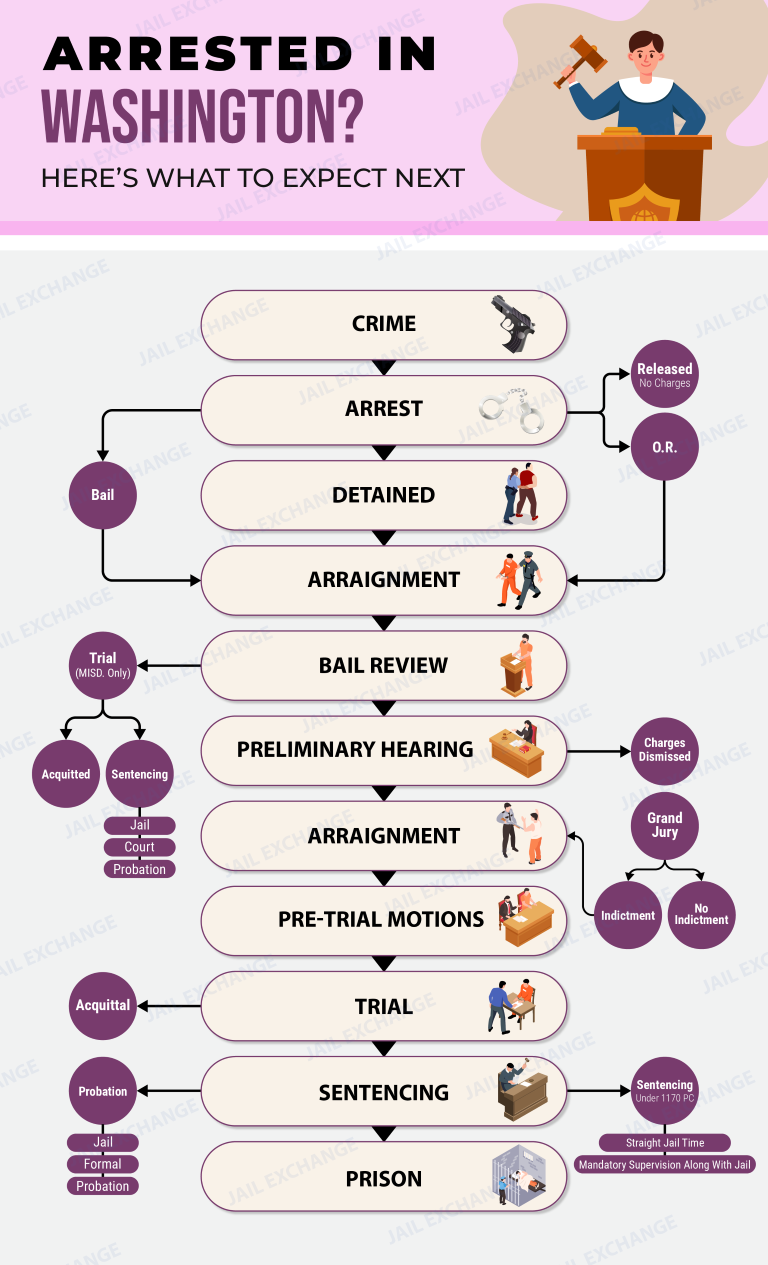
Stevens County Jail Criminal Court Process
Criminal Court Process for Stevens County Washington
Stevens County Criminal Courts in Colville: What Happens After an Arrest
Every criminal case in Stevens County is heard in the courthouse at 215 S. Oak Street, Colville, WA 99114. District Court takes misdemeanors, including those from Colville, Chewelah, Kettle Falls and Springdale, and Superior Court takes felonies. People arrested here wait at the Stevens County Jail, in that same building.
First, see who is in custody on the Sheriff's daily roster, and look again each morning. Our Recent Arrests page shows bookings, charges and warrants. The sections below explain each hearing in plain words.
To learn where a case stands, phone the District Court clerk at 509-684-5249, and for felonies the County Clerk answers at 509-684-7575. Money worries are covered on our bail page.
1. Local courts in Stevens County (Colville, Chewelah, Kettle Falls and Wellpinit)
Stevens County's criminal courts all sit in the county courthouse at 215 S Oak St in Colville. Stevens County Superior Court hears felonies and juvenile cases, and Stevens County District Court hears misdemeanors, gross misdemeanors and infractions for the unincorporated county and for the cities of Colville, Chewelah, Kettle Falls and Springdale, none of which runs its own municipal court. The Stevens County Prosecuting Attorney files charges, and the Stevens County Office of Public Defense, in the same building, represents people who cannot pay a lawyer. Adults are booked into the Stevens County Jail in the courthouse basement, where a judge sets release terms or bail at the first hearing.
- Stevens County Superior Court, 215 S Oak St, Room 209, Colville, WA 99114, (509) 684-7527
- Stevens County Clerk, 215 S Oak St, Room 206, Colville, (509) 684-7575
- Stevens County District Court, 215 S Oak St, Room 213, Colville, (509) 684-5249
- District Court Probation, 215 S Oak St, Room 213, Colville, (509) 684-7586
- Stevens County Juvenile Court, 215 S Oak St, Room 202, Colville, (509) 684-2549
- Stevens County Office of Public Defense, 215 S Oak St, Room 210, Colville, (509) 684-3024
- Stevens County Prosecuting Attorney, 215 S Oak St, Colville, (509) 684-7500
- Stevens County Sheriff's Office and jail, 215 S Oak St, Colville, (509) 684-5296
- Spokane Tribal Court, Agency Square, Building 268, Wellpinit, WA 99040, (509) 258-7717
Which court hears your case. Traffic infractions, DUI, theft, assault in the fourth degree and other non-felony charges go to Stevens County District Court, whether the arrest was made by a deputy on Highway 395, by Colville or Chewelah police, or by Kettle Falls officers; city charges are heard there by agreement. Smaller towns such as Marcus, Northport and Springdale also use the District Court. Every felony is filed in Superior Court, and youth under 18 go to the juvenile division of Superior Court. On the Spokane Indian Reservation in the county's southern end, tribal members accused of offenses are typically prosecuted in Spokane Tribal Court in Wellpinit or, for serious crimes, in federal court. In all state courts, a judge appoints the Office of Public Defense or a contract attorney when the defendant qualifies.
Where pretrial inmates are held. The Stevens County Jail, run by the Sheriff's Office under the courthouse at 215 S Oak St, is rated for 44 beds but has been holding far more: a January 2026 report counted 70 to 80 people a day the previous summer and more than a dozen inmates sent to the Ferry County Jail in Republic for lack of space. Because of crowding, many misdemeanor suspects are cited and released rather than booked. Voters approved a sales tax in 2023 for a new jail of roughly 145 beds next to the courthouse, but construction is not expected before 2027. The Spokane Tribe's police make arrests on the reservation; people held on tribal charges are typically placed in a contract jail, so call the tribal police or the Sheriff to find them.
Stevens County is the largest of the three counties (Stevens, Ferry and Pend Oreille) that share one Superior Court bench. The judges and court administrator are based in Colville and travel to Republic and Newport. District Court is a Stevens County court only, with its own judge and a commissioner.
State courts in the Colville courthouse
- Superior Court, Room 209, (509) 684-7527; administrator (509) 684-7552. Hears all felonies and juvenile offenses.
- District Court, Room 213, (509) 684-5249. Hears county and city misdemeanors and gross misdemeanors, traffic infractions and protection orders.
- Colville, Chewelah, Kettle Falls and Springdale: the state court directory lists each city's cases as handled by Stevens County District Court rather than by a municipal court. The remaining towns, including Marcus and Northport, typically send cases there as well.
Tribal court
- Spokane Tribal Court, Building 268, Agency Square, Wellpinit, (509) 258-7717: a court of general jurisdiction for the Spokane Indian Reservation and its trust lands, hearing criminal cases against Indians and civil cases.
Prosecution, defense, police and intake
- Stevens County Prosecuting Attorney, (509) 684-7500: felonies and county misdemeanors; city cases are typically prosecuted under agreements with the cities.
- Stevens County Office of Public Defense, Room 210, (509) 684-3024: screens defendants and assigns lawyers in Superior and District Court.
- Stevens County Sheriff's Office, (509) 684-5296: county patrol and the jail.
- City police: Colville Police Department, Chewelah Police Department and Kettle Falls Police Department each patrol their towns and book into the county jail.
- Spokane Tribal Police patrol the reservation; the Washington State Patrol covers U.S. 395 and State Route 20.
- Juvenile intake and probation, Stevens County Juvenile Court, Room 202, (509) 684-2549.
- Adult probation, District Court Probation, (509) 684-7586.
2. Misdemeanor (for example, DUI, third-degree malicious mischief, harassment, possession of a controlled substance)
With the Stevens County Jail chronically full, Stevens County officers cite and release on many misdemeanors. The ones most likely to mean a night in custody are DUI, domestic violence, no-contact order violations and arrests on warrants.
The first 48 hours
- A booked person sees a District Court judge or commissioner by the next court day. When there was no warrant, a judge must find probable cause within 48 hours.
- Washington rules favor release on personal recognizance. The court may instead impose conditions or set bail; cash can be posted at the jail, or a licensed bail bond company can post a bond for a nonrefundable fee.
- Domestic violence cases bring a no-contact order at this hearing, which can bar the defendant from going home.
- The Office of Public Defense screens defendants who ask for a lawyer; tell the judge you want one.
From arraignment to sentence
- At arraignment the defendant pleads guilty or not guilty. Pretrial conferences follow, where most cases are negotiated.
- Trials in District Court use a six-person jury.
- A Stevens County District Court sentence can reach 90 days and $1,000 for a misdemeanor, or 364 days and $5,000 for a gross misdemeanor.
- A first DUI brings at least one day in jail (or 15 days of electronic home monitoring), fines starting at $350 plus fees, a license action and an ignition interlock; a breath test of .15 or higher or a refusal raises the minimums.
- Since 2023, possession of drugs is a gross misdemeanor, usually capped at 180 days, with prosecutors encouraged to offer treatment-based diversion.
- Because of crowding, District Court sentences may be served later on a booking date, through work crew or on home monitoring when the court allows.
3. Felony (for example, second-degree theft, residential burglary, felony harassment, vehicle prowl with priors)
Felony suspects are booked into the Stevens County Jail; if the jail is over capacity, a person may be moved to the Ferry County Jail while the case proceeds in Colville.
Charging
- The preliminary appearance in Superior Court happens by the end of the next court day. The judge confirms probable cause, decides release or bail, and appoints counsel through the Office of Public Defense.
- The prosecutor must file an information within 72 hours, not counting weekends and holidays, or the defendant is released.
- Arraignment comes within three days of filing for a person in custody and within 14 days after the next appearance for one who is out.
Moving toward resolution
- Trial must begin within 60 days of arraignment if the defendant is jailed and 90 days if released, but continuances requested by either side are routine.
- An omnibus hearing settles motions and witness lists. Most cases resolve by plea; a 12-person jury hears the rest.
- Stevens County Superior Court judges sentence within a standard range from the state grid. Statutory maximums are five years for a Class C felony, ten years for Class B and life for Class A.
- A sentence of up to a year is served in county custody; longer sentences go to the Department of Corrections, with community custody after release.
- Sentencing alternatives include the Drug Offender Sentencing Alternative, the First-Time Offender Waiver and the Parenting Sentencing Alternative.
Theft thresholds
- Property over $750 up to $5,000 is second-degree theft, a Class C felony; above $5,000 is first-degree theft, Class B.
4. Violent felony (for example, first-degree assault, first-degree arson, manslaughter, murder)
Violent cases in Stevens County are filed in Superior Court and the accused is usually held at the Stevens County Jail, one of the few cases where the crowded jail will almost always find a bed. At the first appearance the prosecutor may seek high bail or ask that the person be held without release because of danger to others.
- When the crime happens on the Spokane Reservation and involves a tribal member, it is typically a federal prosecution under the Major Crimes Act rather than a Stevens County case.
- Serious violent offenses limit good-time credit to 10% of the sentence. Firearm and deadly weapon enhancements add flat, consecutive time.
- Victims and surviving family members have a state constitutional right to be informed and heard.
- Washington has no death penalty. Aggravated first-degree murder brings life without release for adults; younger defendants receive an individualized sentence.
- The Office of Public Defense assigns experienced counsel in these cases and can seek funds for investigators, mental health evaluations and expert testimony.
- Cases of this gravity commonly take a year or longer to reach trial in Colville.
5. Juveniles (under 18) arrested in Stevens County
Youth cases are handled by Stevens County Juvenile Court in the courthouse, Room 202, (509) 684-2549. Juvenile court staff run intake, diversion and probation, and share administration with Ferry and Pend Oreille counties.
Detention
Stevens County has no juvenile detention center. Youth who must be held are taken to Martin Hall Juvenile Facility, 201 S Pine St, Medical Lake, (509) 565-8113, which is still operating and serves several counties in northeast Washington. The new justice center proposals have discussed local juvenile beds, but nothing is built. Visits at Martin Hall are limited to parents and guardians.
Steps in the case
- A detention hearing is held within roughly 72 hours, excluding weekends and holidays. The judge decides whether to release the youth to a parent with conditions; bail is rarely set.
- Juveniles have a right to counsel; the Office of Public Defense arranges a lawyer.
- Many first or minor offenses go to diversion, which avoids a conviction record if completed.
- A judge decides contested cases without a jury. Results range from local sanctions (probation, community service, short detention) to commitment with Juvenile Rehabilitation at Green Hill School, Echo Glen Children's Center or a community facility.
- Juvenile Rehabilitation custody can, for the most serious offenses, last to age 25.
- Sixteen- and 17-year-olds charged with serious violent offenses start in adult court automatically; others can be transferred after a decline hearing.
- Offenses by tribal youth on the Spokane Reservation may be handled by the Spokane Tribe's own court.
6. Federal cases (U.S. District Court) from Stevens County
Stevens County is in the Eastern District of Washington. Federal cases from the county are typically heard at the district's headquarters courthouse in downtown Spokane, 920 W Riverside Ave; the clerk can be reached at (509) 458-3400.
What makes a Stevens County case federal
- The Spokane Indian Reservation. Washington took only limited jurisdiction over tribal trust land, so major crimes by or against tribal members there are typically investigated by the FBI and tribal police and charged federally.
- Federal land. Lake Roosevelt National Recreation Area lines the county's western edge, and the Colville National Forest covers much of the north.
- The border. The Laurier and Frontier crossings bring drug smuggling and immigration charges.
- Drug trafficking, firearm possession by prohibited persons and child exploitation offenses.
Offices
- U.S. Attorney's Office, Eastern District of Washington, main office in Spokane, (509) 353-2767.
- Federal Defenders of Eastern Washington and Idaho represent defendants who cannot pay, (509) 624-7606; Criminal Justice Act panel lawyers cover conflicts.
Federal procedure in brief
A federal arrestee from Stevens County appears first before a magistrate judge in Spokane. Federal judges do not set a bail amount the way state courts do; the federal release statute gives them a choice between conditions and detention. The government must indict within 30 days, and the Speedy Trial Act aims at trial within 70 days, though judges often exclude time. Federal Sentencing Guidelines shape the sentence; there is no parole, so roughly 85% of the term is served in the Bureau of Prisons, then supervised release. Appeals go to the Ninth Circuit Court of Appeals, headquartered in San Francisco and also sitting in Seattle. Pretrial federal detainees are housed by the U.S. Marshals in contract jails, mainly in Spokane, so they can appear on a county roster. After sentencing, find a person through the Federal Bureau of Prisons inmate locator.
This summary explains how Stevens County criminal cases typically proceed and is not legal advice; jail capacity, court schedules and Washington law change over time. Speak with a Washington-licensed criminal defense attorney about any actual charge. For a public defender, ask at the first hearing or call the Stevens County Office of Public Defense at (509) 684-3024. For custody and release questions, call the Stevens County Sheriff's Office at (509) 684-5296.
↑ Back to the question list