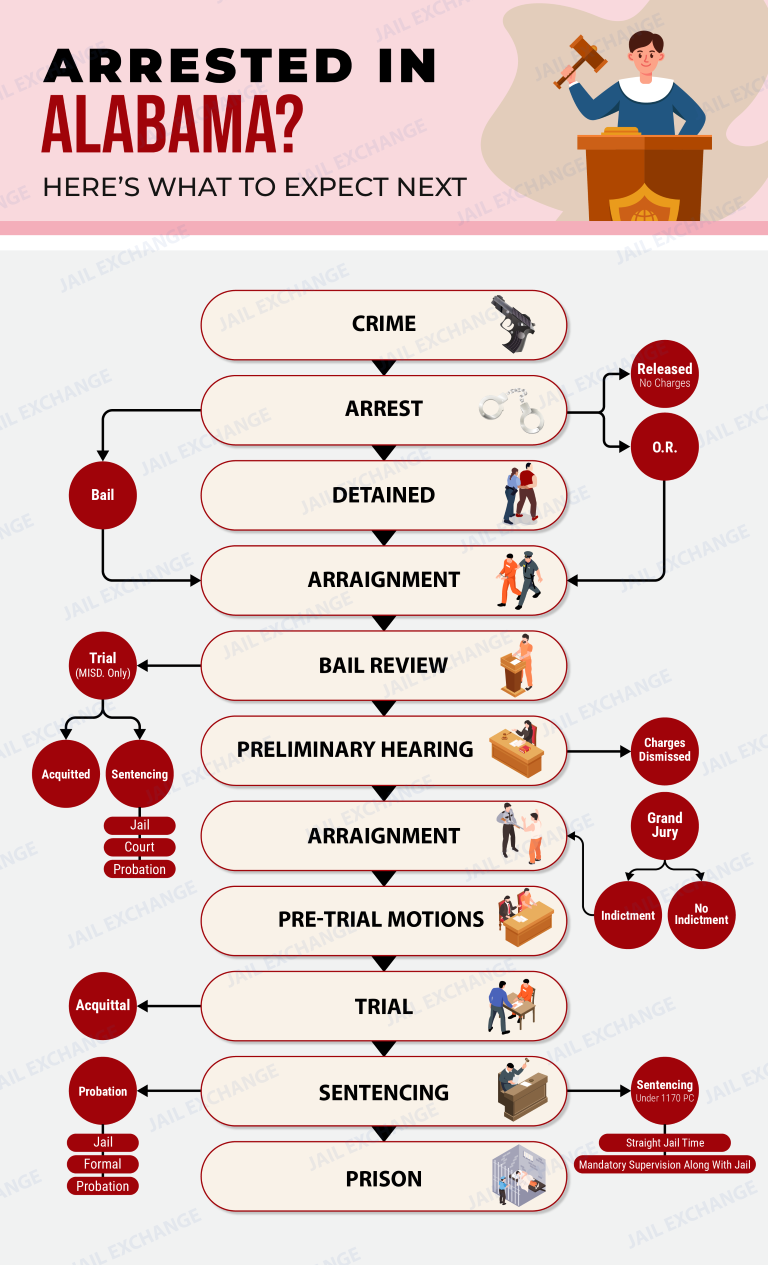
Fayette County Jail Criminal Court Process
Criminal Court Process for Fayette County Alabama
Fayette County Criminal Courts and Cases
Here is how a Fayette County criminal case unfolds, from the booking desk to sentencing day. The Temple Avenue courthouse in the city of Fayette houses both Circuit Court and District Court. Grown-ups charged here wait at the Fayette County Jail, 113 1st Avenue Northwest, Fayette, AL 35555, until they make bond or a judge lets them go.
Check custody before driving to court. The sheriff's custody search shows who the 1st Avenue jail holds. Our Inmate Search page goes deeper on new arrests, warrants, the charges listed, mugshots and collecting a wallet or phone later.
For a hearing date on a state charge, call the Circuit Clerk at 205-932-4617, weekdays from 8 to 5. Give the full name and any case number, then ask for the date, time and type of hearing. Still waiting on a release? Our Fayette bail guide lays out each step.
1. Which courts hear criminal cases in Fayette County?
Fayette County has two state trial courts under one roof. District Court takes state misdemeanors, traffic tickets, juvenile matters and the first steps of felony cases, like preliminary hearings. Circuit Court tries felonies, holds jury trials and hears appeals from the lower courts.
Both sit at the Fayette County Courthouse, 113 Temple Avenue North, Fayette, AL 35555, and share one clerk at 205-932-4617. The county belongs to the 24th Judicial Circuit, together with Lamar and Pickens counties, so judges and the District Attorney cover all three. City charges from Fayette and Berry start out in those towns' own courts instead.
↑ Back to the question list2. What are the Temple Avenue clerk's hours?
The courthouse stands at 113 Temple Avenue North, Fayette, AL 35555. The Circuit Clerk keeps files for both Circuit and District Court there and answers at 205-932-4617. The office is open 8:00 a.m. to 5:00 p.m., Monday through Friday. Mail goes to P.O. Box 906, Fayette, AL 35555.
Bring the case number and the hearing notice when you visit. Staff can help with court dates, copies of filings, bond paperwork and the form for asking for a court-appointed lawyer. They cannot give legal advice, so save questions about what to plead for the defense lawyer. The Fayette Circuit Clerk's website lists the office phone and hours.
↑ Back to the question list3. Which town courts handle Fayette city and Berry charges?
Fayette and Berry each keep a small court for cases their own officers bring:
- Fayette Municipal Court: City Hall, 203 Temple Avenue North, Fayette, AL 35555, 205-932-5367. A city magistrate handles the paperwork.
- Berry Municipal Court: the town hall building on School Avenue in Berry, 205-689-4562. Court usually meets on the fourth Tuesday of each month.
Arrests in Belk and out in the countryside are filed in District Court on Temple Avenue. In the Fayette County piece of Glen Allen, arrests also go to District Court. Winfield officers file in Winfield's own court, which is in Marion County. The ticket or bond paper names the right court, so read it first.
↑ Back to the question list4. Is guilt decided at the first hearing?
No. This hearing is usually quick. The judge names the charge out loud, notes the person can keep quiet and can have a lawyer, and sets or checks the release terms. Guilt is not decided here. When the charge is a felony, the person also learns they can demand a preliminary hearing.
Timing matters. Rule 4.3 requires a judge to look over any warrantless arrest within 48 hours. For a warrant arrest, a person stuck in jail because they cannot meet the terms must be brought in within 72 hours. In family violence cases, the accused must see a judge before getting bond, unless 24 hours pass first. To find the date, call the Circuit Clerk at 113 Temple Avenue North, Fayette, AL 35555, 205-932-4617.
↑ Back to the question list5. Theft, harassment or DUI: what path do small charges follow?
Misdemeanors such as criminal mischief, disorderly conduct, harassment and petty theft stay in District Court or a town court. A typical path:
- Arraignment, the moment to request a lawyer paid by the state.
- Talks with the prosecutor about a plea, or a trial before the judge alone.
- Most Fayette County cases resolve in two to four months.
Top penalties set by Alabama law:
- Class A (fourth-degree theft, second-degree criminal mischief): as much as twelve months locked up and a $6,000 fine.
- Class B: half a year at most, with a top fine of $3,000.
- Class C, such as disorderly conduct: up to three months and $500.
- First DUI: up to a year, a $600 to $2,100 fine and 90 days without a license.
6. What steps does a Fayette felony case go through?
Felonies such as drug sales, gun theft, burglary and dangerous fleeing start in District Court and end in Circuit Court. The stages are:
- Preliminary hearing in District Court on demand within 30 days, unless an indictment comes first.
- Fayette County grand jury; indictment transfers the case to Circuit Court, though it can be waived for an early plea.
- Plea agreement or jury trial after Circuit Court arraignment, typically within a year.
An indictment is only a formal charge, not proof of guilt. While the case moves, the person stays at the Fayette County Jail, 113 1st Avenue Northwest, Fayette, AL 35555, 205-932-3205, unless bond is posted. The clerk at 113 Temple Avenue North, Fayette, AL 35555, 205-932-4617, can tell you which stage a case is in.
↑ Back to the question list7. How many years can each felony class bring?
Alabama sorts felonies into four classes. Prison ranges by class:
- Class A, the most serious: anywhere from ten years to 99, or life.
- Class B, such as selling drugs: 2 to 20 years and up to $30,000.
- Class C, such as gun theft or third-degree burglary: 366 days to 10 years and up to $15,000.
- Class D (theft of $500 to $1,500): from 366 days up to 5 years, with fines topping out at $7,500.
Presumptive sentencing standards usually point nonviolent Class C and D offenders without serious records toward probation or community corrections. Repeat felons face longer terms. If the person was not yet 21 when the crime happened, the lawyer can request youthful offender treatment; the file is then sealed and the term limited to three years. Ask the defense lawyer whether that could apply.
↑ Back to the question list8. What is different about violent charges?
Violent cases carry more risk at every step. Aniah's Law lets the prosecutor request a special hearing. There, the judge can refuse bail to someone accused of murder, first-degree robbery and other grave crimes. Since voters spoke on May 19, 2026, attempted murder counts too. It also added shots fired into a lived-in home or a car with people in it.
- First-degree assault: Class B, 2 to 20 years, with at least 10 years if a deadly weapon was used.
- Murder, attempted murder and first-degree robbery: all Class A, with a floor of 20 years once a gun is involved.
- Capital murder: a jury may weigh death or life without parole.
Calls from the jail are recorded, so nobody should talk about the case on them.
↑ Back to the question list9. Who prosecutes Fayette County cases?
State prosecutions belong to the District Attorney for the 24th Judicial Circuit, who also serves Lamar and Pickens counties. The main office is at 50 Court Square, Suite 200, Carrollton, AL 35447, 205-367-9915. A Fayette office inside the courthouse at 113 Temple Avenue North, Fayette, AL 35555 handles victim services and local questions at 205-932-6349.
Keep in mind that the prosecutor represents Alabama, not the accused or the family. The prosecutor can talk with victims and witnesses, but the person charged needs a separate defense lawyer. City charges in Fayette or Berry are prosecuted in those town courts. Victims can ask the Fayette office about court dates and their rights in the case.
↑ Back to the question list10. Who pays the defense lawyer when a family is broke?
The 24th Circuit has no public defender office. Instead, Fayette judges appoint state-paid private or contract lawyers for people who face jail and cannot afford to hire one. The accused fills out a sworn statement about money, debts and family, and the judge decides.
Under Rule 6.3, a family posting bond does not by itself make someone ineligible. Ask early, before any plea. The Circuit Clerk at 113 Temple Avenue North, Fayette, AL 35555, 205-932-4617, has the form. Alabama's Office of Indigent Defense Services, 100 North Union Street, Suite 680, Montgomery, AL 36104, 334-242-7059, runs the statewide system that pays these lawyers. Anyone may still choose to pay a private lawyer instead.
↑ Back to the question list11. Which office gives out court dates and file copies?
The surest way is a call to the Circuit Clerk at 113 Temple Avenue North, Fayette, AL 35555, 205-932-4617. Give the clerk the spelling of the name, the date of birth and any case number, then ask when the next setting is and what it is for.
For records on a screen, Alacourt Access lets you choose Fayette from the county list. A name lookup is $9.99 and comes with one case. Read the fees before you buy. Town court dates come from Fayette Municipal Court at City Hall, 203 Temple Avenue North, Fayette, AL 35555, 205-932-5367, or from Berry's court office at 205-689-4562. Keep in mind the charge on the jail list may be rewritten when the District Attorney files.
↑ Back to the question list12. How do I check for a Fayette County warrant?
The Sheriff's Office answers warrant questions at 205-932-3205. Walk-in help is at the sheriff's building, 113 1st Avenue Northwest, Fayette, AL 35555. A city warrant may be held by the Fayette Police Department instead, at 118 1st Avenue Northeast, Fayette, AL 35555, 205-932-5312.
To look for related court cases, search Alacourt Access or call the Circuit Clerk at 113 Temple Avenue North, Fayette, AL 35555, 205-932-4617. A clean case search does not prove there is no warrant. Talk with a lawyer first. Turning yourself in with a lawyer and bond money ready usually goes better than an arrest at home or work.
↑ Back to the question list13. Can a guilty verdict get a new trial?
Yes. In District Court and the town courts, a judge hears the trial alone. If the verdict is guilty, the person has 14 days to appeal. The case then starts over in Circuit Court, and the person may request a jury this time.
The 14-day limit is strict, so talk with the defense lawyer right after the verdict. File the appeal through the court that heard the case. For a District Court case, that means the Circuit Clerk at 113 Temple Avenue North, Fayette, AL 35555, 205-932-4617. For a Fayette city case, call the municipal court at City Hall, 203 Temple Avenue North, Fayette, AL 35555, 205-932-5367. An appeal may also need an appeal bond.
↑ Back to the question list14. Where do federal charges from Fayette County go?
Fayette County federal cases belong to Tuscaloosa, part of the Northern District of Alabama. Hearings are held in Tuscaloosa's federal building, the Richard Shelby Federal Building and Courthouse, 2005 University Boulevard, Tuscaloosa, AL 35401, 205-561-1670. Jasper lost its federal court sessions at the end of 2024. Because the clerk's staff splits time with Birmingham, try the Birmingham clerk line, 205-278-1700, when Tuscaloosa does not pick up.
- Typical charges: felon with a gun, large drug conspiracies and benefits fraud.
- A magistrate judge runs the opening hearing and uses the Bail Reform Act, not a bail chart.
- Prosecutors get 30 days to indict, and trial should start inside 70 days, not counting excused delays.
- Federal guideline sentences have no parole, so about 85 percent is spent inside before supervised release.
Before trial, the U.S. Marshals, 1729 5th Avenue North, Room 240, Birmingham, AL 35203, 205-829-6611, often house people at the Pickens County Detention Facility, 188 Cemetery Street, Carrollton, AL 35447, 205-367-2000. The Eleventh Circuit in Atlanta hears appeals from Tuscaloosa.
↑ Back to the question list15. How does an ICE detainer affect the criminal case?
Immigration holds and criminal charges are two different matters. On Form I-247A, ICE may request a heads-up before the person leaves and an added stay of no more than 48 hours. That paper neither closes the Fayette case nor decides whether the person can remain in the country.
ICE work in Alabama is run from New Orleans: 181 James Drive W, St. Rose, LA 70087, 504-318-2360. ICE holds people for short stays at jails such as the Pickens County Detention Facility, 188 Cemetery Street, Carrollton, AL 35447, 205-367-2000. Once ICE moves someone, the ICE Online Detainee Locator System can find them once you type in the A-number and home country. Pleading guilty can follow a person into immigration court, so get advice from an immigration lawyer before signing any deal.
↑ Back to the question list16. How are juvenile cases handled in Fayette County?
Fayette County's District Judge sits as juvenile court. The Juvenile Probation Office in Fayette, 205-932-3417, reviews each referral and decides on release, an informal adjustment or a petition. Fayette lacks a youth detention center, so probation intake knows where any held child went. Youth are not released on bail; any child held must have a hearing within 72 hours.
Many cases end with diversion or with probation through the local juvenile office. After a serious offense, a judge can order commitment to the Alabama Department of Youth Services. Under Section 12-15-204, a 16- or 17-year-old lands in adult court with no hearing at all for capital murder, any Class A felony, trafficking, or a felony tied to a deadly weapon, a death or a serious injury. Other children 14 or older can be transferred after a hearing under §12-15-203.
↑ Back to the question list17. How can I tell when someone moves to state prison?
Someone given more than a year normally goes to state prison. First, they wait in the Fayette jail until ADOC has room. Their first ADOC stop is a reception center for processing, where workers rate them by medical and mental health, risk level and gang membership.
The ADOC inmate search finds people by name or by their six-digit AIS number. It covers current custody and leaves out youthful offender records. The state prison guide lists prison addresses and mail rules after the assignment is known. Until the move, the jail at 113 1st Avenue Northwest, Fayette, AL 35555, 205-932-3205, can confirm the person is still there.
↑ Back to the question list