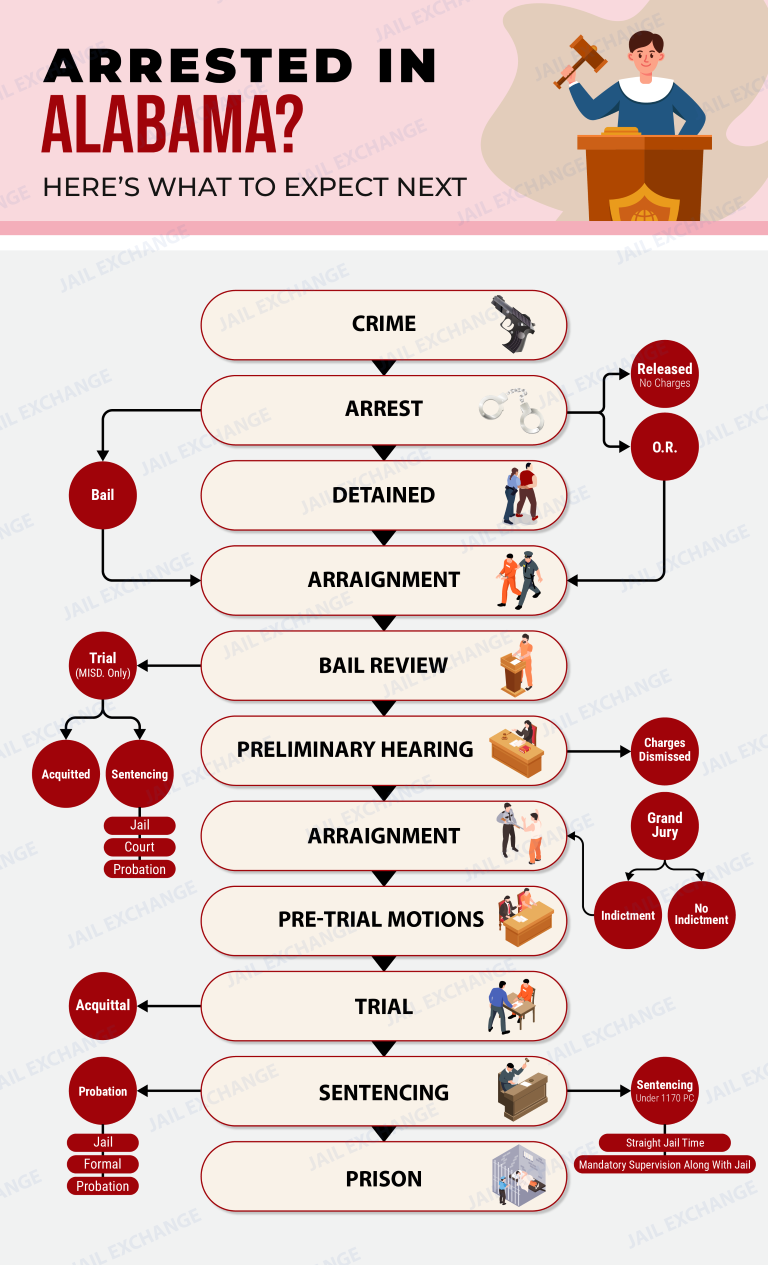
Hale County Jail Criminal Court Process
Criminal Court Process for Hale County Alabama
Hale County Criminal Court Guide
This guide traces how a Hale County criminal charge travels from a first hearing on toward a plea, trial or appeal. Circuit, District and juvenile judges all sit in the Greensboro courthouse on Main Street. Adults awaiting trial stay at the Hale County Jail, 1001 Main Street, Room 18, Greensboro, AL 36744, a short walk down the hall from the courtrooms.
Before making the drive to Greensboro, look the person up in the official county inmate search to confirm they are still held. Our Inmates in Custody page shows fresh bookings plus warrants, charges, mugshots and property release.
First, phone the circuit clerk at 334-624-4257 and give the defendant's full name and birthday. The clerk can read off the case number, when the next setting is, and which room it is in. Someone still sitting in Room 18 may be able to leave on bond, and our bail page covers bond types and payment.
1. Which court will hear a Hale County criminal case?
Two things usually pick the courtroom: the agency that filed the charge and its seriousness. Charges written by deputies or state troopers land in District Court, where misdemeanors are tried and felony cases get their early hearings. A felony climbs to Circuit Court only after the grand jury indicts, and jury trials happen there.
Greensboro and Moundville officers often file town ordinance charges in their own municipal courts. Children under 18 go to juvenile court. District and city judges decide cases alone without jurors, so a defendant found guilty in either one may file within 14 days for a fresh trial in front of Circuit Court jurors.
↑ Back to the question list2. What does the Greensboro circuit clerk handle?
Circuit Court, District Court and juvenile court all meet in the county courthouse, 1001 Main Street, Greensboro, AL 36744. One circuit clerk's office keeps the files for all three, and its phone is 334-624-4257. The counter is open 8:00 a.m. to 4:30 p.m., Monday through Friday.
Counter staff look up case numbers and hearing dates, copy public filings, and hand out the paperwork for requesting an appointed attorney. Clerks cannot tell anyone what to plead or say, so bring those questions to a lawyer. The county belongs to the 4th Judicial Circuit, which means its judges rotate through neighboring counties and hold Greensboro terms on a set calendar.
↑ Back to the question list3. How do Greensboro and Moundville city courts work?
Ordinance and traffic charges in two towns stay in local city courts:
- Greensboro Municipal Court: City Hall, 1101 Main Street, Greensboro, AL 36744, 334-624-8119
- Moundville Municipal Court: 410 Market Street, Moundville, AL 35474, 205-371-2641. Because Moundville crosses into Tuscaloosa County, this court also hears charges from that side of town.
For arrests in Akron or Newbern, ask the circuit clerk at 334-624-4257 which court has the charge. When a town charge could bring jail time, the city judge appoints counsel for anyone unable to afford it. Anyone convicted by a city judge may file a notice within 14 days to restart the case before a Circuit Court jury.
↑ Back to the question list4. What happens in a misdemeanor case?
Misdemeanors are lower-level charges such as criminal trespass, harassment, theft of services under $500 or a first DUI. Most of these cases follow a short path:
- Arraignment at the next District Court day, which is held a few times each month, or at the next city court session.
- Defendants who qualify get a court-appointed attorney once they ask.
- The charge is resolved by a plea, by dismissal (sometimes once the victim is repaid) or by a bench trial.
- Filing a written appeal inside 14 days moves a guilty verdict up for a jury.
Even a misdemeanor can mean jail time and a record, so it is worth talking to a lawyer before entering a plea.
↑ Back to the question list5. What penalties can a misdemeanor bring?
Alabama ranks misdemeanors by class, and the maximum punishment drops at each level:
- Class A, such as harassing communications: a year at most in jail and a $6,000 fine at the top end.
- Class B, such as harassment: up to 6 months and $3,000.
- Class C, such as third-degree criminal trespass: up to 3 months and $500.
- Violations: no more than 30 days.
- First DUI: a maximum of one year locked up, a fine from $600 to $2,100, a suspended license and a DUI course.
Picking up a fourth DUI inside 10 years makes it a felony. Many first cases end with probation, fines or classes instead of jail, but the judge decides based on the facts and the person's record.
↑ Back to the question list6. How does a felony case in Hale County reach trial?
Felony defendants remain in the county jail on Main Street until someone posts bond. During the opening hearing, the judge looks at release terms and names counsel for those who qualify. After that, the case usually moves through these stages:
- A probable cause hearing, held when the defense requests it, where a District judge weighs the state's proof.
- Grand jury review during one of the county's scheduled terms. Once jurors return an indictment, the file moves to Circuit Court.
- Arraignment in front of a 4th Circuit judge, then discovery and pretrial motions.
- A guilty plea or a jury trial in Greensboro, often a year or more after the arrest.
7. What prison time can a felony bring?
Felonies are also sorted by class. Common examples from local cases:
- Class B, such as second-degree burglary or stealing a gun: 2 to 20 years in prison and a fine up to $30,000.
- Class C, such as breaking into a vehicle: a year and a day at minimum, 10 years at most, and fines reaching $15,000.
- Class D, such as possessing a controlled drug other than marijuana: at least a year and a day, 5 years at most, and fines reaching $7,500.
Nonviolent Class C and D convictions often end in probation or community corrections. The Habitual Felony Offender Act adds time for people with earlier felonies. Someone charged for acts committed before age 21 can request youthful offender status. A granted request seals the file, and the punishment cannot go past 3 years.
↑ Back to the question list8. How are violent felony charges handled in Greensboro?
Murder and first-degree robbery, assault or arson are Class A felonies, punished by 10 to 99 years or life, with fines up to $60,000, and using a gun raises the minimum. A capital murder conviction brings either life without parole or a death sentence. A person facing these charges may stay at the county jail until trial, which often takes two years or more.
Aniah's Law allows a judge to refuse bond once a hearing is held on certain violent charges. Voters widened it on May 19, 2026, covering attempted murder and shots fired into a house or car with people in it. Lawyers appointed in the most serious cases must have trial experience. Anything said on a jail phone call can be recorded and used as evidence.
↑ Back to the question list9. How soon must a person see a judge?
Rule 4.3 sets the deadlines. With a warrantless arrest, Alabama requires a judge to review probable cause no later than 48 hours afterward. With a warrant arrest where release terms cannot be met, the defendant goes before a judge or magistrate inside 72 hours.
Many people charged with a misdemeanor never wait that long, because they can pay a scheduled bail and leave. At that opening appearance, the charge is read aloud, bond is reviewed, and the judge asks whether the defendant wants appointed counsel. To learn when that hearing is set, call the jail at 334-624-3081 or the circuit clerk at 334-624-4257.
↑ Back to the question list10. How is a lawyer appointed in Hale County?
The county has no public defender's office. Judges here name private attorneys instead, and the state covers their fees. The defendant swears to a form showing earnings, belongings, bills and household size. Ask the circuit clerk at 1001 Main Street, Greensboro, AL 36744, 334-624-4257, how to get the form, and make the request before the first hearing.
Under Rule 6.3, the judge can review the request again if the person's money situation changes. City judges also appoint lawyers when a town charge could lead to jail. The state Office of Indigent Defense Services, 100 North Union Street, Suite 680, Montgomery, AL 36104, 334-242-7059, oversees the program. Anyone can still hire a private lawyer at any point in the case.
↑ Back to the question list11. Who prosecutes criminal cases in Greensboro?
Prosecutors from the 4th Judicial Circuit District Attorney's office bring state charges in Greensboro. The office works out of Selma and serves Bibb, Dallas, Perry and Wilcox counties as well. Its mailing address is P.O. Box 987, Selma, and the phone is 334-874-2540.
Victims and witnesses can call that office to ask about a case, a court date or their rights. The prosecutor decides which charges to file, makes plea offers and argues bond at no-bail hearings. A defendant should not call the prosecutor directly about the case. All talks about a plea or the evidence should go through the defense lawyer, who can explain what each offer means.
↑ Back to the question list12. How does Hale County handle juvenile cases?
Youths under 18 have their cases heard in juvenile court at the Greensboro courthouse. Every case begins with intake by the county's Juvenile Probation office, 1001 Main Street, Room 13, Greensboro, AL 36744, 334-624-2023. Room 13 staff know where each detained youth is placed and when that first hearing is. Ala. Code §12-15-207 requires a hearing within 72 hours for a detained youth.
The juvenile judge has several choices:
- Close the case through an informal adjustment if the child follows set terms.
- Order probation with school, curfew or community service rules.
- Place a youth with serious or repeat offenses in the care of the Alabama Department of Youth Services.
Families who cannot pay for a lawyer receive an appointed one.
↑ Back to the question list13. Can a teenager face adult court?
Under Ala. Code §12-15-204, teens aged 16 or 17 go straight to adult court when the charge is capital murder or another capital crime, a Class A felony, a trafficking count, or a felony with a deadly weapon or that causes death or serious injury. These teens may be held at the county jail instead of a juvenile center.
In other cases, prosecutors may file a motion under §12-15-203 asking that a youth 14 or older be tried as an adult, which leads to a transfer hearing. The judge looks at the child's age, record, the charge and whether juvenile services could help. A lawyer should be involved before that hearing. Call juvenile probation at 334-624-2023 to learn which court has the case.
↑ Back to the question list14. Is there a Hale County warrant or court date?
- Sheriff's Office: deputies serve county warrants from 1001 Main Street, Room 18, Greensboro, AL 36744, 334-624-3081. The Sheriff's Office website has more contact details.
- Circuit clerk: 1001 Main Street, Greensboro, AL 36744, 334-624-4257, for court dates and missed hearings.
- Statewide records: Alacourt Access charges $9.99 to search a name.
When a warrant turns up, hire or call a lawyer to arrange the surrender. Arriving at Room 18 on purpose, with bond arranged, usually goes far better than deputies showing up at a house or job site.
↑ Back to the question list15. Which federal court takes charges from this county?
Hale County is in the Southern District of Alabama, Northern Division, along with Dallas, Marengo, Perry and Wilcox counties. The Federal Building and U.S. Courthouse at 908 Alabama Avenue, Selma, AL 36701 is used only when the court sets a case there, so most work happens through the clerk's office in Mobile at 251-690-2371. Federal charges cover crimes like drug conspiracies, gun possession by a felon, fraud and identity theft, or offenses on federal land such as the Talladega National Forest in the county's northeast.
A U.S. magistrate judge holds the opening hearing and rules on custody using the Bail Reform Act. Federal prosecutors must indict within 30 days. After that, by the Speedy Trial Act, defendants are owed a trial in 70 days, yet judges pause that count often. Prisoners serve about 85% of the sentence, and an appeal is heard by the Eleventh Circuit, based in Atlanta. The U.S. Marshals Service, 155 St. Joseph Street, Suite 201, Mobile, AL 36602, 251-499-6620, keeps pretrial prisoners. After sentencing, use the federal inmate locator.
↑ Back to the question list16. How does an ICE hold affect a state court case?
Through Form I-247A, ICE can tell the Greensboro jail it wants to hold a noncitizen for up to 48 hours after the local case would let them out. The state charge keeps moving regardless. Court dates still happen, and a paid bond does not lift the hold.
Here, the responsible immigration office is ICE's New Orleans Field Office, 181 James Drive W, St. Rose, LA 70087, 504-318-2360. If ICE takes the person, search the ICE Online Detainee Locator by alien registration number and home country. Pleading guilty may change a noncitizen's immigration case, so ask the defense attorney to bring in an immigration lawyer before any deal is signed.
↑ Back to the question list17. How do I find someone after they leave the county jail?
People leave the Greensboro jail for different reasons: bond, transfer, state prison or federal custody. Use the search that fits:
- State prison: Alabama's prison system has an ADOC inmate search that works with a name or an AIS number, and it is free.
- Federal prison: use the BOP locator after sentencing, or phone the Marshals at 251-499-6620 while the case is open.
- Custody alerts: VINELink, where you choose Alabama and sign up for updates.
- Nearby jail: a Moundville arrest on a Tuscaloosa County charge may go to the Tuscaloosa County Jail, 1600 26th Avenue, Tuscaloosa, AL 35401, 205-349-4511.
18. How can I avoid missing a hearing in Greensboro?
Court dates can be moved, so call the circuit clerk at 334-624-4257 a day or two before each hearing to confirm the date, time and courtroom. For a Moundville city case, call 205-371-2641. Write every date down, and keep any notice the court mails to you.
Plan the trip to the courthouse ahead of time, because rides can be hard to find in rural areas. Arrive early, dress neatly and bring your papers. If an emergency will make you late or keep you away, call the defense lawyer and the clerk right away. A missed date can lead to a new warrant and the loss of bond money.
↑ Back to the question list