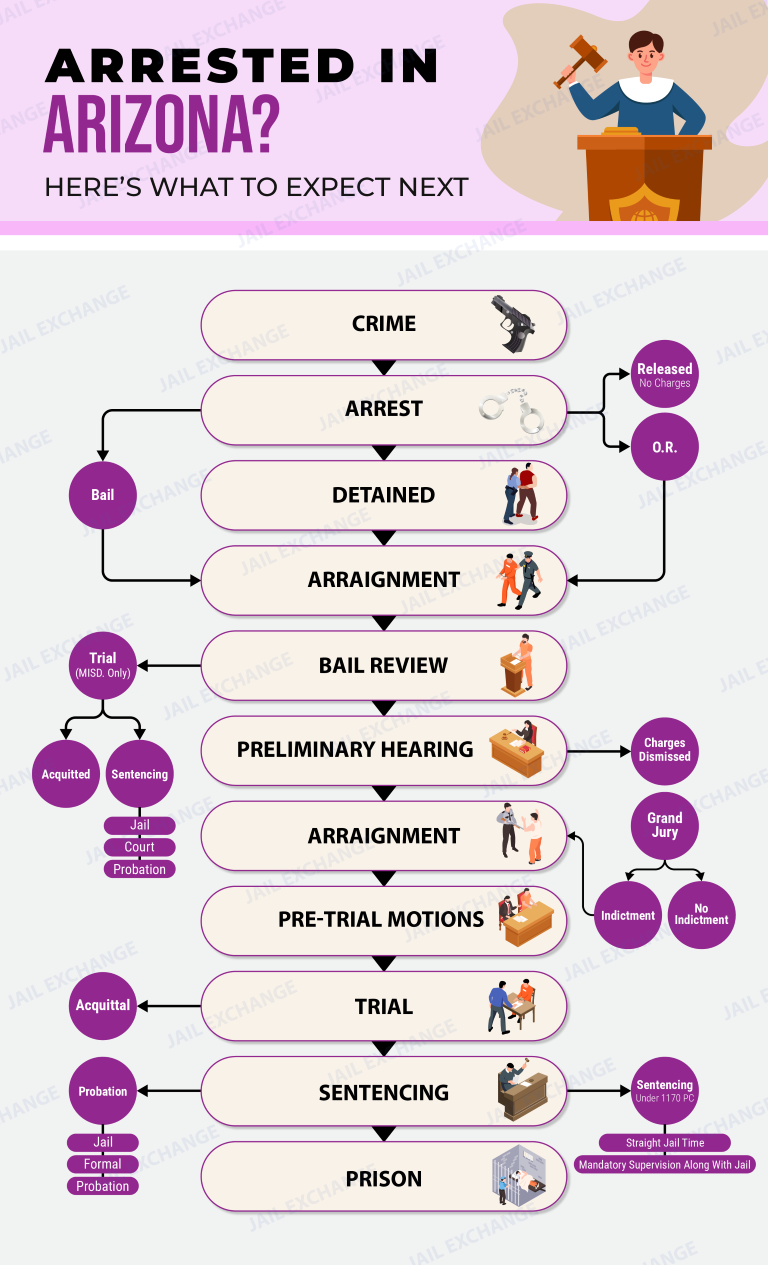
Apache County Jail Criminal Court Process
Criminal Court Process for Apache County Arizona
How Criminal Cases Work in the Apache County Courts
Apache County runs more than 200 miles from the Utah line down to the White Mountains, and its court system is spread thin across that distance. Felony cases under state law go to the Superior Court of Arizona in Apache County, housed in the courthouse at 70 West 3rd South, St. Johns, AZ 85936. The Clerk of the Superior Court can be reached at (928) 337-7550. Lower-level cases, first appearances and many early felony steps happen in the county’s four justice courts, and the three small towns of St. Johns, Eagar and Springerville each have a municipal court for violations inside town limits:
- St. Johns Justice Court, inside the courthouse at 70 West 3rd South, St. Johns: (928) 337-7558. The same number reaches the St. Johns and Eagar municipal courts.
- Round Valley Justice Court, 130 S. Mountain Avenue, Springerville, AZ 85938: (928) 333-4613, shared with the Springerville Municipal Court.
- Chinle Justice Court, serving the northern part of the county on the Navajo Nation: (928) 674-5922
- Puerco Justice Court in Sanders, along Interstate 40: (928) 688-2729
The Apache County Attorney’s Office, 245 West 1st South in St. Johns, (928) 337-7560, prosecutes felonies in Superior Court and misdemeanors in the justice courts; each town handles its own municipal prosecutions. Anyone jailed for a state offense stays at the county jail at 370 South Washington Street in St. Johns.
Federal charges follow a separate track. Apache County is part of the Prescott/Flagstaff Division of the U.S. District Court for the District of Arizona, and hearings for the region are held in the federal courtroom at 123 N. San Francisco Street, Suite 200, Flagstaff, AZ 86001, (928) 774-2566. That location takes no filings, which go through the clerk’s office in Phoenix, and some cases from the county end up in Prescott or Phoenix. The dividing line is which government’s law was broken. Breaking an Arizona law puts the case in front of the County Attorney and a state judge; breaking a federal statute, such as drug or weapons trafficking, immigration violations, counterfeiting, robbing a federally insured bank, or offenses on national forest or other federal land, are brought by the U.S. Attorney. Tribal land changes the picture in this county more than almost anywhere else in Arizona. Most of northern Apache County lies within the Navajo Nation, and its southern edge includes part of the Fort Apache Indian Reservation of the White Mountain Apache Tribe. Under the federal Major Crimes Act, murder, sexual abuse, kidnapping, serious assaults and similar felonies committed by a Native American on a reservation are federal cases, while Navajo Nation and White Mountain Apache tribal courts handle most lesser offenses by tribal members.
Each box below follows one kind of Apache County charge from arrest to the end.
- Misdemeanors such as a first DUI, shoplifting, a fistfight or a broken window
- Felonies such as burglary, selling drugs, car theft or aggravated DUI
- Violent and serious felonies (murder, sexual assault, armed robbery)
- The Apache County courthouse in St. Johns
- Federal charges from Apache County
- Locating a person after an Apache County arrest
- Immigration detainers and Apache County cases
Misdemeanors such as a first DUI, shoplifting, a fistfight or a broken window
An arrest outside town limits sends a misdemeanor to whichever of the four justice courts covers that precinct, while a violation inside St. Johns, Eagar or Springerville usually goes to that town’s municipal court. Many Apache County stops close with a paper ticket and a hearing date, and the person drives home. A person who stays locked up goes before a judge within 24 hours (Rule 4.1). Arizona's starting point is release on a signed pledge to return, and the judge adds conditions only when they seem needed for safety or to make sure the person returns.
Misdemeanors in this state come in three sizes. The biggest, class 1, takes in most first DUIs and shoplifting and tops out at half a year behind bars and $2,500. Class 2 tops out at four months and $750. Class 3 tops out at 30 days and $500. Surcharges increase every fine considerably. A DUI conviction also carries mandatory jail time, an ignition interlock and license consequences. Someone who could be jailed but can't afford counsel gets a county-paid lawyer, and the judge may order a small repayment.
Arizona does not guarantee a jury in every misdemeanor. A judge usually decides these cases without a jury. DUI defendants can ask for one, and in justice and municipal courts that jury has six members. Most cases end before trial through a plea, a dismissal, or deferred prosecution, and judges frequently impose probation, counseling, fines or community restitution in place of jail. Expect a few weeks to several months from citation to finish.
For a teenager, the path is different. A youth under 18 accused of a misdemeanor is generally handled by the Juvenile Court, a division of the Apache County Superior Court in St. Johns, with the County Attorney screening the referral. A first or minor slip often goes to diversion, and a teen who finishes classes, service hours or repayment never has a formal petition filed. Things like underage drinking, tobacco, curfew breaks and most traffic tickets may be handled by a justice or town court.
Felonies such as burglary, selling drugs, car theft or aggravated DUI
A felony usually begins with a complaint and an initial appearance before a justice of the peace, often in St. Johns or over a jail video link. The judge uses that hearing to set release rules and to give counsel to anybody who can't pay; in Apache County that representation is provided through the county’s indigent defense system, with outside attorneys assigned when there is a conflict.
Next, the prosecutor picks one of two charging paths. The first is a preliminary hearing, where a judge checks for probable cause. Rule 5.1 puts it 10 days after the first hearing if the person is locked up and 20 days if the person is out, though the time can be stretched or given up. The other is a grand jury indictment, which skips that hearing. Both routes lead to an arraignment in Superior Court, where the defense usually pleads not guilty and the court sets a calendar.
Under Rule 8 the trial should start within 150 days of arraignment when the person is jailed, or 180 days when the person is free. Complex cases get more time, and delays are common. Arizona has six felony classes, and a class 6 offense can sometimes be designated or later reduced to a misdemeanor under A.R.S. 13-604. Probation is available for many first offenses, but prior felony convictions trigger the repetitive-offender ranges in A.R.S. 13-703, and a prison term is served at a rate of at least 85% before release. A felony jury has eight members unless the possible sentence is 30 years or more. Most Apache County felonies resolve through plea agreements within several months to a year.
Teenagers charged with felonies are usually prosecuted by petition in the Juvenile Court, and a detained youth must have a delinquency petition filed and a detention hearing held within roughly 24 hours each, and weekends and holidays count. Apache County does not run a youth lockup; detained youth are housed under contract at a facility in another county, which recent state listings identify as Pinal County’s detention center in Florence. Under A.R.S. 13-501(B) the County Attorney may file adult charges against a juvenile 14 or older for a class 1 or 2 felony, certain class 3 felonies, dangerous offenses, or when the youth is a chronic felony offender. Juvenile Court jurisdiction normally ends at 18, though the state can file notice to extend it to 19 for a youth who is 17 when the case begins.
Violent and serious felonies (murder, sexual assault, armed robbery)
A killing, rape or armed robbery moves through those same felony stages, but slower and with much more riding on it. Arizona's constitution (Article 2, Section 22) lets a judge keep someone jailed with no bail in a capital or sexual assault case when guilt looks clear. For other very serious felonies, the judge may also deny bail once a hearing proves release rules could not protect the public. Court decisions since 2017 have narrowed some of the automatic categories, so these hearings now often turn on individual evidence.
A crime involving a deadly weapon or serious physical injury is charged as a “dangerous” offense under A.R.S. 13-704, which rules out probation and sets mandatory prison ranges. Armed robbery is a class 2 dangerous felony carrying 7 to 21 years for a first offense. Sexual assault brings a flat sentence of 5.25 to 14 years with no early release, plus sex-offender registration. First-degree murder is punished by death or life in prison. Arizona carried out executions in 2022, paused, and resumed them in 2025. When the County Attorney seeks death, the jury has 12 members and two qualified defense lawyers are appointed. Location matters here: a crime on the Navajo Nation or Fort Apache land that involves a Native American may end up in federal court instead.
Crime victims have enforceable rights under the Arizona Victims’ Bill of Rights in Article 2, Section 2.1, which promise victims word of each hearing, a voice when release, a plea deal or a sentence is decided, the choice to skip a defense interview, and repayment of losses. Homicide and sexual assault cases in Apache County routinely take one to three years.
For juveniles, the most serious charges remove the choice entirely. Under A.R.S. 13-501(A), a 15-, 16- or 17-year-old accused of first- or second-degree murder, forcible sexual assault, armed robbery, any other violent felony offense, or any felony as a chronic felony offender must be prosecuted as an adult in Superior Court. A younger teen charged with one of these crimes stays in Juvenile Court unless the County Attorney uses its discretionary authority for those 14 and up. Even in adult court, a teen cannot get a death sentence or a required life term with no chance of release.
The Apache County courthouse in St. Johns
Felony cases and the clerk's office share one building in the county seat. Justice courts in places like Chinle and Springerville handle lesser cases, but the address below is the main one:
- Apache County courthouse (Superior Court and clerk): 70 West 3rd Street South, St. Johns, AZ 85936 · 928-337-7550
Federal charges from Apache County
Federal crimes, including many on the Navajo Nation, are prosecuted in the U.S. District Court for the District of Arizona. County judges and county bail don't touch them. The usual steps:
- First hearing before a magistrate at Flagstaff federal courthouse, 123 North San Francisco Street, Flagstaff, AZ 86001 (928-774-2566).
- An interview with federal pretrial services.
- A detention hearing, if prosecutors ask the judge to hold the person.
- Custody with the Marshals in a contract jail until the case ends.
The Marshals office for this area is U.S. Marshals Service, 123 North San Francisco Street, Suite 101, Flagstaff, 928-213-0135.
Locating a person after an Apache County arrest
- Apache County Inmate Search: family name plus given name brings up the booking.
- VINELink (https://vinelink.vineapps.com/): Arizona statewide; it covers every county jail and ADCRR.
- Federal Bureau of Prisons Inmate Locator (https://www.bop.gov/inmateloc/): name or register number. Unsentenced people may be missing, so call 928-213-0135.
- ADCRR Inmate Data Search (https://inmatedatasearch.azcorrections.gov/): ADCRR number or last name for state prison.
- ICE Online Detainee Locator System (https://locator.ice.gov/odls/): A-number or name, plus birth country. No result? Phone 602-257-5900.
Immigration detainers and Apache County cases
A detainer from ICE is an officer's paperwork, never a court order, and it requests up to 48 extra hours, and weekends and holidays count. Arizona's A.R.S. 11-1051 stops counties from restricting immigration enforcement, yet it doesn't require a hold, and Apache County has no public 287(g) deal. The state case keeps moving either way.
Cases are handled by ICE Phoenix Field Office, 2035 North Central Avenue, Phoenix, 602-257-5900. Detention sites used for this region include:
- Eloy Detention Center: 1705 East Hanna Road, Eloy, AZ 85131 · 520-464-3000
- Florence Service Processing Center: 3250 North Pinal Parkway, Florence, AZ 85132 · 520-868-5862
- Central Arizona Florence Correctional Center: Florence, AZ · 520-868-9095
This is a general guide to how Apache County criminal cases proceed, not legal advice. If you are charged, get a defense lawyer, or ask the Superior Court clerk in St. Johns about a free one at (928) 337-7550 about appointed counsel.
Before any hearing, call the St. Johns clerk at 928-337-7550 to confirm the courtroom and time.