Ajo District Jail Criminal Court Process
Criminal Court Process for Pima County Arizona
The Criminal Court Process in Pima County, Arizona
Criminal cases in Pima County, home to Tucson and roughly a million people, are divided among three layers of courts. Felonies are tried in the Arizona Superior Court in Pima County, headquartered at 110 West Congress Street, Tucson, AZ 85701 ((520) 724-4200). Misdemeanors committed in unincorporated areas or charged by the county go to the justice courts, while offenses inside Tucson, Marana, Oro Valley, Sahuarita or South Tucson are usually filed in that city or town’s own court. The Pima County Attorney prosecutes every felony and the misdemeanors in the justice courts; the City of Tucson Prosecutor and other municipal prosecutors take misdemeanors in their city courts. Use the links further down to read about a particular kind of charge. Key locations: For the next step, try our inmate lookup page.
- Pima County Consolidated Justice Court, 240 North Stone Avenue, Tucson, AZ 85701: (520) 724-3171
- Green Valley Justice Court, 601 North La Cañada Drive, Green Valley, AZ 85614: (520) 222-0200
- Ajo Justice Court, 111 West La Mina Avenue, Ajo, AZ 85321: (520) 387-7684
- Tucson City Court, 103 East Alameda Street, Tucson, AZ 85701: (520) 791-4216
- Marana Municipal Court, 11555 West Civic Center Drive, Marana, AZ 85653: (520) 382-2700
- Oro Valley Town Court, 11000 North La Cañada Drive, Oro Valley, AZ 85737: (520) 229-4780
- Sahuarita Municipal Court, 360 West Sahuarita Center Way, Sahuarita, AZ 85629: (520) 344-7150
Tucson is also a federal court city. The U.S. District Court for the District of Arizona sits at the Tucson federal courthouse, 405 West Congress Street, Tucson, AZ 85701 ((520) 205-4200), just a block from the Superior Court. Its Tucson Division covers Pima, Cochise, Santa Cruz, Graham and Greenlee counties and, thanks to the border, handles a huge share of the country's federal criminal filings.
State or federal? It hinges on which government wrote the law at issue. Breaking an Arizona statute leads to a case brought by the County Attorney or a city prosecutor in the state courts above. Breaking a federal law leads to charges by the U.S. Attorney in the Tucson federal courthouse; typical examples include smuggling drugs or people across the border, illegal reentry after deportation, robbing a federally insured bank, firearms offenses, and crimes committed on federal land such as Saguaro National Park or Davis-Monthan Air Force Base. Pima County also contains two reservations: the Tohono O’odham Nation, including its San Xavier District just south of Tucson, and the Pascua Yaqui Tribe reservation on the city’s southwest edge. Major crimes such as murder, kidnapping or sexual abuse involving Native Americans there fall under federal jurisdiction through the Major Crimes Act, while each tribe’s court prosecutes lesser offenses. The Pascua Yaqui court was among the first in the country to prosecute non-Native defendants for certain domestic violence crimes under a 2013 federal law.
- Misdemeanor charges (shoplifting, a first DUI, domestic violence assault, criminal damage)
- Felony charges (burglary, aggravated DUI, drug possession for sale, auto theft)
- Violent and dangerous felonies (homicide, sexual assault, armed robbery)
- Pima County Superior Court buildings
- How do I check on a warrant in Pima County?
- Federal cases from Pima County
- Searching for someone after a Pima arrest
- ICE detainers in Pima County
1. Misdemeanor charges (shoplifting, a first DUI, domestic violence assault, criminal damage)
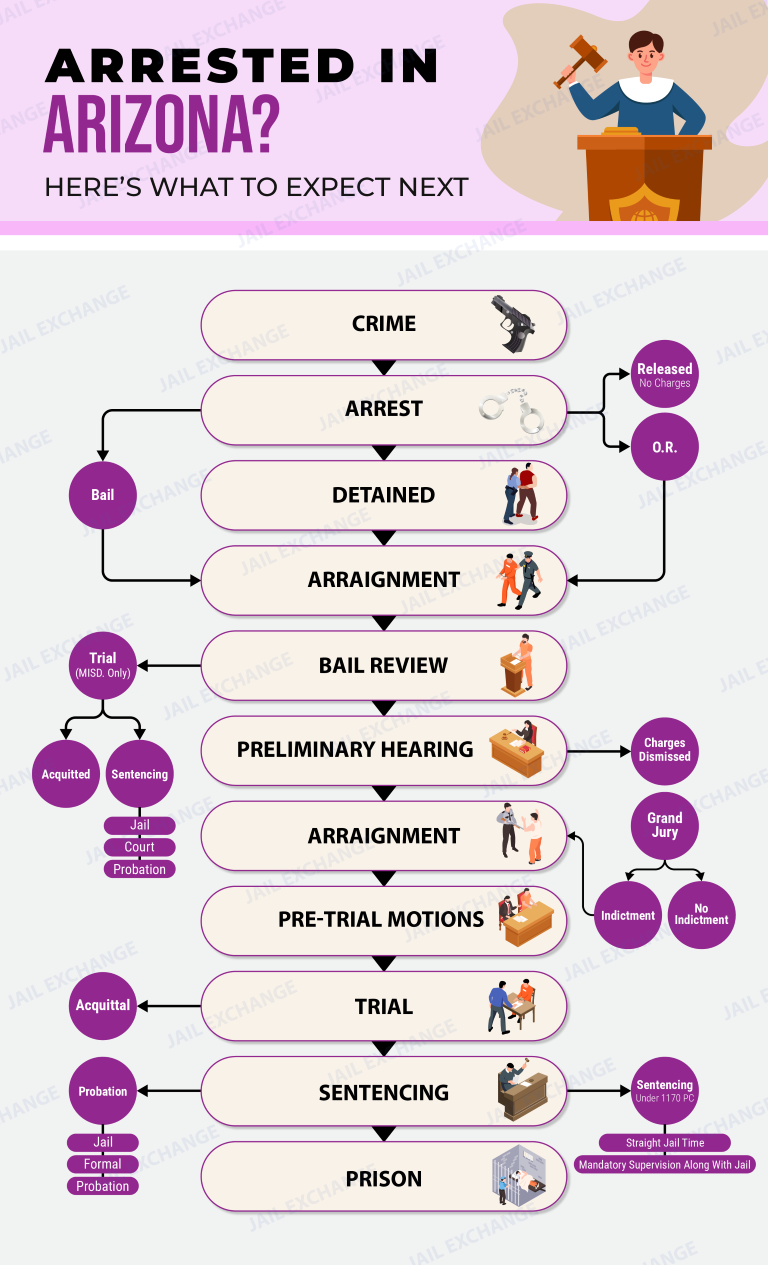
For a Pima County misdemeanor, the court is picked by location and by the agency on the report. A Tucson Police stop inside city limits usually leads to Tucson City Court, while a Sheriff’s deputy or state trooper outside the city usually files in the Consolidated Justice Court downtown or the Green Valley or Ajo justice court. People taken into custody see a judge within 24 hours of arrest, and Arizona’s rules assume release on recognizance unless the judge decides otherwise. Domestic violence arrests often come with no-contact orders as a release condition.
Maximum penalties depend on the class. Class 1 misdemeanors, the most serious, can bring a six-month jail term and fines up to $2,500; class 2 offenses can bring four months and $750; and class 3 offenses 30 days and $500, with surcharges added to every fine. A first-offense DUI requires at least 10 days in jail, though a judge may suspend nine of them after alcohol screening. Judges decide most misdemeanor cases, but DUI defendants and some others can demand a six-member jury.
Public defense for misdemeanors depends on the court. The City of Tucson Public Defender represents eligible defendants in Tucson City Court, and the Pima County Public Defender covers the justice courts. First-timers often finish through diversion, a deferred deal, or a plea down to something smaller.
If the accused is under 18: the Pima County Juvenile Court Center at 2225 East Ajo Way, Tucson ((520) 724-2000), a division of the Superior Court, handles misdemeanors by minors as delinquency cases. A held child stays in the detention unit on that same campus and gets a detention hearing before a juvenile judge within 24 hours, with hearings held weekday afternoons and weekend mornings, and parents are expected to attend. Many first-time minor offenses are steered into diversion through juvenile probation, and certain matters such as underage alcohol, tobacco, curfew or traffic violations may be sent to a justice or city court instead.
2. Felony charges (burglary, aggravated DUI, drug possession for sale, auto theft)
After a felony arrest in Pima County, the initial appearance comes within 24 hours, and the judge chooses release terms, which can mean check-ins with pretrial staff or a bond. Formal charges then arrive through one of two routes: a grand jury indictment, used in a large share of Pima County felonies, or a complaint followed by a preliminary hearing, which must happen within 10 days if the defendant is jailed or 20 days if the defendant is free.
The case then moves to the Superior Court on West Congress Street for arraignment. From that date, the rule says trial within 150 days for a jailed defendant and 180 for one at home, or 270 days in complex cases, although continuances are common. Pretrial conferences, plea negotiations, and motions to suppress evidence fill most of that time, and nearly all Tucson felony files end in a plea deal.
Arizona classifies felonies from class 2 down to class 6. Probation is a realistic outcome for many first offenses that are not labeled “dangerous,” and personal-use drug possession on a first or second conviction must result in probation under Proposition 200. A class 6 felony may be designated a misdemeanor by the judge, immediately or after successful probation. Repeat offenders and crimes involving a weapon or serious injury carry mandatory prison terms, and inmates must serve 85% of the sentence. Felony juries have eight members. Pima County provides appointed lawyers through its Public Defender, Legal Defender and Legal Advocate offices and an Office of Court Appointed Counsel that assigns private attorneys when the others have conflicts.
If the accused is under 18: the Juvenile Court Center on East Ajo Way keeps most felony cases against teenagers, where outcomes run from probation and counseling up to a stay in a state youth prison. For youths at least 14 years old, the County Attorney has discretion to file adult charges for class 1 and class 2 felonies, certain class 3 felonies, dangerous offenses and chronic felony offenders under A.R.S. 13-501(B). Juvenile jurisdiction normally ends on the 18th birthday, but if the state files notice while the youth is 17, the court can keep the case until age 19.
3. Violent and dangerous felonies (homicide, sexual assault, armed robbery)
Killings, rapes and armed robberies in Tucson take the felony route above, but bail is tighter and prison terms much longer. Under the Arizona Constitution, bail may be refused outright on a capital count backed by solid evidence, and a judge who decides after a hearing that a defendant charged with a serious felony is too dangerous for any release conditions may order the person held. As a result, many of these defendants wait for trial in the Pima County Adult Detention Complex. A jury of 12 rather than eight is required whenever the possible sentence is death or at least 30 years.
- First-degree murder: death, natural life, or life with possible release after 25 years. Arizona carried out its first execution in eight years in 2022.
- Second-degree murder: a range of 10 to 25 years for a first offense.
- Armed robbery: as a dangerous class 2 felony, 7 to 21 years for someone with no prior felonies, and more with priors.
- Sexual assault: 5.25 to 14 years for a first conviction, with no early release, followed by sex offender registration.
Arizona’s Victims’ Bill of Rights guarantees Pima victims a heads-up on court dates, a chance to address bail, plea offers and the sentence, the option to skip defense interviews, and payback for losses. In capital cases, Pima County’s defense offices assign specially qualified lawyers, and these cases can take several years to reach trial.
If the accused is under 18: a 15-, 16- or 17-year-old accused in Pima County of first- or second-degree murder, forcible sexual assault, armed robbery or another violent felony is not eligible for juvenile court at all. Under A.R.S. 13-501(A), adult prosecution in the Superior Court is mandatory for that youth, and the same mandate applies to a chronic felony offender in that age group. These youths cannot receive the death penalty, and life sentences for minors are subject to federal constitutional limits. A 14-year-old facing similar charges may also be prosecuted as an adult, but only if the County Attorney chooses to do so.
4. Pima County Superior Court buildings
Adult cases are heard downtown on Congress Street, and juvenile cases on Ajo Way:
- Downtown Tucson Superior Court: 110 West Congress Street, Tucson, AZ 85701 · 520-724-4200
- Juvenile court center on Ajo Way: 2225 East Ajo Way, Tucson, AZ 85713 · 520-724-2000
5. How do I check on a warrant in Pima County?
The sheriff's department advises contacting the court of jurisdiction about a suspected warrant, and its non-emergency line, 520-351-4900, can help point you to the right court. Statewide, Arizona DPS offers a free warrant search, and the judiciary's Public Access case lookup covers cases from many courts. To clear a warrant, a defense attorney can arrange bond and a new appearance with the issuing court, whether that is a justice, city, or superior court. The Clerk of the Superior Court in Tucson answers at 520-724-3200.
6. Federal cases from Pima County
Border and drug cases are often federal and go to the U.S. District Court for the District of Arizona in Tucson:
- Defendants first see a magistrate judge at Tucson federal courthouse, 405 West Congress Street, Tucson, AZ 85701 (clerk 520-205-4200), often in large group hearings for border cases.
- Federal pretrial officers prepare a report on ties, work and record.
- Prosecutors can argue for pretrial detention, and a hearing settles it.
- Those kept in custody are placed by the Marshals, sometimes in Florence or Eloy.
The Tucson Marshals office: U.S. Marshals Service, 405 West Congress Street, Suite 2300, Tucson, 520-879-6900.
7. Searching for someone after a Pima arrest
- Pima County Inmate Search: the Silverlake Road jail; search by last and first name.
- VINELink (https://vinelink.vineapps.com/): select Arizona to see current custody, and sign up for a release alert.
- Federal Bureau of Prisons Inmate Locator (https://www.bop.gov/inmateloc/): federal prisons by register number. If the case is still pending, ring 520-879-6900.
- ADCRR Inmate Data Search (https://inmatedatasearch.azcorrections.gov/): state prison placement by ADCRR number or name.
- ICE Online Detainee Locator System (https://locator.ice.gov/odls/): immigration custody using the A-number and birth country; dial 520-295-4100 if it's blank.
8. ICE detainers in Pima County
Pima County does not hold people past release on an ICE detainer without a judicial warrant. A detainer seeks up to 48 hours, with weekends and holidays counted. Under A.R.S. 11-1051, though, Pima can't adopt rules limiting enforcement, so ICE may make arrests outside.
Tucson-area cases belong to the ICE office in Tucson (part of the Phoenix Field Office), 6431 South Country Club Road, Tucson, 520-295-4100. Sites:
- Eloy Detention Center: 1705 East Hanna Road, Eloy, AZ 85131 · 520-464-3000
- Florence Service Processing Center: 3250 North Pinal Parkway, Florence, AZ 85132 · 520-868-5862
- Central Arizona Florence Correctional Center: Florence, AZ · 520-868-9095
These paragraphs give background on Tucson-area cases and are not legal advice. A real case needs real counsel, or dial the Pima County Public Defender at (520) 724-6800.
Call the Superior Court at 520-724-4200 to confirm your hearing before heading downtown.