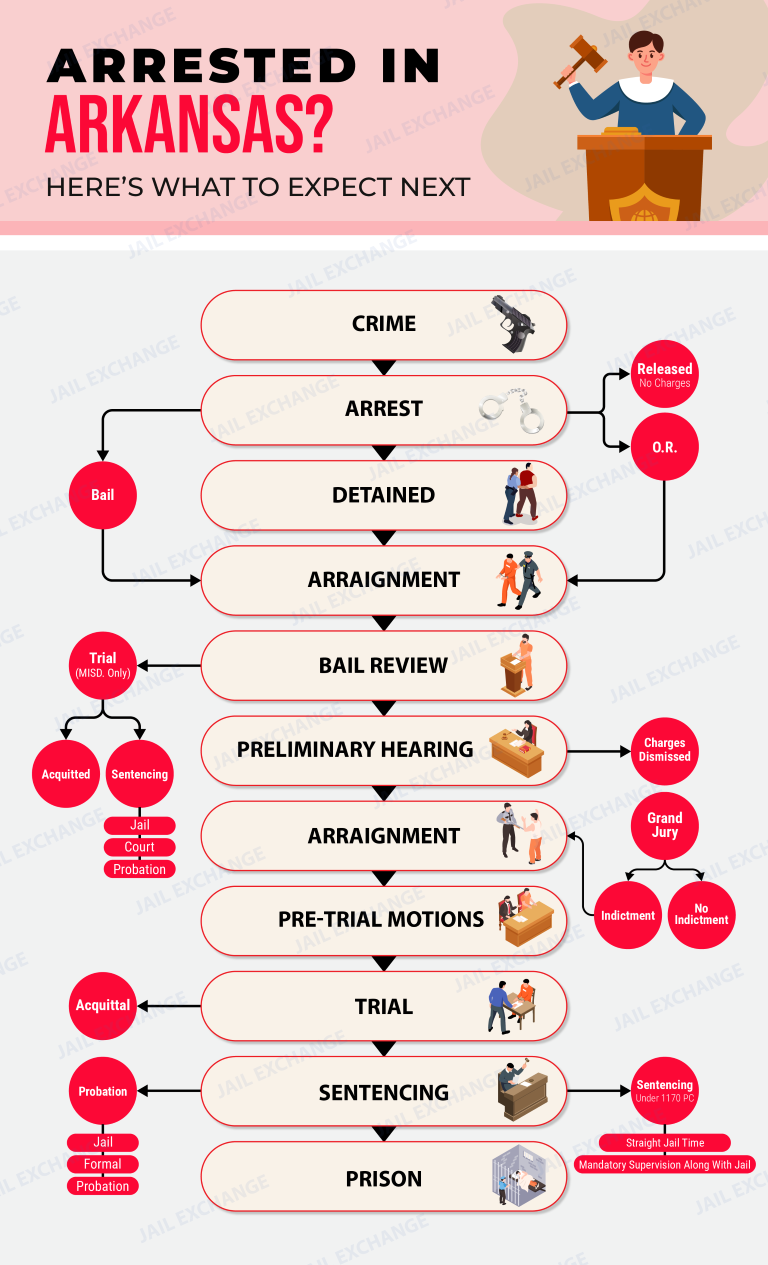
Cleburne County Detention Center Criminal Court Process
Criminal Court Process for Cleburne County Arkansas
How a Criminal Case Moves Through Cleburne County Courts
Cleburne County wraps around Greers Ferry Lake in the foothills of the Ozarks, and its criminal docket runs through two state courts in Heber Springs. Felonies are tried by the Cleburne County Circuit Court, which sits in the Cleburne County Courthouse, 301 W. Main Street, Heber Springs, AR 72543. The Circuit Clerk can be reached at (501) 362-8149. Cleburne is one of five counties in Arkansas’s Sixteenth Judicial Circuit, along with Fulton, Independence, Izard and Stone, so its circuit judges travel among those courthouses. The circuit court also has a juvenile division and decides appeals that come up from district court.
Misdemeanors, traffic tickets and the earliest hearings in many felony arrests go to the Cleburne County District Court, 922 S. 9th Street, Heber Springs, AR 72543, (501) 362-6585. The elected Prosecuting Attorney for the Sixteenth Judicial District files felony charges and state misdemeanors throughout the five counties. People charged with a crime who lack money for counsel can ask for a public defender from the district office funded through the Arkansas Public Defender Commission, a state agency.
Federal prosecutions arising in Cleburne County belong to the Central Division of the U.S. District Court for the Eastern District of Arkansas, which holds court at the federal courthouse in Little Rock; the clerk’s office is at 600 W. Capitol Avenue, Room A-149, Little Rock, AR 72201, (501) 604-5351. No federal courtroom operates inside the county. The dividing line is which government wrote the law that was broken. An act that violates the Arkansas Criminal Code is a state offense, charged by the local prosecuting attorney and heard in circuit or district court. A federal crime breaks a statute passed by Congress or touches a federal interest: a methamphetamine ring that moves product across state lines, possession of a gun by someone federally barred from having one, fraud against a federally insured bank, or certain offenses on federal Corps of Engineers property surrounding Greers Ferry Lake and its dam. Federal agents and the U.S. Attorney’s office decide which of those matters to pursue, and certain acts may break both state and federal law.
Pick a type of charge below for a walkthrough of the usual steps.
- Cleburne County misdemeanors: small-dollar theft, a first DWI, battery, trespass
- Heber Springs felony dockets: break-ins, larger thefts, drug sales and repeat DWI
- Cleburne County’s gravest charges: capital murder and murder, rape, aggravated robbery
- Cleburne County courthouse addresses and phones
- Federal charges out of Cleburne County
- Tracking down a Cleburne County inmate
- ICE detainers and where Cleburne County detainees go
Cleburne County misdemeanors: small-dollar theft, a first DWI, battery, trespass
Most misdemeanors in Cleburne County begin with a ticket or arrest by sheriff's deputies, Heber Springs or other town police, or state troopers. Someone taken to jail goes before a judge promptly, as required by Rule 8.1 of the Arkansas Rules of Criminal Procedure, and the rules favor letting the defendant out on a signed promise unless conditions are needed to secure attendance or protect others. When money bail is set, families may pay the full amount or use a bail company holding a license from the state’s Professional Bail Bond Company and Professional Bail Bondsman Licensing Board.
Arkansas divides misdemeanors into three classes. Class A misdemeanors bring a maximum of a year behind bars and $2,500 in fines; Class B tops out at 90 days and $1,000; Class C at 30 days and $500. Shoplifting and similar thefts of $1,000 or less usually count as Class A, the same class as third-degree battery. Criminal trespass is usually a Class B or C offense depending on the property involved. A first DWI can mean 24 hours up to one year locked up, fines from $150 to $1,000, a license suspension and, for a restricted license, typically an ignition interlock.
The district judge decides these cases without a jury. Within 30 days, either side's loss can be appealed to circuit court, which hears the whole case fresh, and the defendant may ask for jurors there. In practice, most Cleburne County misdemeanors finish with a plea, a reduced charge, probation, fines and costs, or a class, usually within a few months.
A teenager under 18 accused of the same kind of conduct normally appears before the juvenile division of the Cleburne County Circuit Court rather than the district judge. The prosecutor may offer a diversion agreement that keeps a first-time youth out of formal adjudication if the youth finishes tasks like counseling, paying back losses or volunteer work. Minor traffic matters are among the few juvenile violations that may still be handled in district court.
Heber Springs felony dockets: break-ins, larger thefts, drug sales and repeat drunk driving
After a warrantless felony arrest, a judge has 48 hours to decide whether reasonable cause exists. At the first appearance, often held before the district judge in Heber Springs, the court reviews the charge, sets bond and finds out if a court-appointed lawyer is needed. A financial affidavit is used to decide eligibility, and Arkansas law allows the judge to order a defendant to pay toward the cost of the public defender if able.
Rather than relying on a grand jury, the Sixteenth District prosecutor typically charges a felony by filing a written information in circuit court. Arraignment follows, then discovery, plea talks and pretrial motions. Rule 28.1 requires that a defendant be brought to trial within 12 months, not counting delays the rules exclude, such as continuances the defense requests. Felony juries in Arkansas have 12 members, and if a defendant is convicted at trial, the same jury usually recommends the sentence within the statutory range.
Felony ranges depend on class: Class Y carries 10 to 40 years or life; Class A, 6 to 30; Class B, 5 to 20; Class C, 3 to 10; and Class D, up to 6. Breaking into a home to commit a crime is residential burglary, a Class B felony, while the commercial version is Class C. Stealing property worth more than $1,000 moves theft into felony territory. Penalties for delivering a controlled substance scale with the drug and the weight. A ten-year look-back applies, and the fourth DWI in that span is charged as a felony. Plea bargains settle the bulk of Cleburne County felonies, often with probation or a suspended sentence for people without serious records.
For juveniles, Arkansas leaves much to the prosecutor. A 16- or 17-year-old accused of any felony can be charged in either the juvenile division or the adult criminal division, and either side may ask for a transfer hearing, where the judge weighs ten statutory factors and must find clear and convincing evidence to move the case. A detained youth must receive a detention hearing within 72 hours. Kept in juvenile court, a case may close with supervision, treatment or placement with the Division of Youth Services, which first sends youths to its assessment center near Alexander. Prosecutors can also seek an Extended Juvenile Jurisdiction designation, which allows supervision past 18 and an adult sentence held in reserve.
Cleburne County’s gravest charges: capital murder and murder, rape, aggravated robbery
These prosecutions follow the felony path but carry far heavier stakes. Article 2, Section 8 of the Arkansas Constitution guarantees bail except in capital cases where the proof is evident or the presumption great, so a person charged with capital murder may be held without any bond. Bond for other violent charges is frequently set high, with no-contact orders protecting the alleged victim.
Class Y, the top felony class, covers first-degree murder, rape and aggravated robbery and carries a floor of 10 years. Capital murder has only two possible punishments: death or life without parole. Under the Protect Arkansas Act, for crimes committed on or after January 1, 2025, a person convicted of capital murder, rape or aggravated robbery must serve the entire sentence, and second-degree murder requires at least 85%. Arkansas had 23 men under a death sentence as of April 2026 and has not executed anyone since 2017. Lethal injection remains the method, and the legislature authorized nitrogen hypoxia in 2025.
Victims in Cleburne County have rights under the Arkansas victims’ rights statutes, Ark. Code 16-90-1101 and following, including notice of hearings, a chance to be heard on release and plea decisions, and a chance to describe the harm to the judge before sentence is passed. The Sixteenth District prosecutor’s victim-witness coordinator explains each stage and helps with restitution requests. Serious violent cases can take a year or longer to resolve.
Youths aged 14 or 15 facing the gravest charges, including capital or first-degree murder, rape, kidnapping and aggravated robbery, can skip juvenile court and start in adult court, and older teens may be charged there for any felony. A transfer hearing can still send the case back to juvenile court or to Extended Juvenile Jurisdiction. Anyone under 18 at the time of the crime cannot receive the death penalty, and Arkansas’s 2017 Fair Sentencing of Minors Act lets someone who was a juvenile at the time of a capital murder seek parole once 30 years are served.
Cleburne County courthouse addresses and phones
Two state courts handle criminal cases in Cleburne County:
- Cleburne County Circuit Court: Cleburne County Courthouse, 301 W. Main Street, Heber Springs, AR 72543, 501-362-8149
- Cleburne County District Court, Heber Springs: 922 S. 9th Street, Heber Springs, AR 72543, 501-362-6585
- District Court, Greers Ferry Department: 8739 Edgemont Road, Greers Ferry
- District Court, Quitman and Concord Departments: call the Heber Springs office for dates
Circuit court tries felonies and hears juvenile cases and appeals. Misdemeanors, traffic citations and a felony suspect's opening hearing are district court work.
Federal charges out of Cleburne County
Federal crimes such as meth distribution, gun possession by a felon or fraud against a federal program go to Little Rock, home of the Central Division of the U.S. District Court for the Eastern District of Arkansas, at the federal courthouse in Little Rock, 500 West Capitol Avenue, Little Rock, AR 72201, 501-604-5351.
- The first appearance is in front of a magistrate judge.
- Pretrial Services writes a background report for the judge.
- Prosecutors who want the defendant held must win a detention hearing.
- A felony case needs a grand jury indictment before trial.
- The U.S. Marshals keep custody of federal defendants: U.S. Marshals Service, 600 West Capitol Avenue, Little Rock, AR 72201, 501-324-6256.
One arrest can lead to both a state case in Heber Springs and a federal case, and the two move on separate tracks.
Tracking down a Cleburne County inmate
- Cleburne County jail: Cleburne County Inmate Search. Search by surname for the booking date and charge list.
- VINE: VINELink (https://vinelink.vineapps.com/). Select Arkansas, search the name and sign up for free custody alerts.
- Federal Bureau of Prisons: Federal Bureau of Prisons Inmate Locator (https://www.bop.gov/inmateloc/). Sentenced federal inmates show up by register number or name.
- Arkansas Division of Correction: Arkansas Division of Correction Inmate Search (https://apps.ark.org/inmate_info/). Enter a name or ADC number to find the state unit.
ICE detainers and where Cleburne County detainees go
An ICE detainer asks the Heber Springs jail to hold a person as long as 48 hours past release, with weekends and holidays counted. The county charges stay open.
The ICE New Orleans Field Office, 181 James Drive W, St. Rose, LA 70087, 504-318-2360 handles all of Arkansas, and people it detains often go to Louisiana:
- LaSalle ICE Processing Center: 830 Pinehill Road, Jena, LA 71342 · 318-992-1600
- Pine Prairie ICE Processing Center: 1133 Hampton Dupre Road, Pine Prairie, LA 70576 · 337-599-2400
Use the ICE Online Detainee Locator System (https://locator.ice.gov/odls/) with an A-number, or a full name and birth country.
This overview of Cleburne County criminal procedure is meant as background, not legal advice. Defense counsel can answer questions about a specific charge, or you can call the Cleburne County Circuit Clerk at (501) 362-8149 to ask about public defender appointment.
Felony hearing dates come from the Heber Springs circuit clerk at 501-362-8149. For misdemeanor or traffic dates, call the district court at 501-362-6585.