Drew County Jail and Detention Center Criminal Court Process
Criminal Court Process for Drew County Arkansas
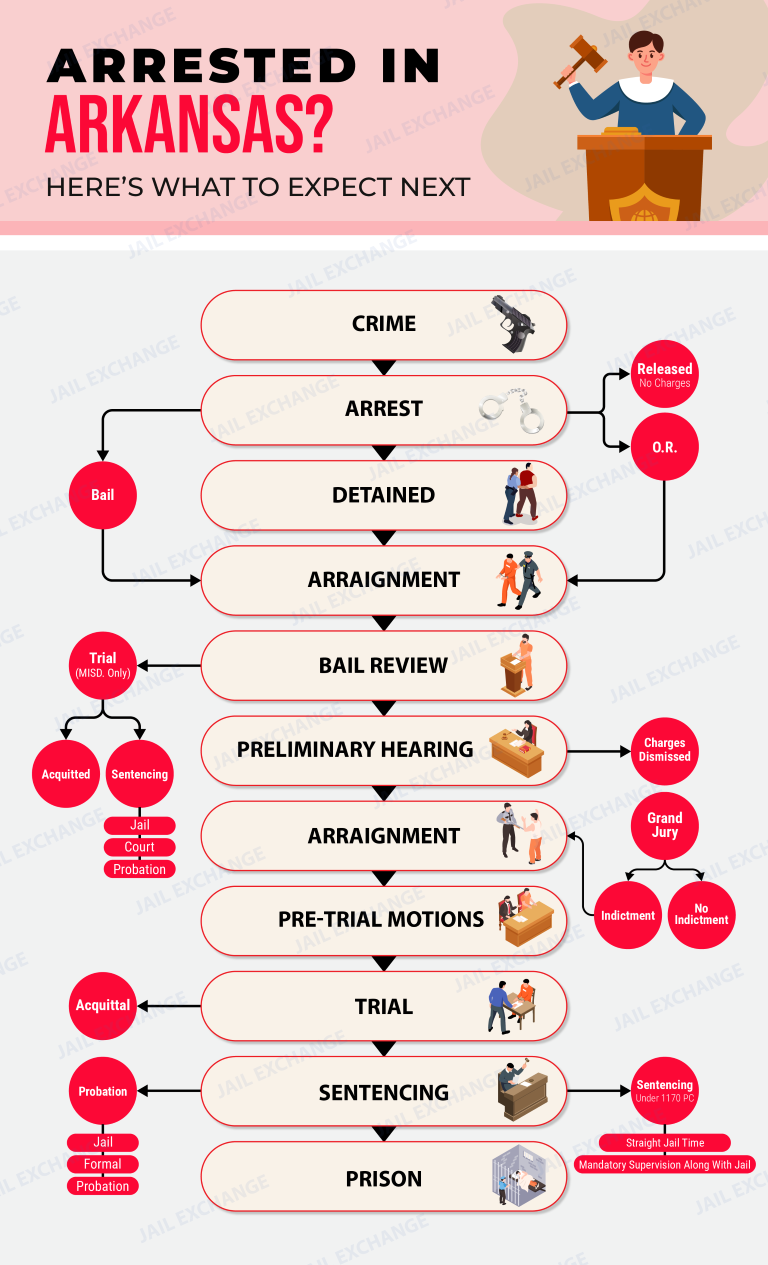
How a Criminal Case Moves Through the Drew County Courts
Drew County, home to Monticello and the University of Arkansas at Monticello, belongs to the 10th Judicial Circuit, a five-county circuit in southeast Arkansas that also takes in Ashley, Bradley, Chicot and Desha counties. Felony prosecutions, jury trials and the juvenile docket are all handled by the Drew County Circuit Court at the Drew County Courthouse, 210 South Main Street, Monticello, AR 71655, where one of the circuit’s five judges keeps chambers. The Circuit Clerk’s office in that building files criminal cases and answers questions about court dates at (870) 460-6250.
Lesser offenses start in the Drew County District Court, 107 East Jackson Street, Monticello, AR 71655; phone (870) 367-4420. That court hears misdemeanors and traffic charges, holds first appearances for people booked into the county jail, and conducts probable-cause and bond hearings in felony matters before they are transferred upstairs to circuit court.
Charging decisions belong to the elected Prosecuting Attorney for the 10th Judicial District, whose main office is in Monticello at 506 South Main Street; call (870) 367-9896. That office prosecutes felonies and state misdemeanors across all five counties. Defendants without money for a lawyer are served by public defenders funded through the state’s Arkansas Public Defender Commission; the circuit clerk can explain how to ask for one.
Drew County has no federal courthouse. Under the federal statute that maps Arkansas’s judicial divisions (28 U.S.C. § 83), Monticello-area federal matters go before the Central Division (Little Rock courthouse) of the U.S. District Court for the Eastern District of Arkansas, housed in the federal courthouse in Little Rock; mail for the clerk goes to 600 West Capitol Avenue, Room A149, Little Rock, AR 72201, and the phone is (501) 604-5351. What decides the courthouse is the law that was broken. Offenses defined in the Arkansas Code, which covers nearly every burglary, assault, theft and DWI, are prosecuted by the local prosecuting attorney in the Monticello courts. Federal jurisdiction comes from breaking a law Congress passed, such as moving drugs across state lines, robbing an FDIC-insured bank, defrauding Medicare, mailing threats, or a convicted felon possessing a firearm, and when agencies like the FBI, DEA or ATF investigate. Those cases are presented by the U.S. Attorney in Little Rock. Arkansas has no Indian reservations, so tribal jurisdiction is not a factor here. Choose a category to see how a typical case unfolds.
- Drew County misdemeanors (petty theft under $1,000, first DWI, battery, trespass)
- Felonies in Monticello’s circuit court (burglary, felony theft, drug delivery, repeat DWI)
- The gravest violent charges (murder, capital murder, rape, aggravated robbery)
- Drew County court addresses and phones
- Drew County arrests that become federal cases
- Looking up a Drew County inmate
- ICE detainers and where Drew County detainees are held
Drew County misdemeanors (petty theft under $1,000, first DWI, battery, trespass)
Lesser offenses here often start with a ticket from Monticello police, a deputy or a trooper giving a court date at the Jackson Street district court. When the person is arrested and jailed instead, Rule 8.1 of the Arkansas Rules of Criminal Procedure requires a prompt first appearance, and after a warrantless arrest, a judge reviews the basis for custody within two days. The Arkansas Constitution makes every charge bailable except a capital offense with strong proof (art. 2, § 8), and Rule 9.1 tells judges to try release on recognizance or conditions before demanding money. A family that uses a licensed bondsman generally pays a nonrefundable premium of 10% of the bond.
Arkansas grades misdemeanors by class. Class A, which covers theft of property worth $1,000 or less and third-degree battery, can mean 12 months in jail and a $2,500 fine at most. Class B tops out at 90 days and $1,000, and Class C at 30 days and $500; most criminal trespass charges fall in the lower classes. For a first DWI the jail range is 24 hours to a year (service hours can replace it), a fine, license suspension and an ignition interlock requirement. Drew’s district judge decides guilt alone, since no jury sits at that level. Someone convicted there can appeal within 30 days to the Drew County Circuit Court and receive an entirely new trial, which can be before a jury.
Under 18: A Drew County teenager accused of shoplifting or a fight normally goes to circuit court's juvenile division instead of district court, where it is treated as a delinquency case, not a prosecution. Under Ark. Code § 9-27-318, conduct that would be only a misdemeanor for an adult must stay in juvenile court. First referrals are often handled informally through diversion, while a minor’s traffic tickets may go to district court. A youth held in a juvenile detention facility must be brought before the court, generally within 72 hours, for a hearing on whether continued detention is justified.
Felonies in Monticello’s circuit court (burglary, felony theft, drug delivery, repeat DWI)
Most felony defendants in Drew County see the district judge first, at a hearing where bond is set and the court confirms there was probable cause for the arrest. The prosecuting attorney then decides whether to file a felony information in circuit court. Arkansas rarely uses grand juries; the information, a written charge signed by the prosecutor, is the normal path. The defendant pleads at arraignment in Monticello, and a qualifying defendant receives an appointed public defender then. A court can set a public defender fee that fits the defendant's means (Ark. Code § 16-87-213).
Rule 28.1 sets a 12-month clock from arrest or charge to felony trial, minus delays the defense asks for or causes. Trials in circuit court use a 12-member jury, and in Arkansas the jury also recommends the sentence after a guilty verdict. Felonies are ranked by class:
- Class B (residential burglary, theft over $25,000): 5 to 20 years
- Class C (commercial burglary, theft of $5,000 to $25,000): 3 to 10 years
- Class D (theft of more than $1,000 up to $5,000): up to 6 years
The substance involved and its weight set the class of a delivery charge, and big amounts can reach Class Y. DWI turns into a felony charge at the fourth offense within a decade. Probation or a suspended sentence is a common result for first-time felony defendants.
Under 18: For a 16- or 17-year-old accused of any felony, Arkansas gives the prosecutor a choice: file in the juvenile division or in the criminal division of circuit court (Ark. Code § 9-27-318). Prosecution or defense can request a transfer hearing. The judge looks at how serious the offense is, the youth’s record and maturity, and whether youth services might still help, and moves the case only on clear and convincing evidence. When a felony stays on the juvenile side, results may include probation, repayment, treatment or a Division of Youth Services commitment. The court may also designate the case for Extended Juvenile Jurisdiction, which combines a juvenile outcome with an adult sentence held back unless the youth falls short.
The gravest violent charges (murder, capital murder, rape, aggravated robbery)
Violent felonies use the same prosecutor and the same circuit courtroom, though far more is on the line. When the charge is capital murder and the proof is evident, the judge may refuse bail altogether, and in other serious cases bonds are typically set high with no-contact orders. After a capital murder conviction, jurors pick between death and life without parole. Class Y covers rape, aggravated robbery and first-degree murder, with 10 to 40 years or life, and second-degree murder is a Class A felony with a 6-to-30-year range.
The Protect Arkansas Act (Act 659 of 2023) tightened release for crimes committed on or after January 1, 2025. Prisoners serving time for capital murder, rape, aggravated robbery and some other crimes now complete 100% of the sentence, and those convicted of second-degree murder, first-degree sexual assault and manslaughter must serve at least 85%. Arkansas held 23 men on death row in April 2026. Its last execution took place in 2017, and in 2025 lawmakers added nitrogen hypoxia as a method alongside lethal injection.
Crime victims have statutory rights under Ark. Code § 16-90-1101 and following sections, which cover hearing notices, restitution, and a turn to speak at sentencing. A victim-witness coordinator in the Monticello prosecutor’s office guides victims through each stage, and violent cases here often take a year or longer.
Under 18: A 14- or 15-year-old accused of capital murder, first-degree murder, rape, kidnapping, aggravated robbery or a similar listed felony can be charged directly in the adult criminal division at the prosecutor’s discretion, subject to a transfer hearing if either side requests one. If the youth is convicted as an adult, the death penalty is off the table, and a 2017 state law ended life without parole for crimes committed before 18, so 30 years into a sentence, someone convicted of capital murder as a youth may go before the parole board. On the juvenile side, outcomes include Division of Youth Services commitment or Extended Juvenile Jurisdiction, keeping the court in the picture until 21.
Drew County court addresses and phones
Both Drew County courts are in downtown Monticello:
- Drew County Circuit Court: Drew County Courthouse, 210 South Main Street, Monticello, AR 71655, circuit clerk 870-460-6250
- Drew County District Court: 107 East Jackson Street, Monticello, AR 71655, 870-367-4420
Circuit court has the felony trials, juvenile cases and appeals. On Jackson Street, district court hears tickets and misdemeanors and runs first appearances and bond hearings before a felony heads to circuit court.
Drew County arrests that become federal cases
Drew County's federal cases go to Little Rock, not to the Delta courthouse in Helena that serves Chicot and Desha. Its federal home is the Central Division of the U.S. District Court for the Eastern District of Arkansas, at the federal courthouse in Little Rock, 500 West Capitol Avenue, Little Rock, AR 72201, 501-604-5351.
- The first appearance is before a magistrate judge, who reads the charges.
- The court receives a pretrial report on the defendant's background.
- A detention hearing comes next if prosecutors oppose release.
- A grand jury indictment is required before a felony trial.
- People held on federal charges are in U.S. Marshals custody: U.S. Marshals Service, 600 West Capitol Avenue, Little Rock, AR 72201, 501-324-6256.
State and federal charges over the same conduct can both go forward, each on its own track.
Looking up a Drew County inmate
- Drew County jail: Drew County Inmate Search. A surname search gives booking date and charges.
- VINE: VINELink (https://vinelink.vineapps.com/). Search an Arkansas name to see the current holding facility. Notices are free.
- Federal Bureau of Prisons: Federal Bureau of Prisons Inmate Locator (https://www.bop.gov/inmateloc/). Search federal inmates by register number or name.
- Arkansas Division of Correction: Arkansas Division of Correction Inmate Search (https://apps.ark.org/inmate_info/). Type an ADC number or name for the prison unit.
ICE detainers and where Drew County detainees are held
ICE can file a detainer asking the Monticello jail to keep a person up to 48 hours after release, and weekends and holidays count. The county case keeps moving.
The ICE New Orleans Field Office, 181 James Drive W, St. Rose, LA 70087, 504-318-2360 handles Arkansas, and detainees often go to Louisiana:
- LaSalle ICE Processing Center: 830 Pinehill Road, Jena, LA 71342 · 318-992-1600
- Pine Prairie ICE Processing Center: 1133 Hampton Dupre Road, Pine Prairie, LA 70576 · 337-599-2400
Find detainees in the ICE Online Detainee Locator System (https://locator.ice.gov/odls/) by A-number, or by name and birth country.
Here you’ll find a broad outline of Monticello’s criminal courts, not legal advice. Hire a defense lawyer for an actual case, and the circuit clerk explains how to request a public defender at (870) 460-6250.
To confirm a felony date, phone the circuit clerk at 870-460-6250. District court at 870-367-4420 has misdemeanor and traffic dates.