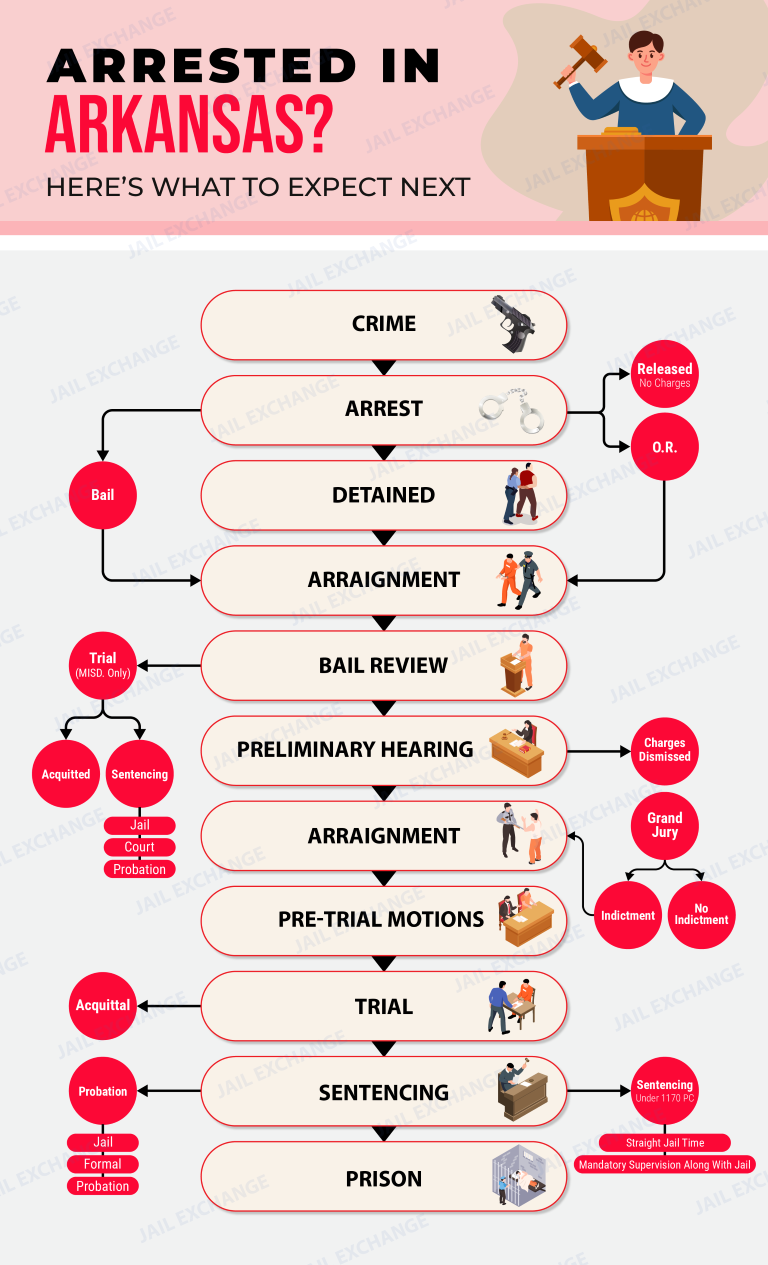
Lawrence County Detention Center Criminal Court Process
Criminal Court Process for Lawrence County Arkansas
Lawrence County Courts and the Criminal Process
Lawrence County’s courts once met at Powhatan, on the Black River, where the 1888 courthouse still stands as a state park. Today the county’s justice system is centered in Walnut Ridge, alongside Hoxie, Imboden, Black Rock and Portia. Felony prosecutions are heard by the Lawrence County Circuit Court, one of the four county courts that make up the 3rd Judicial Circuit; Jackson, Randolph and Sharp complete it. The Circuit Clerk’s office, which manages felony, juvenile and appeal files, is at 315 W. Main Street, Suite 7, Walnut Ridge, AR 72476, with a phone number of (870) 886-1112. Circuit court in Walnut Ridge also handles juvenile cases and rehears appeals from district court.
Misdemeanor charges, traffic citations and first steps in felony cases belong to the Lawrence County District Court, which operates departments for Walnut Ridge, Hoxie, Black Rock and Portia. The chief clerk’s office is at 111 W. Main Street, Walnut Ridge, (870) 886-1140.
Prosecution is in the hands of the elected 3rd Judicial District Prosecuting Attorney and the deputy who handles Lawrence County cases. If a defendant cannot afford a lawyer, a 3rd District public defender, paid through the state’s Arkansas Public Defender Commission, takes the case. Arrestees go to the Lawrence County Detention Center at 501 W. Elm Street in Walnut Ridge.
Federal matters travel roughly 30 miles southeast to Jonesboro and are heard in the Northern Division courtrooms of the federal courthouse, 615 S. Main Street, Jonesboro, AR 72401; the clerk there answers at (870) 972-4610. Here is the basic distinction. When the Arkansas legislature has made something a crime, it is a state offense, and the 3rd District prosecutor charges it in Walnut Ridge. When Congress has made something a crime, it is a federal offense, and federal prosecutors from Little Rock charge it in Jonesboro after investigations by federal agencies. Methamphetamine distribution rings that span several states, felons in possession of firearms, theft from the U.S. mail, tax evasion and wire fraud are examples of cases that commonly end up in federal court.
Choose a category to see how that kind of case is usually handled.
- Lesser charges heard without a jury (theft of property worth less than the felony amount, a DWI first offense, battery, trespass)
- Circuit court felonies (burglary, higher-value theft, drug delivery, a felony DWI)
- Violent charges carrying decades or life (murder, capital murder, rape, aggravated robbery)
- Lawrence County court offices
- Federal court for Lawrence County
- Inmate searches for Lawrence County
- ICE detainers in Lawrence County
Lesser charges heard without a jury (theft of property worth less than the felony amount, a DWI first offense, battery, trespass)
An officer in Hoxie or Walnut Ridge may just hand over a citation listing the date to appear in district court. Those who are jailed on Elm Street must be presented to a judge without needless delay; for warrantless arrests, a judge must also find probable cause inside 48 hours. Arkansas favors releasing misdemeanor defendants, ideally on their own signature, yet a judge may still set money bail, which a family covers with cash or a licensed bondsman's surety.
Penalties differ by class. Class A misdemeanors, a group that includes most third-degree battery and petty theft cases, carry a maximum of $2,500 plus up to a year in the Elm Street jail. Class B misdemeanors allow up to 90 days in jail and $1,000. Class C, where most trespass charges fit, allows up to 30 days in jail and $500. First-time DWI is governed by its own statute and can bring a short jail stay or community service, a fine, alcohol safety education and suspension or restriction of the license.
Misdemeanors are tried to the district judge without a jury. Within a 30-day window, a conviction can be appealed up to the Walnut Ridge circuit judge, who starts the case over and will seat jurors if the defendant asks. Lawrence County judges appoint public defenders when jail is possible and a private attorney is unaffordable; Arkansas courts may charge a fee for appointed counsel but can waive it where paying would be a hardship.
Misdemeanors committed by minors are generally the business of the 3rd Circuit’s juvenile judge, with traffic tickets and some alcohol offenses forming the main exceptions that stay in district court. Juvenile officers in Lawrence County often handle first offenses informally through diversion, requiring a youth to complete classes, community service or restitution in place of a formal petition.
Circuit court felonies (burglary, higher-value theft, drug delivery, a felony DWI)
When someone is jailed on a felony in Lawrence County, the first court appearance is usually a quick hearing on probable cause, bond and appointment of counsel. Charges are formalized when the 3rd District prosecutor files a felony information, Arkansas’s standard charging paper, with the circuit clerk. With one exception, a capital offense where proof is evident or presumption great, the Arkansas Constitution guarantees that bail will be set.
Arraignment follows in circuit court in Walnut Ridge, and the case proceeds through discovery and motions. Arkansas’s Rule 28.1 sets the trial deadline at one year from arrest or charge, excluding delays that the rules permit. Most cases end in a plea deal; when one goes to trial, a unanimous panel of twelve decides guilt and, most of the time, the penalty too.
Arkansas groups felonies by class. A Class D conviction allows a maximum of six years, Class C between three and ten, Class B between five and twenty, and Class A between six and thirty; the top tier, Class Y, spans ten to forty years or life. Residential burglary is Class B; commercial burglary is generally one class lower. Theft crosses into felony territory based on property value, drug delivery is graded by what was sold and its weight, and a fourth drunk-driving conviction inside a decade is a Class D felony. Probation and suspended sentences are common outcomes alongside prison terms in the Division of Correction.
Prosecutors have discretion to file adult felony charges once a youth is 16 or 17, while younger teens are generally charged in juvenile court except for the gravest offenses. A transfer hearing can be held on motion to shift the case between divisions. Detention requires a judge’s hearing within 72 hours of the youth’s arrival. With no juvenile facility in the county, Lawrence County contracts with a regional detention center for youths who must be held. Dispositions in juvenile court include probation, counseling, fines, restitution and, for the most serious cases, DYS commitment.
Violent charges carrying decades or life (murder, capital murder, rape, aggravated robbery)
Killings, rapes and armed robberies move through the same felony stages, just with longer preparation, more forensic evidence and much heavier consequences. Capital murder can be punished only by death or life without parole. Class Y includes rape, aggravated robbery and first-degree murder. Because of the Protect Arkansas Act, a capital murder, rape or aggravated robbery committed in 2025 or later leads to a sentence served in full, and second-degree murder and certain other violent felonies require at least 85%.
Arkansas last carried out an execution in 2017, and roughly two dozen prisoners remain under death sentences. Since 2025, Arkansas law has authorized nitrogen hypoxia as well as lethal injection. Capital defendants receive appointed attorneys qualified to handle death penalty cases, and the circuit judge can hold a capital defendant without bail on strong proof.
Victims in Arkansas have a legal right to hearing notices, a seat in the courtroom, a meeting with the prosecutor, and a turn to speak when the judge decides punishment. Families of victims can lean on the victim-witness coordinator in the 3rd District prosecutor’s office.
For 14- and 15-year-olds, adult prosecution is possible only on the most serious accusations, such as murder, kidnapping, rape, first-degree battery, aggravated robbery or a terroristic act. A juvenile judge can also designate serious cases for Extended Juvenile Jurisdiction, which provides juvenile treatment while keeping an adult sentence available. Arkansas prohibits death sentences for offenses committed before age 18, and juvenile life without parole was abolished in 2017.
Lawrence County court offices
Both courts work out of Walnut Ridge, and the district court's town departments meet there as well:
- Lawrence County Circuit Court: 315 West Main Street, Suite 7, Walnut Ridge, AR 72476, circuit clerk 870-886-1112
- Lawrence County District Court clerk: 111 West Main Street, Walnut Ridge, AR 72476, 870-886-1140
- District Court courtroom: 315 West Main Street, Walnut Ridge
- Departments: Walnut Ridge, Hoxie, Black Rock and Portia, with sessions for the last three held in Walnut Ridge
Traffic, misdemeanor and city ordinance cases are heard in district court, which also opens each felony. Felonies, juvenile delinquency and district court appeals move to circuit court, where an appeal gets a fresh trial.
Federal court for Lawrence County
A federal case from Lawrence County is filed in the U.S. District Court for the Eastern District of Arkansas, Northern Division, at the federal courthouse in Jonesboro, 615 South Main Street, Jonesboro, AR 72401, 870-972-4610.
- A magistrate judge conducts the opening hearing.
- Pretrial services reports on the defendant's background.
- Prosecutors can ask for detention until trial.
- Felony charges proceed after a grand jury indictment.
- Defendants held in custody are kept by the U.S. Marshals: U.S. Marshals Service, 600 West Capitol Avenue, Little Rock, AR 72201, 501-324-6256.
One act can lead to a state case in Walnut Ridge and a separate federal case in Jonesboro.
Inmate searches for Lawrence County
- Lawrence County Detention Center: Lawrence County Inmate Search. Search a name to see who is booked in now.
- VINE: VINELink (https://vinelink.vineapps.com/). Choose Arkansas to find a location and set up alerts.
- Federal Bureau of Prisons: Federal Bureau of Prisons Inmate Locator (https://www.bop.gov/inmateloc/). Name or register number finds a federal prisoner.
- Arkansas Division of Correction: Arkansas Division of Correction Inmate Search (https://apps.ark.org/inmate_info/). An ADC number or name shows the prison unit.
ICE detainers in Lawrence County
A detainer from ICE asks the Walnut Ridge jail to keep someone up to 48 hours after release would otherwise happen, weekends and holidays included. The local case is not paused while that plays out.
Arkansas falls under the ICE New Orleans Field Office, 181 James Drive W, St. Rose, LA 70087, 504-318-2360, which tends to move northeast Arkansas detainees south to Louisiana:
- LaSalle ICE Processing Center: 830 Pinehill Road, Jena, LA 71342 · 318-992-1600
- Pine Prairie ICE Processing Center: 1133 Hampton Dupre Road, Pine Prairie, LA 70576 · 337-599-2400
To find a detainee in the ICE Online Detainee Locator System (https://locator.ice.gov/odls/), enter the A-number, or the name with country of birth.
Nothing here is legal advice; it is background on how Lawrence County cases tend to go. Questions about an open charge belong with a defense lawyer. Public defender requests go through the circuit clerk at (870) 886-1112 about requesting a public defender.
Before driving to Walnut Ridge, call the circuit clerk at 870-886-1112 for felony or juvenile hearings, or the district court clerk at 870-886-1140 for misdemeanor and traffic dates.