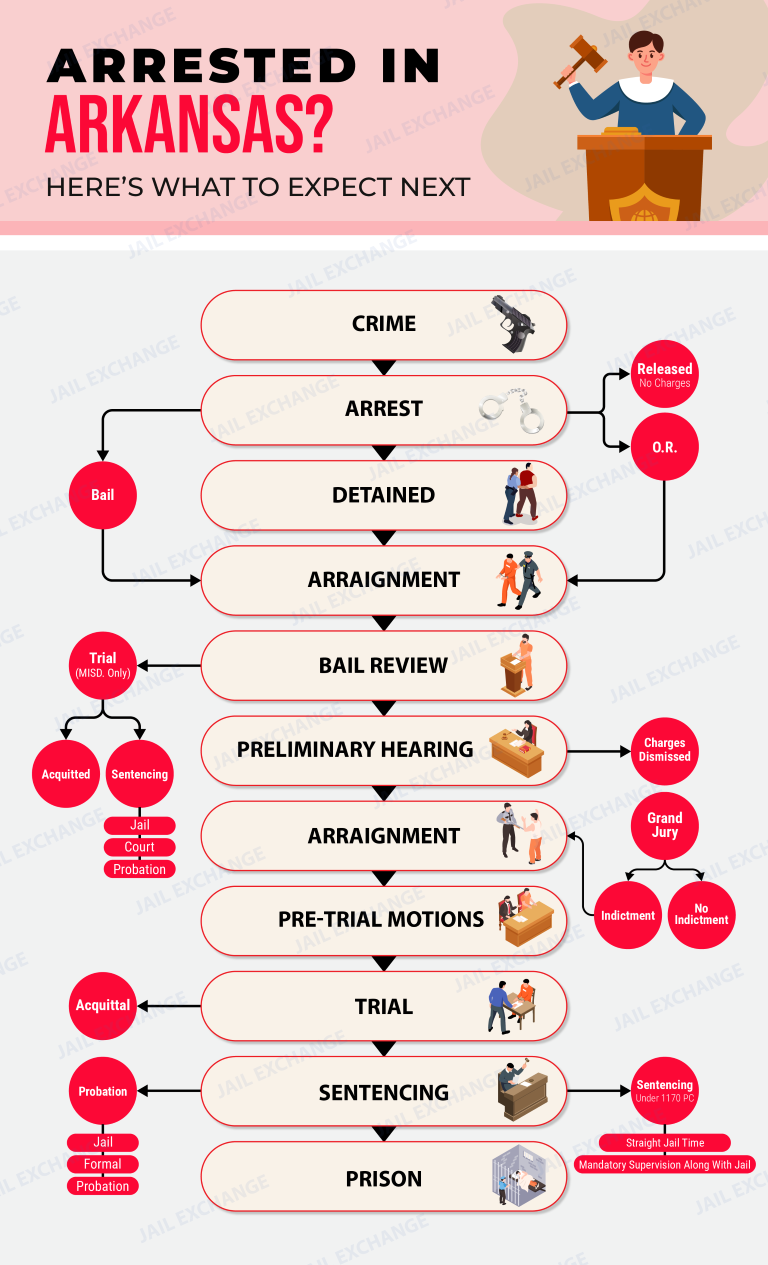
Lincoln County Detention Center Criminal Court Process
Criminal Court Process for Lincoln County Arkansas
Criminal Justice in Lincoln County, Arkansas
Lincoln County, a farming county southeast of Pine Bluff, is best known statewide for two prisons: the Cummins Unit, where Arkansas carries out executions, and the Varner Unit, whose Supermax houses the men on death row. Those state prisons hold people sentenced from all over Arkansas, though. Local criminal cases are decided in Star City, the county seat, at the Lincoln County Courthouse, 300 S. Drew Street, Star City, AR 71667. The Lincoln County Circuit Court shares its judges with Jefferson County as the 11th Judicial Circuit–West, and the Circuit Clerk in Star City can be reached at (870) 628-3154. Circuit court tries felonies, retries appealed district court cases, and through its juvenile division, which sits in Pine Bluff, hears delinquency cases from both counties. Our bail guide and inmate search cover the other steps.
Misdemeanors go to the Lincoln County District Court, a state district court whose judges also serve Jefferson County. Its Division 3 judge sits in Room 201 of the Star City courthouse, and the clerk for county cases answers at (870) 628-4904. Cases from inside Star City have their own clerk at (870) 628-4244, and there are also departments for Gould ((870) 263-4475) and Grady ((870) 479-3904).
Charges are brought by the 11th Judicial District–West Prosecuting Attorney, the same elected office that prosecutes in Jefferson County. The Arkansas Public Defender Commission funds the 11th West public defenders who are appointed for qualifying defendants. Adults arrested locally are taken to the Lincoln County Detention Center on State Highway 11 South in Star City, a small jail that holds men; women and overflow detainees may be housed elsewhere by arrangement.
When a Lincoln County case is federal, it is tried in Little Rock before the Central Division judges, at the federal courthouse at 500 W. Capitol Avenue, Little Rock, AR 72201 (clerk: (501) 604-5351). A state crime is one prohibited by the Arkansas Code and charged by the 11th West prosecutor. A federal crime is one prohibited by the United States Code; the U.S. Attorney charges it once federal agents, often from the FBI or DEA, finish their work. Examples include running drugs across state lines, possessing firearms after a felony conviction, defrauding federal agricultural or nutrition programs, and civil rights violations by public officials. Crimes committed by inmates inside the state prisons in Lincoln County are generally state crimes prosecuted locally, since those are Arkansas facilities.
Choose the charge type for a description of the usual steps.
- Minor criminal charges (theft of property under the felony cutoff, first DWI, battery, trespass)
- Felony-level offenses (burglary, felony theft, sale or delivery of drugs, felony DWI)
- Killings, rape and armed robbery (murder of any degree, rape, aggravated robbery)
- Lincoln County court offices
- How can I find out about a warrant in Lincoln County?
- Federal court for Lincoln County
- Inmate searches for Lincoln County
- ICE detainers in Lincoln County
1. Minor criminal charges (theft of property under the felony cutoff, first DWI, battery, trespass)
Most misdemeanor cases in Lincoln County begin with a citation from a sheriff’s deputy, a Star City or Gould officer, or a state trooper, telling the person when to appear before the district judge. Bookings at the Highway 11 jail must be followed promptly by a court appearance, and if officers had no warrant, the judge must rule on probable cause inside 48 hours. Arkansas’s rules favor pretrial release; where cash is demanded, families either pay the full amount or hire a bondsman with a state license.
Penalties depend on the class of misdemeanor. Most third-degree batteries and low-value thefts are Class A, exposing the defendant to a year in jail plus $2,500. Below that, Class B allows three months and $1,000; Class C, home to most trespassing, permits a month in jail and $500. First-offense DWI carries a separate statutory package: a possible jail stay that community service can replace, a fine, a state alcohol class and license penalties that often include an interlock.
Verdicts in Room 201 come from the judge, since district court seats no jurors. Losing there is not the end: a 30-day appeal to Lincoln County Circuit Court wipes the slate clean, and the new trial can be held before jurors. For a person facing possible jail time without funds for counsel, the judge can name a public defender, and Arkansas courts can charge a fee for appointed counsel that the judge may waive based on ability to pay.
Misdemeanor cases involving juveniles are generally sent to the 11th West circuit’s juvenile division instead of district court, apart from traffic offenses and some alcohol citations. First-time juvenile offenders are frequently offered diversion, with requirements like counseling, community service or restitution, which ends the case without an adjudication if completed.
2. Felony-level offenses (burglary, felony theft, sale or delivery of drugs, felony DWI)
Felony arrestees generally meet the district judge in Star City first, for a short hearing on probable cause, bond and a lawyer. Formal charges come by way of a felony information, the document nearly every Arkansas prosecutor uses instead of an indictment, filed by the 11th West office. Under the Arkansas Constitution, only a capital accusation with strong proof can justify refusing bail.
Circuit judges from Pine Bluff hold Lincoln County terms at the Drew Street courthouse, and arraignment and pretrial hearings are set for those days. Under Rule 28.1, the case must be tried within 12 months, with excluded periods not counted. Twelve Lincoln County jurors hear a felony trial; all must agree on guilt, and the same panel usually sets the punishment.
The range for each Arkansas felony class: Class D, zero to six years; Class C, three to ten years; Class B, five to twenty years; Class A, six to thirty; Class Y, ten to forty or life. A residential burglary is a Class B felony, while a commercial burglary is usually Class C. Theft is graded by the value stolen and drug delivery by the drug and its quantity, while a fourth DWI inside ten years is treated as Class D. Many cases end with plea agreements involving probation or suspended sentences, while others result in prison time.
Most teen felony cases go to the juvenile judge, yet the prosecutor keeps the power to file in the criminal division whenever the youth is 16 or 17. Transfer hearings can move a case either way. Locked-up youths see a judge for a detention hearing inside 72 hours. Lacking a youth facility, Lincoln County places detained juveniles in a detention center outside the county. A delinquency finding can bring probation, counseling, restitution or placement with the state’s youth services division.
3. Killings, rape and armed robbery (murder of any degree, rape, aggravated robbery)
Homicide, rape and armed robbery prosecutions follow the felony process but with longer timelines and severe sentences. For capital murder the only sentences are execution and life without parole. First-degree murder, like rape and aggravated robbery, is Class Y. The Protect Arkansas Act, effective for crimes from New Year’s Day 2025, made those three offenses ineligible for any early release and requires 85% service for second-degree murder and other designated violent offenses.
Arkansas’s death row, at the Varner Supermax in this county, holds about two dozen men. The last execution, at the Cummins Unit nearby, took place in 2017; since 2025 the law has permitted nitrogen hypoxia as an alternative method. Capital defendants get specially qualified appointed lawyers, and a judge can keep them jailed without bond on strong proof.
Victims of crime in Arkansas are entitled by statute to hear when court is set, sit in, confer with the prosecuting attorney, and speak up before punishment is handed down. The 11th West prosecutor’s victim-witness coordinator assists victims in Lincoln County cases.
Adult charges are permitted against 14- and 15-year-olds for a handful of grave offenses, among them murder, kidnapping, first-degree battery, rape, terroristic acts and aggravated robbery. As a middle path, a judge can designate Extended Juvenile Jurisdiction, which pairs rehabilitation services with a backup adult sentence. Juveniles are never eligible for the Cummins execution chamber, and since 2017 Arkansas law forbids life-without-parole terms for them.
4. Lincoln County court offices
The circuit and district courts both meet in the Lincoln County Courthouse in Star City, and two towns have their own district court departments:
- Lincoln County Circuit Court: Room 103, 300 South Drew Street, Star City, AR 71667, circuit clerk 870-628-3154
- Lincoln County District Court, Division 3: Room 201, 300 South Drew Street, Star City, AR 71667, county cases 870-628-4904
- Star City department (city cases): 870-628-4244
- Gould department: 870-263-4475
- Grady department: 870-479-3904
Misdemeanor, traffic and ordinance cases stay in district court, along with each felony's opening hearings. Felony trials, delinquency petitions and district court appeals, which are heard fresh, belong to circuit court.
5. How can I find out about a warrant in Lincoln County?
Reach the sheriff's office in Star City at 870-628-4271; its deputies serve warrants countywide and can confirm one by name. Arkansas's judiciary offers a free lookup at Search ARCourts, where you can search cases from circuit and district courts statewide. To clear a warrant, many people retain an attorney who arranges a surrender at the lockup on Highway 11 South and asks the judge for a fair bond. The Circuit Clerk keeps felony files and can be reached at 870-628-3154. Bring identification and any notices.
6. Federal court for Lincoln County
Federal cases from Lincoln County go to the U.S. District Court for the Eastern District of Arkansas, Central Division, at the federal courthouse in Little Rock, 500 West Capitol Avenue, Little Rock, AR 72201, 501-604-5351.
- The defendant first stands before a magistrate judge.
- Pretrial services writes up the defendant's background.
- The prosecution may ask for detention before trial.
- A grand jury indictment moves a felony forward.
- Detained defendants remain with the U.S. Marshals: U.S. Marshals Service, 600 West Capitol Avenue, Little Rock, AR 72201, 501-324-6256.
A Star City state case and a Little Rock federal case can both come from the same events, and they are handled apart.
7. Inmate searches for Lincoln County
- Lincoln County Detention Center: Lincoln County Inmate Search. Look for a name among current bookings.
- VINE: VINELink (https://vinelink.vineapps.com/). Pick Arkansas for custody location and notices.
- Federal Bureau of Prisons: Federal Bureau of Prisons Inmate Locator (https://www.bop.gov/inmateloc/). Find federal inmates with a name or register number.
- Arkansas Division of Correction: Arkansas Division of Correction Inmate Search (https://apps.ark.org/inmate_info/). Locate a state inmate's unit by ADC number or name.
8. ICE detainers in Lincoln County
Through a detainer, ICE can ask the Star City jail to hold a person no longer than 48 hours after the planned release, with weekends and holidays counted. The state case goes on while this happens.
Arkansas falls under the ICE New Orleans Field Office, 181 James Drive W, St. Rose, LA 70087, 504-318-2360, and people held for ICE from this region are often moved to Louisiana:
- LaSalle ICE Processing Center: 830 Pinehill Road, Jena, LA 71342 · 318-992-1600
- Pine Prairie ICE Processing Center: 1133 Hampton Dupre Road, Pine Prairie, LA 70576 · 337-599-2400
The ICE Online Detainee Locator System (https://locator.ice.gov/odls/) searches by A-number, or by name together with birth country.
Consider this a general map of the Lincoln County criminal process rather than legal advice. For a specific case, talk with a defense lawyer; the Lincoln County Circuit Clerk at (870) 628-3154 handles questions about applying for a public defender.
Before heading to Star City, call the circuit clerk at 870-628-3154 with felony or juvenile questions, or Room 201's district court clerk at 870-628-4904 about county misdemeanor and traffic dates.