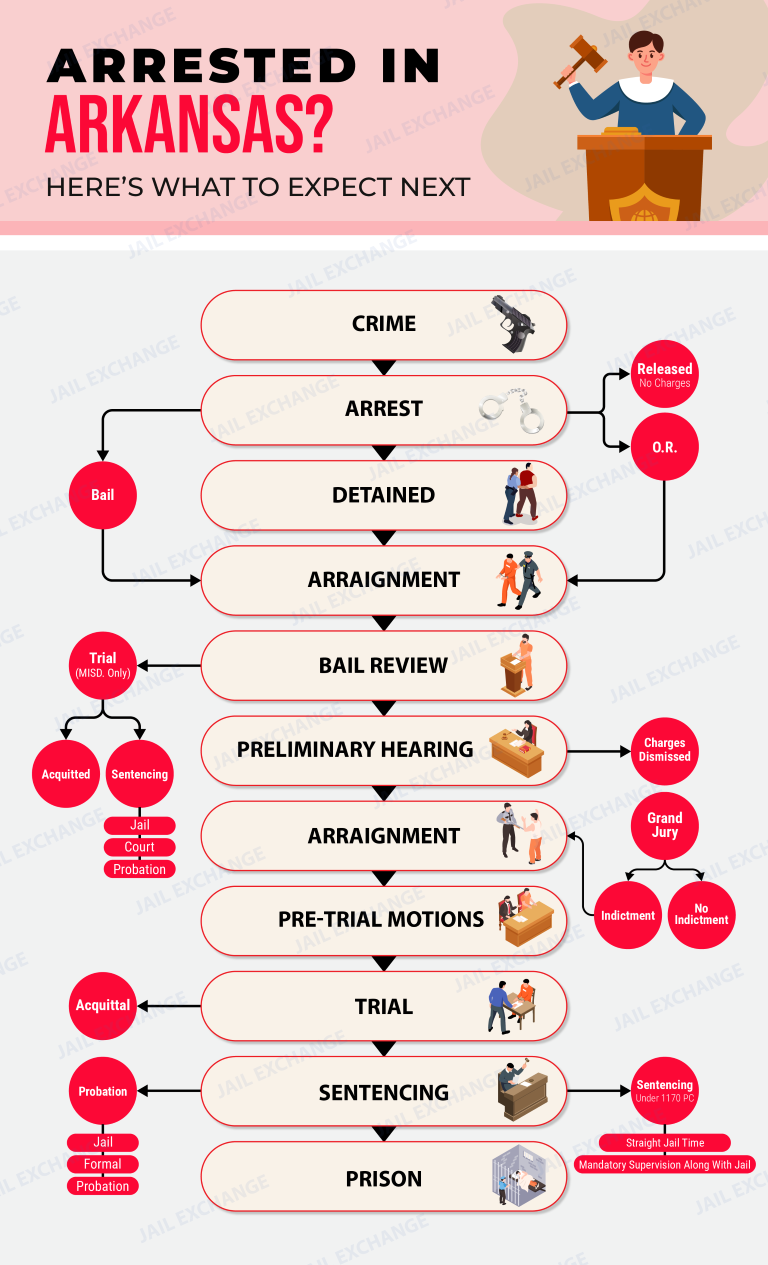
Prairie County Jail Criminal Court Process
Criminal Court Process for Prairie County Arkansas
The Criminal Court Process in Prairie County
Prairie County is one of the Arkansas counties split into two judicial districts, each with its own courthouse. The Northern District Courthouse stands at 200 Courthouse Square, Des Arc, AR 72040, and the Southern District Courthouse is in DeValls Bluff. Felony cases are heard by the Prairie County Circuit Court, which belongs to the 17th Judicial Circuit and shares its judges with White County. The circuit clerk’s office in Des Arc answers at (870) 256-4434, and the DeValls Bluff office at (870) 998-2314. The circuit court also contains the county’s juvenile division and takes appeals from the district court.
Tickets, misdemeanors and the first felony hearings are handled by the Prairie County District Court, which sits in four towns:
- Des Arc (Division 1): clerk (870) 256-9217
- DeValls Bluff: clerk (870) 998-2301
- Hazen: clerk (870) 255-4514
- Biscoe: clerk (870) 998-2226
The elected Prosecuting Attorney for the 17th Judicial District brings state charges in both counties of the circuit. People arrested in Prairie County are typically booked into the sheriff’s jail in Des Arc.
Federal judges do not hold court anywhere in Prairie County. By act of Congress, Prairie County is grouped with Little Rock for federal purposes (the Eastern District’s Central Division), so a federal indictment from here is heard by the U.S. District Court in Little Rock, inside the federal courthouse at 500 West Capitol Avenue, Little Rock, AR 72201, (501) 604-5351. Whose statute was broken decides which court gets a case. A state crime violates the Arkansas Criminal Code, is prosecuted by the local Prosecuting Attorney and is tried in circuit or district court. Federal crimes break laws passed by Congress and is brought by the U.S. Attorney, usually once the FBI, DEA, ATF or a similar federal agency has built the case. Running drugs along Interstate 40 to other states, robbing a federally insured bank, a felon possessing a gun, and fraud using the mail or wires are common federal cases. A single act can sometimes support charges in both systems.
Tap a charge category to see how a Prairie County case tends to unfold.
- Less serious misdemeanor cases (trespass, battery, a first DWI, theft below $1,000)
- Felony prosecutions (break-ins and burglary, theft over $1,000, delivering drugs, repeat DWI)
- The gravest violent crimes (aggravated robbery, rape, murder, capital murder)
- Prairie County court offices
- Federal court for Prairie County
- Inmate searches for Prairie County
- ICE detainers in Prairie County
Less serious misdemeanor cases (trespass, battery, a first DWI, theft below $1,000)
A misdemeanor in Prairie County is filed in whichever district court department covers the place where it happened, so a ticket written in Hazen is answered in Hazen and one from Des Arc goes to Des Arc. A written ticket, with the date printed on it, is how many of these cases begin. If the officer books the suspect at the Des Arc jail, Arkansas procedure rules call for a court appearance without unnecessary delay, and an arrest made without a warrant has to be backed by a judge's probable-cause ruling inside 48 hours. Rule 9.1 asks for the mildest terms that will make sure the defendant returns.
Arkansas sets misdemeanor penalties by class. Maximums run from a year in jail with a $2,500 fine (Class A) down to ninety days with $1,000 (Class B) and thirty days with $500 (Class C). Petty shoplifting, up to the $1,000 mark, carries a Class A grade, as does third-degree battery. Most trespass is Class C. A first DWI sits outside the class system: the judge may impose anywhere from a day to twelve months in jail and fine the driver at least $150 (at most $1,000), on top of a license suspension.
A judge, with no jury, decides district court trials. A conviction can be appealed within 30 days, and the Prairie County Circuit Court then retries it from scratch, where jurors are available on request. Most such cases close with a plea, a fine and probation, or a dismissal. Someone without money for private counsel can request the 17th Judicial District’s public defender, and Arkansas law allows the judge to assess a user fee of up to $400 for that representation.
Children under 18 who commit minor offenses are not sent through the district court calendar in the usual way. Their matters go to the circuit court’s juvenile division, where an intake officer may recommend an informal adjustment, a diversion agreement or a formal delinquency petition. District courts can still handle some traffic and underage tobacco or alcohol citations. Youths facing a delinquency petition have a right to counsel, often a public defender.
Felony prosecutions (break-ins and burglary, theft over $1,000, delivering drugs, repeat DWI)
Following a felony arrest, a district judge normally handles the opening hearing: finding probable cause, fixing a bond amount and taking up any request for a court-appointed lawyer. The state constitution guarantees bail to everyone except people accused of a capital offense backed by strong proof. When the full sum is out of reach, many families use a licensed bondsman, whose fee stays with the company.
Arkansas prosecutors rarely use grand juries. Charges are brought on a written felony information that the prosecutor lodges with the circuit clerk in Des Arc or DeValls Bluff, followed by arraignment, discovery and pretrial hearings. Under Rule 28.1 the state has a year, not counting excluded delays, to bring the defendant to trial, and someone who has been held in jail for nine months without trial on that charge must be released on conditions. Felony trials use a 12-person jury.
Prison ranges climb with the class: zero to six years for D, three to ten for C, five to twenty for B, six to thirty for A, and for Class Y a decade to forty years or a life term. Theft above $1,000 begins as a Class D felony and reaches Class B at $25,000. Residential burglary is a Class B felony. A driver convicted of DWI a fourth time inside a ten-year window faces a felony, while the class of a drug delivery count turns on the substance and the amount. Most Prairie County felony cases end with negotiated pleas, often involving probation or a suspended sentence, about six months to a year after charges are filed.
For 16- and 17-year-olds, the Prosecuting Attorney has a choice. Under section 9-27-318 of the juvenile code, the prosecutor may bring any felony against a youth that age in juvenile court or in adult court. A motion to move the case can come from the defense or the state; in ruling, the judge weighs how serious the act was, the youth’s past record and whether treatment is likely to work, with clear and convincing evidence required to move the case. If the child is locked up, a judge must review that detention within 72 hours. Youth whose cases stay in juvenile court can be placed with the Division of Youth Services, which oversees treatment centers in several regions of Arkansas.
The gravest violent crimes (aggravated robbery, rape, murder, capital murder)
Killings, rapes and armed robberies in Prairie County move like other felonies: a first appearance in district court, then trial before 12 jurors in circuit court. Capital murder carries just two sentences: execution, or life with no parole. Murder in the first degree, rape and aggravated robbery are Class Y crimes, punishable by ten to forty years or life; the lesser charge of second-degree murder is Class A, at six to thirty. Because capital murder is non-bailable when the proof is strong, people charged with it usually remain in custody while the case is pending.
Arkansas still carries out executions at the Cummins Unit. Twenty-three men were on death row as of April 2026, the most recent execution happened in April 2017, and nitrogen hypoxia became a legal alternative to lethal injection in 2025. When the death penalty is sought, specially qualified lawyers from the Arkansas Public Defender Commission’s capital defense unit or the private bar handle the defense. The Protect Arkansas Act, which reaches offenses dated January 1, 2025 or later, removes any early release on capital murder, rape and aggravated robbery terms, with an 85% floor for a long list of other violent offenses.
Arkansas statutes let crime victims and surviving relatives learn about upcoming hearings, speak before sentence is passed and ask for restitution. The 17th District’s victim-witness coordinators help explain those steps. A homicide case in a small county like this one often lasts one to two years.
Adult prosecution reaches down to age 14 when the accusation is one of seven grave offenses, among them capital murder, rape, kidnapping and aggravated robbery, and for 16- and 17-year-olds that option covers every felony. Some juvenile cases are tagged Extended Juvenile Jurisdiction. The youth gets a juvenile sentence, and an adult term is held in reserve in case things go badly. A person who was a minor at the time of the offense cannot be sentenced to die, and a 2017 state law lets a person sentenced for a capital murder committed before age 18 seek parole after serving 30 years.
Prairie County court offices
Prairie County splits its circuit work between two courthouse towns and runs district court in four places:
- Circuit Court, Northern District: 200 Courthouse Square, Des Arc, AR 72040, 870-256-4434
- Circuit Court, Southern District: DeValls Bluff, AR 72041, 870-998-2314
- District Court, Des Arc: P.O. Box 389, Des Arc, AR 72040, 870-256-9217
- District Court, DeValls Bluff: P.O. Box 297, DeValls Bluff, AR 72041, 870-998-2301
- District Court, Hazen: P.O. Box 564, Hazen, AR 72064, 870-255-4514
- District Court, Biscoe: P.O. Box 187, Biscoe, AR 72017, 870-998-2226
Each town court takes the tickets, misdemeanors and opening felony hearings from its own area. The circuit court, sitting in Des Arc or DeValls Bluff, takes felony trials, youth cases and appeals.
Federal court for Prairie County
A federal case from Prairie County is heard by the U.S. District Court for the Eastern District of Arkansas, Central Division, at the federal courthouse in Little Rock, 500 West Capitol Avenue, Little Rock, AR 72201, 501-604-5351.
- The opening federal hearing is run by a magistrate judge.
- A pretrial officer writes up the defendant's background.
- The government may ask that the defendant stay locked up.
- Grand juries hand up the bulk of federal felony charges.
- Federal detainees are held by the U.S. Marshals: U.S. Marshals Service, 600 West Capitol Avenue, Little Rock, AR 72201, 501-324-6256.
Families should plan for the trip to Little Rock for each federal hearing.
Inmate searches for Prairie County
- Prairie County Jail: Prairie County Inmate Search. Shows who is in custody on the Des Arc square.
- VINE: VINELink (https://vinelink.vineapps.com/). Select Arkansas to search custody in every county.
- Federal Bureau of Prisons: Federal Bureau of Prisons Inmate Locator (https://www.bop.gov/inmateloc/). Find a federal prisoner with a name or a register number.
- Arkansas Division of Correction: Arkansas Division of Correction Inmate Search (https://apps.ark.org/inmate_info/). Locate state prisoners by name or ADC number.
ICE detainers in Prairie County
With a detainer, ICE can request that the Des Arc jail hold a person as long as 48 hours beyond release, with weekends and holidays counted. The local charge keeps moving all the same.
Arkansas falls under the ICE New Orleans Field Office, 181 James Drive W, St. Rose, LA 70087, 504-318-2360, and ICE often ships people held around Prairie County to Louisiana sites:
- LaSalle ICE Processing Center: 830 Pinehill Road, Jena, LA 71342 · 318-992-1600
- Pine Prairie ICE Processing Center: 1133 Hampton Dupre Road, Pine Prairie, LA 70576 · 337-599-2400
The ICE Online Detainee Locator System (https://locator.ice.gov/odls/) matches fastest on an A-number, or try a complete name plus birth country.
Here you will find a broad overview of Prairie County criminal cases, offered without legal advice. A person facing charges may hire defense counsel or phone the Prairie County Circuit Clerk at (870) 256-4434 about appointment of a public defender.
Phone the jail (870-256-4138) first, then the town district clerk for tickets and misdemeanors, or the circuit clerk (870-256-4434 in Des Arc, 870-998-2314 in DeValls Bluff) for felonies and youth cases.