San Francisco County Juvenile Hall Criminal Court Process
Criminal Court Process for San Francisco County California
From Arrest to Verdict: San Francisco’s Criminal Courts
Because San Francisco is a combined city and county, one court handles every adult criminal case filed within its 47 square miles, from a shoplifting citation in Union Square to a homicide in the Bayview. That court is the Superior Court of California, County of San Francisco. When California unified its trial courts around 2000, the old municipal court disappeared, which is why no separate “city court” for crimes exists here. Nearly all criminal business takes place at the Hall of Justice, 850 Bryant Street, San Francisco, CA 94103, between Sixth and Seventh Streets in SoMa. The Criminal Clerk’s Office is in Room 101 and answers general questions, filings and records requests at (415) 551-0651. The court’s administrative headquarters at the Civic Center Courthouse can be reached at (415) 551-4000. A few criminal matters are heard elsewhere:
- Hall of Justice, 850 Bryant Street, San Francisco, CA 94103: arraignments, the master calendar (Department 22), preliminary hearings and most misdemeanor and felony trials. Criminal clerk: (415) 551-0651
- Civic Center Courthouse, 400 McAllister Street, San Francisco, CA 94102: some criminal calendars and trials. Main line: (415) 551-4000
- Community Justice Center, 575 Polk Street, San Francisco, CA 94102: a collaborative court serving the Tenderloin, Civic Center and nearby neighborhoods, which pairs cases with treatment, housing and social services
If you are unsure which department a case is in, the daily calendar is posted on the monitor outside Room 101, or you can call the clerk. Choose the San Francisco charge group below to see the usual steps.
- Lesser SF charges (retail theft, first DUI, battery, trespass)
- San Francisco felonies: break-ins, big thefts, drug dealing, injury DUIs
- San Francisco’s gravest cases: homicide, rape, robbery with a weapon
- San Francisco Superior Court locations
- Federal cases in San Francisco
- ICE detainers in San Francisco court
- San Francisco custody searches
- Calling to confirm a San Francisco hearing
- Can I find out about a warrant before going to Bryant Street?
1. Lesser SF charges (retail theft, first DUI, battery, trespass)
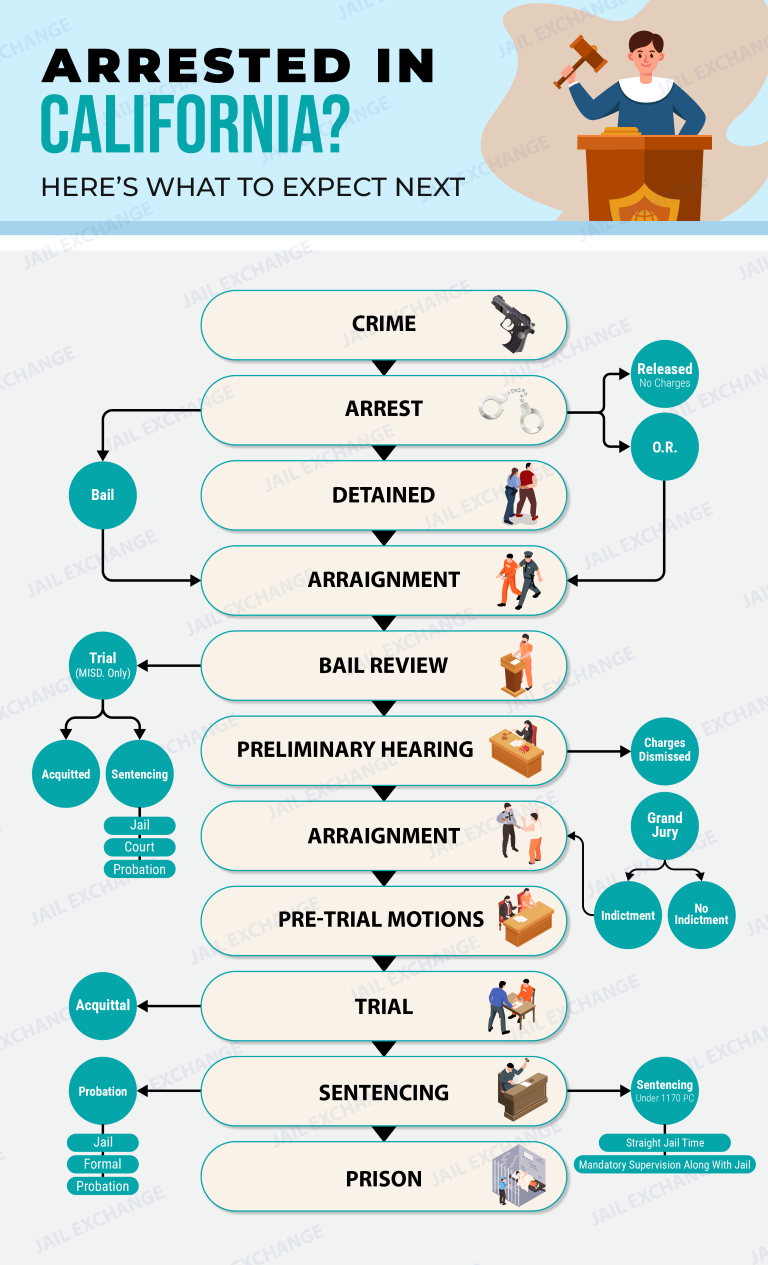
With one government running both city and county, the elected District Attorney files all San Francisco misdemeanors; there is no separate city attorney criminal unit. For lower-level offenses, SFPD commonly cites and releases, with the paperwork naming a date at 850 Bryant. When someone is instead booked into the Sheriff’s custody, state law gives the jail 48 hours, skipping Sundays and holidays, to bring the person before a judge.
That first appearance, the arraignment, is where the charges are formally read and a plea is entered, usually “not guilty” for now. The judge also decides on release terms. A defendant facing possible jail who can’t pay an attorney gets the San Francisco Public Defender, which is unusual in being the only elected public defender’s office in California. That lawyer is assigned by the first hearing, and the state stopped billing people for appointed defense years ago. On many small charges, the attorney can appear in court without the client present.
Pretrial conferences settle most SF misdemeanors through a plea, a downgrade, or dropped charges. Diversion is another path a judge may allow: misdemeanor diversion: if the person finishes counseling, classes or other conditions, the charge is dropped. DUI, domestic violence and offenses that require sex-offender registration are not eligible for diversion. Some Tenderloin and Civic Center cases are routed to the Community Justice Center on Polk Street, where a judge supervises treatment and services instead of a traditional prosecution track. A case that does not resolve is tried to a jury of 12, and a defendant has the right to start trial within 30 days of arraignment if in custody, or 45 days if released, although lawyers often waive that deadline to prepare.
The common ceiling for an SF misdemeanor is six months locked up and a $1,000 fine, with some offenses reaching a year. Sentences more often involve probation, fines, classes or community service. A ticket case often closes in one to several months.
2. San Francisco felonies: break-ins, big thefts, drug dealing, injury DUIs
San Francisco felonies start with a complaint from prosecutors, and the defendant is brought to a courtroom at the Hall of Justice for arraignment within 48 hours of arrest. Release, bail and any protective orders are addressed at that hearing. Under the California Supreme Court’s 2021 ruling in In re Humphrey, a judge who sets bail must take into account whether the person is able to pay it, and release with conditions is often considered as an alternative to money bail. Humphrey started in San Francisco, and in 2026 the court added in Kowalczyk that bail set at 850 Bryant must also be within the defendant’s means.
Defendants who can’t pay get the elected Public Defender from day one. If a conflict blocks that office, for example a co-defendant it already speaks for, a San Francisco judge appoints a lawyer from a panel of private attorneys instead.
Next comes a preliminary hearing, usually inside 10 court days unless the defense agrees to push it, where a judge weighs if the proof is enough for trial. Prosecutors may bypass that step by presenting the case to the county grand jury for an indictment, though that route is uncommon. If the judge sends the case on, prosecutors file an “information” listing the charges, he answers them at a second arraignment, and the 60-day countdown to trial begins unless his lawyer gives it up. Giving up that deadline is common, and the large majority of these cases settle by plea deal, negotiated through the master calendar in Department 22 or the trial departments.
After a guilty verdict or plea, San Francisco Adult Probation prepares a report, and the judge generally imposes sentence within 20 court days of a verdict. Since 2011, many lower felony terms are spent in the county jail on Bryant Street or in San Bruno instead of a state prison. A “wobbler” crime may be filed as a felony or a misdemeanor, and a judge can sometimes lower it afterward. Expect a San Francisco felony to last many months, and sometimes longer than a year.
3. San Francisco’s gravest cases: homicide, rape, robbery with a weapon
Nothing about the basic sequence changes for the gravest charges: arraignment, a preliminary hearing or indictment, and then trial. The differences are in custody, length and exposure. Under the state constitution, denial of bail is allowed in SF for felonies of violence or sexual assault when clear and convincing proof points to a real chance that freeing him would get someone badly hurt. That is why many of these defendants remain in Sheriff’s jail for the whole case.
Under the Three Strikes law, every one of these crimes counts as a strike. One past strike doubles the term, and two past strikes can bring 25 years to life. A violent felony conviction means serving 85% of the prison term at minimum.
- Murder: a conviction for second-degree murder carries 15 years to life, and one for first-degree murder carries 25 years to life. A “special circumstances” finding, like a murder tied to a robbery or rape, raises the punishment to death or life without any chance of release. Only the elected DA in SF can ask for a death sentence, and the governor’s 2019 order has stopped every execution statewide.
- Armed robbery: nine years is the most for the base SF robbery charge. Gun add-ons pile on 10 years, 20 years, or 25 years to life, for using a firearm, firing it, or wounding someone with it. Judges have had the power to drop those add-ons since 2018.
- Rape: as many as eight years, extra if aggravating facts are proven, and registration for life on the top sex-offender tier.
The Public Defender staffs these cases with its most seasoned trial attorneys, and whenever prosecutors seek the death penalty, two qualified defense lawyers must be appointed. Victims hold constitutional rights under Marsy’s Law, including notice of each SF court date, a voice at sentencing, and restitution, with support available through the District Attorney’s victim services unit. Lab work, investigators and expert testimony often keep SF cases open one to three years, while murder trials can take five or longer.
4. San Francisco Superior Court locations
- Hall of justice (criminal): 850 Bryant Street, San Francisco, CA 94103 · 415-551-0651
- Civic center courthouse: 400 McAllister Street, San Francisco, CA 94102 · 415-551-4000
- Polk Street annex: 575 Polk Street, San Francisco, CA 94102 · 415-551-4000
- Juvenile justice center: 375 Woodside Avenue, San Francisco, CA 94127 · 415-753-7800
Here is what each building is used for:
- 850 Bryant Street holds nearly every adult criminal hearing in the city, from first arraignments to jury trials, and the county jail sits in the same block.
- The McAllister and Polk Street buildings near City Hall mainly hear civil, family and probate matters, so a criminal date there is rare.
- Youth cases go to the juvenile center on Woodside Avenue, beside juvenile hall.
- Check the court notice for the department number, since Bryant Street has many courtrooms on several floors.
The Superior Court here has judges who let a party attend some matters remotely through CourtCall, a private vendor that bills per appearance. Approval rests with the judge; after that, the person in the case registers on CourtCall and schedules, a fee waiver from the court pays for it, and many of its departments provide their own free video link.
5. Federal cases in San Francisco
The city's federal arrests go straight to the Northern District of California a short walk from City Hall. A magistrate judge at San Francisco federal courthouse, 450 Golden Gate Avenue, San Francisco, CA 94102 opens the case, Pretrial Services reports, and the court decides detention. Marshals: U.S. Marshals Service, 450 Golden Gate Avenue, 20th floor, San Francisco, 415-436-7677.
6. ICE detainers in San Francisco court
Bryant Street judges move forward regardless of a detainer. SB 54 and city law limit jail cooperation at release. The immigration court in San Francisco is a separate federal system. Defense counsel should explain immigration effects before a plea. ICE: San Francisco ICE field office, 630 Sansome Street, Room 590, San Francisco, CA 94111, 415-365-8800; detention sites:
- Mesa Verde ICE Processing Center: 425 Golden State Avenue, Bakersfield, CA 93301
- Golden State Annex: 611 Frontage Road, McFarland, CA 93250
- California City detention site: 22844 Virginia Boulevard, California City, CA 93505
7. San Francisco custody searches
- San Francisco County Inmate Search: Sheriff's jails.
- VINELink (https://vinelink.vineapps.com/): statewide.
- Federal Bureau of Prisons Inmate Locator (https://www.bop.gov/inmateloc/): federal; pretrial 415-436-7677.
- CDCR Inmate Locator (https://inmatelocator.cdcr.ca.gov/): prison.
- ICE Online Detainee Locator System (https://locator.ice.gov/odls/): A-number or name and birth country; 415-365-8800.
8. Calling to confirm a San Francisco hearing
Most criminal cases are heard at 850 Bryant Street. Call the clerk's office at 415-551-0651 with the case number and ask for the department and time. If he is still in custody, the Sheriff's intake line, 415-553-1430, can confirm the court list.
9. Can I find out about a warrant before going to Bryant Street?
Yes. SFPD and Sheriff's deputies both serve warrants in the city. The Sheriff's Office at (415) 554-7225 can search a name across the city's file and California's, or your lawyer can run the check ahead of time. The Superior Court's case information page finds criminal cases by name or number. Your lawyer can arrange surrender at the Intake and Release Center, 425 7th Street, or petition the judge for a recall. The Hall of Justice criminal clerk at 850 Bryant Street handles questions about new dates.
Use this as a broad San Francisco guide only; it isn’t legal advice. Anyone charged in the city can retain private counsel, or call the San Francisco Public Defender at (415) 553-1671.