New Castle County Juvenile Detention Center Criminal Court Process
Criminal Court Process for New Castle County Delaware
Delaware is split into three counties. New Castle sits at the top of the state, Kent is in the middle and Sussex covers the south. Here’s the twist: none of the three has its own jail. One state agency, the Department of Correction (DOC), runs every lockup in Delaware. That includes the place someone sleeps the night of an arrest, the prisons where long sentences are served and the centers for treatment and work release. So whether a person is picked up in Newark, Dover or Rehoboth Beach, they end up in a DOC building. Here are the sites, sorted by area:
- New Castle County
- Howard R. Young Correctional Institution (“Gander Hill”), 1301 East 12th Street, Wilmington, (302) 429-7700. Grown men, mostly detainees, meaning people whose cases aren’t finished yet.
- Baylor Women’s Correctional Institution, 660 Baylor Boulevard, New Castle, (302) 577-3004. The state’s prison for women from every county, before trial and after sentencing.
- Hazel D. Plant Women’s Treatment Facility, 620 Baylor Boulevard, New Castle, (302) 777-6800. Women in drug and alcohol treatment and work release.
- Plummer Community Corrections Center, 38 Todds Lane, Wilmington. Closed in March 2026. The men it used to take now go mostly to the treatment center near Smyrna, with some sent to Georgetown or placed on home confinement.
- Near Smyrna (where Kent and New Castle meet)
- James T. Vaughn Correctional Center, 1181 Paddock Road, near Smyrna, (302) 653-9261. Delaware’s biggest prison, about 2,600 men, including maximum security and Kent County men awaiting trial.
- Community Corrections Treatment Center (CCTC), 875 Smyrna Landing Road, near Smyrna, (302) 659-6100. A 250-bed center for men in treatment, plus the New Castle County work release program.
- Kent County
- Morris Community Corrections Center, 300 Water Street, Dover. Closed. Kent men who would have gone there now go mainly to CCTC near Smyrna, and a few to Georgetown.
- Sussex County
- Sussex Correctional Institution (SCI), 23203 DuPont Boulevard, Georgetown, (302) 856-5280. Sussex men awaiting trial, plus men serving medium- and minimum-security sentences.
- Sussex Community Corrections Center (SCCC), 23207 DuPont Boulevard, Georgetown, (302) 856-5790. Work release, treatment and a probation-violation program.
A quick word on “levels.” The DOC ranks supervision from Level I to Level V. Level V means prison. Level IV means a person lives at a state center but gets more freedom, such as leaving for a job. Hazel D. Plant, CCTC and SCCC are all Level IV.
The state courts. Delaware uses four kinds of court for criminal cases, and each county has its own set:
- Justice of the Peace (JP) Court is the first stop after an arrest. A magistrate, which is a JP judge, sets release terms and handles a few small charges.
- Court of Common Pleas decides most misdemeanors for adults and holds early hearings in felony cases.
- Superior Court tries felonies, the serious crimes.
- Family Court takes cases against kids, along with some adult misdemeanors where the victim is a family member or partner.
Where to find them in each county:
- New Castle: JP Court 11, 2 Penns Way, Suite 100A, New Castle, (302) 323-4450, open around the clock. JP Court 20, 824 N. Market Street, Wilmington, weekdays. Common Pleas ((302) 255-0900), Superior Court ((302) 255-0800) and Family Court ((302) 255-0300) all share the Leonard L. Williams Justice Center, 500 N. King Street, Wilmington.
- Kent: JP Court 7, 480 Bank Lane, Dover, listed as open 24 hours. Common Pleas ((302) 735-3900) and Superior Court ((302) 735-1900) are in the Kent County Courthouse, 414 Federal Street, Dover. Family Court is at 445 S. Governors Avenue, Dover, (302) 672-1000.
- Sussex: JP Court 3, Shortly Road, Georgetown, (302) 856-1445, open 6 a.m. to midnight. After 11 p.m., new arrests are sent up to JP Court 7 in Dover. Common Pleas ((302) 858-5700) and Superior Court ((302) 855-7055) are in the Sussex County Courthouse, 1 The Circle, Suite 2, Georgetown. Family Court moved into a new Georgetown building in November 2025, (302) 855-7400.
One office, the Delaware Department of Justice, led by the Attorney General, prosecutes crimes in every county. If someone can’t afford a lawyer, the Office of Defense Services, Delaware’s public defender, can step in. Its main office is at 820 N. French Street in Wilmington, (302) 577-5200, with branches in Dover, (302) 739-4476, and Georgetown, (302) 856-5310. When the defenders can’t take a case, often because they already speak for a co-defendant, the Office of Conflicts Counsel finds an outside lawyer, (302) 468-5074.
Free case lookup: The courts run a free search tool named CourtConnect. It sounds handy, but it only covers civil matters, like lawsuits and money judgments from JP Court, Common Pleas and Superior Court. You won’t find criminal charges on it. To follow a criminal case, try the courts’ calendars page. Superior Court posts its criminal trial and suppression hearing lists there, along with sentencing lists. (A suppression hearing is where a judge decides whether certain evidence can be used.) New Castle’s lists come out weekly, while Kent’s and Sussex’s come out monthly. Common Pleas doesn’t put its criminal dates on that page. Your other option is the phone. Superior Court criminal case management answers at (302) 255-0693 in New Castle, (302) 735-1902 in Kent and (302) 855-7046 in Sussex. You can also try the Common Pleas clerk numbers listed above. Before you dial, write down the person’s full legal name and date of birth.
Federal court: The whole state shares one federal courthouse. Cases there go before the U.S. District Court for Delaware, which meets in the J. Caleb Boggs Federal Building, 844 N. King Street, Wilmington, (302) 573-6170. So what decides whether a case is state or federal? Most crimes break Delaware law, so they stay in the state courts above. A case turns federal when it breaks a law written by Congress, or when it happens on land owned by the U.S. government. Some Delaware examples: a fight or theft on Dover Air Force Base, moving drugs or guns along I-95 or Route 13, smuggling through the Port of Wilmington, robbing a bank, or scamming people online. Choose a charge type below for the state steps.
- Misdemeanors and probation violations: shoplifting, DUI, disorderly conduct
- Felonies: break-ins, selling drugs, car theft, illegal gun possession
- Violent felonies: murder, rape, armed robbery, kidnapping
Misdemeanors and probation violations: shoplifting, DUI, disorderly conduct
Lawmakers call the smaller crimes misdemeanors. Once someone is arrested, police bring the person to a JP Court, where a magistrate holds the initial presentment. Think of it as the opening step in court. The charges are explained, and the magistrate sets the rules the person must follow to go home.
Back in 2018, Delaware changed how bail works. Magistrates now look at a risk assessment, a score that guesses how likely someone is to skip court. Cash bail is used much less. Plenty of people charged with misdemeanors walk out the same day without paying anything, though they may have to check in with a pretrial officer or avoid contact with someone. A man who can’t meet the terms waits at Gander Hill, Vaughn or SCI, depending on the county. A woman waits at Baylor.
Most misdemeanor cases are decided in Common Pleas, and anyone charged there can ask for a jury. A handful of small charges finish in JP Court. If the alleged victim is a relative or partner, Family Court usually takes the case. The longest possible punishments are:
- Class A misdemeanor: up to a year locked up and a $2,300 fine
- Class B misdemeanor: up to six months and $1,150
- Unclassified misdemeanor: up to 30 days and $575, unless the specific law sets another limit
Probation violations at the treatment centers: Lots of people at Hazel D. Plant, CCTC and SCCC are there because of a violation of probation, or VOP. Probation lets a person serve a sentence out in the community if they follow rules. Failing a drug test, missing a check-in or breaking curfew are rule breaks. The probation officer can then use an administrative warrant, which is an arrest order that comes from the probation office instead of a judge. The person goes back to the court that gave the original sentence. That means Superior Court for a felony and Common Pleas for a misdemeanor. No jury sits in on it. The State just needs “some competent evidence” of a broken rule, which is much easier to meet than the proof needed at a trial. If the person admits the violation, that settles it. The judge can put them back on probation, move them up to a Level IV stay at a treatment center, or send them to prison for no longer than the suspended time left on the old sentence. At SCCC, the 250-bed Sussex Violation of Probation Center is built for short, strict stays with 5 a.m. wake-ups and community service.
Under 18: Kids’ cases go to Family Court instead of the adult courts. For a first small offense, police may give a teen a Juvenile Civil Citation. That means the teen completes a program in place of being formally charged.
Felonies: break-ins, selling drugs, car theft, illegal gun possession
A felony is a crime that can bring more than a year in prison. The case still opens with a JP magistrate. Men who aren’t released wait at the prison for their county: Gander Hill for New Castle, Vaughn for Kent and SCI for Sussex. Women from anywhere in Delaware wait at Baylor.
Next, a Common Pleas judge may hold a preliminary hearing. The question is whether there’s probable cause, meaning there’s a fair basis for thinking this person did the crime. Prosecutors can skip that step and go to a grand jury instead. That’s a group of local residents who look at the evidence in private. If they agree, they hand up an indictment, the official charge. After that, the case moves to Superior Court for an arraignment. At the arraignment, the charges are read out and the defendant says “guilty” or “not guilty.”
Delaware sorts felonies into seven classes, from A (worst) to G. Class B carries 2 to 25 years. The top limits for the rest are 15 years for C, 8 for D, 5 for E, 3 for F and 2 for G. Judges can look at the SENTAC guidelines, a chart of suggested sentences, but they aren’t required to follow them. Most felony cases end in a plea deal, where the defendant admits to a charge and gets something easier in return. If there is a trial, 12 jurors hear it. Many sentences step down over time, from prison to a Level IV center like CCTC or SCCC and then to probation.
Under 18: Family Court keeps nearly all teen felony cases. If a judge orders a teen held, the Division of Youth Rehabilitative Services runs two detention centers: the New Castle County Detention Center in Wilmington and Stevenson House in Milford. A judge has to review that detention within 14 business days and again at least every 21 days. A teen found responsible might get probation, counseling or a state youth program such as the Ferris School.
Violent felonies: murder, rape, armed robbery, kidnapping
Violent felonies are tried in Superior Court in the county where they happened. A judge may refuse release to someone who seems dangerous. Because of that, many of these people stay locked up for the whole case, men at Gander Hill, Vaughn or SCI and women at Baylor. These cases can drag on for a year or more. The Level IV treatment centers don’t hold people waiting on violent charges.
- Class A felony, such as first-degree rape: at least 15 years, up to life
- Class B felony, which includes most first-degree robbery: 2 to 25 years
- First-degree murder by an adult: a life sentence, and parole is never allowed
Delaware no longer has a death penalty. In Rauf v. State, decided August 2, 2016, the Delaware Supreme Court ruled the old law unconstitutional. Then, on September 26, 2024, Governor John Carney signed House Bill 70, which took it out of the law books.
Under Delaware’s Victims’ Bill of Rights, crime victims can be told about court dates and get a turn to talk in court when it’s time to sentence. The Attorney General’s Victim/Witness program answers toll free at (800) 870-1790. The county lines are (302) 577-8500 for New Castle, (302) 257-3293 for Kent and (302) 752-3263 for Sussex. The DOC has its own victim information line at (302) 857-5440.
Under 18: A few very serious charges send a teen’s case to Superior Court right away. For 16- and 17-year-olds, that list includes murder, first- or second-degree rape, first-degree assault and some armed robberies. For murder and the top rape charges, it can start as young as 13. The teen’s lawyer can then ask for a reverse amenability hearing. In plain words, that’s the teen’s chance to show the judge that Family Court can still help and that moving the case back is fair. If the judge says no, adult penalties apply.
This guide sketches how Delaware cases usually unfold; it isn’t legal advice. When a family member is facing charges, a lawyer is the right next step, or you can call the Office of Defense Services at (302) 577-5200.
Criminal Court Process for New Castle County Delaware
New Castle County Delaware Criminal Court System - Definitions
It might be helpful to define some words that will be used on this site, when explaining the Delaware Court System and how it works. The definitions on this site are for general information and not legal advice. It is always preferred to follow information given by your attorney or local authorities.
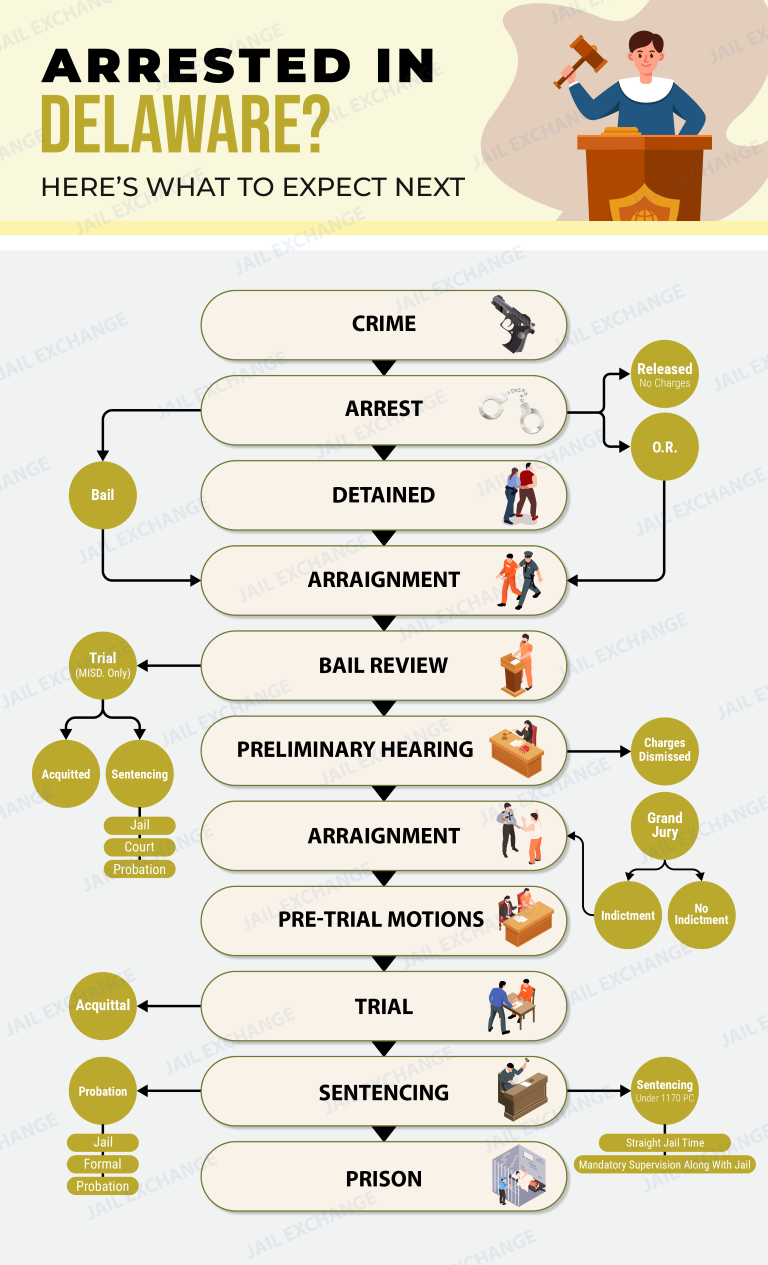
If you scroll down below this content, and the listing of the courts in New Castle County, you will find a simple flowchart diagram and a video that will help you visualize the stages of the Criminal Court Process.
Arrest is when Delaware, New Castle County or local police take a person into custody and start the legal process. The arrested person may or may not be immediately jailed.
In less serious crimes, the person may only be given a citation ordering that they appear in municipal or New Castle County court on a certain date. In cases involving more serious crimes, the person is usually placed in the county jail until an arraignment, or a judge decides the next step.
Booking is when the New Castle County sheriff or local police gather information such as the detainee’s name, address and why the person is being arrested. Booking also includes fingerprinting, criminal history, investigation, and verification of identity. Bail for lower-level crimes may be set right after booking so the arrested can “bail or bond out” before being detained.
The prosecution, sometimes called “the government” or “the people” or “the state” is the side that presses the charges and seeks punishment for the offense. These are attorneys that work for the state of Delaware, New Castle County or a city or town. The prosecuting attorney for New Castle County or the district is called the Deputy Attorney General. Delaware is different than almost every other state because the district courts are not served by a county prosecutor but rather a state prosecutor. A U.S. Attorney prosecutes federal cases.
Jurisdiction is an important term in the court system that means whether a court has the obligation or duty or right to handle a case. For example, if you run a red light in your town or city, a municipal court would likely have jurisdiction over your case, but the next town or city over would not have jurisdiction over your case. If you attempted to flee from police when they attempted to stop you after you ran the red light, it becomes a more serious crime, and the municipal court might not have jurisdiction so you might be assigned to a higher-level court that has jurisdiction over the more serious crime. Jurisdiction varies from state to state and sometimes county to county.
Arraignment is when a judge determines whether the charges are supported by the prosecution’s initial evidence and tells the arrested what they are charged with, and the person says whether they are guilty or not guilty. At this time, the person is called the defendant, and the opposing side is called the prosecution. If there is reason to believe that the arrested is guilty, the judge will set bail conditions or send the defendant to jail or release them ROR (release on recognizances). An arraignment is not a trial, and the defendant is entitled to a trial within a reasonable amount of time after the arraignment.
Bail is money paid that is held by the New Castle County or municipal court to make sure that the arrested does not flee the area before their trial. Bail amounts and other conditions are determined at the arraignment.
Once the case is over, the bail money is returned to the defendant. If a person does not pay bail, they remain in the New Castle County Jail until their trial. Bail can be denied if the court feels that the arrested would be a danger to others if released. Sometimes the court decides that there is a good chance that the arrested will show up for trial and not flee so they are released on their own promise, or recognizance without having to pay bail.
A bond proceeding is the determination of how much bail is to be paid and usually happens at the same time as an arraignment. During bond proceedings, the defendant can have an attorney present but does not have the right to an attorney. A judge or court officer in the {county extended} or municipal court sets bail. Judges in Delaware rely on a statewide bail schedule, which sets out a recommended range of bail amounts for different offenses. Judges can still exercise discretion in setting bail above or below the recommended range.
The types of bail in Delaware include:
- Own Recognizance Bail where the defendant is not required to pay any money but signs a bond guaranteeing that they will appear at future court appearances. If the defendant does not show, the full amount will be due and the people who signed the paperwork will be responsible for paying the court.
- Cash Only
Unsecured Bail is when the defendant signs a bond guaranteeing appearance for future court appointments and if the defendant does not show, the court will require that the bail amount be paid.
Surety Bond is when defendant pays a percentage of the bond amount (usually 10%) to a professional bondsman or bail bond company licensed to do business in Delaware, {county extended}. The bondsman then signs the bond on behalf of the defendant. The defendant does not receive any of the money back. If the bondsman feels the defendant is a flight risk, they can refuse to give a bond or charge a higher fee. For example, a bondsman may determine a defendant is a flight risk if they are from a state other than Delaware.
A Property Bond is a bond in which the bond is pledged in land or home real estate (mobile homes are not accepted). Usually, the property must be in New Castle County, and it must be worth at least the amount of the bond.
It is always important to have family involvement after being arrested. Not only can they make calls and communicate on your behalf (not all bond companies will accept collect calls), but family support will show the court that there are people who will make sure that the defendant makes it to court, not only for the defendant’s own good, but because they may have signed bond paperwork and responsible to pay if the defendant does not show in court. Chances of obtaining a bond from a bond company or clerk of court are better if family is involved.
(There have been phone scams where a bond company calls and informs a person that their family member has been arrested and they ask for financial information. A bondsman will not call asking for money without involvement of the arrested.)
A criminal defense attorney (also called lawyer or counsel) is hired or retained to represent the arrested as early as possible after the arrest.
If there is a chance that the case might go to trial and the defendant cannot afford an attorney, the 6th Amendment of the U.S. Constitution requires that the court provide an attorney. This is called indigent representation and a public defender or assigned attorney would represent the defendant in all proceedings. Indigent representation is only available misdemeanor and felony cases that could result in jail time, juvenile cases, and certain appeal cases. If the defendant proves that money is not available to pay an attorney, the State of Delaware funds the public defenders that represent the indigent defendants and one would be assigned at the court.
For less serious cases or civil cases, there are pro bono volunteers who volunteer legal services for free or for a small fee. They often will hold clinics to teach people how to represent themselves in court. This website provides contact information for pro bono services in Delaware.
Many courts will provide forms and help for people who want to represent themselves, called pro se. Here is a link for self-help in Delaware.
A district court can refer to the first level of the legal system, or a minor court. District courts are in the community. A district court can also refer to a U.S. Federal District Court that hears federal cases. There is one U.S. federal district court in Delaware. It is important that you check the address of the court you are to appear in rather than to ask someone because that person might give you directions to the wrong “district” court. Being late to court can land you in custody as well.
Pretrial proceeding is the process where both sides (prosecution and defense) gather information, interview witnesses, request records, videos etc. Pretrial proceedings also include communications with the judge assigned to the case and these appearances are either in person or by on-line conferencing. Some pretrial proceedings may not require a defendant’s appearance, allowing an attorney to appear in their place. The information that is gathered is called discovery and both sides must share the information that they have gathered. This information does not include conversations between the arrested and their attorney.
Most cases do not go to trial because both sides reach a plea deal, where both sides try to reach a reasonable punishment based on what was learned in the pretrial proceedings. A plea deal can only happen if the accused person admits they are guilty in exchange for a lighter punishment. The reason they must admit guilt is because it would not be fair to punish someone who claims they are not guilty. There are times in plea bargaining when the prosecution agrees to give a lighter sentence in exchange for information leading to the arrest of a more serious criminal related to the crime.
Trial is where both sides share their information in front of a judge or a judge and jury. After listening to all the evidence, the judge or jury decides the verdict which is whether the person is guilty or not guilty. If a court has only a judge hearing both sides, it is called a bench trial. If a jury is selected, it is called a jury trial. If the defendant is found not guilty, they are released. If they are found to be guilty, the next step is sentencing.
Sentencing is the punishment that the judge decides the person should get. This could be jail or prison time, fines, community service, probation, or a combination.
Appeal is asking for a higher court to hear the case again at an appellate court. If the accused person thinks something went wrong at trial or has new information that was not available during the trial or that the sentence is too harsh, the defense attorney can ask for an appeal. It is not unusual for an appeal when there is a long jail sentence, but an appeal can be denied if the appellate court feels that the original trial or sentencing was fair.
Delaware Felony vs Misdemeanor
In Delaware, a misdemeanor is divided into Class A or B. Class A misdemeanors have punishments of jail for up to 1 year and fines up to $2300 and possibly other conditions. Class B misdemeanors have punishments of 6 months in jail and fine up to $1,150 and possibly other conditions.
A felony crime is a more serious crime than a misdemeanor and is divided into 7 categories, Class A is the most serious with 15 years to life imprisonment and Class G is the least serious with up to 2 years in state prison. A felony is a crime to where the punishment is more than one year in prison. Examples of felony crimes are murder, rape, theft, aggravated assault, drug trafficking, kidnapping and identity theft.
The New Castle County Clerk of Court is an elected official whose responsibilities for Criminal Court’s administrative issues include receiving criminal warrants, receiving bail, creating the trial schedule, receiving fees, fines and maintaining court records.
A warrant is used to get someone to appear in court or to law enforcement. There must be good reason to believe that the person is involved in a crime. The warrant gives authority to arrest the person and search for evidence for the investigation of the crime.
A criminal summons is issued to request that a person appear in court at a particular time and date. It does not involve an arrest. A traffic ticket, summary citation or lesser misdemeanor could be considered a summons if you are given a court date.
A summary citation, commonly referred to as a ticket, is a criminal summons by a law enforcement officer either in person or via mail accusing the defendant of a minor offense, stating potential fine, listing the court having jurisdiction and instructions for addressing the issue. Defendants may or may not be required to appear in court or handle the matter by entering a plea via mail.
Fines are usually paid to the District Court or clerk of court and payment methods can be found on the District Court or New Castle County Clerk of Court website. If you do not pay your fine on time, you can lose your driver’s license, must pay additional fees or even have a warrant for your arrest. It is important to read the instructions on the ticket issued by the police officer or court at the time of your arrest. For a parking ticket or summary citation, the fine amount and how to send payment should be on the ticket.
Delaware Criminal Court System - How it Works
In Delaware, there are several types of courts that handle criminal cases including Supreme Court (for appeals), Superior Court, Family Court, Court of Common Pleas and Justice of the Peace courts. In May of 1998, Municipal Court merged with Court of Common Pleas and the Justice of the Peace Court.
Justice of the peace courts can hear lower-level misdemeanor cases and violations, most motor vehicle cases, violation of county and city codes, alcoholic beverage violations, limited juvenile offenses. Justice of the Peace courts can issue warrants for all criminal offenses and conduct initial appearances and set bond for all criminal offenses.
Court of common pleas handles misdemeanors including drug offenses, motor vehicle offenses. The Court of Common Pleas can also hold preliminary hearings for felony charges and appeals from the Justice of the Peace Courts. The Court receives approximately 97% of its criminal cases from the Justice of the Peace Courts.
Superior court handles all criminal cases and is the only court that can handle felonies and drug offenses (not including minors and also marijuana cases). It can hear certain appeals from the Court of Common Pleas.
Family court handles juvenile cases, adult misdemeanor crimes against juveniles, orders of protection and misdemeanor crimes between family members. The following link is for the Delaware Division of Youth Rehabilitative Services.
Specialty courts are being adopted in many states as a way to handle cases that involve non-violent and first-time offender cases in a way to where the offender can retain a job or responsibilities while following specific orders of the court as returned court appearances, periodic evaluations or testing for substances.
The Delaware Court of Common Pleas provides specialty courts in the area of DUI treatment, Drug Rehabilitation for non-violent offenders, Mental Health court and a Trauma Informed Probation Program. In addition, Delaware Superior Courts hold Problem-Solving court for mental health, drug rehabilitation, reentry and veterans treatment court.
District courts of appeal conduct review of cases on appeal from county and circuit courts.
The Delaware Supreme Court is like our United States’ Supreme Court because it has a panel of judges that rule on matters that have to do with someone’s constitutional rights or policies and laws. The Delaware State Supreme Court deals with the state constitution or laws or policies. Sometimes the Supreme Court will hear criminal cases on appeal when there is a question on the state laws or procedures that lead to the appeal.
The criminal cases are usually referred from the district courts of appeal.
FEDERAL COURT
Federal Court deals with crimes involving violations of United States laws. Federal crimes include federal drug trafficking, federal tax evasion and fraud that crossed state lines and include crimes that occur on federal property as post offices or federal buildings.
Cases involving crimes that involve the FBI or DEA or Immigration agencies are federal crimes. Terrorism is a federal crime.
There are some differences in the Federal court system as compared to the Delaware state court system. For example, the attorneys who work for the courts are called United States Attorneys and Federal judges are called District Court Judges (not to be confused by local state district courts).
Federal Magistrate Judges hear the case early on, but they do not decide on the cases at a trial like the Federal District Court Judges. In a federal case, a grand jury is used for indictments.
There is one U.S. Federal Judicial District in Delaware.