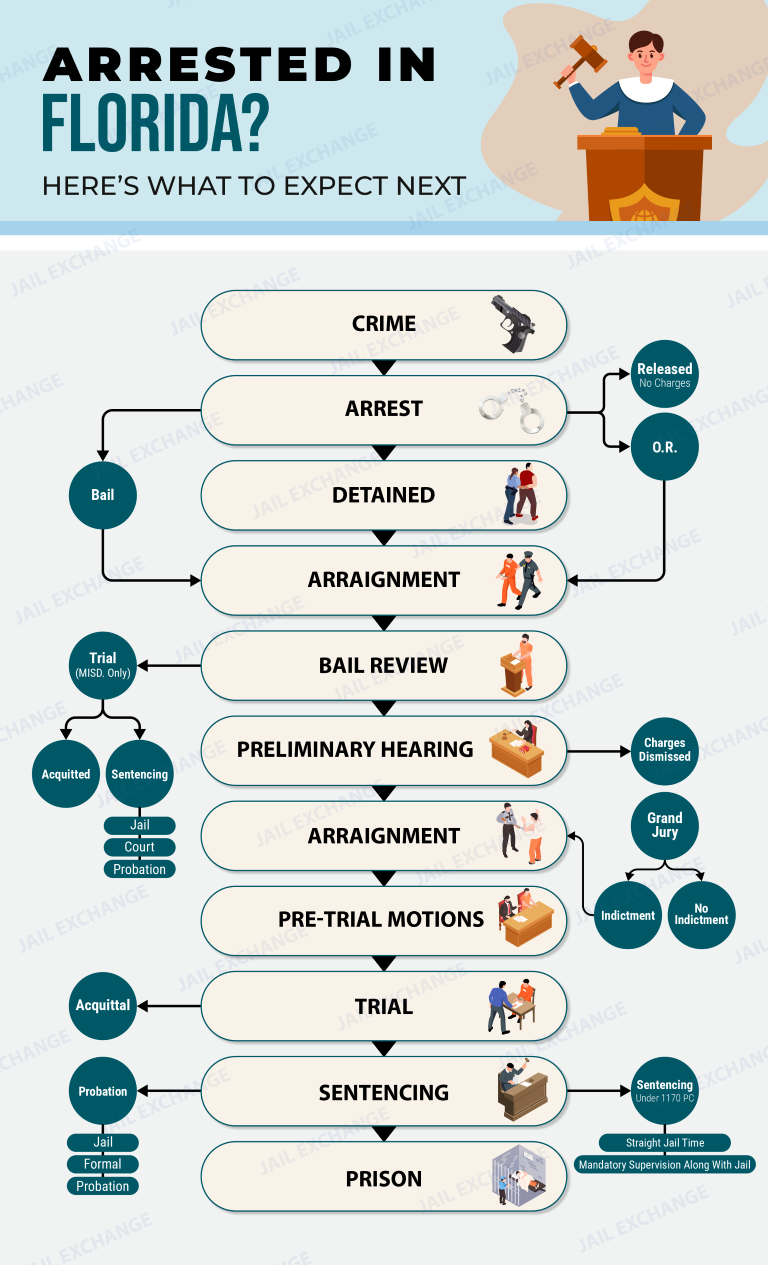
Joseph Conte Facility Criminal Court Process
Criminal Court Process for Broward County Florida
Broward County Criminal Court Explained
Broward is home to almost 2 million people, from Fort Lauderdale and Hollywood to Pembroke Pines and Coral Springs, yet its criminal courts boil down to two. Broward County Court hears misdemeanors (minor crimes), criminal traffic charges like DUI, and breaks of local ordinances. Broward Circuit Court hears felonies (major crimes) and juvenile cases. Broward is a judicial circuit all by itself, the Seventeenth Judicial Circuit, so no other county shares its judges. The main criminal courthouse is the Broward County Courthouse, 201 SE 6th Street, Fort Lauderdale, FL 33301. The Clerk of Courts’ main line is (954) 831-6565. Everyone arrested in Broward is processed at Central Intake inside the Broward Sheriff’s Office Main Jail, 555 SE 1st Avenue, a block from the courthouse. You can also check our bond guide and inmate search guide.
Search a case for free: The Broward Clerk’s public Case Search lets anyone look up court cases without signing in. Search by party name or by case number to see charges, hearings and outcomes. Juvenile, sealed and expunged files won’t appear, and certain documents open only for registered users.
Federal court: Broward is covered by the Southern District of Florida, Fort Lauderdale Division, whose courthouse stands at 299 E. Broward Boulevard. Here’s the basic split: the state prosecutes crimes under Florida law, and the federal government prosecutes crimes under U.S. law or on federal property. Broward sees many federal cases because of Port Everglades, Fort Lauderdale-Hollywood International Airport, and the Coast Guard station at the port, all places where drug and gun smuggling by sea or air gets caught. Big health care and investment fraud cases are often federal too. Broward also contains tribal land: the Seminole Tribe’s Hollywood Reservation, part of the Big Cypress Reservation out west, and Miccosukee land along Alligator Alley. Florida has authority over most crimes on these reservations, but some cases there can become federal. Choose a topic below.
1. Misdemeanor court in Broward: DUI, retail theft, cannabis, domestic battery
Lots of small Broward cases never involve a jail cell. The officer writes a notice to appear, you sign it, and you show up on the date it names. Get arrested, though, and BSO deputies take you to Central Intake. People still inside by morning see a magistrate at first appearance, which Florida requires within 24 hours, even on Sundays. BSO says those Main Jail hearings usually kick off around 8 a.m., and relatives may watch on lobby monitors. Until the magistrate rules, release amounts come from the 2026 statewide bond schedule, a Florida Supreme Court list that names the smallest bond allowed per offense. Put simply, a bond is money or a pledge left with the court so the judge trusts you to return. Domestic violence and certain other arrests mean waiting for the magistrate no matter what. State-licensed bondsmen near the Fort Lauderdale jail usually collect a 10% premium when posting a state bond.
Who prosecutes? The Seventeenth Circuit State Attorney, elected by Broward voters, handles every state crime here. Who defends Broward defendants who can't pay a lawyer? The Broward Public Defender, also elected, whose main office is in the SE 6th Street courthouse; a judge decides who qualifies. Conflict cases can be assigned to regional conflict counsel or to private court-appointed attorneys. Under Florida Statute 938.29, a Broward judge can order a convicted person to pay back the cost of that defense, and unpaid fees may turn into a lien.
Penalties stay modest in Broward County Court. A first-degree misdemeanor, DUI for example, can bring as much as a year inside a BSO jail, and the fine may hit $1,000. For a second-degree misdemeanor, Broward judges can go no higher than 60 days and $500. Diversion programs and specialty courts, like mental health court, give some defendants a path to dismissal. The speedy trial rule calls for a Broward misdemeanor trial within 90 days of formal charges, a deadline defendants may give up. Six jurors hear these trials.
Under 18: Broward teens charged with crimes go to the Circuit Court's juvenile division. For many first-time minor offenses, a Fort Lauderdale or BSO officer may skip the arrest and issue a Section 985.12 civil citation; the teen completes assigned tasks and keeps a clean record. A held Broward youth gets a detention hearing within 24 hours, where the judge chooses home or secure detention.
2. Broward felony court: burglary, car theft, fraud, drug trafficking
Once first appearance is over, a Broward felony file lands with a Circuit Court judge at the downtown courthouse. Prosecutors read the BSO or city police report and, if they decide to go forward, file an information listing the formal charges. The accused then enters a plea at arraignment. During discovery, each side hands over its evidence, and a string of pretrial hearings follows.
How long can a Broward felony sentence be? It depends on the degree. Third-degree crimes, including grand theft over $750 and most drug possession, cap out at 5 years of prison time. Second-degree crimes, such as a home burglary, cap out at 15. First-degree crimes cap out at 30. Next comes Florida’s Criminal Punishment Code scoresheet, which turns the charge and the person’s record into points, and the total sets the lowest sentence Broward judges may impose without special reasons. Once in prison, a person has to serve 85% of the time, at minimum. Felony drug court and veterans treatment court are options for some defendants.
Broward felonies get a 175-day speedy trial clock, but in Broward’s busy courtrooms the defense often waives it. Non-capital felony juries are six people.
Under 18: A Broward teen held on a felony goes to the Broward Juvenile Detention Center on NW 22nd Avenue, which the Department of Juvenile Justice runs. Prosecutors in Fort Lauderdale may use Section 985.557 to “direct file,” which means charging the teen in adult court. In Broward, most felony charges qualify for youths of 16 or 17, while only a set of grave offenses qualifies at ages 14 and 15. Mandatory direct file ended statewide in 2019, leaving the call to Broward’s elected State Attorney.
3. Serious violence cases in Broward: murder, armed robbery, carjacking, sexual battery
A violent charge travels the same Broward Circuit Court route, with much higher stakes. The State Attorney may ask for pretrial detention, urging the judge to hold the defendant with no bond. Guns bring in the 10-20-Life statute (Section 775.087). For crimes on its list, holding a firearm sets a minimum of 10 years; pulling the trigger, 20; injuring or killing a victim with the shot, 25 years up to life. Certain sexual batteries and armed carjackings rank as life felonies.
At the very top is the capital felony, usually first-degree murder. In Broward, that charge requires a grand jury indictment and a trial in front of 12 jurors, and the only sentences are death or life without parole. A 2023 law lowered the bar for a death verdict in Broward and statewide: 8 of the 12 votes, not all 12. Broward men sentenced to death are sent to Union Correctional Institution near Raiford; women condemned to death stay at Lowell.
Florida’s constitution protects Broward crime victims through the Marsy’s Law amendment Floridians passed in 2018 (Article I, Section 16(b)). Any Broward victim can ask the State Attorney for notice of each court date, sit in on the case, and address the judge when a plea deal or sentence is on the table. Seventeenth Circuit victim advocates can help.
Under 18: If the charge carries death or life, Section 985.56 lets a Broward grand jury indict any child, however young, and move the case to adult court. No Broward defendant can face execution for something done as a minor.
4. Who can confirm a warrant from a Broward courtroom?
A quick first step is the clerk's public Case Search, which lists felony and misdemeanor files with any capias noted. Seventeenth Circuit warrants are held and served by BSO, the Sheriff's Office, at (954) 764-4357; staff want a legal name and birth date. Through a defense lawyer, you can walk in at Central Intake on SE 1st Avenue, or the lawyer can ask the court to recall the warrant. SE Sixth Street is home to the Clerk of Courts for new dates. FDLE's statewide wanted persons search widens the net to other agencies.
Immigration holds. When ICE files a detainer in Broward:
- the judge at the Broward bond hearing hears about it (F.S. 908.105)
- Broward prosecutors are told as well
- bond is still possible in Broward
- ICE may keep the person up to 48 hours past release
- Broward counts weekends and holidays in that time
- F.S. 907.041: in Broward, an unauthorized alien facing a Broward forcible felony charge stays in the Broward jail until first appearance
- after that hearing, Broward judges start from detention, though Broward defense lawyers can rebut it
Town courts. Broward has no city or town courts. The 1972 Article V reform phased them out. In Broward, a city ordinance case goes to Broward County Court, which also hears misdemeanors.
For Broward County readers: these pages give a general guide rather than legal advice, and your case has its own facts. Please talk with a lawyer, or call the Broward Public Defender’s office at (954) 831-8650.