Charlotte County Jail Criminal Court Process
Criminal Court Process for Charlotte County Florida
Charlotte County Criminal Court Made Easy
Whether an arrest happens in Port Charlotte, Punta Gorda or Englewood, Charlotte County cases split between two trial courts. Charlotte County Court handles misdemeanors, meaning the lighter crimes, plus criminal traffic cases and local ordinance violations. Charlotte Circuit Court handles felonies, meaning the heavier crimes, and juvenile cases. The county is part of Florida’s Twentieth Judicial Circuit, a five-county circuit that also includes Collier, Glades, Hendry and Lee. Criminal hearings are held at the Charlotte County Justice Center, 350 E. Marion Avenue, Punta Gorda, FL 33950, and the Justice Center’s general number is (941) 505-4716. The Clerk of the Circuit Court also has an office at 18500 Murdock Circle in Port Charlotte. Adults who are arrested are taken to the Charlotte County Jail, 26601 Airport Road, near Punta Gorda Airport. Our bail guide and inmate search cover the other steps.
Free case lookup: Charlotte’s clerk keeps its own records system. On CharlotteClerk.com, open the Court Records menu and choose Search. Criminal and civil cases can be found by searching a name or case number, and you’ll see charges, upcoming dates and results. Juvenile matters, sealed files and anything else made confidential by law will not show up. The Justice Center also has free public computers for searching.
Federal court: In the federal system, Charlotte belongs to the Fort Myers Division of Florida’s Middle District; its judges sit in the federal courthouse at 2110 First Street, Fort Myers. The division also takes cases from Collier, DeSoto, Glades, Hendry and Lee. How is that different from state court? State judges enforce Florida’s criminal laws. Federal judges enforce laws passed by Congress and handle crimes on federal property. In Charlotte, that can mean drug smuggling by boat through Charlotte Harbor and the Gulf, which the U.S. Coast Guard patrols; crimes at Punta Gorda Airport involving air travel; mail theft; a convicted felon with a gun; or large fraud schemes aimed at retirees or hurricane aid. There is no reservation in Charlotte County; the nearest Seminole land is the Brighton Reservation in Glades County. Choose a topic below.
1. Punta Gorda misdemeanor hearings: DUI, shoplifting, battery, boating violations
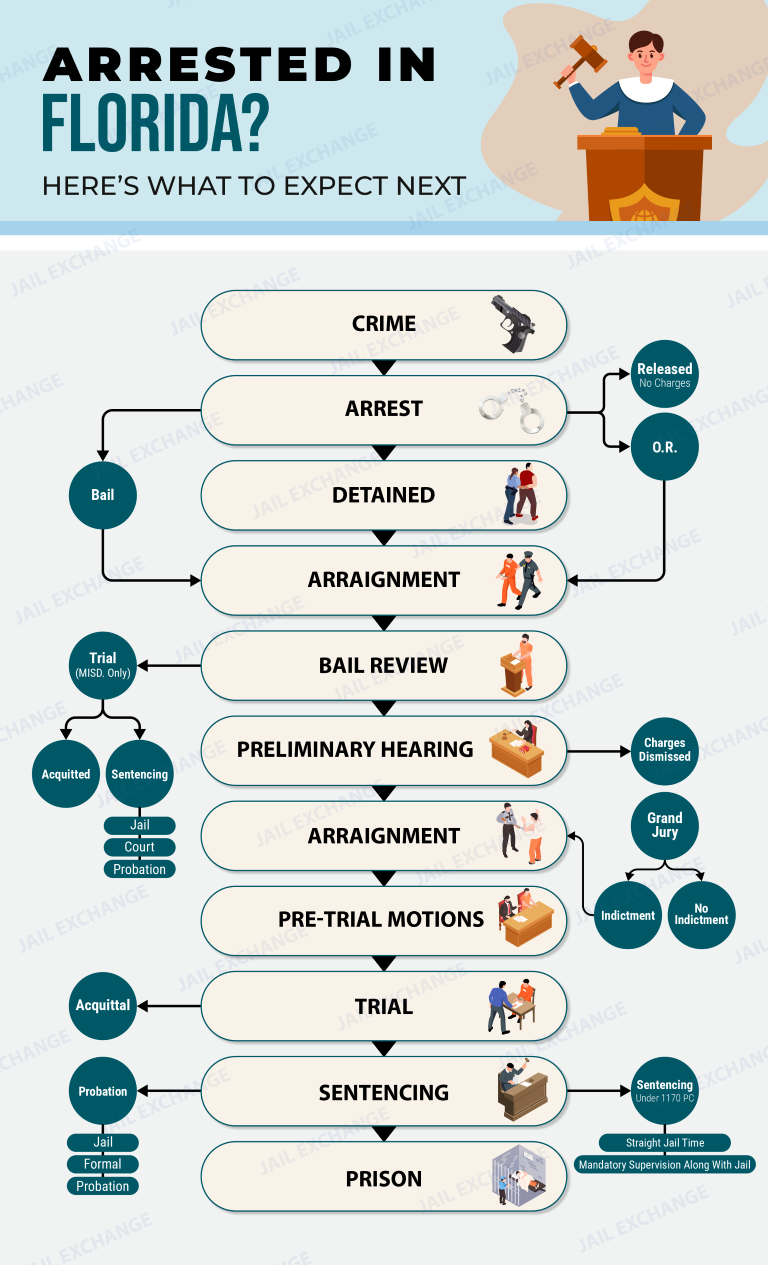
Charlotte deputies and Punta Gorda police can choose between arresting a person and writing a notice to appear, which simply orders the person to come to the Marion Avenue courthouse later. Everyone booked at Charlotte's Airport Road jail sees a judge for first appearance within a day, as Florida Rule 3.130 requires. Until that hearing, Charlotte uses the Florida Supreme Court’s uniform bond schedule for 2026, which sets a lowest bond for each offense across the state. A bond works like collateral, cash or a pledge parked with the Charlotte court until your case wraps up. Some crimes require the judge to decide before anyone is released. Licensed bail agents in Charlotte post state bonds for a 10% premium.
Charges in Charlotte come from the State Attorney of the Twentieth Judicial Circuit, an elected prosecutor with an office inside the Justice Center. For Charlotte defendants without money for counsel, a judge can appoint the Twentieth Circuit Public Defender, an elected office that serves all five counties. A conflict of interest can send a case to the regional conflict counsel office or to a private lawyer chosen by the court. Florida’s Section 938.29 lets judges require people who are convicted to pay back the cost of their appointed defense, and the charge may become a lien.
On Marion Avenue, the ceiling for a first-degree misdemeanor is a 1-year jail sentence plus $1,000. Second-degree misdemeanors in Charlotte stop at 60 days plus $500. Diversion options may let some first-time Charlotte offenders earn a dismissal. For Charlotte misdemeanors, the speedy trial clock gives prosecutors 90 days from formal charging, though the accused may waive it. Juries in Charlotte County Court have six members.
Kids and teens: Minors accused of crimes go to Charlotte Circuit Court’s juvenile division. With a civil citation (Section 985.12), Charlotte officers can handle many first small offenses without an arrest; instead, the young person completes community service, an apology letter or counseling. When a Charlotte child is kept in custody, a judge holds a detention hearing before 24 hours pass.
2. Charlotte felonies: burglary, elder fraud, drug possession or sales, grand theft
Felony cases in Charlotte also begin at first appearance, where the judge checks for probable cause and sets conditions of release. Prosecutors then decide on formal charges and file them in a document called an information. A Charlotte defendant pleads at arraignment in the Justice Center, and then the case moves through evidence sharing and pretrial hearings.
Florida sets prison limits by degree. Third-degree felonies, such as possession of most illegal drugs or grand theft starting at $750, have a 5-year limit. Second-degree felonies have a 15-year limit; breaking into a home or cheating an older person out of a large sum often falls here. First-degree felonies have a 30-year limit. Before sentencing, Charlotte’s court prepares a Criminal Punishment Code scoresheet; its points set the least amount of time allowed. In Florida, prison inmates must serve 85% of their sentence at minimum. Charlotte judges also use probation and drug court.
Under the speedy trial rule, felonies should be tried within 175 days of formal charges, though defendants often waive this. Florida uses a six-person jury for felonies that aren’t capital.
Kids and teens: Charlotte teens held on felony charges are driven south to Fort Myers, where DJJ operates the Southwest Florida Regional Juvenile Detention Center. Section 985.557 allows the State Attorney to direct file, so a Punta Gorda or Port Charlotte teen aged 16 or 17 can be charged as an adult on most felonies. A 14- or 15-year-old faces that only for a limited group of serious felonies. Since 2019, this is always the prosecutor’s choice.
3. Charlotte County violent offenses: murder, armed robbery, sexual battery, aggravated battery
A violent felony in Charlotte takes the same path but with stiffer rules. A judge may refuse bond at a pretrial detention hearing. Using a gun calls in the state’s 10-20-Life law (Section 775.087). On its listed crimes, possession brings a mandatory 10 years; discharge, 20 years; and a shooting that causes death or great bodily harm, 25 years to life. Life felonies, which include certain sexual batteries, can mean life in prison.
Charlotte's top charge is the capital felony, mainly first-degree murder, with only death or life without parole as punishment. Charlotte prosecutors need a grand jury to indict, and 12 jurors hear the trial. Florida’s 2023 law requires just 8 of the 12 jurors to vote for death. Men awaiting execution are held at Raiford’s Union Correctional Institution; condemned women are kept at Lowell.
Charlotte crime victims have rights under Marsy’s Law (Article I, Section 16(b)), so they can be kept in the loop, attend hearings and address the judge, most of all when a plea or sentence is decided.
Kids and teens: Section 985.56 allows Charlotte grand jurors to indict a minor, at any age, as an adult for a crime punishable by death or a life sentence. A death sentence, though, is off-limits for crimes committed by minors.
4. Can I look up Charlotte County warrants online?
Yes. A warrants page on the Sheriff's Office site draws from its own file, and the warrants desk answers at (941) 639-2101. Punta Gorda court cases, and any capias, surface in the clerk's records search. Your lawyer can schedule a walk-in at the Airport Road jail or ask the judge to set the warrant aside. Hearing dates are reset by the Clerk of Court at the Justice Center on East Marion Avenue. Port Charlotte and Englewood matters are heard there too. For other counties, see FDLE's statewide wanted persons list.
Immigration holds. If ICE lodges a Charlotte detainer on someone:
- the Charlotte bond judge must be told (F.S. 908.105)
- notice goes to the Charlotte state attorney
- bond is still possible in Charlotte
- ICE may keep the person up to 48 hours past release
- in Charlotte, weekends and holidays count
- F.S. 907.041: in Charlotte, an unauthorized alien facing a Charlotte forcible felony charge stays in the Charlotte jail until first appearance
- at that point a Charlotte judge presumes detention, but the Charlotte defense can rebut it
Town courts. Charlotte has no city or town courts. The 1972 Article V reform phased them out. In Charlotte, a city ordinance case goes to Charlotte County Court, which also hears misdemeanors.
Charlotte County: read this guide as a general explanation, not legal advice; every case is different. A lawyer can help, or call the Twentieth Circuit Public Defender’s main office in Fort Myers at (239) 533-2911.