Duval Regional Juvenile Detention Center Criminal Court Process
Criminal Court Process for Duval County Florida
Duval County and Jacksonville: How a Criminal Case Moves Through Court
Jacksonville and Duval County merged their governments back in 1968, so here the city and the county are nearly the same thing. In the court system, Duval anchors Florida’s Fourth Judicial Circuit, which also takes in Clay and Nassau counties. There are two kinds of trial court. On the lower rung, Duval County Court sorts out misdemeanors, ordinance cases and criminal traffic charges (a Jacksonville DUI, say, or a fender-bender hit-and-run). On the upper rung, Duval Circuit Court tries felonies, and a juvenile division inside it handles Jacksonville kids under 18. Our bail guide and inmate search cover the other steps.
Most criminal hearings take place in the big Duval County Courthouse, 501 W. Adams Street, Jacksonville, FL 32202, in downtown Jacksonville. The Duval Clerk of Courts’ main line is (904) 255-2000, and staff there can connect you to the criminal departments. Adults arrested by the Jacksonville Sheriff’s Office or by the beach-city and Baldwin police go to the sheriff’s John E. Goode Pre-Trial Detention Facility, 500 E. Adams Street, a short walk from the courthouse.
Free case lookup: The Duval Clerk’s online records system is called CORE. Anybody can search it free by a name or a case number. Without an account, you can view public filings in cases that aren’t confidential. A free registered account adds features like requesting documents. Juvenile cases and other confidential records aren’t open to the public, and documents marked “Unavailable” aren’t posted online.
1. Jacksonville misdemeanors: DUI, shoplifting, domestic battery, resisting an officer without violence
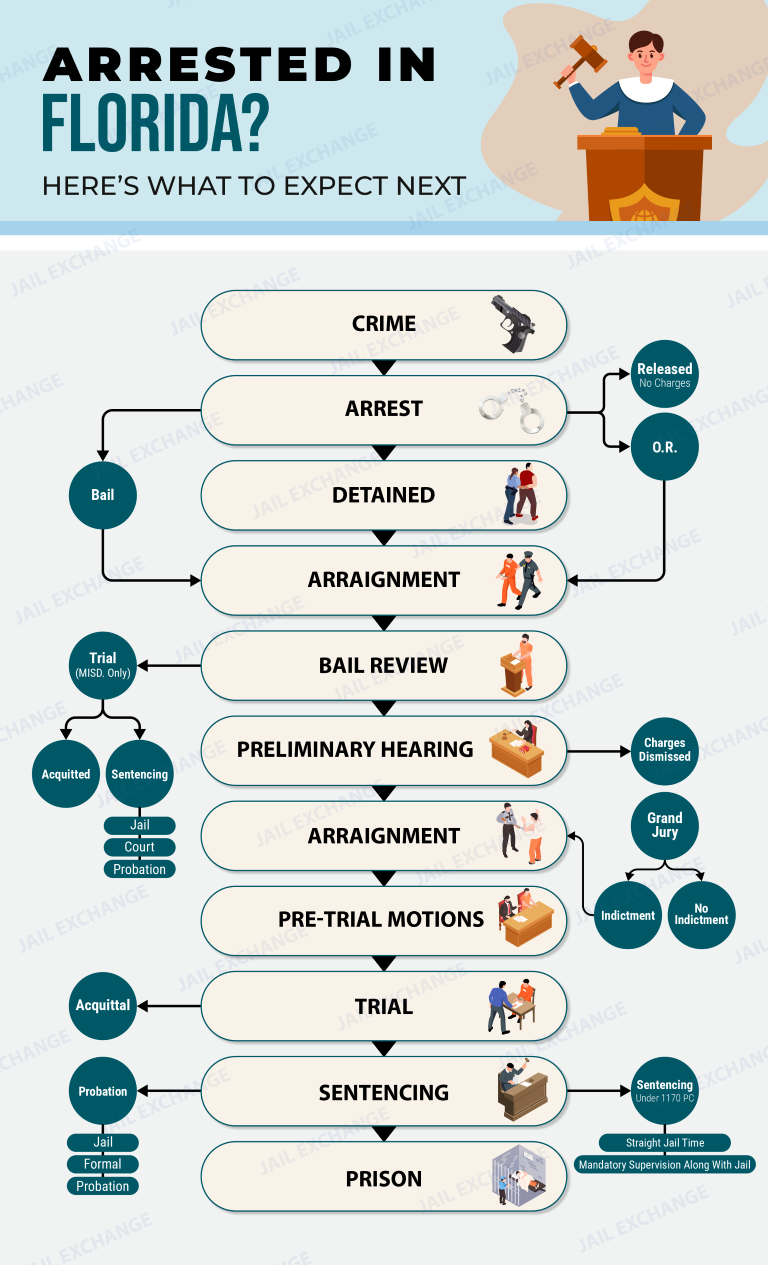
In Duval, misdemeanors make up the giant share of criminal cases. A JSO officer can skip the jail trip and issue a notice to appear, naming the date to report to 501 W. Adams. People taken to the Pre-Trial Detention Facility instead see a judge at first appearance within 24 hours, often on video from the jail. That judge goes over the charge and sets the conditions of pretrial release, which are the rules you follow while your case is open. Since January 1, 2026, every Florida jail, Jacksonville’s included, has followed one Supreme Court bond schedule with minimum amounts for anyone released before that hearing. For some offenses, domestic violence included, release waits on the judge. A bondsman’s premium runs 10% of the bond amount in Florida, with $100 as the floor.
What’s the most you can get? A first-degree misdemeanor can cost a year in a Duval jail and a $1,000 fine. With second degree, Jacksonville judges are held to two months (60 days) and $500. The State Attorney for the Fourth Circuit, an elected official, runs the prosecutor’s office on Bay Street. A judge can appoint the elected Fourth Circuit Public Defender for someone who can’t pay a lawyer. When that office has a conflict, Regional Conflict Counsel can step in. Florida law also permits a fee for a public defender, which can become a lien if left unpaid.
Fourth Circuit prosecutors offer pretrial diversion to some Jacksonville first-timers; finishing it wipes out the charge. If your misdemeanor goes to trial, the speedy-trial rule sets 90 days from formal charging unless waived, and a six-member jury of Duval residents hears it.
Under 18: When a Jacksonville teen is accused of a misdemeanor, Circuit Court’s juvenile division takes it. Instead of arresting a first offender, JSO can often issue a civil citation (Florida Statute 985.12), and the kid then makes up for it through counseling or service hours, leaving no arrest on file. Locked-up youth must get a detention hearing inside 24 hours. Jacksonville’s state-run juvenile lockup, the Duval Regional Juvenile Detention Center, is where they wait.
2. Duval felony court: car break-ins, fentanyl trafficking, felon with a gun, grand theft
A felony can put someone in a Florida prison. Every Duval felony starts with first appearance. After that, a Fourth Circuit prosecutor looks over the evidence and decides whether to file formal charges in an information. The defendant is then arraigned, which means formally told the charges and asked to plead. Months of discovery, motions and plea talks follow. Most felony cases at 501 W. Adams Street end in a plea, not a trial.
Florida felonies come in degrees. Third-degree felonies can mean as much as 5 years in prison. Second-degree felonies can mean 15. First-degree felonies can mean 30. Life felonies and capital felonies are at the top. Sentencing at the Adams Street courthouse relies on Florida’s Criminal Punishment Code scoresheet, which piles up points for the offense, the harm and prior record, and the score sets a floor. Florida’s 85% rule then keeps prisoners inside for nearly the whole term. A felon caught with a gun faces a second-degree felony and, in some cases, a 3-year minimum.
Duval felony defendants can demand trial by day 175 after formal charges are filed, a right most of them waive. Juries for Jacksonville felony trials hold six people; only capital trials use twelve.
Under 18: Most juvenile felony cases stay in the juvenile division, where judges can choose probation, treatment or a commitment program. The State Attorney can also “direct file” adult charges. Jacksonville prosecutors may do that for nearly any felony when the teen is 16 or 17. Younger teens, 14 or 15, qualify only for crimes listed in Florida Statute 985.557, carjacking, robbery and home burglary among them.
3. Jacksonville violent felony cases: murder, shootings, carjacking, sexual battery
Violent felony cases in Duval go through the same steps, but the penalties can be enormous. Someone judged dangerous at a pretrial detention hearing stays at the Adams Street jail, bond denied. In carjackings, robberies and similar crimes, Florida’s 10-20-Life law stacks on mandatory prison: possession of a gun, 10 years; a shot fired, 20; a death or great bodily harm, 25 years or more, possibly life. Sexual battery (Florida’s legal word for rape) can carry life in prison.
Duval first-degree murder cases start with a grand jury indictment; a conviction brings death or life without parole. Florida passed a law in 2023 letting a jury recommend death if 8 of the 12 jurors agree. About an hour southwest of Jacksonville, Union Correctional Institution in Raiford holds the state’s male death row; the women’s is at Lowell Correctional Institution.
Marsy's Law, a Florida constitutional amendment, gives Jacksonville victims notice of each hearing, a seat in court, and a chance to speak before sentencing. In a city with many shooting cases, the Fourth Circuit prosecutor’s victim advocates stay busy helping families.
Under 18: Violent crimes are where Duval teens are most likely to be charged as adults. Even at 14 or 15, a Duval teen accused of carjacking or armed robbery can be direct filed. Under Florida Statute 985.56, a Duval grand jury may also indict a child of any age if death or life is a possible penalty. A death sentence itself remains impossible for anyone who was a minor on the day of the crime.
4. How does Jacksonville handle warrant checks?
JSO, the consolidated Sheriff's Office, holds the Fourth Circuit warrant file; call (904) 630-0500, and its warrants unit needs a birth date to confirm a name. The clerk's CORE system lists each case and any capias. With an attorney, a person can self-surrender at the Pretrial Detention Facility on East Adams Street, a block from the courthouse. Room 2350 of the courthouse on West Adams is where the clerk sets new dates. For warrants from other agencies, FDLE runs a statewide wanted persons search.
Federal court: Duval is the home base of the Middle District of Florida’s Jacksonville Division, whose judges sit downtown on North Hogan Street (No. 300), inside the Bryan Simpson U.S. Courthouse. A case becomes federal if it breaks a federal law or happens on federal property, and Jacksonville has a lot of it. NAS Jacksonville, Naval Station Mayport and the Marine Corps’ Blount Island Command are all in Duval. So are the Timucuan Ecological and Historic Preserve and Fort Caroline National Memorial, run by the National Park Service. JAXPORT’s cargo docks bring smuggling and customs cases, and the Coast Guard at Mayport stops drugs coming by sea. Crimes on airplanes landing at Jacksonville International are federal too. Duval has no tribal land. Pick a section to read.
Immigration holds. If ICE lodges a Duval detainer on someone:
- F.S. 908.105 requires telling the Duval bond judge
- the Duval prosecutor gets notice
- Duval bond can still be granted
- the jail may hold them 48 more hours for ICE
- those hours in Duval include weekends and holidays
- F.S. 907.041: in Duval, an unauthorized alien facing a Duval forcible felony charge stays in the Duval jail until first appearance
- then the Duval court presumes detention, and the Duval defense can push back
Town courts. Duval has no city or town courts. The 1972 Article V reform phased them out. In Duval, a city ordinance case goes to Duval County Court, which also hears misdemeanors.
For Jacksonville readers, this Duval County overview is general background, not legal advice. Each case is different, so talk with a lawyer, or call the Duval Clerk of Courts at (904) 255-2000.