Gulf County Detention Facility Criminal Court Process
Criminal Court Process for Gulf County Florida
Gulf County Criminal Court: From Arrest to Verdict
Gulf County runs from the white beaches of St. Joseph Bay and Cape San Blas north to the river town of Wewahitchka. Port St. Joe is the county seat. Florida’s state crimes here are sorted into two trial courts. Gulf County Court gets the lower-level work: misdemeanors, criminal traffic matters such as driving with no valid license, and breaking ordinances, which are rules passed by the county commission or a city. Gulf Circuit Court gets felonies, crimes punishable by prison, and the juvenile cases for children under 18. The county is one of six in the 14th Judicial Circuit, joined by Bay, Calhoun, Holmes, Jackson and Washington. Our bail guide and inmate search cover the other steps.
Criminal court sits in the Gulf County Courthouse, 1000 Cecil G. Costin Sr. Blvd., Port St. Joe, FL 32456. The Clerk of Court’s phone lines are (850) 229-6112, or (850) 639-5068 from the Wewahitchka end of the county. The Gulf County Detention Facility, the county’s adult jail, is part of the same government complex on Cecil G. Costin Sr. Boulevard.
Look up cases without paying: Gulf’s clerk uses the Online Court Records Search, a free statewide tool for many smaller counties. After selecting Gulf, search with a defendant’s name or the case number. You can view charges, court events and results. Anything confidential stays out of view, including juvenile cases and files a judge has sealed or expunged, and some personal details are blocked out.
1. Port St. Joe misdemeanors: DUI, beach or boat incidents, petit theft, battery
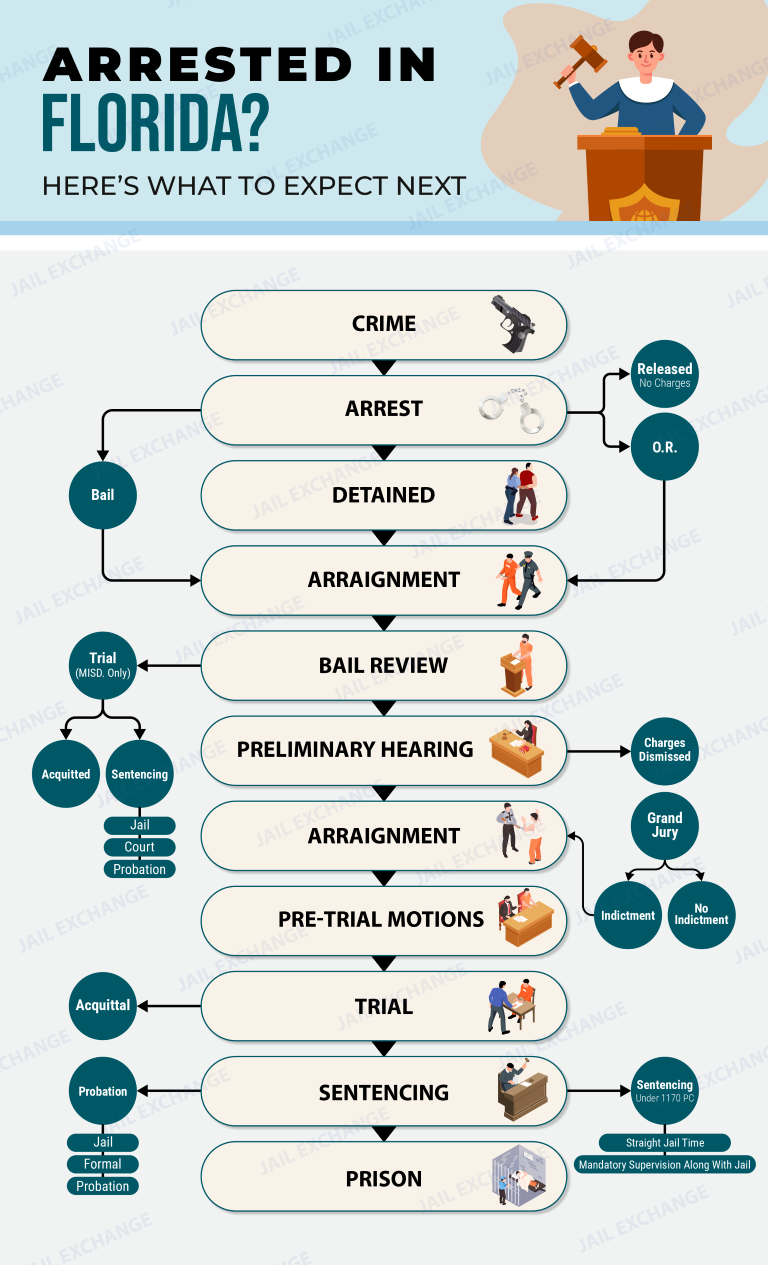
Say a tourist gets into a fight at a beach bar and is charged with battery. Sometimes the officer gives a notice to appear, a summons-style paper that says when to come to court, and no jail time is spent. Other times the person is arrested. Then a Florida rule applies: a Gulf judge must hold a first appearance within 24 hours of arrest to explain the charge, check the arrest, and set release terms. Florida’s Supreme Court issued the statewide bond schedule now in effect for 2026 (administrative order AOSC25-69). It tells the jail the minimum bond for each charge if a person posts it before first appearance. Some charges, though, require waiting for the judge. To get out, many families pay a licensed bail bond agent a premium, which Florida sets at 10% of the bond or a $100 minimum.
Florida limits misdemeanor punishment by degree. The first degree allows a sentence of no more than 12 months and a fine capped at $1,000. For the second degree, the caps fall to 60 days and $500. The voters of the six counties elect the 14th Circuit’s State Attorney, who keeps an office in Port St. Joe and prosecutes all state offenses. A judge decides whether you are poor enough for an appointed lawyer, called being indigent. If you are, the 14th Circuit’s elected Public Defender is assigned. If the public defender in Gulf has a conflict, the court turns to the region's conflict counsel, a separate office the state pays for. Under Florida’s section 938.29, the court can require payment for appointed lawyers and record a lien when it’s not paid.
Diversion is common for first offenses; completing classes, restitution or service can lead to dismissal. A misdemeanor trial is due within 90 days of formal charges under the speedy trial rule unless waived. Six jurors hear these trials.
Under 18: Teens go to juvenile court in Circuit Court, not County Court. Florida’s civil citation law, section 985.12, lets officers send many first-time young offenders to a program of service hours or counseling instead of arresting them. Locking up a teen triggers a detention hearing, which has to happen inside 24 hours. Youths from Gulf who are held in secure detention ride to Panama City and the Bay Regional Juvenile Detention Center, operated by the state’s juvenile justice agency.
2. Gulf felonies: meth or pill sales, burglary of rental homes, grand theft
A felony is serious enough to bring prison time beyond one year. Following first appearance, the prosecutor files a charging document known as an information, or for murder, a grand jury may return an indictment. The defendant pleads at an arraignment. Then come discovery, motions and plea talks.
Sentences grow with the felony’s degree. Third degree: a maximum of 5 years. Second degree: a maximum of 15. First degree: a maximum of 30. Life and capital felonies are the heaviest. Breaking into a vacation rental counts as burglary of a dwelling, a second-degree felony even when nobody is staying there; breaking into a shed or a parked truck is usually third degree. To set a minimum sentence, the judge tallies points on the Criminal Punishment Code scoresheet for the offense and past record. Gulf inmates headed to state prison will serve no less than 85% of the term.
Unless waived, the speedy trial rule gives the state 175 days after formal charges to try a felony. Gulf felony juries seat six people; a capital trial seats 12. Most Gulf felony cases end in a plea.
Under 18: In most Gulf cases, a minor charged with a felony is kept in the juvenile system, where treatment and accountability come first. Section 985.557 still lets prosecutors direct file the case in adult court: at 16 or 17, almost any felony qualifies, while a 14- or 15-year-old must be accused of a listed serious felony. Since a 2019 reform removed mandatory transfers, each direct file is a prosecutor’s decision.
3. Gulf County cases involving violence: murder, armed robbery, aggravated assault with a firearm
Violent felonies use the felony process, but bonds are higher and sentences longer. Prosecutors can ask a judge to keep someone jailed until trial. The gun statute nicknamed 10-20-Life (section 775.087) kicks in when a firearm shows up in robbery, aggravated assault and other listed crimes. Possessing the gun means a 10-year minimum (3 years for aggravated assault), firing it means 20, and causing injury or death with it means 25 years to life.
Prosecutors charge first-degree murder as a capital felony, which ends either in a death sentence or in life with no parole. Under a 2023 change, 8 juror votes are enough for a death recommendation in Florida; unanimity is no longer needed. Condemned men from every Florida county, Gulf included, are sent to Union Correctional Institution (Raiford), and condemned women to Lowell Correctional Institution.
Florida’s Marsy’s Law (section 16(b) of the Declaration of Rights in Article I) protects victims. They may receive notice of hearings, be present, be heard at plea and sentencing, and be protected from the defendant. Victim advocates at the 14th Circuit State Attorney’s office are there to help.
Under 18: Section 985.56 has no minimum age: if the crime could carry death or life imprisonment, grand jurors may indict the child, and adult court takes over. Children can’t receive the death penalty. A juvenile facing life must first have a special hearing where the judge considers age and circumstances.
4. Who holds warrants from the Port St. Joe court?
The Sheriff's Office holds warrants Fourteenth Circuit judges issue here, and it answers at (850) 227-1115. Gulf dockets, including a capias, are posted to the Online Court Records Search. Your attorney can escort the person to the Cecil G. Costin Sr. Boulevard detention facility to surrender at a set time. The clerk, in Room 149 of the same complex, handles new dates, and Wewahitchka cases go through that office too, so one call settles which judge has it. FDLE's statewide wanted persons lookup shows warrants released by agencies elsewhere.
Federal court: Gulf is assigned to the federal Northern District of Florida’s Panama City Division. Hurricane Michael tore up its Panama City courthouse in October 2018. Ever since, the court’s own orders have said in-person hearings for its cases are held in the division where the assigned judge works, which means Tallahassee or Pensacola. Why would a case be federal at all? State court applies Florida law. Federal court applies laws from Congress and usually handles crimes that cross state or national borders, harm the U.S. government, or happen on federal property. Along Gulf’s coast, that can mean drugs smuggled by boat, Coast Guard arrests at sea, or illegal fishing in federal waters. Tyndall Air Force Base sits next door in Bay County. Convicted felons caught with guns and big fraud schemes can also land in federal court. Gulf County has no reservation. Choose a box below.
Immigration holds. Gulf and ICE detainers, in brief:
- the judge at the Gulf bond hearing hears about it (F.S. 908.105)
- the Gulf prosecutor gets notice
- a Gulf judge can still set bond
- ICE may keep the person up to 48 hours past release
- in Gulf, weekends and holidays count
- F.S. 907.041: in Gulf, an unauthorized alien facing a Gulf forcible felony charge stays in the Gulf jail until first appearance
- then the Gulf court presumes detention, and the Gulf defense can push back
Town courts. Gulf has no city or town courts. The 1972 Article V reform phased them out. In Gulf, a city ordinance case goes to Gulf County Court, which also hears misdemeanors.
Consider this a rough sketch of Gulf County’s criminal courts and not legal advice. Hire or ask for a defense lawyer to handle the details of an actual case, or call the Gulf County clerk at (850) 229-6112.