
Gulf County Detention Facility
Gulf County Detention Facility
Gulf County Detention
850-227-1124Gulf County Detention Facility, Port St. Joe
Port St. Joe, Wewahitchka and Cape San Blas arrests are booked at the Gulf County Detention Facility on Cecil G.
Costin Sr. Boulevard. Gulf has no county roster online, so check VINELink or call 850-227-1124.
Our criminal court page has more.
Read inmate search answers
 Read inmate search answers
1. Gulf jail address
The facility is at 1000 Cecil G. Costin Sr. Boulevard, Port St. Joe, FL 32456. Detention: 850-227-1124. Gulf County Sheriff's Office: 850-227-1115.
↑ Back to the question list2. Gulf roster
To learn if someone is in the Gulf jail, search VINELink by name. Call the facility if a recent arrest is missing. Free notices are offered there as well.
↑ Back to the question list3. Bond in Port St. Joe
Gulf is in the Fourteenth Judicial Circuit. First appearance happens within 24 hours, with these choices:
- ROR, freedom without a deposit.
- Cash in full, given back after the case less costs.
- A bondsman at 10 percent, minimum $100 per charge, kept as the fee.
People wanted in Bay or Franklin, or on probation violations, stay put even after paying. A missed Port St. Joe hearing triggers a warrant. See our Gulf bail page.
↑ Back to the question list4. Could a Wewahitchka warrant arrest end at the Costin Boulevard jail?
Yes. Port St. Joe's detention facility on Costin Boulevard books warrant pickups from Wewahitchka, Cape San Blas and Highland View. Call the clerk at 850-229-6112 to learn the next hearing date. The shared court records search shows any capias. Sheriff's deputies run local names; FDLE's statewide wanted roster adds the rest of Florida. An attorney can coordinate a surrender at Costin Boulevard, which shares a campus with the courthouse, so the first appearance can follow quickly. Visits are set up with jail staff.
↑ Back to the question list5. Public defender
The Fourteenth Circuit Public Defender takes Gulf clients ruled indigent; the $50 fee can be waived.
↑ Back to the question list6. Visiting
Call 850-227-1124 for the current visiting schedule. See visiting and remote visits.
↑ Back to the question list7. Phones
Inmates in Port St. Joe can make calls but can't get them. A prepaid account lets family pick up. Read phones, messages and tablets.
↑ Back to the question list8. Money
Account deposits pay for commissary. Use methods the facility approves. See deposits and commissary.
↑ Back to the question list9. Mail
Put the person's name and booking number above the Costin Boulevard address. The mail guide lists what's banned.
↑ Back to the question list10. Gulf juveniles
Gulf kids under 18 are handled in juvenile court. Detention, when ordered, means a ride to the Bay Regional Juvenile Detention Center in Panama City, 850-872-4706, and see a judge within 24 hours. Parents can call 850-227-1115.
↑ Back to the question list11. Medical
Call 850-227-1124 about medicine, seizures, diabetes or suicide risk.
↑ Back to the question list12. Gulf federal cases
The U.S. District Court, Northern District of Florida, hears Gulf federal cases in Panama City, 30 W. Government St., Panama City, FL 32401.
A Gulf defendant meets a magistrate first and returns for a detention hearing on custody. The U.S. Marshals (850-806-0150) may lodge them in a county jail. Use the BOP finder after sentencing.
↑ Back to the question list13. ICE detainers in Gulf County
- Port St. Joe booking prints are sent to DHS.
- ICE may issue an I-247A detainer.
- The facility can hold the person on the detainer up to 48 hours after they would otherwise be released (8 CFR 287.7(d)).
- F.S. 908.105 makes sure the bond judge and prosecutor see the detainer and the clerk files it.
- F.S. 907.041 keeps forcible-felony suspects who are unauthorized aliens in custody until first appearance; detention is presumed there but may be rebutted.
- F.S. 908.11 requires 287(g); ICE lists Gulf under the Task Force Model.
- Families can use ICE's online search or call the Miami field office, 2805 SW 145th Ave., Miramar, FL 33027, 954-843-5800.
14. State prison
Gulf inmates sentenced to prison wait in Port St. Joe for FDC, then go through reception. Track with the FDC database; see Florida prisons.
↑ Back to the question list15. Gulf mugshots
Ask the Gulf County Sheriff's Office (850-227-1115). Most are public; F.S. 119.071 exempts some.
ICE photos need a FOIA request. Federal mugshots are released only for Marshals fugitive searches.
↑ Back to the question list16. Gulf police numbers
- Port St. Joe Police Department: 850-227-1414
- Gulf County Sheriff's Office: 850-227-1115
Emergencies: 911.
↑ Back to the question listGulf County contacts
- Inmate search
- VINELink (Florida inmate search)
- Jail
- Gulf County Detention Facility, 1000 Cecil G. Costin Sr. Boulevard, Port St. Joe, FL 32456, 850-227-1124
- Sheriff
- 850-227-1115
Gulf County bail and bond: Port St. Joe, the 14th Circuit, and how to get someone home
Adults arrested in Gulf County are taken to the Gulf County Detention Facility at 1000 Cecil G.
Costin Sr. Boulevard in Port St. Joe, the same street address the county lists for its courthouse. For the booking, charges, and bail, enter the name in Gulf County Inmate Search.
The detention facility's phone, 850-227-1124, is for questions the search leaves open. Gulf County is part of Florida's 14th Judicial Circuit.
1. Is the person at the Port St. Joe facility or somewhere else?
Use Gulf County Inmate Search first. It is the quickest way to confirm a booking. If the person is not listed, the arrest may be hours old, or the person may be held by the arresting agency before booking.
Call 850-227-1124 to ask where the person is. Because some small Florida counties house certain inmates in a neighboring county, ask whether a woman or a person with a special need is being held in Port St. Joe or at another jail.
2. Is there a deadline for the first judge hearing in Gulf County?
Yes: within 24 hours of a Gulf arrest, under Florida Rule 3.130, unless the person was already freed. Video hearings are allowed. The Gulf judge can release the person, set conditions, and set or change bond.
The courthouse is at 1000 Cecil G. Costin Sr. Boulevard, Port St. Joe, FL 32456. Call 850-227-1124 to find out when hearings happen.
3. What are the standard bond amounts for the most common charges?
The Florida Supreme Court's 2026 statewide schedule lists starting amounts for release before the first hearing. A third-degree felony involving force or a threat of force: $5,000. A third-degree felony without force: $2,500. A first-degree misdemeanor with force: $1,000. A first-degree misdemeanor without force: $500. A second-degree misdemeanor with force: $250. A second-degree misdemeanor without force: $150.
In Gulf, DUI is $1,000 for a first-degree misdemeanor, $750 for a repeat second-degree case, and $500 the first time. The chief judge of the 14th Circuit may raise these. Ask the facility for the amount that applies today.
4. Can the judge ignore the schedule?
Yes. Section 903.011 says the schedule doesn't bind a Gulf judge at first appearance or any bail ruling. The judge may set a higher or lower figure or order release with conditions.
Under section 903.046, a Gulf judge looks at the offense, how strong the evidence is, family and work ties, past missed hearings, probation status, and public safety. Bring proof that supports the person.
5. Where do I pay in Gulf, and what do they accept?
The Clerk of Court is in the courthouse, Room 149, open Monday to Friday from 9 a.m. to 5 p.m. Eastern. The clerk's website takes no personal checks at the office. Payment hours and accepted payment types for bail can differ from that, so telephone first: 850-227-1124. Ask who takes the payment, whether it is the facility or the Clerk of Court, what forms of payment are accepted, and when the office closes.
Never wire money or buy gift cards to settle a bond.
6. How does the state control what a bondsman charges?
It sets the rate in two ways. The Florida Department of Financial Services sets the Gulf premium at 10 percent of bail, so $1,500 bail costs $150. And Florida Statutes 648.33 says the agent must charge the rate filed with and approved by the state, no higher and no lower.
Once the person you're helping is out of jail, the agent has earned that fee. If release never happens, it should be returned. Ask for the collateral terms and every other cost in writing, and look up the license first.
7. Does Gulf County take land as security?
Some courts allow it, but each county sets its own steps. Phone 850-227-1124 to learn who reviews Gulf property bonds, if the land must be local, the equity required, and who signs.
Property bonds take days. If the person must be out quickly, a bail agent may be the better route.
8. Why does it say the person must wait for first appearance?
Florida Statutes 903.011(6) lists the cases where nobody can be released before a judge sees them. Gulf examples include a felony arrest during supervision, many recent arrests, and the most serious felony charges.
A Gulf court may hold without bail under Article I, section 14 of the Florida Constitution for capital or life charges with clear guilt, or when no terms protect the community, ensure a return, or guard the court process. Ask the facility which rule applies.
9. Whom do I ask for if we need a court-appointed lawyer?
Let the Gulf judge know at first appearance that you can't pay. The Public Defender for the 14th Circuit serves Bay, Calhoun, Gulf, Holmes, Jackson, and Washington Counties. Income is reviewed before an appointment is made.
Hiring a private lawyer for a bond hearing is allowed at any time.
10. Where does a Gulf County juvenile go if held?
The Department of Juvenile Justice screens the child in Panama City at 651 West 14th Street, Suite M, FL 32401, 850-767-3262. Children held in secure detention from this area are generally placed at the Bay Regional Juvenile Detention Center, 450 East 11th Street, Panama City, FL 32401, 850-872-4706.
A juvenile record stays private, so the adult search shows no child. The Gulf County juvenile probation office is at 651 West 14th Street, Suites K and M, 850-872-7630. Ask the Panama City office where the Gulf child is and when the hearing is.
11. What if a Gulf city officer arrested the person?
If a Gulf city officer arrested, get that department's report number and ask where the person was taken. Then keep checking Gulf County Inmate Search until the booking appears.
12. What if the defendant never comes back to Port St. Joe for court?
Once a defendant misses court, the judge may forfeit the bond. Under section 903.26 the clerk mails a notice within five days, and the forfeited sum is due within 60 days unless a Gulf judge discharges it. Gulf families should call both the lawyer and the agent at once.
A new offense or broken condition can also end release under section 903.0471.
13. Is cash bail paid in Gulf County returned?
Typically yes, once the case closes, after any fines, costs, or fees the court orders. The Gulf County Clerk's website says a cash bond is applied to court costs or fines. Gulf agents keep the premium after release, and collateral should come back within 21 days of the bond's discharge, per the Department of Financial Services. In Gulf, save each receipt and ask the clerk how refunds work.
Deposits on an inmate account are separate from bail.
14. What should I do about an unexpected call asking for bail money?
Hang up. No real office asks for prepaid cards or crypto. Then dial 850-227-1124 yourself and ask the facility what it needs.
15. Does an immigration hold change bond in Gulf?
- An ICE detainer (Form I-247A) asks the Gulf jail to hold someone longer.
- That extra hold in Gulf lasts up to 48 hours.
- In Gulf, weekends and holidays count toward those 48 hours.
- Posting bond in Gulf does not end an ICE hold.
- F.S. 908.105 says the Gulf bond judge must be told.
- The Gulf prosecutor is told too.
- F.S. 908.11 requires the Gulf sheriff to work with ICE under 287(g).
- For Gulf, ICE's 287(g) list shows:
- Task Force Model
- If ICE takes someone from Gulf, search the ICE detainee locator.
Gulf County bail contacts
- County jail
- Gulf County Detention Facility, 1000 Cecil G. Costin Sr. Boulevard, Port St. Joe, FL; 850-227-1124
- Bond guide
- bail bond instructions for this facility
- Custody lookup
- Gulf County Inmate Search
- Courthouse
- Gulf County Courthouse, 1000 Cecil G. Costin Sr. Boulevard, Port St. Joe, FL 32456
- Clerk of Court
- Gulf County Courthouse, Room 149, 1000 Cecil G. Costin Sr. Boulevard, Port St. Joe, FL 32456; Wewahitchka annex, 153 North 3rd Street (Fridays)
- Circuit
- Florida's 14th Judicial Circuit (Bay, Calhoun, Gulf, Holmes, Jackson, and Washington Counties)
- Public defender
- 14th Circuit Public Defender; request one at first appearance
- Juvenile detention
- Bay Regional Juvenile Detention Center, 450 East 11th Street, Panama City, FL 32401; 850-872-4706; Department of Juvenile Justice screening, 651 West 14th Street, Suite M, Panama City, 850-767-3262
- Bail agents
- Gulf bail agents: licensed by the Florida Department of Financial Services; fee is 10 percent of a state bond
Gulf's posted rules may be revised, and the judge can order something else. In Gulf, check with the facility or clerk before sending anything. Treat this Gulf page as a first step, not legal advice.
Gulf County Detention Facility Visitation
Confirm the housing facility before traveling. Gulf County Detention Facility is at 1000 Cecil G. Costin Sr. Boulevard, Port St. Joe, FL 32456. Call the detention facility directly at 850-227-1124 to arrange a visit.
Women held for Gulf County: the Liberty County Sheriff confirms that its jail houses female inmates from Gulf County. Call Liberty County Jail at 850-643-2235 to confirm the person is there and arrange visiting under that facility's rules. Do not travel to Port St. Joe solely because the arrest occurred in Gulf County.
Arrange your visit
- Have the person's full legal name, date of birth and arrest or booking date if known. Confirm that they remain at this facility and are eligible for visits.
- Ask how to join the approved visitor list, whether an application or appointment is needed, and the next available day and time for that person's housing assignment. Confirm the session length, weekly allowance, visitor limit and arrival deadline.
- Ask whether the approved visit uses a non-contact partition or plexiglass, a jail video terminal, or another arrangement. Confirm whether any public contact visits are permitted rather than assuming physical contact is allowed.
- Confirm the check-in entrance, accepted ID, child/guardian requirements and clothing rules. Ask staff to state the time zone: Port St. Joe uses Eastern Time, while part of Gulf County uses Central Time.
Visits are a privilege and depend on eligibility, housing arrangements and facility operations. Confirm your appointment before leaving home, including holiday or last-minute changes.
Video visits from home
Before registering or paying a video provider, ask the jail whether remote visits are available for this person and obtain its current provider link, approval steps, hours and charges. A phone or commissary account does not by itself establish access to video visits.
Arrival and safety
Bring valid government-issued photo ID and keys only unless staff approve an exception. Wear conservative, non-revealing clothing and confirm the local dress requirements before traveling. Ask about any necessary items for a child or disability accommodation in advance. No weapons, illegal drugs or contraband anywhere on jail property, including parked vehicles.
Attorney and professional visits
Call 850-227-1124 to arrange a professional visit separately from family visiting. Confirm the available hours, professional credentials and ID, permitted legal papers or equipment, and the process for confidential communication. Do not use an ordinary family video account for privileged discussions without the jail's approval.
Sources: Gulf County Detention Facility; Florida county jail directory; Liberty County Sheriff.
Gulf County Criminal Court: From Arrest to Verdict
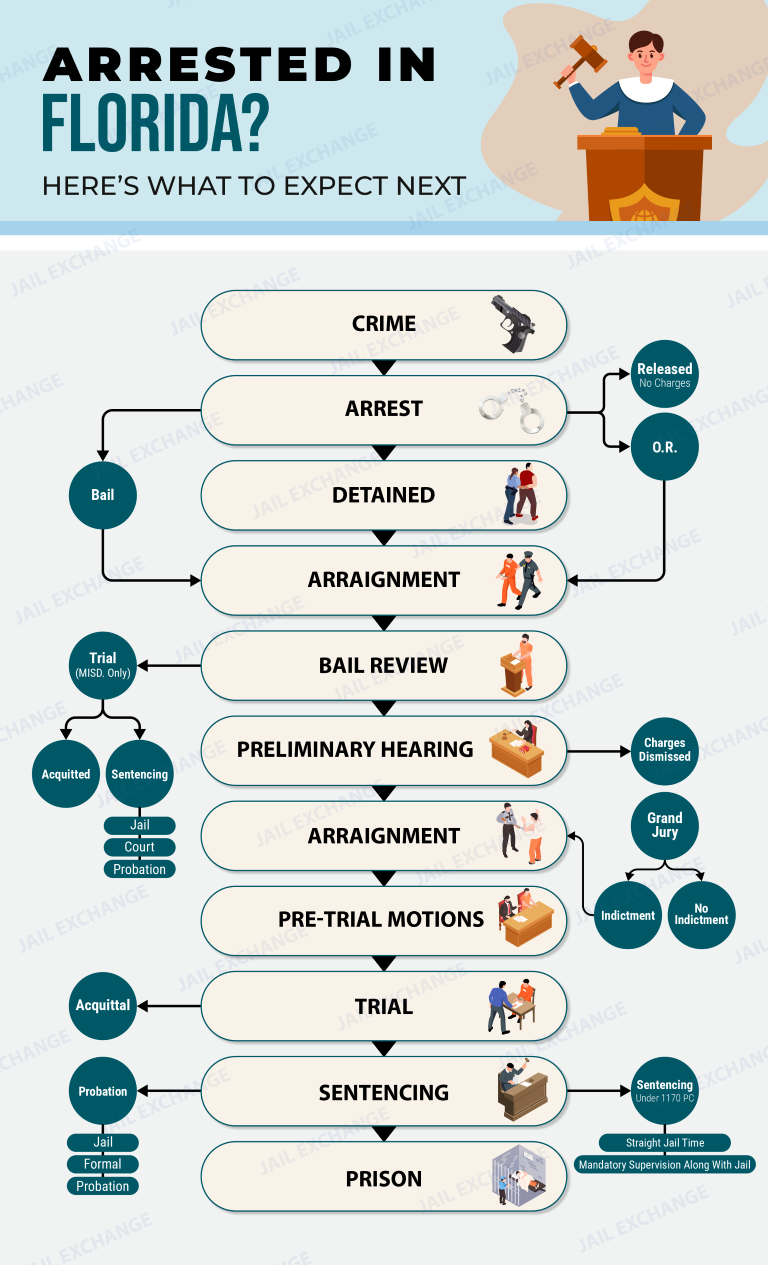
Gulf County runs from the white beaches of St. Joseph Bay and Cape San Blas north to the river town of Wewahitchka. Port St. Joe is the county seat. Florida’s state crimes here are sorted into two trial courts. Gulf County Court gets the lower-level work: misdemeanors, criminal traffic matters such as driving with no valid license, and breaking ordinances, which are rules passed by the county commission or a city. Gulf Circuit Court gets felonies, crimes punishable by prison, and the juvenile cases for children under 18. The county is one of six in the 14th Judicial Circuit, joined by Bay, Calhoun, Holmes, Jackson and Washington. Our bail guide and inmate search cover the other steps.
Criminal court sits in the Gulf County Courthouse, 1000 Cecil G. Costin Sr. Blvd., Port St. Joe, FL 32456. The Clerk of Court’s phone lines are (850) 229-6112, or (850) 639-5068 from the Wewahitchka end of the county. The Gulf County Detention Facility, the county’s adult jail, is part of the same government complex on Cecil G. Costin Sr. Boulevard.
Look up cases without paying: Gulf’s clerk uses the Online Court Records Search, a free statewide tool for many smaller counties. After selecting Gulf, search with a defendant’s name or the case number. You can view charges, court events and results. Anything confidential stays out of view, including juvenile cases and files a judge has sealed or expunged, and some personal details are blocked out.
1. Port St. Joe misdemeanors: DUI, beach or boat incidents, petit theft, battery
Say a tourist gets into a fight at a beach bar and is charged with battery. Sometimes the officer gives a notice to appear, a summons-style paper that says when to come to court, and no jail time is spent. Other times the person is arrested. Then a Florida rule applies: a Gulf judge must hold a first appearance within 24 hours of arrest to explain the charge, check the arrest, and set release terms. Florida’s Supreme Court issued the statewide bond schedule now in effect for 2026 (administrative order AOSC25-69). It tells the jail the minimum bond for each charge if a person posts it before first appearance. Some charges, though, require waiting for the judge. To get out, many families pay a licensed bail bond agent a premium, which Florida sets at 10% of the bond or a $100 minimum.
Florida limits misdemeanor punishment by degree. The first degree allows a sentence of no more than 12 months and a fine capped at $1,000. For the second degree, the caps fall to 60 days and $500. The voters of the six counties elect the 14th Circuit’s State Attorney, who keeps an office in Port St. Joe and prosecutes all state offenses. A judge decides whether you are poor enough for an appointed lawyer, called being indigent. If you are, the 14th Circuit’s elected Public Defender is assigned. If the public defender in Gulf has a conflict, the court turns to the region's conflict counsel, a separate office the state pays for. Under Florida’s section 938.29, the court can require payment for appointed lawyers and record a lien when it’s not paid.
Diversion is common for first offenses; completing classes, restitution or service can lead to dismissal. A misdemeanor trial is due within 90 days of formal charges under the speedy trial rule unless waived. Six jurors hear these trials.
Under 18: Teens go to juvenile court in Circuit Court, not County Court. Florida’s civil citation law, section 985.12, lets officers send many first-time young offenders to a program of service hours or counseling instead of arresting them. Locking up a teen triggers a detention hearing, which has to happen inside 24 hours. Youths from Gulf who are held in secure detention ride to Panama City and the Bay Regional Juvenile Detention Center, operated by the state’s juvenile justice agency.
2. Gulf felonies: meth or pill sales, burglary of rental homes, grand theft
A felony is serious enough to bring prison time beyond one year. Following first appearance, the prosecutor files a charging document known as an information, or for murder, a grand jury may return an indictment. The defendant pleads at an arraignment. Then come discovery, motions and plea talks.
Sentences grow with the felony’s degree. Third degree: a maximum of 5 years. Second degree: a maximum of 15. First degree: a maximum of 30. Life and capital felonies are the heaviest. Breaking into a vacation rental counts as burglary of a dwelling, a second-degree felony even when nobody is staying there; breaking into a shed or a parked truck is usually third degree. To set a minimum sentence, the judge tallies points on the Criminal Punishment Code scoresheet for the offense and past record. Gulf inmates headed to state prison will serve no less than 85% of the term.
Unless waived, the speedy trial rule gives the state 175 days after formal charges to try a felony. Gulf felony juries seat six people; a capital trial seats 12. Most Gulf felony cases end in a plea.
Under 18: In most Gulf cases, a minor charged with a felony is kept in the juvenile system, where treatment and accountability come first. Section 985.557 still lets prosecutors direct file the case in adult court: at 16 or 17, almost any felony qualifies, while a 14- or 15-year-old must be accused of a listed serious felony. Since a 2019 reform removed mandatory transfers, each direct file is a prosecutor’s decision.
3. Gulf County cases involving violence: murder, armed robbery, aggravated assault with a firearm
Violent felonies use the felony process, but bonds are higher and sentences longer. Prosecutors can ask a judge to keep someone jailed until trial. The gun statute nicknamed 10-20-Life (section 775.087) kicks in when a firearm shows up in robbery, aggravated assault and other listed crimes. Possessing the gun means a 10-year minimum (3 years for aggravated assault), firing it means 20, and causing injury or death with it means 25 years to life.
Prosecutors charge first-degree murder as a capital felony, which ends either in a death sentence or in life with no parole. Under a 2023 change, 8 juror votes are enough for a death recommendation in Florida; unanimity is no longer needed. Condemned men from every Florida county, Gulf included, are sent to Union Correctional Institution (Raiford), and condemned women to Lowell Correctional Institution.
Florida’s Marsy’s Law (section 16(b) of the Declaration of Rights in Article I) protects victims. They may receive notice of hearings, be present, be heard at plea and sentencing, and be protected from the defendant. Victim advocates at the 14th Circuit State Attorney’s office are there to help.
Under 18: Section 985.56 has no minimum age: if the crime could carry death or life imprisonment, grand jurors may indict the child, and adult court takes over. Children can’t receive the death penalty. A juvenile facing life must first have a special hearing where the judge considers age and circumstances.
4. Who holds warrants from the Port St. Joe court?
The Sheriff's Office holds warrants Fourteenth Circuit judges issue here, and it answers at (850) 227-1115. Gulf dockets, including a capias, are posted to the Online Court Records Search. Your attorney can escort the person to the Cecil G. Costin Sr. Boulevard detention facility to surrender at a set time. The clerk, in Room 149 of the same complex, handles new dates, and Wewahitchka cases go through that office too, so one call settles which judge has it. FDLE's statewide wanted persons lookup shows warrants released by agencies elsewhere.
Federal court: Gulf is assigned to the federal Northern District of Florida’s Panama City Division. Hurricane Michael tore up its Panama City courthouse in October 2018. Ever since, the court’s own orders have said in-person hearings for its cases are held in the division where the assigned judge works, which means Tallahassee or Pensacola. Why would a case be federal at all? State court applies Florida law. Federal court applies laws from Congress and usually handles crimes that cross state or national borders, harm the U.S. government, or happen on federal property. Along Gulf’s coast, that can mean drugs smuggled by boat, Coast Guard arrests at sea, or illegal fishing in federal waters. Tyndall Air Force Base sits next door in Bay County. Convicted felons caught with guns and big fraud schemes can also land in federal court. Gulf County has no reservation. Choose a box below.
Immigration holds. Gulf and ICE detainers, in brief:
- the judge at the Gulf bond hearing hears about it (F.S. 908.105)
- the Gulf prosecutor gets notice
- a Gulf judge can still set bond
- ICE may keep the person up to 48 hours past release
- in Gulf, weekends and holidays count
- F.S. 907.041: in Gulf, an unauthorized alien facing a Gulf forcible felony charge stays in the Gulf jail until first appearance
- then the Gulf court presumes detention, and the Gulf defense can push back
Town courts. Gulf has no city or town courts. The 1972 Article V reform phased them out. In Gulf, a city ordinance case goes to Gulf County Court, which also hears misdemeanors.
Consider this a rough sketch of Gulf County’s criminal courts and not legal advice. Hire or ask for a defense lawyer to handle the details of an actual case, or call the Gulf County clerk at (850) 229-6112.
McDaniel Supply Company (operated online through the Jail Pack Store) allows family members and friends to purchase pre-approved commissary care packages, snack bundles, meats, personal hygiene kits, and apparel sent directly to an incarcerated loved one. Each package is packed to comply with individual detention center security standards, ensuring smooth intake and housing unit delivery.
Important: Package Deadlines and Delivery Windows Vary
Detention centers do not manage care package deliveries under identical schedules. While some facilities allow weekly orders, others restrict deliveries to bi-weekly or monthly distribution windows, and spending limits vary from jail to jail. You should verify the facility's active cutoff schedule and order allowances by calling them directly. If an order is submitted after the weekly processing deadline, delivery will be held until the following cycle, leaving your loved one waiting an extra cycle for fresh snacks, thermal wear, or personal care supplies.
Step-by-Step Instructions to Place a Commissary Package Order
- Confirm the inmate's legal first and last name, date of birth, and assigned booking or inmate ID number.
- Navigate to www.jailpackstore.com or mcdanielsupplyco.net.
- Select your state and detention center to open the jail's authorized merchandise catalog.
- Search for the inmate to link the purchase directly to their active housing record.
- Select allowable snack foods, candies, personal care goods, and clothing items up to the facility's allowed spending limit.
- Proceed to checkout, enter your debit or credit card billing details, and submit payment.
- Save your digital receipt and confirmation tracking number for your records.
What the Inmate Needs to Do
The inmate does not need an internet account to receive care packages. McDaniel Supply Company prepares the order in secure, tamper-evident packaging and delivers it directly to the jail commissary department. Facility staff inspect the shipment and deliver the items during regular housing unit commissary rounds, where the inmate signs for receipt.
Official Providers: Jail Pack Store | McDaniel Supply Company
Customer Service Telephone: 1-800-822-9388 or 1-912-427-9022
Support Hours: Monday – Friday, 8:00 AM – 5:00 PM EST
Supported Languages: English and Spanish
Other Services Provided by McDaniel Supply Company
In addition to Commissary Care Packages, McDaniel Supply provides trust deposit services at participating facilities:
- Inmate Trust Money Deposits: Send money directly into an inmate's jail trust account for independent canteen shopping.
• Learn more on our website: Inmate Trust Deposits Guide | • Visit official vendor page: Jail Pack Store Deposits
Buy Commissary for an Inmate in the Gulf County Detention Facility
Gulf County Detention Facility Inmate Commissary - Sending Money or Purchasing Commissary for an Inmate
Gulf County Detention Facility allows inmates to purchase commissary. This can be snacks, hygiene products, stamps, stationary, clothing and even electronics.
You can buy commissary for an inmate using an online service called McDaniel Supply Company / jailpackstore.com.

There is a monthly limit of $200-300 on how much inmates can spend on commissary items.
This amount is subject to change so call the facility at 850-227-1124 in order to confirm the amount that cannot be exceeded.
Inmates have access to both an in-house commissary store, and commissary packages that can be purchased and shipped to the inmate by friends and family.
Scroll down for information on the Gulf County Detention Facility's service they use for you being able to purchase commissary items online and have them shipped directly to the inmate.
You can also go to our Inmate Money page for information on how to send money to an inmate.
McDaniel Supply Inmate Trust Deposits allow friends and family members to transfer money directly into an incarcerated person's jail trust and canteen account using a credit or debit card online. Deposited funds give your loved one the financial balance needed to buy personal care goods, over-the-counter medical supplies, stationery, and snacks from the facility commissary.
Important: Facility Banking Policies Vary Across Jails
Once a person is booked and moved to a housing unit, facilities do not always allow cash drop-offs or phone payments directly to the jail window. Some might and you should confirm this by calling the facility and asking. But if you do not register online and fund your loved one's trust account immediately, they may be forced to wait days or weeks for standard paper processing, leaving them without essential soap, clean undergarments, basic medical sundries or snacks.
Step-by-Step Instructions to Register and Deposit Funds
- Confirm the inmate's legal first and last name, date of birth, and assigned booking or inmate ID number.
- Navigate to www.jailpackstore.com on your computer or mobile device.
- Click on Secure Inmate Deposit or Make a Deposit.
- Select the state and facility where the inmate is currently detained.
- Search for the inmate to confirm their active housing record matches the facility ledger.
- Enter your deposit dollar amount, review convenience fees, and enter your debit or credit card billing details.
- Submit payment and save the digital confirmation receipt for your financial records.
What the Inmate Needs to Do
The inmate does not need an internet account to receive funds. Once the electronic transaction clears, the balance posts directly to their jail trust ledger according to facility accounting schedules. The inmate can review their updated balance at a dayroom kiosk terminal or on their weekly trust statement and place orders on their regular commissary day.
Official Providers: Jail Pack Store | McDaniel Supply Company
Customer Service Telephone: 1-800-822-9388 or 1-912-427-9022
Support Hours: Monday – Friday, 8:00 AM – 5:00 PM EST
Supported Languages: English and Spanish
Other Services Provided by McDaniel Supply Company
In addition to Trust Money Deposits, McDaniel Supply provides direct care package delivery:
- Commissary & Care Packages: Order pre-approved snack boxes, food packages, and clothing directly to the jail.
• Learn more on our website: Commissary Orders Guide | • Visit official vendor page: Jail Pack Store Commissary
Deposit Money for an Inmate in the Gulf County Detention Facility
Gift cards, prepaid cards and crypto are never how a genuine jail or sheriff's office collects money, so anyone demanding those is running a scam. Real deposits for an inmate's trust and canteen account at the Gulf County Detention Facility in Port St. Joe happen these ways instead.
Have a debit or credit card? Head to the Jail Pack Store (McDaniel Supply) site, where you can send funds after reviewing its convenience fee. That same company also accepts card payments over the phone at 800-822-9388.
Visiting Port St. Joe? Gulf's deposit kiosk sits in the facility lobby or visitation area, and it takes cards or cash.
Prefer paper? A cashier's check or money order needs the inmate's name and ID number across the memo line. Gulf withholds both the payee and the mailing address from the public, so get each one by calling 850-227-1124 ahead of time. Personal checks and cash don't belong in an envelope.
Keep in mind that canteen money and bail are two unrelated things, so a deposit here is not bail money.
The Gulf County Detention Facility in Port St. Joe is a 125-bed jail run by a county warden instead of the sheriff. It holds men waiting for trial or serving under a year. Women arrested in Gulf County are housed at the Liberty County Jail in Bristol, so mail for a woman should go there. Every type of mail for the men here uses the Cecil G. Costin Sr. Boulevard address.
Letters, legal mail, books and magazines:
Inmate's Full Name & Inmate ID#
Gulf County Detention Facility
1000 Cecil G. Costin Sr. Blvd.
Port St. Joe, FL 32456
- Find them first: Search the inmate lookup for the person's inmate ID number. A letter that is not fully addressed may never be delivered.
- Return address: Put your full name and address in the top left corner of the envelope or postcard.
- Photos: Regular prints are fine. Polaroids are not.
- Pens: Blue or black ink. Leave out felt markers, crayon and colored ink, and no drawings on the outside.
- Nothing added: Keep glitter, confetti, lipstick marks and perfume off the paper.
- Books: Hardcovers and books with wire spiral binding are never accepted. Books about violence, sex, gangs, drugs or escape are sent back.
- Magazines and newspapers: News, sports and special-interest titles shipped straight from the publisher. Issues with adult content or profanity are confiscated.
- Greeting cards: Plain, with no music.
- Stamps: Family can't mail stamps. Inmates buy them, and anyone with no money gets two or three a week with paper and envelopes.
- Money: Families add money online with a debit or credit card.
- Withheld mail: Mail that breaks the rules may be held without telling the inmate, and contraband can bring criminal charges.
Information for this service is currently unavailable.
Information for this service is currently unavailable.
Information for this service is currently unavailable.
Gulf County County Jails
Gulf County Juvenile Facilities
Nearby counties
- Gulf County Detention: 850-227-1124
- Gulf County Sheriff Administration: 850-639-5717
- Liberty County Jail (women): 850- 643-2235
- Sheriff Gulf County: 850-227-1115
The Gulf County Detention Facility serves the following cities and towns of Gulf County: Port St. Joe and Wewahitchka.