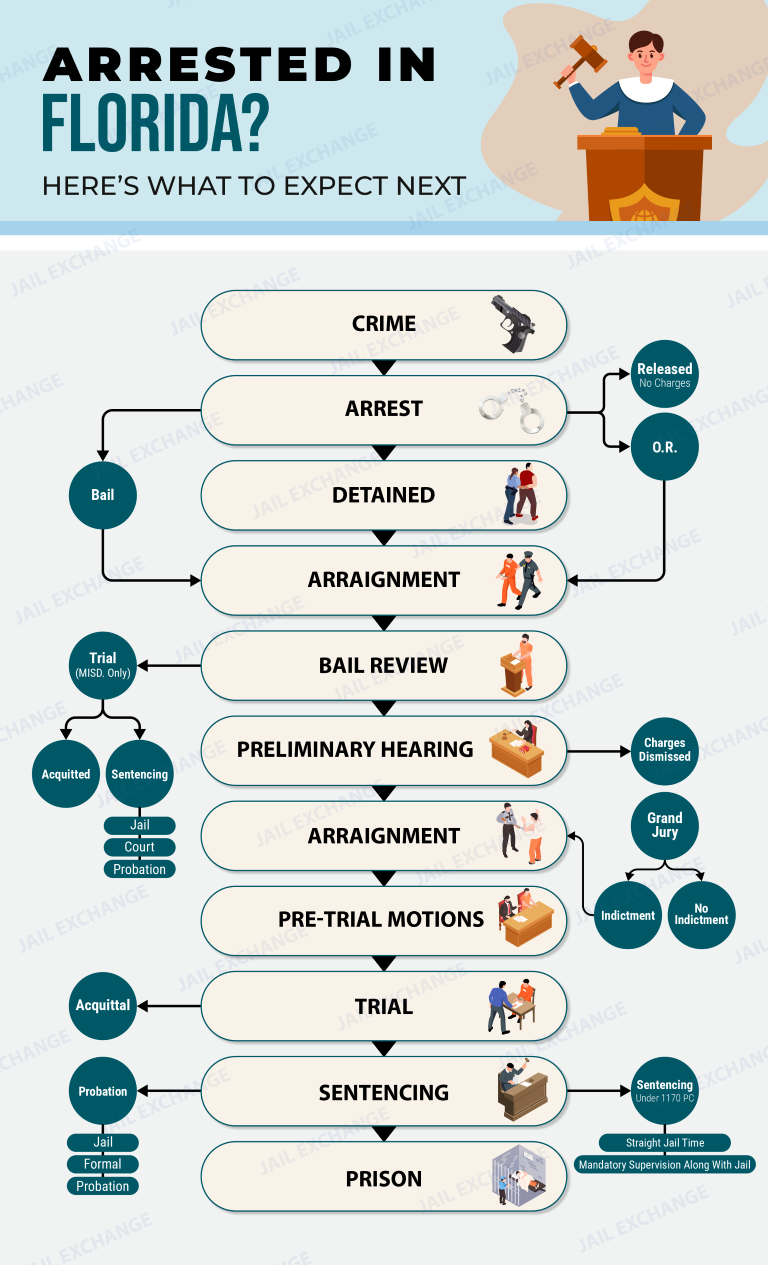
Jackson County Corrections Facility Criminal Court Process
Criminal Court Process for Jackson County Florida
Jackson County Criminal Courts in Plain English
Jackson County is the only Florida county that touches both Alabama and Georgia, and Marianna is its county seat. Criminal cases here go to one of two state courts. Misdemeanors, criminal traffic cases (DUI, or driving after your license was revoked), and local ordinance violations are decided in Jackson County Court. Jackson Circuit Court is where felonies are decided, along with all cases against children. Our bail guide and inmate search cover the other steps.
The county belongs to Florida’s 14th Judicial Circuit, a six-county Panhandle circuit that also includes Bay, Calhoun, Gulf, Holmes and Washington. Jackson’s criminal hearings take place at the Jackson County Courthouse, 4445 Lafayette Street, Marianna, FL 32446. The Clerk of Court’s main number there is (850) 482-9552, and the State Attorney’s Jackson County office can be reached at (850) 482-9555. Jackson is a little unusual: its jail, the Jackson County Correctional Facility at 2737 Penn Avenue in Marianna, is run by the county’s Board of County Commissioners through a corrections department, not by the Sheriff.
Free case lookup: Start at the Jackson Clerk’s Search Records page. From there, the free court records search lets you find a case by someone’s name or the case number, and shows the charges, hearing dates and outcomes. Jackson is also one of the counties on the free shared statewide records portal. Juvenile cases, sealed records and other confidential information are not shown to the public.
1. Marianna misdemeanor court: petit theft, DUI, simple battery, worthless checks
Officers in Marianna, Graceville, Sneads and the rest of the county can often give a notice to appear for a minor crime instead of taking someone to jail. That notice tells you exactly when to come to court. Booking at the Penn Avenue facility starts a 24-hour clock under Florida Rule 3.130; before it runs out, you’ll have a hearing with a judge called first appearance. Until then, staff check the Florida Supreme Court’s 2026 bond schedule (order AOSC25-69), showing the lowest bond permitted for each charge. Bond is a cash payment or pledge to make sure the person returns. For certain charges, like domestic violence, the person must wait for the judge before release. Bail bond agents, who must be licensed by the state, generally charge 10% of the bond as a fee that is not paid back.
Every state crime in Jackson, from shoplifting to murder, is prosecuted by the 14th Circuit’s State Attorney, who is elected. Jackson voters also elect the circuit's Public Defender, whose lawyers serve people a judge finds unable to pay. Conflicts send the case to a lawyer with Criminal Conflict and Civil Regional Counsel, a regional state office. A judge may use Statute 938.29 to order repayment of some appointed-lawyer costs, and the unpaid amount can be recorded as a lien.
If convicted of a first-degree misdemeanor, a person faces as much as a year in the Penn Avenue jail and a $1,000 fine. A second-degree conviction tops out at 60 days and $500. Writing a bad check for a small amount is usually a misdemeanor, while larger amounts can be felonies. Under the speedy trial rule, a misdemeanor must generally be tried within 90 days unless the defendant waives it. A six-person jury hears misdemeanor trials. First-time offenders are often offered pretrial diversion, which leads to the charge being dropped after the program is completed.
Kids and teens: In Florida, people under 18 face charges before a Circuit Court juvenile judge. Many young people caught in a first minor offense can receive a civil citation or prearrest diversion under Statute 985.12, earning a second chance through service hours or counseling, with no arrest on record. A Jackson County child who must be detained goes to Panama City's Bay Regional Juvenile Detention Center, run by the state's juvenile justice agency, and a judge reviews it at a hearing within a day.
2. Jackson County felonies: home burglary, livestock or timber theft, meth trafficking, contraband in a prison
In Florida, a felony means a possible state prison term beyond one year. In Jackson, a felony begins at first appearance, where bond or pretrial release terms are set, letting the person go home before trial under certain rules. The State Attorney’s office in Marianna then reviews the case and decides whether to file an information, which formally charges the felony. The defendant then enters a plea at an arraignment.
Florida felonies are ranked by degree. A third-degree felony is punishable by up to 5 years; stealing cattle or timber worth $750 or more is often charged at this level. A second-degree felony is punishable by up to 15 years; burglary of a dwelling is usually second degree. A first-degree felony is punishable by up to 30 years. Jackson has several state prisons, and bringing drugs, phones or weapons into one is a felony under Florida law as well. The judge scores the case on a Criminal Punishment Code scoresheet, with points for the crime and record that set the minimum sentence. Florida prisoners serve no less than 85% of a sentence.
The speedy trial limit for a felony is 175 days, but it can be waived. Jackson felony trials use six jurors, and all six must vote the same way. Most Jackson felony cases end with a plea bargain.
Kids and teens: Juvenile judges hold on to most teen felony cases, with a focus on helping the young person change. Prosecutors do have a way out, though: direct file under Statute 985.557, which brings adult charges. It can be used with most felonies for teens aged 16 or 17, and with certain listed serious crimes for those aged 14 or 15. Since 2019, Florida has had no mandatory direct file, so the prosecutor decides each Jackson County case separately.
3. Violent felony cases in Jackson County: murder, armed robbery, sexual battery, attacks on officers
Violent felonies move through the Marianna courtroom in the same order, but with much more at risk. Florida reserves its two harshest categories, life felonies and capital felonies, for the worst crimes. Premeditated murder, the classic capital crime, brings death or life imprisonment with no parole. When the evidence is strong in such a case, bond can be refused until trial.
Gun crimes bring Statute 775.087, nicknamed 10-20-Life, into play: a gun in hand during a listed crime means 10 years minimum, a shot fired means 20, and a death or serious injury means 25 years up to life. Attacking a law enforcement or corrections officer also raises the penalty for many crimes.
In death penalty cases, a 12-person jury decides, and since 2023 at least 8 jurors must agree before death can be recommended. Condemned men are held at Union Correctional Institution near Raiford; condemned women, at Lowell Correctional Institution. Marsy's Law in the Florida Constitution gives Jackson victims court-date notice and a say at sentencing.
Kids and teens: For any crime that could bring death or life, Statute 985.56 permits a grand jury (residents who privately study the evidence) to indict a Jackson County child regardless of age, placing the case in adult court. Young people can’t be sentenced to death for crimes committed before they turned 18. Life sentences for juveniles also require a separate Marianna hearing on the teen’s maturity, home life and potential for change.
4. How are Marianna court warrants checked and cleared?
Jackson deputies keep and serve the warrant file; the Sheriff's Office number is (850) 482-9624, and a name with birth date is enough for a check. The clerk's Search Records page pulls up cases, showing a capias if one was ordered. A planned surrender at the Penn Avenue correctional facility goes best once an attorney has called ahead. Lafayette Street is where the clerk's office sets new dates, and Graceville, Sneads and Cottondale cases come there too. Beyond the county line, FDLE publishes a statewide wanted persons search anyone can use.
Federal court: Jackson County’s federal crimes are assigned to the Panama City Division within Florida’s Northern District. According to the Federal Defender’s office, that division’s cases have been moved for now to the federal courthouse in Tallahassee, on North Adams Street (number 111, ZIP 32301), so always check where a federal hearing will be. What makes a crime federal? Florida prosecutes crimes against state law. The federal government steps in when a U.S. law is broken, when a crime crosses state lines, or when it happens on federal property. Jackson has a big example of federal property: FCI Marianna, a federal prison. Crimes inside it, like smuggling drugs or phones to inmates, are federal. Because Jackson borders two states and Interstate 10 runs through it, drug trafficking that crosses into Alabama or Georgia can also become a federal case. The county has no tribal reservation or military base. Pick a topic below.
Immigration holds. How Jackson handles an ICE detainer:
- the Jackson bond judge must be told (F.S. 908.105)
- notice goes to the Jackson state attorney
- a Jackson judge can still set bond
- the jail may hold them 48 more hours for ICE
- Jackson counts weekends and holidays in that time
- for Jackson forcible felony cases, unlawful status blocks Jackson release before first appearance (F.S. 907.041)
- then the Jackson court presumes detention, and the Jackson defense can push back
Town courts. Since 1972 Article V changes, Jackson has had no city courts. Any Jackson city ordinance case is heard in Jackson County Court instead, alongside misdemeanors.
Jackson County readers should know this is general information about local criminal courts, never legal advice. Your own lawyer can review your Jackson case; for records and dates, call the Jackson County Clerk of Court at (850) 482-9552.