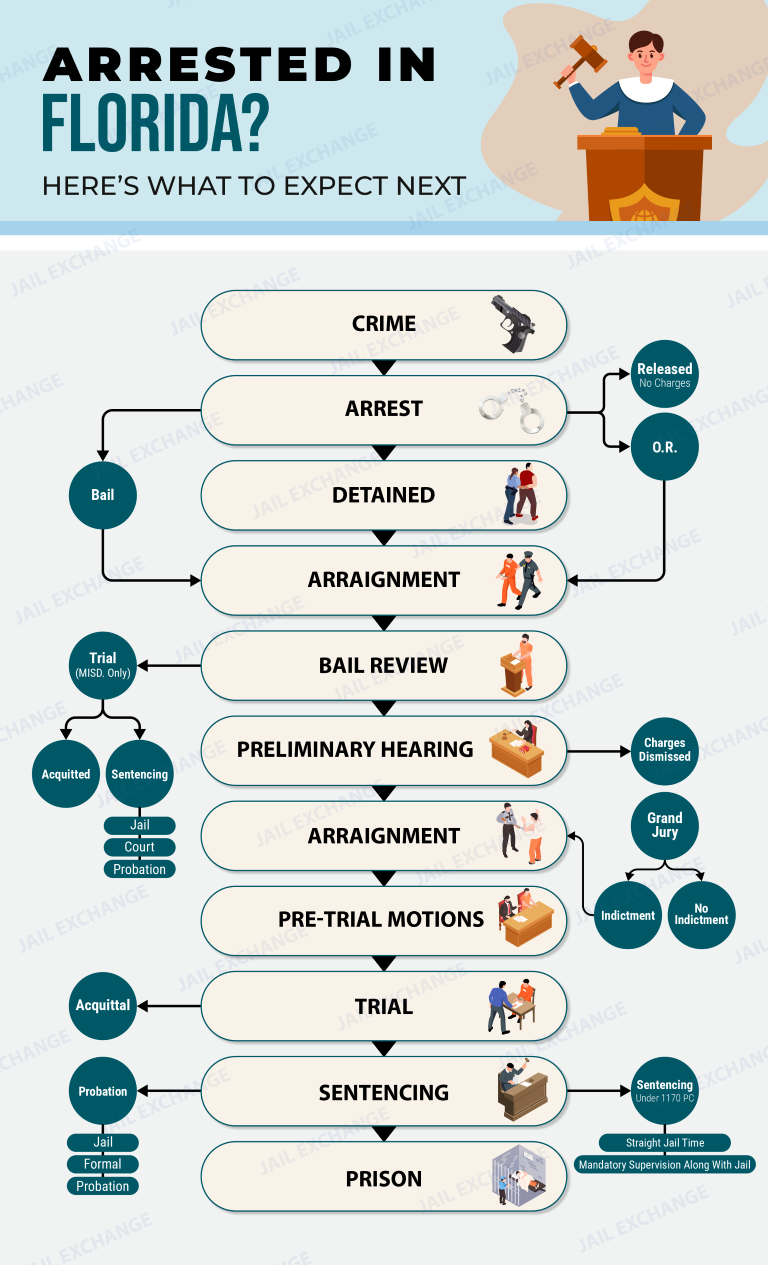
Lafayette County Detention Center Criminal Court Process
Criminal Court Process for Lafayette County Florida
Lafayette County Criminal Court: A Plain-English Walkthrough
Fewer people live in Lafayette than in almost any other Florida county, and it’s tucked along the Suwannee River. Even so, it has the same two-court setup as every county in the state. Lafayette County Court is where misdemeanors, traffic crimes (reckless driving, for one, or DUI) and county ordinance cases get decided. Lafayette Circuit Court deals with felonies and with juvenile cases, meaning children charged with crimes. Lafayette is one of seven counties in the Third Judicial Circuit. Its neighbors in that circuit are Columbia, Dixie, Hamilton, Madison, Suwannee and Taylor, and the judges travel among them. You can also check our bond guide and inmate search guide.
Criminal court in Lafayette meets at the Lafayette County Courthouse, 120 W. Main Street, Mayo, FL 32066. To reach the Clerk of Court, dial (386) 294-1600. Arrested adults usually wait at the Lafayette County Jail, 178 NW Crawford Street in Mayo, which the Sheriff runs. Mayo Correctional Institution, nearby, is a different place. It’s a state prison.
Checking a case online, no charge: Lafayette’s Clerk posts its records on the shared shared court records portal that many small Florida counties use. Select Lafayette, then type the name of the person charged, or the case number. It shows the charges, upcoming court dates and outcomes. Confidential items, like juvenile matters and sealed or expunged cases, are kept off the public view.
1. Lafayette misdemeanors: DUI, petty theft, disorderly conduct
What happens right after an arrest? For a minor Lafayette charge, a deputy may issue a notice to appear, a slip naming your court day. When it’s a jail booking, Florida Rule of Criminal Procedure 3.130 gives a Lafayette judge one day to see you. The judge reads the charge and decides on pretrial release, meaning freedom to leave jail while the charge is still pending. A uniform bond schedule, issued by Florida’s Supreme Court for 2026, sets the smallest bond amounts the jail can take before that hearing. A few charges, though, mean you must wait for the judge. Families often use a bail bond agent, who charges a nonrefundable premium, usually 10% of the bond.
How serious can a misdemeanor get? First degree: a maximum of 12 months in jail, plus fines reaching $1,000. And for second degree, sixty days and $500 at the most. Many people instead get probation, a class, or community service hours. The prosecutor is the elected Third Circuit State Attorney. Lafayette defendants unable to pay a lawyer can seek the Third Circuit Public Defender. If there’s a conflict, the Regional Counsel for that part of Florida (full name: Criminal Conflict and Civil Regional Counsel) can step in for Lafayette defendants. Florida law, Fla. Stat. 938.29, lets the judge assess a public defender fee, and it can become a lien if it isn’t paid.
First-time offenders sometimes qualify for pretrial diversion. Finish the program, and the State Attorney may drop the charge. A trial in County Court is in front of six jurors. Under the speedy trial rule, a Lafayette misdemeanor must be tried within 90 days of formal charging, except when the defense agrees to wait.
Teens in Lafayette: Children under 18 aren’t tried in County Court. Instead, juvenile judges in Circuit Court decide their misdemeanor cases. Florida’s civil citation law, Fla. Stat. 985.12, allows officers to skip arrest for many first-time minor offenses. Instead, the teen agrees to things like an apology letter or service hours. Doing them keeps an arrest off their record.
2. Lafayette felonies: burglary, meth possession, grand theft
In Lafayette, as statewide, a felony can bring over a year, served in a Florida state prison. After first appearance, the State Attorney looks over the reports and chooses whether to file the official charging paper, called an information. Then comes arraignment. That’s when you enter a plea in Circuit Court. For felonies, the speedy trial clock runs 175 days after formal charges are filed, unless the time is waived.
How long can a sentence be? A third-degree felony can mean 5 years. Second degree, as many as 15. First degree, as many as 30. A life felony can mean life. To set the minimum, the judge uses a Criminal Punishment Code scoresheet. It works like a point total: the charge, injuries to a victim and earlier convictions all add points. Florida inmates serve no less than 85% of a prison term. When a gun is part of certain felonies, the 10-20-Life law kicks in, with mandatory minimum terms of 10, 20, or 25-to-life years depending on whether the gun was carried, fired, or hurt someone badly.
Mayo felony trials have six jurors, and they must all agree. Most felony cases, though, end in a plea agreement worked out between the lawyers.
Teens in Lafayette: When police pick up a child on a felony, the child can be locked up at a Department of Juvenile Justice detention center. Lafayette has no youth center, so children go to a regional one, such as Tallahassee or Gainesville. Within 24 hours, at a detention hearing, the judge rules on whether the child may go home. Prosecutors can “direct file” adult charges against many 16- and 17-year-olds accused of felonies. For 14- and 15-year-olds, that’s limited to a set list of very serious crimes in Fla. Stat. 985.557.
3. Lafayette violent crimes: murder, robbery, aggravated battery
Violent Lafayette charges follow those same steps, with much more at stake. Bond can be denied completely in cases punishable by life or death if the proof is strong. When the state wants to charge a capital crime, it must go through a grand jury, a panel of Lafayette County residents who listen to evidence privately. If they agree there’s enough, they return an indictment.
First-degree murder is Florida’s top crime, a capital felony. A Lafayette conviction for it brings execution or a whole-life term. In those trials, 12 jurors hear the case. A 2023 change means a death sentence now needs a recommendation from only 8 of the 12, not all of them. Executions happen at Florida State Prison near Starke. Most death-row men in Florida sit at Union Correctional Institution in the town of Raiford; Lowell Correctional Institution holds the few women. Robbery with a gun or sexual battery on a child can bring decades or life.
Victims and their families in Lafayette have rights too, thanks to Marsy’s Law (Article I, Section 16 of Florida’s constitution). They can learn about each hearing, attend it, and be heard by the judge, including at sentencing.
Teens in Lafayette: Some Lafayette crimes carry a possible death or life sentence. For those, a grand jury may indict even a very young child, as Fla. Stat. 985.56 allows. Once indicted, that child is handled as an adult. Still, no one can be executed for something done before turning 18.
4. How do I find out whether Mayo has a warrant for someone?
Sheriff's Office deputies keep and serve warrants issued by Third Circuit judges, and the agency answers at (386) 294-1222; its warrants staff will check a name. Mayo dockets live on the shared court records portal, capias entries included. Counsel can phone the Crawford Street detention center and pick the day of surrender. West Main Street is home to the clerk for new dates, and Day and the riverside fish camps are part of the same court. For a statewide check, FDLE has a wanted persons search built from agencies' releases.
Federal court: Lafayette’s federal cases go to Gainesville, home of a division of the Northern District of Florida’s U.S. District Court, located at 401 SE 1st Avenue, Gainesville, FL 32601. Most crimes in Lafayette break Florida law and stay in Mayo. Congress writes federal laws, and breaking one of those, or doing harm on property the national government owns (say, a post office), can make it a federal matter. Examples that can go federal from a rural county like this one include large drug-trafficking rings, felons caught with guns, stealing mail, and child exploitation online. Lafayette has no national forest, military base or tribal land. The nearest Seminole reservation is in South Florida, far away. Tap a section below.
Immigration holds. In Lafayette, an ICE detainer works like this:
- the judge at the Lafayette bond hearing hears about it (F.S. 908.105)
- the Lafayette prosecutor gets notice
- Lafayette bond can still be granted
- the jail may hold them 48 more hours for ICE
- those hours in Lafayette include weekends and holidays
- for Lafayette forcible felony cases, unlawful status blocks Lafayette release before first appearance (F.S. 907.041)
- then the Lafayette court presumes detention, and the Lafayette defense can push back
Town courts. Lafayette has no city or town courts. The 1972 Article V reform phased them out. In Lafayette, a city ordinance case goes to Lafayette County Court, which also hears misdemeanors.
Here you’ll find a general picture of Lafayette County criminal court, and it isn’t legal advice. If a real charge is hanging over you, get advice from a Mayo-area defense attorney, or try the Lafayette County Clerk at (386) 294-1600.