
Marion County Jail
Marion County Jail
Jail Phone Number
352-351-8077Marion County Jail, Ocala
Ocala, Belleview, Dunnellon and the Marion part of The Villages all book adults into the Marion County Jail on NW 10th Street.
Search Marion County Inmate Search or call 352-351-8077.
Our court guide explains what comes next.
Read inmate search answers
 Read inmate search answers
1. Marion jail address
The Marion County Jail sits at 3290 NW 10th Street, Ocala, FL 34475. Jail: 352-351-8077. Marion County Sheriff's Office: 352-732-8181.
↑ Back to the question list2. Looking up a Marion inmate
Try Marion County Inmate Search for charges and bond. Arrests made overnight may post by morning. VINELink gives release alerts.
↑ Back to the question list3. Bond in Ocala
Marion is in the Fifth Judicial Circuit. A judge sees each new arrest within 24 hours. Possible results:
- ROR, where nothing is owed.
- Cash bond: pay the clerk the full sum; most comes back after the case.
- Surety: a bondsman's 10 percent, at least $100 a charge, which you won't see again.
Bond won't free someone Lake, Alachua or a probation officer wants. Skipping an Ocala court date gets a warrant issued. See our Marion bail page.
↑ Back to the question list4. Could a Belleview or Dunnellon warrant arrest end on NW 10th Street?
Yes. The NW 10th Street jail is the shared booking stop for deputies and for the Belleview and Dunnellon police. For the case and the next hearing date, phone the clerk at 352-671-5604. Any capias is listed on the shared court records search. Marion's Sheriff's Office runs local warrant checks, and FDLE's statewide wanted register reaches beyond the county. If the warrant is yours, an attorney can set a surrender time, which usually helps at bond and shortens the stay.
↑ Back to the question list5. Public defender
The Fifth Circuit Public Defender, which has an Ocala office, takes Marion clients found indigent. The $50 fee can be waived.
↑ Back to the question list6. Visiting on NW 10th Street
Visits need scheduling; video is widely used. Call 352-351-8077. See visits and remote visits.
↑ Back to the question list7. Phones
Marion inmates dial out through a prepaid account and can't receive calls. Our pages on phones, messages and tablets explain.
↑ Back to the question list8. Money
Funds added to the account pay for commissary. Ask which deposit services Ocala accepts. See money and commissary.
↑ Back to the question list9. Mail
Each envelope needs name, booking number and 3290 NW 10th Street. No stickers. See mail rules.
↑ Back to the question list10. Marion juveniles
Juvenile court hears cases for Marion youth under 18. Detention means the Marion Regional Juvenile Detention Center in Ocala, 352-732-1450, with a hearing inside 24 hours. Parents can call 352-732-8181.
↑ Back to the question list11. Medical
Phone 352-351-8077 to warn staff about seizures, insulin needs, heart drugs or suicidal talk.
↑ Back to the question list12. Marion federal cases
The U.S. District Court, Middle District of Florida, has an Ocala division at 207 NW 2nd St., Ocala, FL 34475, which hears Marion federal cases.
An Ocala magistrate holds the first hearing, and prosecutors may ask for detention. The U.S. Marshals (352-547-3680) can keep federal prisoners in county jails. Use the BOP finder after sentencing.
↑ Back to the question list13. ICE detainers in Marion
- NW 10th Street booking prints go to DHS.
- ICE may file an I-247A detainer.
- Marion can hold the person awaiting ICE transport up to 48 hours after they would otherwise be released (8 CFR 287.7(d)).
- F.S. 908.105: the Marion bond judge sees the detainer, prosecutors get it, and it's docketed.
- F.S. 907.041: for an Ocala defendant without lawful status facing a forcible felony, release before first appearance isn't allowed; the judge then presumes detention, though it can be rebutted.
- F.S. 908.11: 287(g) is required; Marion deputies work ICE task force cases, and the jail is a warrant service site.
- Ocala families can enter details on ICE's detainee page or call the Miami field office, 2805 SW 145th Ave., Miramar, FL 33027, 954-843-5800.
14. State prison
Marion inmates sentenced to prison wait in Ocala until the state transports them to reception. Use FDC's offender search; addresses are on our Florida page.
↑ Back to the question list15. Marion mugshots online
Yes. The Marion inmate inquiry shows mugshots for most inmates in its photo column; a few say the photo is not available. Copies are by request at 352-732-8181.
ICE photos: file through ICE FOIA. Federal booking photos aren't released unless the Marshals are looking for a fugitive.
↑ Back to the question list16. Marion police numbers
- Ocala Police Department: 352-369-7070
- Marion County Sheriff's Office: 352-732-8181
Emergencies: 911.
↑ Back to the question listMarion County contacts
- Inmate search
- Marion County Inmate Search
- Jail
- Marion County Jail, 3290 NW 10th Street, Ocala, FL 34475, 352-351-8077
- Sheriff
- 352-732-8181
Marion County bail and bond: the Ocala jail, round-the-clock payment, and what to expect
Marion County's adult jail is the Marion County Jail in Ocala, run by the Sheriff's Office Detention Bureau.
First, look in Marion County Inmate Search for the booking and the bail. The jail's main line is 352-351-8077.
The sheriff's website says bonds are accepted 24 hours a day, and a judge can change any amount at first appearance.
1. Is my daughter booked into the Ocala jail?
Use Marion County Inmate Search and enter the last name first. If it comes up empty, the booking may still be underway. Look again in a few hours.
Call 352-351-8077 if the name is still missing, and ask if she was arrested by the Ocala Police Department or another agency and has not yet reached the county jail.
2. What is the Ocala jail address?
The Marion County Jail is at 3290 NW 10th Street, Ocala, FL 34475, according to the sheriff's own pages. Do not confuse it with the sheriff's office on NW 30th Avenue, which is a different building. The sheriff's main number is 352-732-8181 and the jail's is 352-351-8077.
3. What is the Jail Information and Visitation Center?
The sheriff's website names it as the place to pay a bond in person, with cash or a certified check payable to the Marion County Clerk of Courts. It says bonds are accepted 24 hours a day, once booking and identification are finished. Release can take several hours after the money is received. Check the amount on Marion County Inmate Search first, and ask 352-351-8077 about the entrance and what to bring. Bring the booking details and a government photo ID to the Marion jail.
4. Does Marion take credit or debit cards for bail?
Yes, but not at the counter. The sheriff's website points card users to an outside online payment service, which also takes payments by phone. The sheriff says that service is not a bonding company and that the Sheriff's Office does not set its fees. Type the web address from the sheriff's page yourself, and confirm with the jail at 352-351-8077 before you enter card details. Money on a Marion inmate's account pays for calls and snacks; it is not bail.
5. What are the bail amounts for common charges?
Marion uses the 2026 statewide schedule (order AOSC25-69) before first appearance, from $150 for the lightest misdemeanor to $5,000 for a forcible third-degree felony; a first DUI filed as second-degree is $500.
Local judges can set other amounts, so trust the figure shown on Marion County Inmate Search for your family member.
6. Who can lower the bail?
Only a judge, under Florida Statutes 903.011(4). The judge looks at the factors in section 903.046, such as the charge, work and family ties, health, and past missed court dates. A Marion lawyer can ask the court to revisit the money portion. A Marion bond hearing goes better with proof of a job, an address, and nearby relatives.
7. How long before a Marion judge hears the case?
Rule 3.130 of the Florida Rules of Criminal Procedure puts first appearance within 24 hours of arrest. Judges often handle this by video. The sheriff's website does not list the hearing time, so call the jail at 352-351-8077 and ask. At the Marion hearing, the judge rules on release and may add terms under section 903.047.
8. What does a bondsman really cost?
The fee is the premium. The Florida Department of Financial Services puts it at 10 percent of court-set bail, so a $5,000 Marion bail costs $500. After the agent gets the person out, that money is earned and stays with the agent. If no release ever happens, the fee comes back to you. Section 648.33 makes a Marion agent charge exactly the filed rate, so walk away from any other deal.
Any collateral should be returned to you within 21 days of the court discharging the bond. The sheriff says the jail cannot recommend an agent, so look for a registered one yourself.
9. Can Marion land or a house bail someone out?
In Marion it's possible but slow, and state law gives no single checklist. Call the jail at 352-351-8077 and ask who handles property bonds in Marion County, whether the land must be here, and how much equity is needed. Every owner will likely need to sign. A bond that is recorded becomes a two-year lien on the property (section 903.26).
10. Why might Marion hold someone with no bond?
Section 903.011(6) makes some Marion arrestees wait for a judge, including registered sexual offenders.
Marion courts can deny bail on a capital or life count if guilt is clear (Article I, section 14 of the Florida Constitution). A hold from another county is another reason.
11. Can the county give us a lawyer?
Marion defendants can request appointed counsel when they first see the judge. The jail lists a public defender number of 352-671-5454; confirm it when you call. A public defender can ask for bail to be lowered or for release with conditions.
12. Which building holds a minor from Marion County?
The Marion Regional Juvenile Detention Center in Ocala is the state juvenile facility listed for the county, with a phone of 352-732-1450. It serves Marion, Citrus, Hernando, Lake, and Sumter counties. Marion juvenile cases are private, so a child may be missing from the adult search.
13. What if he skips his hearing?
For Marion, that means a possible warrant and loss of the bond. Marion's clerk notifies within five days (section 903.26), and payment falls due 60 days later. A defendant who returns inside 90 days may win back nearly everything under section 903.28. Call your lawyer and your agent the same day.
14. When is cash bail returned?
When a Marion case ends, the clerk returns non-agent cash after taking out unpaid costs and fees. Marion bail agents keep their fees. Ask the Marion clerk's office how to request the refund, and save your receipt.
15. How do I check that a payment request is real?
Marion's jail never seeks gift cards or person-to-person app transfers. Call 352-351-8077 yourself before you pay anyone who contacts you.
16. How do ICE holds work at the Marion jail?
- ICE uses Form I-247A to ask Marion jailers for more time.
- In Marion, that means up to 48 more hours.
- In Marion, weekends and holidays count toward those 48 hours.
- Posting bond in Marion does not end an ICE hold.
- Under F.S. 908.105, the Marion judge setting bond must hear about it.
- The Marion state attorney gets notice as well.
- Florida law (F.S. 908.11) puts the Marion sheriff in the 287(g) program.
- For Marion, ICE's 287(g) list shows:
- Task Force Model
- Warrant Service Officer
- If ICE takes someone from Marion, search the ICE detainee locator.
Marion County bail contacts
- Jail
- Marion County Jail, 3290 NW 10th Street, Ocala, FL 34475; 352-351-8077
- Bond guide
- bail and bond instructions for the jail
- Custody lookup
- Marion County Inmate Search
- Sheriff's office
- Marion County Sheriff's Office, 692 NW 30th Avenue, Ocala, FL 34475; 352-732-8181
- Public defender
- Listed number 352-671-5454
- Youth detention
- Marion Regional Juvenile Detention Center, Ocala; 352-732-1450
- Statewide schedule
- Supreme Court order AOSC25-69
In Marion, figures, hours, payment rules, and phones are not fixed, and a judge can set another bond. Call the jail before any money moves.
Instructions on How to Post Bond Online in Marion County

CASH BOND ONLINE provides a secure, 24/7 web portal that allows families to post full cash appearance bonds online using a debit or credit card, avoiding the delay of traveling to a courthouse or jail booking window with large amounts of cash.
Important: Verify Magistration and Bond Eligibility First
Not every facility accepts cash bonds through an online portal around the clock, and court hours vary. Call the booking desk to verify that intake is completed, that the magistrate has officially set the bail amount, and that the person has no additional hold orders before paying. Once an electronic bond is processed, administrative transaction fees cannot be refunded.
Step-by-Step Instructions to Register and Access Service
- Contact the jail booking desk to confirm the defendant is cleared for bond release and obtain the exact dollar amount required.
- Open your web browser and navigate to www.cashbondonline.com.
- Select the participating state, county, or municipality.
- Type in the defendant's full legal name, date of birth, and booking or case number.
- Enter your debit or credit card payment information, review the processing charge, and authorize the transaction.
- Print the electronic confirmation receipt and notify the booking desk with your confirmation number.
What the Inmate Needs to Do
The booking officer receives the electronic payment confirmation, prepares the release paperwork, and has the defendant sign the court appearance bond agreement before initiating their discharge.
Official Provider: CASH BOND ONLINE Official Website
Customer Service Telephone: 1-888-474-0610
Support Hours: 24/7/365
Supported Languages: English and Spanish
Other Services Provided by CASH BOND ONLINE
In addition to CASH BOND ONLINE Bail Services, CASH BOND ONLINE provides several other communication, financial, and visitation services at participating correctional facilities:
- Inmate Trust Money Deposits: Deposit funds into an inmate's personal trust account for canteen and phone usage.
• Learn more on our website: Inmate Trust Money Deposits Guide | • Visit official vendor page: CASH BOND ONLINE Inmate Trust Money Deposits
Marion County Jail Visitation: Book the Correct Video Session
Marion County Jail: 3290 NW 10th Street, Ocala, FL 34475. Public visits use video, either at the Jail Information and Visitation Center or remotely through Securus. Do not assume that an on-site appointment means a face-to-face contact visit.
Make an appointment first
- Register with Securus, choose Marion County Jail in Florida and the person you wish to visit, then select the appropriate on-site or remote option and an available time. Enter every visitor’s first and last name.
- For staff booking help, call 352-438-5961, daily 9 a.m.–9 p.m. Have the inmate’s legal name, birth date and booking date if known. Ask about eligibility, the check-in entrance and available appointments.
- Book no more than a week ahead. Remote appointments require at least one day’s notice. The November 2025 handbook lists a $5 remote visit; review the price shown before payment. On-site limits are one 30-minute visit per day and four per week per inmate.
Hours: confirm your actual reservation
The November 2025 handbook lists daily 9–11:30 a.m., 1–4:30 p.m. and 7–9:45 p.m., Eastern Time. The Sheriff’s web page differs: its general section starts at 8 a.m., while its appointment section ends the first two blocks at 11 a.m. and 4 p.m. Use the confirmed appointment, not an assumed walk-in time. Call 352-438-5961 if the displayed options conflict.
Arriving and visiting
- Bring a current government photo ID. The handbook’s stricter rule permits identification only in the visiting area; arrange storage of keys and other belongings before check-in, or obtain a staff-approved exception.
- On-site groups: two adults and one child, or one adult and two children. Visitors 17 or younger need a parent or legal guardian.
- Arrive with time to check in. A late arrival may shorten or forfeit the session. Only booked visitors may participate, and faces must remain visible.
- Wear regular, fully covering clothing. No swimsuits, transparent, obscene, provocative or tight-fitting clothing. Do not record visits or use extra phones/electronic devices during them. Public visits are monitored and recorded.
- No weapons, illegal drugs or contraband anywhere on jail property, including parked vehicles. Intoxication or disruptive conduct can end a visit.
Attorneys, clergy and special circumstances
Attorneys are not restricted to public visiting hours. Call the jail at 352-351-8077 to arrange access and confirm credentials, documents and confidential visiting arrangements. Clergy must meet the handbook’s local church approval/licensing criteria, show photo ID and call to schedule a video visit; only the scheduled clergy member may attend, and that visit does not use the inmate’s regular two-hour weekly allowance.
Ask for Watch Commander approval for special visits involving hardship, emergencies, extended time or long-distance travel; bring proof when requested. Hospital visits and suicide-precaution housing require the designated jail authority’s approval. Inmate workers cannot leave work to visit.
Sheriff’s visitation instructions and current handbook. Confirm the visitor-center entrance when booking: the handbook’s SW 10th Street description differs from the jail’s NW 10th Street address.

Securus Video Connect allows families to conduct scheduled face-to-face video visits with incarcerated loved ones from home. Using a computer with a webcam or the Securus mobile app, visitors can join live video sessions without traveling to the facility or waiting in jail visitor lobbies.
Important: Advance Registration and Visitor Clearance Required
Detention centers do not permit unscheduled or unverified video sessions. Correctional facilities require prospective visitors to submit government-issued photo identification and receive administrative clearance before booking an appointment, an approval process that can take up to 48 hours depending on facility staffing. You should verify your visitor approval status with the facility prior to scheduling. If you do not register well in advance, you will miss your loved one's scheduled visiting window for the week.
Step-by-Step Instructions to Register and Schedule a Video Visit
- Visit securustech.online or open the Securus mobile app.
- Register your account and upload a clear photograph of your government-issued ID (driver's license or passport) for facility background review.
- Wait for email confirmation indicating that facility administration has granted visitor approval.
- Select Schedule a Visit, choose your detention facility, and select the inmate.
- Browse the available schedule calendar, select an open 20- or 30-minute time slot, and pay the fee using a credit or debit card.
- Log into the website or app 10 minutes prior to the start time on a device with a functioning camera, microphone, and reliable high-speed internet connection.
What the Inmate Needs to Do
The inmate receives an alert on their housing unit video kiosk or personal tablet. At the scheduled time, they log in with their PIN and sit in front of the terminal. Inmates and visitors must strictly observe jail dress and conduct rules; sessions are monitored by staff and will terminate immediately upon any violation.
Official Provider: Securus Technologies Official Website
Customer Service Telephone: 1-800-844-6591
Support Hours: 24 hours a day, 7 days a week, 365 days a year
Supported Languages: English and Spanish
Other Services Provided by Securus Technologies
In addition to Securus Video Connect, Securus and its subsidiary JPay offer several other communication, financial, and visitation services:
- AdvanceConnect Prepaid Calling: Prepay for phone calling credits so your loved one can call your mobile phone directly.
• Learn more on our website: AdvanceConnect Calling Guide | • Visit official vendor page: Securus AdvanceConnect - Direct Bill Phone Calling: Establish an invoiced monthly billing account for qualified residential landlines.
• Learn more on our website: Direct Bill Phone Calling Guide | • Visit official vendor page: Securus Direct Bill - JPay Money Deposits (Trust & Canteen): Send money directly into an inmate's jail trust account for commissary store purchases.
• Learn more on our website: Money Deposits Guide | • Visit official vendor page: JPay Money Transfers - JPay Email Messaging & Photos: Send electronic letters, photos, and VideoGrams directly to their tablet or kiosk.
• Learn more on our website: Email Messaging Guide | • Visit official vendor page: JPay Email Services
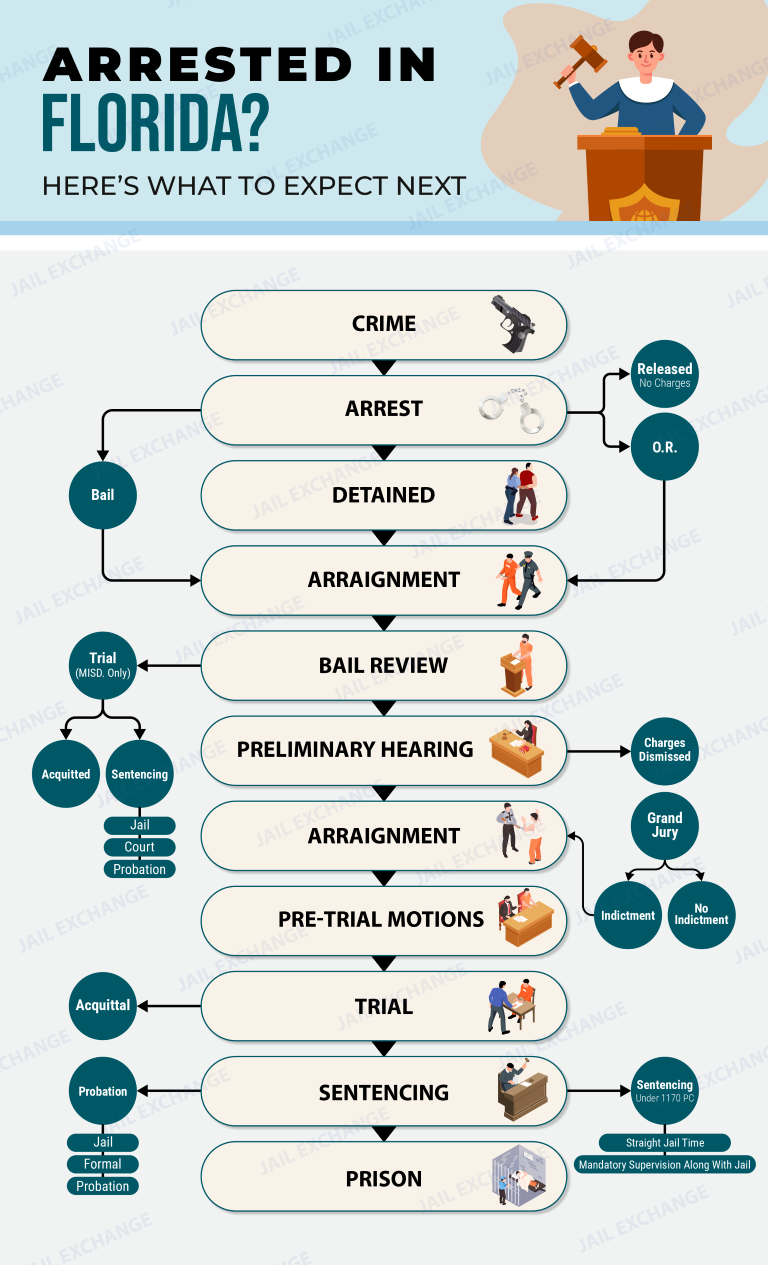
How a Criminal Case Works in Marion County, Florida
If someone you know was arrested in Ocala or anywhere else in Marion County, their case will go to one of two state trial courts. Marion County Court hears misdemeanors (the less serious crimes), criminal traffic cases like reckless driving, and violations of local ordinances. Marion Circuit Court takes felonies, the grave charges that may mean prison time, plus all juvenile delinquency matters. The 5th Judicial Circuit groups Marion with four neighbors: Citrus, Hernando, Lake and Sumter counties. Criminal court happens at the Marion County Judicial Center, 110 NW 1st Ave., Ocala, FL 34475. The Clerk of Court’s criminal courts staff can be reached at (352) 671-5604. Adults are jailed at the Marion County Jail, 3290 NW 10th St., Ocala, run by the Marion County Sheriff’s Office. Our bail guide and inmate search cover the other steps.
Free case lookup: Marion’s clerk uses the shared statewide records system many Florida counties rely on. Open the Marion County court records search and look someone up by name, or plug in a case number if you have it. You’ll see charges, court dates and what’s been filed. Records that the law keeps private, like juvenile cases or sealed files, won’t appear, and some document images need a free registration.
Federal court: Ocala has its own federal courthouse. The Middle District of Florida’s Ocala Division sits in the Golden-Collum Memorial building at 207 NW Second St., Ocala, FL 34475. It also handles Citrus, Hernando, Lake and Sumter. The basic split works like this. Florida prosecutors charge people who break Florida laws. Federal prosecutors charge people who break laws passed by Congress, or who commit crimes on federal land. The big example in Marion County is the Ocala National Forest, where U.S. Forest Service officers patrol. Interstate drug rings, gun crimes by people with felony convictions, bank robbery and online fraud can also become federal cases. No tribal reservation lies inside Marion’s borders. Tap a topic below.
1. Lower-level Marion cases: petit theft, DUI, disorderly conduct, battery
What happens right after an arrest? Every person kept at the NW 10th Street jail goes before a judge in under 24 hours. Lawyers call that the first appearance. There the judge checks that police had a good reason for the arrest and sets pretrial release rules, meaning the conditions for going home until the case ends. For many charges, a person can bond out sooner. A 2026 Florida Supreme Court order, AOSC25-69, created a single statewide bond schedule. It names a minimum amount for each charge before a judge gets involved. Some charges still mean waiting for the judge. A state-licensed bail bond agent in Marion can post the bond for a fee, which the state's consumer page puts at 10% of the bond. That fee is not refunded.
How bad can a misdemeanor get? A first-degree misdemeanor, like petit theft of $100 to $750 or simple battery, can cost up to 12 months in jail plus up to $1,000. Disorderly conduct is a second-degree misdemeanor, capped at 60 jail days and a $500 penalty. A first DUI is its own category with fines, probation, DUI school and a license suspension. Marion’s State Attorney offers pretrial intervention programs for some first-time offenders, which can end with the charge dismissed.
Who is on each side? The prosecutor is the State Attorney for the 5th Circuit, elected by voters in all five counties. The 5th Circuit Public Defender, also elected, may step in when a judge finds the accused too poor to hire counsel. When a conflict of interest exists, regional conflict counsel takes over the defense. Florida law in section 938.29 says a person who used an appointed lawyer can be ordered to repay at least $50 on a misdemeanor, and the state can place a lien for the amount. Rule 3.191 sets a 90-day clock, starting at formal charging, for misdemeanor trials, and the defense may give that clock up. The jury is six people.
Under 18: Children’s cases go to the juvenile division of Marion Circuit Court. For a first minor offense, a deputy or officer can often skip the arrest and write a civil citation under section 985.12. Finishing the assigned tasks means no arrest record.
2. Felonies in Ocala’s Circuit Court: burglary, meth or fentanyl sales, grand theft auto, fraud
How does a felony case start? Once the jail hearing is done, Ocala prosecutors weigh the evidence and may put formal charges in writing. That paper is the information. Then the person is arraigned in Circuit Court, the two sides share evidence, and the judge sets pretrial dates. A Marion felony can take many months.
What are the possible sentences? Florida grades felonies by degree. Third degree means up to 5 years in prison, as with stealing a car. Second degree means up to 15 years, as with an ordinary cocaine sale. First degree tops out at 30 years, though certain ones permit a life term. Drug trafficking charges can carry mandatory minimum prison terms set by the amount of drugs. A scoresheet from the Criminal Punishment Code turns the charges and the person’s past into points, and that number usually sets the lowest allowed sentence. Every Florida prison sentence must be at least 85% served.
How fast is trial? Under Rule 3.191, a felony trial should start within 175 days after formal charges are filed; defendants may waive that. A jury of six decides most Florida felony trials. Most cases end in a plea agreement instead.
Under 18: A youth who is held after arrest is taken to the Marion Regional Juvenile Detention Center, a state DJJ lockup in Ocala. A judge must review the hold at a detention hearing within 24 hours. Many juvenile felony cases end with probation or a commitment program rather than adult prison.
3. Ocala-area violent felonies: murder, robbery with a weapon, sex crimes, aggravated battery
What’s different about violent cases? The court process is the same, but release is harder and the punishments are much longer. A judge can hold a pretrial detention hearing and keep a person jailed until trial. With guns, Florida’s 10-20-Life rule in section 775.087 takes over. It orders a minimum of 10 years when a gun is possessed during crimes like robbery, 20 years when it is fired, and 25-to-life when that shot kills or gravely injures someone.
Can Marion County seek the death penalty? Yes. Marion prosecutors file first-degree murder as a capital felony. A Marion judge has two options: death or life without parole. Twelve jurors hear the penalty phase. Since a 2023 change, eight of those twelve votes are enough to recommend death; unanimity is no longer needed. Most condemned men wait at Union Correctional Institution in Raiford, and condemned women are kept at Lowell, just north of Ocala.
What about victims? Marsy’s Law (Fla. Const. art. I, §16(b)) promises victims they’ll be told about court dates and can speak, sentencing included.
Under 18: Can a teen be tried as an adult? Sometimes. Section 985.557 gives the State Attorney a choice called “direct file.” Teens who are 16 or 17 can face adult court on nearly any felony. Those aged 14 or 15 qualify only for violent crimes the statute names. Nothing forces a direct file anymore; that rule ended in 2019. Also, under section 985.56, the grand jury can indict a minor, whatever the age, if the charge could bring death or a life term.
4. How do I check for an Ocala court warrant?
A fair place to start is the shared court records search, which shows any capias. Marion's Sheriff's Office keeps Fifth Circuit warrants and answers at (352) 732-8181; deputies will confirm a name. Through a lawyer, pick a surrender time at the NW 10th Street jail and press for a reasonable bond. New dates are handled by the clerk on NW First Avenue, and Belleview, Dunnellon and Silver Springs Shores cases come there as well. FDLE posts a statewide wanted persons search too.
Immigration holds. Marion detainer basics:
- the judge at the Marion bond hearing hears about it (F.S. 908.105)
- Marion prosecutors are told as well
- Marion bond can still be granted
- ICE may keep the person up to 48 hours past release
- in Marion, weekends and holidays count
- a Marion forcible felony charge plus unlawful status in Marion means no release before first appearance (F.S. 907.041)
- after that hearing, Marion judges start from detention, though Marion defense lawyers can rebut it
Town courts. Looking for a Marion town court? There is none. Florida's 1972 Article V reform did away with Marion town courts, so Marion city ordinance cases go to Marion County Court.
Marion families: this guide explains the general steps only. It isn’t legal advice. For charge-specific advice, consult a defense lawyer or the Marion County Clerk's criminal courts line, (352) 671-5604.

JailATM provides a secure electronic payment portal that allows friends and family members to deposit funds directly into an incarcerated person's jail trust and commissary account. Deposited money provides the financial balance needed for your loved one to purchase personal hygiene items, snacks, over-the-counter medical sundries, and correspondence supplies from the facility commissary.
Important: Facility Deposit Rules and Window Intake Vary
Once a person is booked and moved to a housing unit, facilities do not always allow cash drop-offs or phone payments directly to the jail window. Some might and you should confirm this by calling the facility and asking. But if you do not register online and fund your loved one's trust account immediately, they may be forced to wait days or weeks for standard paper processing, leaving them without essential soap, clean undergarments, basic medical sundries or snacks.
Step-by-Step Instructions to Register and Deposit Funds
- Obtain the inmate's legal first and last name, date of birth, and assigned facility booking ID number.
- Navigate to deposits.jailatm.com/webdeposits/ on your computer or mobile device.
- Click Sign In or Register to set up your verified user account using your email address and password.
- Select the state and the detention facility where the inmate is currently housed.
- Search for the inmate using their ID number or legal last name to confirm an exact roster match.
- Enter your desired deposit dollar amount and review the calculated transaction and convenience fees.
- Input your debit or credit card billing details, complete payment authorization, and save your digital receipt.
What the Inmate Needs to Do
The inmate does not need an internet account to receive funds. Once the electronic transaction clears, the balance posts directly to their jail trust ledger according to facility accounting schedules. The inmate can review their updated balance at a dayroom pod kiosk or on their weekly trust statement and place orders on their regular commissary day.
Official Provider: JailATM Official Website
Customer Service Telephone: 1-877-810-0914
Support Hours: Monday – Friday, 8:00 AM – 5:00 PM CST
Supported Languages: English and Spanish
Other Services Provided by JailATM
In addition to Trust & Commissary Money Deposits, JailATM provides several other communication, store, and visitation services at participating facilities:
- Commissary Gift Packs & Store Ordering: Order pre-approved snack boxes, food packages, and hygiene bundles sent directly to the jail.
• Learn more on our website: Commissary Gift Packs Guide | • Visit official vendor page: JailATM Store Orders - Digital Messaging & Picture Sharing: Send electronic messages and photos directly to an inmate's housing unit kiosk.
• Learn more on our website: Digital Messaging Guide | • Visit official vendor page: JailATM Messaging - Remote Video Visitation: Schedule and join live video visits from home using your computer or smartphone.
• Learn more on our website: Video Visitation Guide | • Visit official vendor page: JailATM Video Visits
Deposit Money for an Inmate in the Marion County Jail
Canteen extras that the jail itself doesn't hand out are what account money buys for someone at the Marion County Jail, 3290 NW 10th Street in Ocala.
JailATM is the online route. Create a login on JailATM, pick Marion County Jail, locate the inmate, then finish with debit or credit. Both a transaction fee and a convenience fee appear on screen ahead of the final confirmation.
Mail: every piece of incoming mail passes through the jail's mail unit, which screens it for checks, cash and money orders. Marion's Sheriff's Office has not made the payee for a money order public; phone 352-351-8077 for it before mailing. Mailing cash or a personal check is out.
Showing up in person: whether Ocala's jail has a lobby kiosk or will take money at a window is likewise unpublished. That same number answers it before you drive over.
Getting money back out: during the first 30 days only, an inmate can sign a release form to pass money or property to someone outside, and whoever collects it must bring a photo ID. One more distinction: account funds aren't bail, and cash bonds go through a separate process.
Mail Restrictions - Send Inmates Pre-metered Postcards Only
POSTCARDS ONLY!!
When mailing a postcard to an inmate, please address your mail as follows:
Inmate's Full Name & PIN #
Marion County Jail
3290 NW 10th St
Ocala, FL 34475
- All mail sent to an inmate at the Marion County Jail must include the sender's name and mailing address in the top left corner of the postcard.
- Postcards are to be a plain white postcard, no larger than 3 1/4″ x 5 1/2” and are to be a “stamped postcard” (the stamp is pre-inked directly on the postcard and purchased through the US Post Office).
- Failure to include your return address will most likely result in your mail NOT being delivered and your postcard destroyed.
- Always use blue or black ink. Do NOT use felt markers or crayons.
- Do not use lipstick, perfume, colored ink or markers, or crayons.
- When books, newspapers and magazines are allowed, they must be new, and only be sent directly from the publisher.
- Packages, when allowed, must only be sent directly to an inmate from the third-party vendor outlined on our Commissary Page.
Inmates have their mail delivered Monday thru Friday. There is no limit on how much mail they can receive. Inmates are allowed to send mail to friends and family, but NOT to co-defendants, other inmates in this or other jails or prisons, and NOT from people they have a 'no contact' order in place from.
The Marion County Jail has a zero-tolerance policy regarding mail violations.
Follow these instructions exactly to help ensure that your inmate receives his/her mail and not have it thrown away.
Scroll down for a list of Frequently Asked Questions and Answers regarding how to send an inmate mail, or call the Marion County Jail at 352-351-8077 with your questions.
Securus AdvanceConnect is a prepaid calling account that links directly to your mobile phone or landline number, allowing you to receive outbound calls from an incarcerated individual. Because correctional phone systems never allow incoming calls, funding an AdvanceConnect balance ensures calls are accepted immediately without being blocked by cell carriers.
Important: Mobile Networks Block Inmate Calls Without Prepaid Funds
Correctional facilities do not allow collect billing to cell phones, and mobile carriers automatically block incoming collect calls from detention centers. While some residential landlines may allow direct billing, mobile phones and VoIP services require an active prepaid AdvanceConnect balance, which you can verify with your phone provider. If you do not register online and fund your account right away, your loved one will hear an automated error message stating that your number cannot accept calls.
Step-by-Step Instructions to Register and Fund AdvanceConnect
- Go to securustech.online or open the Securus mobile app.
- Select Sign Up and create your account using your 10-digit telephone number and email address.
- Search for your facility by state and agency name, then add the inmate using their full legal name or booking ID.
- Select AdvanceConnect under calling accounts.
- Choose your deposit amount, review convenience and transaction fees, and enter your credit or debit card billing details.
- Authorize payment and confirm that your mobile phone allows calls from automated or unknown correctional numbers.
What the Inmate Needs to Do
The inmate picks up any dayroom phone or logs onto their handheld tablet, dials your 10-digit number, and enters their assigned PIN. The automated system verifies that your AdvanceConnect account has an active balance and connects the call. All calls are subject to recording and monitoring by facility staff.
Official Provider: Securus Technologies Official Website
Customer Service Telephone: 1-800-844-6591
Support Hours: 24 hours a day, 7 days a week, 365 days a year
Supported Languages: English and Spanish
Other Services Provided by Securus Technologies
In addition to AdvanceConnect Prepaid Calling, Securus Technologies and its subsidiary JPay provide several other communication, financial, and visitation services:
- Direct Bill Phone Calling: Establish a monthly billed calling account for verified landline numbers.
• Learn more on our website: Direct Bill Phone Calling Guide | • Visit official vendor page: Securus Direct Bill - Securus Video Connect: Schedule and join live video visits from home using your computer or smartphone.
• Learn more on our website: Video Visitation Guide | • Visit official vendor page: Securus Video Connect - JPay Money Deposits (Trust & Canteen): Send money directly into an inmate's jail trust account for commissary store purchases.
• Learn more on our website: Money Deposits Guide | • Visit official vendor page: JPay Money Transfers - JPay Email Messaging & Photos: Send electronic messages, photo attachments, and VideoGrams directly to their tablet or kiosk.
• Learn more on our website: Email Messaging Guide | • Visit official vendor page: JPay Email Services
Securus Direct Bill is an invoiced telephone calling service designed for approved residential landlines, law offices, and commercial businesses. Instead of prepaying funds in advance, calls received from an incarcerated individual are billed directly to your account on a monthly itemized billing invoice.
Important: Direct Bill Requires Credit Approval and Qualifying Lines
Direct Bill is not available for mobile cell phones, internet VoIP numbers, or customers with poor or unestablished telephone credit history. Correctional facilities enforce strict telecommunications billing rules, which you can verify by calling Securus customer care. If your line does not meet credit approval standards, you must open an AdvanceConnect prepaid account instead to receive incoming calls from your loved one.
Step-by-Step Instructions to Set Up a Direct Bill Account
- Contact Securus customer service at 1-800-844-6591 or submit an application via securustech.net.
- Provide your billing name, service address, and qualifying residential or business landline telephone number.
- Submit to a standard credit evaluation performed by Securus to determine billing eligibility.
- Establish your authorized monthly credit limit upon approval.
- When your phone rings with a call from the detention center, follow the recorded operator instructions and press the requested key to accept charges.
- Pay your monthly billing invoice online, by phone, or through the mail.
What the Inmate Needs to Do
The inmate dials your phone number from any dayroom telephone and keys in their assigned PIN. The automated system verifies that your account is in good standing and has not exceeded its monthly spending ceiling before connecting the call. All non-privileged conversations are recorded and monitored.
Official Provider: Securus Technologies Official Website
Customer Service Telephone: 1-800-844-6591
Support Hours: 24 hours a day, 7 days a week, 365 days a year
Supported Languages: English and Spanish
Other Services Provided by Securus Technologies
In addition to Direct Bill Calling, Securus and its subsidiary JPay offer several other communication, financial, and visitation services:
- AdvanceConnect Prepaid Calling: Fund a prepaid calling account tied to your mobile phone number.
• Learn more on our website: AdvanceConnect Calling Guide | • Visit official vendor page: Securus AdvanceConnect - Securus Video Connect: Schedule and join live video visits from home using your computer or smartphone.
• Learn more on our website: Video Visitation Guide | • Visit official vendor page: Securus Video Connect - JPay Money Deposits (Trust & Canteen): Send money directly into an inmate's jail trust account for commissary store purchases.
• Learn more on our website: Money Deposits Guide | • Visit official vendor page: JPay Money Transfers - JPay Email Messaging & Photos: Send electronic letters, photos, and VideoGrams directly to their tablet or kiosk.
• Learn more on our website: Email Messaging Guide | • Visit official vendor page: JPay Email Services
Securus eMessaging provides a digital messaging service that allows family members to send electronic letters, digital photos, and eCards directly to an incarcerated loved one via handheld tablets and housing unit kiosks. Messages are screened electronically, delivering communication within hours instead of waiting days for postal mail delivery.
Important: Physical Mail Bans and Stamp Requirements Vary
Inmates cannot receive incoming phone calls, and traditional postal mail rules differ across correctional systems. While some jails continue to accept handwritten letters, many facilities have transitioned entirely to electronic messaging or digital mail scanning, which you can verify by checking facility rules. If you do not register online and purchase eMessaging stamps right away, your loved one may face lengthy periods without direct written contact from family.
Step-by-Step Instructions to Register and Send eMessages
- Go to securustech.online or open the Securus mobile app.
- Sign into your verified profile or create an account with your email and phone number.
- Select eMessaging from your service dashboard.
- Link the inmate to your account by selecting the facility and entering their legal name or booking ID.
- Purchase an eMessaging stamp book using a debit or credit card.
- Type your message in the editor, attach photos or eCards if permitted, and optionally include a prepaid reply stamp.
- Submit your message to the facility's screening queue.
What the Inmate Needs to Do
All electronic correspondence is screened by correctional staff before delivery. Once approved, the message arrives in the inmate's inbox on their assigned Securus tablet or housing unit kiosk. The inmate opens the message, views attached photos, and drafts an electronic reply using their available stamp balance.
Official Provider: Securus Technologies Official Website
Customer Service Telephone: 1-800-844-6591
Support Hours: 24 hours a day, 7 days a week, 365 days a year
Supported Languages: English and Spanish
Other Services Provided by Securus Technologies
In addition to eMessaging, Securus provides calling, video visitation, and trust money services:
- AdvanceConnect Prepaid Calling: Prepay for phone calling credits so your loved one can call your mobile phone directly.
• Learn more on our website: AdvanceConnect Calling Guide | • Visit official vendor page: Securus AdvanceConnect - Securus Video Connect: Schedule and join live video visits from home using your computer or smartphone.
• Learn more on our website: Video Visitation Guide | • Visit official vendor page: Securus Video Connect - JPay Money Deposits (Partner Trust Transfers): Send money directly into an inmate's jail trust account for commissary shopping.
• Learn more on our website: Money Deposits Guide | • Visit official vendor page: JPay Money Transfers
Securus Technologies (Aventiv) deploys secure, corrections-grade community tablets to incarcerated individuals across state prison systems and county jails. Operating over a private, encrypted facility network, these devices provide access to digital messaging (eMessaging), phone calls, educational courses, job search tools, eBooks, podcasts, and streaming music directly from housing units.
Important: Tablet Hardware Deployment and Rental Rules Vary
Detention centers do not manage tablet distribution identically. While some agencies issue individual personal tablets to every detainee at booking, others utilize shared pod docking stations or restrict tablet use to specific dayroom hours, which you should confirm with the facility directly. Although core educational and legal resources are generally provided free of charge, sending messages, listening to music, or making phone calls from the tablet requires an active balance funded by outside contacts.
Step-by-Step Instructions to Support and Fund Securus Tablets
- Verify that Securus handheld tablets are deployed at your loved one's specific facility.
- Log into your account at securustech.online or launch the Securus mobile app.
- Ensure the inmate is linked to your contact list using their legal name and booking ID number.
- Purchase eMessaging Stamps for digital messaging, fund an AdvanceConnect account for phone calls, or deposit funds into their Inmate Debit account for music and media.
- Review all transaction charges, complete payment with a credit or debit card, and save your confirmation receipt.
- Notify your loved one that funds have posted so they can access their media and communication apps.
What the Inmate Needs to Do
The inmate unlocks their assigned tablet using their facility PIN or biometric verification. They can access free rehabilitative and educational materials at no charge, or open communication and media applications to draft messages, place phone calls, or stream music using available balances. Devices are docked during quiet hours and shift changes for secure recharging and data synchronization.
Official Provider: Securus Technologies Official Website
Customer Service Telephone: 1-800-844-6591
Support Hours: 24 hours a day, 7 days a week, 365 days a year
Supported Languages: English and Spanish
Other Services Provided by Securus Technologies
In addition to Tablet Services, Securus provides calling, messaging, video visitation, and trust money transfers:
- eMessaging & Digital Mail: Send electronic messages, photo attachments, and eCards directly to an inmate's tablet.
• Learn more on our website: eMessaging Guide | • Visit official vendor page: Securus eMessaging - AdvanceConnect Prepaid Calling: Prepay for phone calling credits so your loved one can call your telephone directly.
• Learn more on our website: AdvanceConnect Calling Guide | • Visit official vendor page: Securus AdvanceConnect - Securus Video Connect: Schedule and join live video visits from home using your computer or smartphone.
• Learn more on our website: Video Visitation Guide | • Visit official vendor page: Securus Video Connect - JPay Money Deposits (Partner Trust Transfers): Send money directly into an inmate's jail trust account for commissary shopping.
• Learn more on our website: Money Deposits Guide | • Visit official vendor page: JPay Money Transfers
Marion County Juvenile Facilities
- Jail (Main): 352-351-8077
- Administration: 352-351-5970
- Adult Probation: 352-742-6246
- Juvenile: 352-732-1450
- Juvenile Probation: 352-732-1279
- Public Defender: 352-671-5454
- Sheriff: 352-732-8181
The Marion County Jail serves the following cities and towns of Marion County: Belleview, Dunnellon, McIntosh, Ocala and Reddick.