Polk County South Jail Criminal Court Process
Criminal Court Process for Polk County Florida
Polk County Criminal Courts in Plain English
Polk lies in central Florida between Tampa and Orlando, and its cities include Lakeland, Winter Haven, and the county seat, Bartow. Two Florida trial courts split up local criminal cases. Misdemeanors, criminal traffic charges and broken county or city ordinances belong to Polk County Court. Felonies and juvenile cases belong to Polk Circuit Court. Polk is the largest of three counties in the Tenth Judicial Circuit; Hardee and Highlands counties are the other two. Criminal cases are centered at the Polk County Courthouse, 255 N. Broadway Ave., Bartow, FL 33830. Polk's Clerk of the Circuit Court can be called at (863) 534-4000. The Polk County Sheriff’s Office runs the county jail, with its central jail in Bartow and a second jail in Frostproof. You can also check our bond guide and inmate search guide.
Case lookup without a fee: From its Court Records page, the Polk Clerk links to a free Court Case Search covering felony, misdemeanor, criminal traffic and ordinance cases. Polk's search takes a name or case number and shows the docket, hearing dates, and many filings. Juvenile cases, sealed or expunged records and confidential information are blocked from public view.
If it’s federal: Polk cases under U.S. law are tried by the Middle District of Florida in its Tampa Division, inside the Sam M. Gibbons courthouse (801 N. Florida Ave., Tampa). A quick way to remember it: lawmakers in Tallahassee define state crimes, while lawmakers in Washington define federal crimes. Federal prosecutors handle crimes that break U.S. laws, cross state lines, or happen on federal land. In Polk, the military’s Avon Park Air Force Range, where pilots practice bombing runs, stretches across the line into the county’s southeast. Scattered tracts of Lake Wales Ridge National Wildlife Refuge are U.S. land too. Other federal cases come from large drug pipelines along I-4, mail and bank fraud, or illegal gun sales. There is no tribal reservation in Polk. Pick a section below.
1. Polk misdemeanors: theft under $750, a first DUI, battery, marijuana
Let’s start with the smaller stuff. A misdemeanor arrest in Polk doesn’t always lead to a jail cell. Deputies can give a notice to appear, a paper that orders you to come to court later. When a person is jailed, a judge holds a first appearance hearing no more than 24 hours after the arrest. Polk often does this by video from the jail. Florida’s Supreme Court keeps a single bond schedule for all counties, renewed yearly, which sets the smallest bond the jail may take for each charge before the judge gets involved. People arrested for domestic violence and a few other crimes have to wait for the judge.
The judge then decides on pretrial release. Options include release on your own promise, a cash or surety bond, or supervised release with check-ins. A licensed bail bond agent may post the bond for a premium, usually 10% of the total and at least $100, which you don’t get back.
First-degree misdemeanors can bring as long as a year in county jail and fines up to $1,000. That includes petit theft of $100 to $750 and simple battery. Second-degree misdemeanors, like loitering or prowling, are capped at 60 days and $500. (Holding 20 grams of marijuana or less without a medical card is actually first-degree.) The jail limit for a first DUI is six months. Many first-time offenders can choose pretrial diversion: they complete assigned classes or volunteer work, and in return prosecutors drop the case.
The State Attorney of the Tenth Circuit is elected by voters in Polk, Hardee and Highlands and files charges in all three. The elected Public Defender of the circuit represents people a judge finds unable to afford a lawyer. Conflict cases are handed to lawyers from Criminal Conflict and Civil Regional Counsel. Lawmakers created that office in 2007 for exactly these situations. A Florida statute allows the court to charge a fee for appointed counsel, and an unpaid fee may be turned into a lien. A six-member jury hears misdemeanor trials, and prosecutors must bring the case to trial in 90 days from formal charging, a deadline the defense can give up.
Under 18: In Polk, a minor’s misdemeanor goes before a Circuit Court juvenile judge in Bartow. For many first-time offenses, police can choose a civil citation: a Lakeland or Haines City teen puts in volunteer time or sees a counselor, and no formal arrest happens. Arrested youths in Polk are usually taken first to the Juvenile Assessment Center for screening. Anyone placed in secure detention must have a hearing within 24 hours; Florida’s Department of Juvenile Justice operates the state’s detention centers.
2. Felonies in Bartow: burglary, grand theft, drug trafficking, felony fleeing
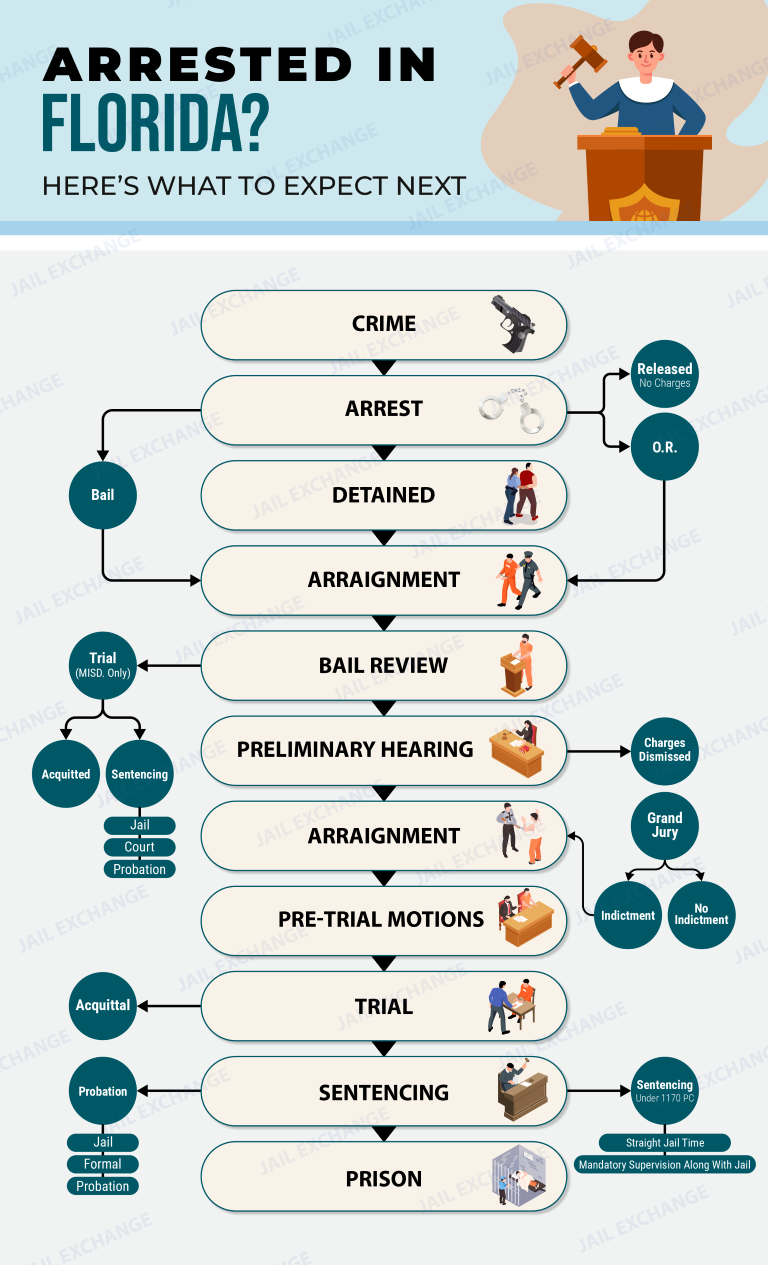
Felony charges carry the possibility of time in a Florida prison. Polk handles them at the Bartow courthouse. After first appearance, assistant state attorneys review the case and either file an information listing the charges or decline to file. If a jailed Polk defendant isn’t charged within 30 days, the defense may ask the judge to act. The person then pleads at arraignment, and the case moves through pretrial hearings toward a plea or trial.
Florida felonies have three main levels, plus life and capital felonies. Grand theft starting at $750 is usually third-degree, with a 5-year cap. Home burglary is usually second-degree, capped at 15. First-degree crimes allow 30 years, and certain ones allow life. Having or selling large amounts of drugs is called trafficking, which comes with mandatory minimum prison terms based on weight. Fleeing police at high speed is a second-degree felony.
At sentencing, everyone works from a Criminal Punishment Code scoresheet. It gives points for the main crime, extra crimes, injuries and past record, and the sum fixes the lowest sentence allowed. Under Florida’s truth-in-sentencing rule, 85% of a prison sentence has to be served. A felony case has a 175-day speedy trial deadline unless it is waived. Treatment-based courts, including drug court and veterans court, are an option for some.
Under 18: Polk teens charged with felonies are mostly kept in the juvenile system, which uses probation, treatment or DJJ residential programs. Prosecutors have the power to direct file, or move a case to adult court, for almost any felony by a youth aged 16 or 17. At 14 or 15, the charge must be one of the grave felonies named in the statute.
3. Crimes that hurt people: murder, armed robbery, sexual battery, aggravated assault
Polk cases like these follow the felony steps above, but more is at stake. When prosecutors request a pretrial detention hearing, a judge who finds the community at risk may refuse bond entirely. Aggravated assault with a deadly weapon is a third-degree felony, but armed robbery with a gun can bring life. When a gun is involved, the 10-20-Life law adds mandatory prison. Carrying one brings a 10-year floor, a fired shot brings a 20-year floor, and a wound or death brings a floor of 25 years with life possible.
Prosecutors can’t charge first-degree murder, a capital crime, on their own; a grand jury must issue an indictment. A conviction means life with no parole, or death. A capital jury has 12 members, and since 2023 Florida allows a death recommendation if at least 8 agree. Most condemned men are imprisoned at Union Correctional Institution, outside Raiford; condemned women are at Lowell Correctional Institution.
Thanks to Marsy’s Law, a victim may learn about every hearing, attend it, and be heard before a plea or sentence. Victim services workers at the Tenth Circuit prosecutor’s office offer support.
Under 18: There is no minimum age once a grand jury indicts a juvenile for a crime where life or death is a possible sentence; the case becomes an adult case. Even so, a Polk teen can’t be put to death for something done before 18. Minors jailed on adult charges are separated by sight and sound from adults.
4. Does Polk County post its warrants online?
Yes. PCSO keeps a warrant search on the Sheriff's Office site and takes questions at (863) 298-6200. Through the clerk's Court Records page, you can read a docket and spot a capias. Ask counsel to arrange your surrender at the Central Jail on Bob Phillips Road and push for a reasonable bond. North Broadway Avenue is where the clerk resets dates, and Lakeland, Winter Haven and Haines City cases are filed in that courthouse. FDLE's statewide wanted persons search catches warrants from other agencies, which helps when a person has moved around.
Immigration holds. Key Polk facts on ICE detainers:
- the Polk bond judge must be told (F.S. 908.105)
- notice goes to the Polk state attorney
- Polk bond can still be granted
- ICE may keep the person up to 48 hours past release
- in Polk, weekends and holidays count
- for Polk forcible felony cases, unlawful status blocks Polk release before first appearance (F.S. 907.041)
- at that point a Polk judge presumes detention, but the Polk defense can rebut it
Town courts. Looking for a Polk town court? There is none. Florida's 1972 Article V reform did away with Polk town courts, so Polk city ordinance cases go to Polk County Court.
Our aim here is to describe Polk County criminal court in everyday language, so please don’t treat it as legal advice. Your own facts deserve a defense attorney’s review, or you can call the Polk County Clerk at (863) 534-4000.