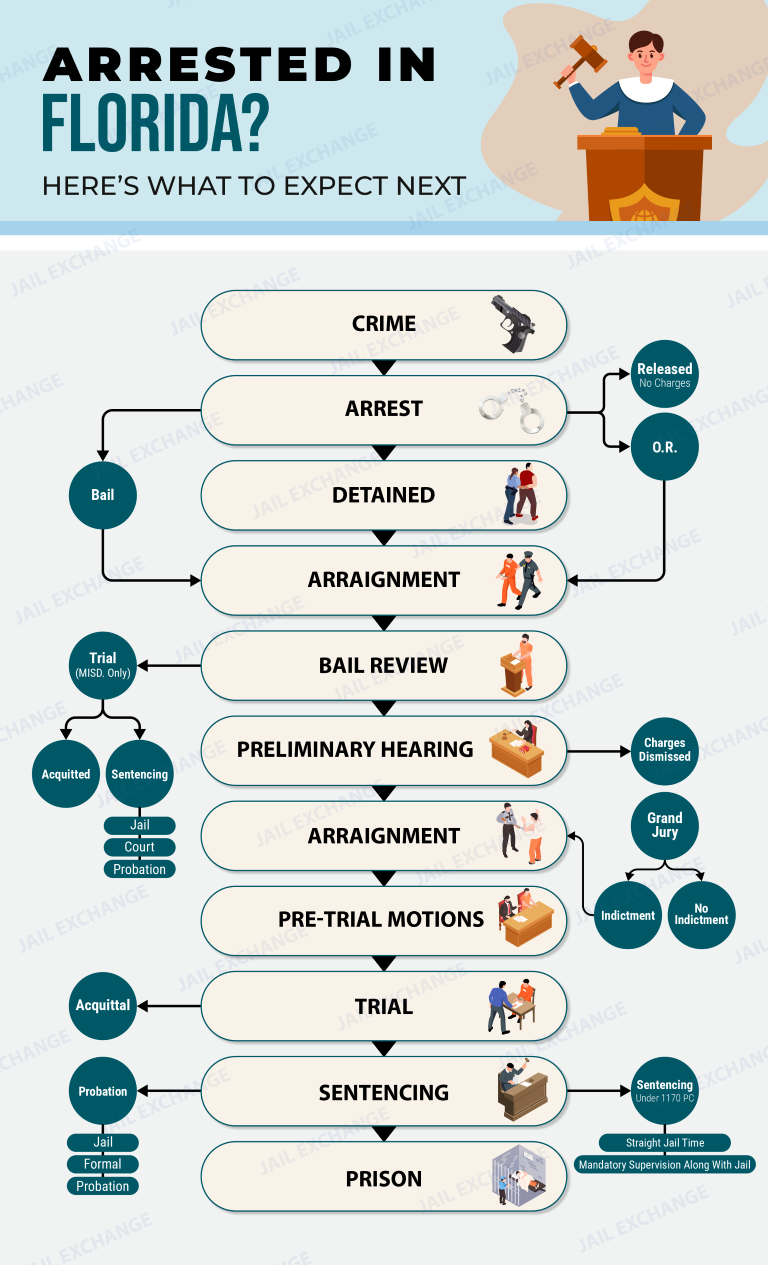
St. Lucie Regional Juvenile Detention Center Criminal Court Process
Criminal Court Process for St. Lucie County Florida
St. Lucie County Criminal Court: What Happens and Where
Whether an arrest happens in Port St. Lucie, Fort Pierce or out near the cattle ranches west of Florida’s Turnpike, the case heads to one of St. Lucie County’s two state trial courts. St. Lucie County Court handles the lighter charges: misdemeanors, criminal traffic cases (think fleeing a Turnpike traffic stop), and broken Port St. Lucie or county ordinances. St. Lucie Circuit Court covers felonies and juvenile cases. St. Lucie is among four counties in the Nineteenth Judicial Circuit, together with Indian River, Martin and Okeechobee, which people call the Treasure Coast circuit. You can also check our bond guide and inmate search guide.
St. Lucie’s criminal hearings are held at the St. Lucie County Courthouse, 218 S. 2nd Street, Fort Pierce, FL 34950, a few blocks from the Indian River Lagoon. Phone the Clerk of the Circuit Court at (772) 462-6900, and its office sits nearby at 201 S. Indian River Drive. After arrest, adults are booked into the St. Lucie County Jail at 900 N. Rock Road on the west side of Fort Pierce, run by the Sheriff.
Free case lookup: Use the Clerk’s Court Case Search. Type in a defendant’s full name, or a St. Lucie case number. The St. Lucie docket shows charges, filings and hearings, and many documents can be opened right on the screen. Some papers need a clerk’s review before release, and juvenile and sealed files aren’t shown.
1. Misdemeanors in St. Lucie: DUI on US 1, shoplifting at Tradition, simple battery, driving on a suspended license
Port St. Lucie police and St. Lucie deputies don’t jail everyone they charge. For lots of minor misdemeanors they hand over a written notice to appear, and the person heads home that day. Rock Road inmates get first appearance, a brief court hearing, within a day; criminal rule 3.130 sets that 24-hour clock. Until then, the St. Lucie jail can release some people on a bond from the Florida Supreme Court's 2026 statewide schedule (AOSC25-69), which sets minimums; the Nineteenth Circuit's chief judge may go higher. Domestic violence and certain other charges require the judge to decide first. Short on money? A licensed Fort Pierce bail bond agency can post it. Florida sets their premium at 10% of the bond, $100 at minimum, and it isn’t returned.
The State Attorney for the Nineteenth Circuit, chosen by voters in all four Treasure Coast counties, prosecutes every state crime here. The circuit’s elected Public Defender represents defendants the court finds unable to hire their own lawyer. When that office has a conflict, Florida’s Regional Counsel lawyers take the client. Florida Statute 938.29 allows St. Lucie judges to charge a fee for appointed lawyers and turn unpaid amounts into a lien.
The two misdemeanor levels in Florida: first degree, with a ceiling of twelve months on Rock Road and $1,000 in fines; second degree, with a ceiling of 60 days and $500. Ninety days from formal charging is the speedy-trial deadline for a St. Lucie misdemeanor, though a defendant may waive it. Six St. Lucie residents make up a misdemeanor jury. People with clean records are often offered pretrial diversion; finish it in St. Lucie and the charge is thrown out.
Under 18: Juvenile cases are heard by Circuit Court judges, not County Court. A Port St. Lucie middle schooler caught in a first minor scrape usually gets a civil citation (Statute 985.12): volunteer hours or counseling in place of an arrest record. Youth from all four Treasure Coast counties who need to be locked up are taken to Fort Pierce’s St. Lucie Regional Juvenile Detention Center, a lockup operated by the state’s juvenile justice department. Within 24 hours, a judge rules on whether each child stays.
2. Felonies in St. Lucie: home burglary, grand theft, drug dealing, fleeing deputies
St. Lucie prosecutors call a charge a felony when it could bring more than one year in a Florida prison. In St. Lucie, a felony arrest is followed by first appearance, and there a judge sets bond and the terms of pretrial release (the rules you follow while waiting for trial, such as GPS monitoring or no contact with a victim). Nineteenth Circuit prosecutors then review the evidence and may sign an information, the paper that formally starts a Fort Pierce felony case. At arraignment in the Fort Pierce courthouse, the St. Lucie defendant pleads, usually not guilty at first.
The lowest St. Lucie felony rung, third degree, stops at 5 years. Burglarizing an empty house is usually second degree, good for up to 15. First-degree felonies, such as trafficking large amounts of cocaine, top out at 30. A Criminal Punishment Code scoresheet turns the crime and a defendant’s history into points, and St. Lucie judges use the total to find the minimum prison time. No Florida inmate leaves before finishing 85% of the term.
A St. Lucie felony carries a 175-day speedy-trial deadline, which most defendants give up for more preparation time. Six jurors hear these trials and must reach one shared verdict.
Under 18: St. Lucie teenagers facing felonies mostly remain in the juvenile system; probation, counseling or a residential program are the usual outcomes. Prosecutors may instead direct file under Statute 985.557, which lets them charge 16- and 17-year-olds as adults for nearly any felony; for 14- and 15-year-olds, only grave crimes on the statute’s list, such as armed robbery, qualify. Adult charges have been optional for prosecutors since 2019, never required.
3. Violent felonies in St. Lucie: murder, armed robbery, sexual battery, aggravated battery with a gun
St. Lucie violent cases go through the same courthouse steps, but the penalties climb to the top of Florida law. Life felonies can bring life in prison. Capital felonies, like first-degree murder, bring execution or life in prison with no parole. If the State Attorney’s proof looks solid, a St. Lucie judge may hold the defendant without bond.
Guns bring in 10-20-Life, the nickname for Florida Statute 775.087. A person who carries a firearm during a crime like robbery faces at least 10 years. Shooting it raises the minimum to 20. Wounding someone badly or killing them with it means 25 years to life.
For a death penalty case, all 12 jurors hear the evidence, but since 2023 only 8 of them must agree on death for a judge to impose it. Condemned men from St. Lucie go to Raiford (Union Correctional Institution), while St. Lucie women given death sentences are sent to Lowell Correctional Institution in Marion County.
Marsy’s Law, in Florida’s constitution, means St. Lucie victims get word of each court date, can watch from the Fort Pierce gallery, and can speak when a judge weighs release, a plea or a sentence. The Nineteenth Circuit State Attorney’s victim advocates help with those steps.
Under 18: Using Statute 985.56, a St. Lucie grand jury can indict (officially accuse) a youngster of any age for a crime punishable by death or life, and the trial proceeds in adult court. Minors at the time of the offense can never be executed, and a life term for one of them first requires a hearing focused on their youth.
4. Who keeps warrants from the Fort Pierce courthouse?
Nineteenth Circuit warrants rest with the Sheriff's Office, where deputies at (772) 462-7300 will check a name. The clerk's website leads to the docket, where any capias is noted. Arrange your surrender through counsel at the North Rock Road jail and seek release. The clerk on South Indian River Drive handles new dates, and Port St. Lucie cases come through that same office. FDLE's statewide wanted persons search lists warrants other agencies post, which helps if the person has lived elsewhere in Florida.
Federal court: Unlike most of central Florida, St. Lucie County is in the Southern District of Florida. Its federal cases go to the Fort Pierce Division, whose judges sit in Fort Pierce itself, in the Alto Lee Adams Sr. U.S. Courthouse on South U.S. Highway 1 (number 101, ZIP 34950). That puts St. Lucie’s state and federal courthouses within walking distance. Which court gets a case depends on who wrote the law: Tallahassee or Washington. Location matters too, since crimes on land the national government controls can become federal. St. Lucie has several of those spots. The Seminole Tribe of Florida’s Fort Pierce Reservation lies inside the county, and some crimes on tribal land fall to federal courts. Boats running drugs or people from the Bahamas into the Fort Pierce Inlet are a federal matter too, often intercepted by Coast Guard Station Fort Pierce crews based at the inlet. The Port of Fort Pierce and Treasure Coast International Airport can also bring federal smuggling charges. Treasure Coast bank holdups, online child predators and felons caught carrying pistols also tend to land in Fort Pierce’s federal building. Pick a topic.
Immigration holds. An ICE detainer in St. Lucie, step by step:
- the St. Lucie bond judge must be told (F.S. 908.105)
- notice goes to the St. Lucie state attorney
- St. Lucie bond can still be granted
- ICE gets up to 48 extra hours
- those hours in St. Lucie include weekends and holidays
- for St. Lucie forcible felony cases, unlawful status blocks St. Lucie release before first appearance (F.S. 907.041)
- at that point a St. Lucie judge presumes detention, but the St. Lucie defense can rebut it
Town courts. Since 1972 Article V changes, St. Lucie has had no city courts. Any St. Lucie city ordinance case is heard in St. Lucie County Court instead, alongside misdemeanors.
Please read this St. Lucie County guide as general information rather than legal advice. A defense lawyer can explain your own case; for court records, call the St. Lucie County Clerk at (772) 462-6900.