Union County Jail Criminal Court Process
Criminal Court Process for Union County Florida
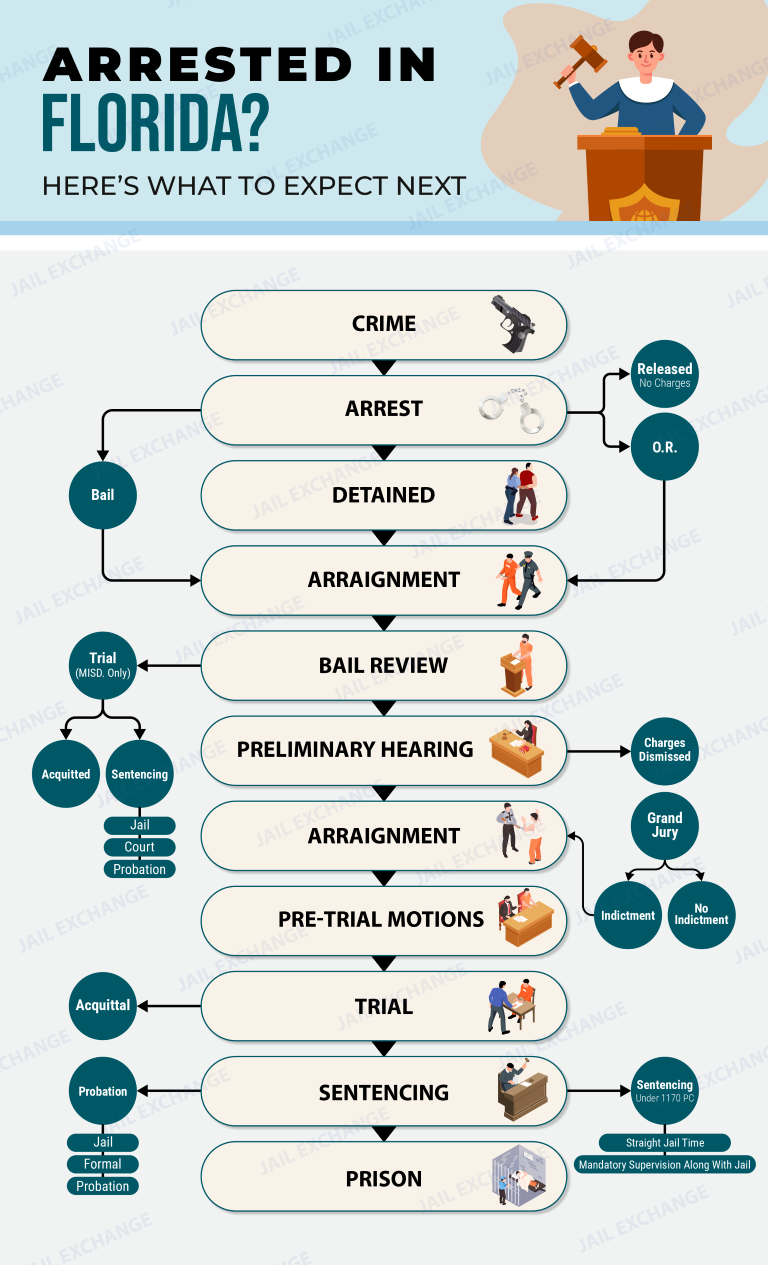
Union County, Florida: How a Criminal Case Moves Through Court
Union is one of Florida’s smallest counties, yet its courts run like everyone else’s. There are two trial courts. Union County Court takes misdemeanors (the lighter crimes), traffic crimes (driving on a suspended license is a common one) and violations of local ordinances. Union County Circuit Court takes felonies (the serious crimes) and cases about kids under 18. Union is part of Florida’s 8th Judicial Circuit. Its circuit partners are Alachua, Baker, Bradford, Gilchrist and Levy. You can also check our bond guide and inmate search guide.
Criminal hearings take place at the Union County Courthouse, 55 W. Main Street, Lake Butler, FL 32054. The clerk keeps the files there; call (386) 496-3711. After an arrest, adults go to the Union County Jail in Lake Butler, run by the sheriff. The town of Raiford in Union County is home to Union Correctional Institution, the state prison that holds Florida’s death row for men.
Free case lookup: Union’s clerk uses the free statewide system called the Online Court Records Search. Pick “Union” from the county list. After that, enter a case number or someone’s first and last name. You’ll see dates, charges and how the case ended. The law keeps certain records out of sight, such as most juvenile files, sealed cases and private details like Social Security numbers.
1. Misdemeanors in Union County Court: petit theft, simple battery, first DUI, trespassing
For small crimes, a deputy might hand you a notice to appear. That ticket lists the day you owe the court a visit. Get taken to jail, though, and Florida gives the system 24 hours to put you in front of a judge. Lawyers call this quick hearing first appearance. For anyone who leaves jail ahead of it, the floor on bail now comes from a single statewide list the Florida Supreme Court put in place for 2026. Think of a bond as a deal: you put up cash or a pledge, and you return for court. Certain arrests, domestic violence among them, keep a person locked up until the judge weighs in. Bondsmen keep a 10% cut of the bond amount (no less than $100) when they post it for you.
First-degree misdemeanors are the top tier: as much as 1 year behind bars and fines reaching $1,000. For the second degree, the cap is 60 days and a $500 fine. Common examples are petit theft (taking something worth under $750) and simple battery (touching or hitting someone on purpose against their will). A first DUI adds a suspended license and DUI school.
The State Attorney for the 8th Circuit, who is chosen by voters, handles the prosecution of all state crimes in Union County. If a judge finds that you can’t afford a lawyer, the 8th Circuit Public Defender can be appointed. Conflict cases, such as two people charged together, are handed to a separate state lawyer office, Criminal Conflict and Civil Regional Counsel. Keep in mind that, per Fla. Stat. 938.29, someone found guilty may be charged for the public defender’s work, and the bill can become a lien. First-timers may qualify for pretrial diversion, a program where the charge is dropped after you finish classes or community service. If you want a trial, Florida’s speedy trial rule puts a misdemeanor on the calendar for trial inside 90 days of formal charges, unless you agree to wait. A jury of six decides.
Kids under 18: A young person who gets in trouble for a first small offense may be offered a civil citation instead of being arrested. That is a program with tasks like community service or counseling, and finishing it keeps an arrest record from being made. A juvenile judge in Circuit Court handles any youth case that is filed.
2. Felonies in Union County: burglary, drug sales, grand theft, dealing in stolen property
A Union County felony is serious enough to bring a state prison term. After the arrest and first appearance, the State Attorney weighs the evidence. If it is strong enough, that office files an information, which is the formal charge. Next comes the arraignment, where the accused tells the court “not guilty,” “guilty” or “no contest.” Felony defendants get a speedy trial window of 175 days after formal charges are filed, yet lots of them waive it to give their lawyer time to prepare.
Florida ranks felonies by degree. The lowest level, third degree, has a 5-year limit. Second degree goes as high as 15. First-degree felonies go up to 30 years, and some, called life felonies, can mean life in prison. To figure out the lowest legal sentence, the court fills out a Criminal Punishment Code scoresheet, a form scoring both the offense and any earlier convictions. Prisoners in Florida have to complete 85% or more of their time before release. Gun crimes are tougher under the 10-20-Life law (Fla. Stat. 775.087): a gun in hand during certain crimes means a 10-year minimum; pulling the trigger doubles that to 20; and wounding or killing a person with it carries 25 years up to life.
Most Union felony cases end with a plea deal, and the others go to a jury of six. Probation, drug court and treatment are possible outcomes, depending on the score and the charge.
Kids under 18: A teen accused of a felony who must be held is usually sent to Gainesville, to the Department of Juvenile Justice’s Alachua Regional Juvenile Detention Center. No more than 24 hours later, a detention hearing settles whether the teen heads home. Prosecutors may move some cases to adult court. This is called a direct file. They can do it for most felonies by 16- and 17-year-olds, and, for kids aged 14 or 15, only a named list of grave felonies. Since 2019, Florida no longer forces this. It is the prosecutor’s choice.
3. Murder, armed robbery, sexual battery and other violent felonies
These cases take the same road as other felonies. What changes is how much is on the line. Bail is often very high, or a judge may hold the person with no bond at all after a special hearing. A no-contact order with the victim is a common condition. Armed robbery and many sexual battery charges are first-degree felonies or life felonies.
In Florida, first-degree murder is classed as a capital felony. That label means the only punishments are life without parole or death. A Union County grand jury has to approve that charge. A grand jury is a group of local citizens who meet in private to decide if there’s enough proof. If the jury convicts, it then votes on death. Since a 2023 law, a death recommendation needs at least 8 of the 12 jurors. Capital trials use 12 jurors instead of six. Union Correctional Institution, in this county, is where Florida’s condemned men are kept. For women, it’s Lowell Correctional Institution, a prison close to Ocala.
Victims in Union County are protected by Marsy’s Law, spelled out in Florida’s constitution under Article I, Section 16(b). Thanks to it, they can learn about hearings, show up for them and talk to the judge at sentencing. Victim advocates from the prosecutor’s office guide them through it.
Kids under 18: For crimes with a possible death or life sentence, grand jurors can return an indictment against a child of any age, which shifts the case to adult court (Fla. Stat. 985.56). Death sentences are off the table for anyone under 18, per the U.S. Supreme Court. A teen facing life also gets an extra sentencing hearing first.
4. Where are Lake Butler court warrants kept?
The Union County Jail on NW 1st Street stands steps from the courthouse, and a planned surrender there goes smoothly when a lawyer calls ahead. The Sheriff's Office keeps Eighth Circuit warrants, and deputies at (386) 496-2501 can check a name. Dockets on the online court records search show whether a capias was signed. New dates come from Room 103, the clerk's office on West Main, and Raiford and Worthington Springs matters land there too. Outside agencies post to FDLE's statewide wanted persons database.
Federal court: Union sits within the territory of the Middle District of Florida, a U.S. District Court, and its Jacksonville Division. Hearings take place in Jacksonville, at 300 North Hogan Street, in the Bryan Simpson United States Courthouse. What makes a case federal instead of state? It has to break a law passed by Congress, or happen on land the national government controls. Union has almost no federal land, so most federal cases from here involve things like drugs shipped across state lines, gun possession by someone with a past felony, mail or bank fraud, or child exploitation online. Florida’s Seminole and Miccosukee tribal lands are all in the southern half of the state, far from Lake Butler. Pick a topic below.
Immigration holds. Key Union facts on ICE detainers:
- the judge at the Union bond hearing hears about it (F.S. 908.105)
- the Union prosecutor gets notice
- bond is still possible in Union
- the jail may hold them 48 more hours for ICE
- Union counts weekends and holidays in that time
- F.S. 907.041: in Union, an unauthorized alien facing a Union forcible felony charge stays in the Union jail until first appearance
- at that point a Union judge presumes detention, but the Union defense can rebut it
Town courts. Looking for a Union town court? There is none. Florida's 1972 Article V reform did away with Union town courts, so Union city ordinance cases go to Union County Court.
Remember to treat this Union County guide as general information, not legal advice. Laws change and cases differ, so consult a defense lawyer or phone the Union County Clerk of Court, (386) 496-3711.